Soliton solutions to the coupled Sasa-Satsuma-mKdV equation
We consider the soliton solutions of a recently proposed coupled Sasa-Satsuma-mKdV equation using the Kadomtsev-Petviashvili reduction method. The system consists of a complex-valued component coupled with a real-valued one. Under zero or nonzero bou…
Authors: Changyan Shi, Bao-Feng Feng
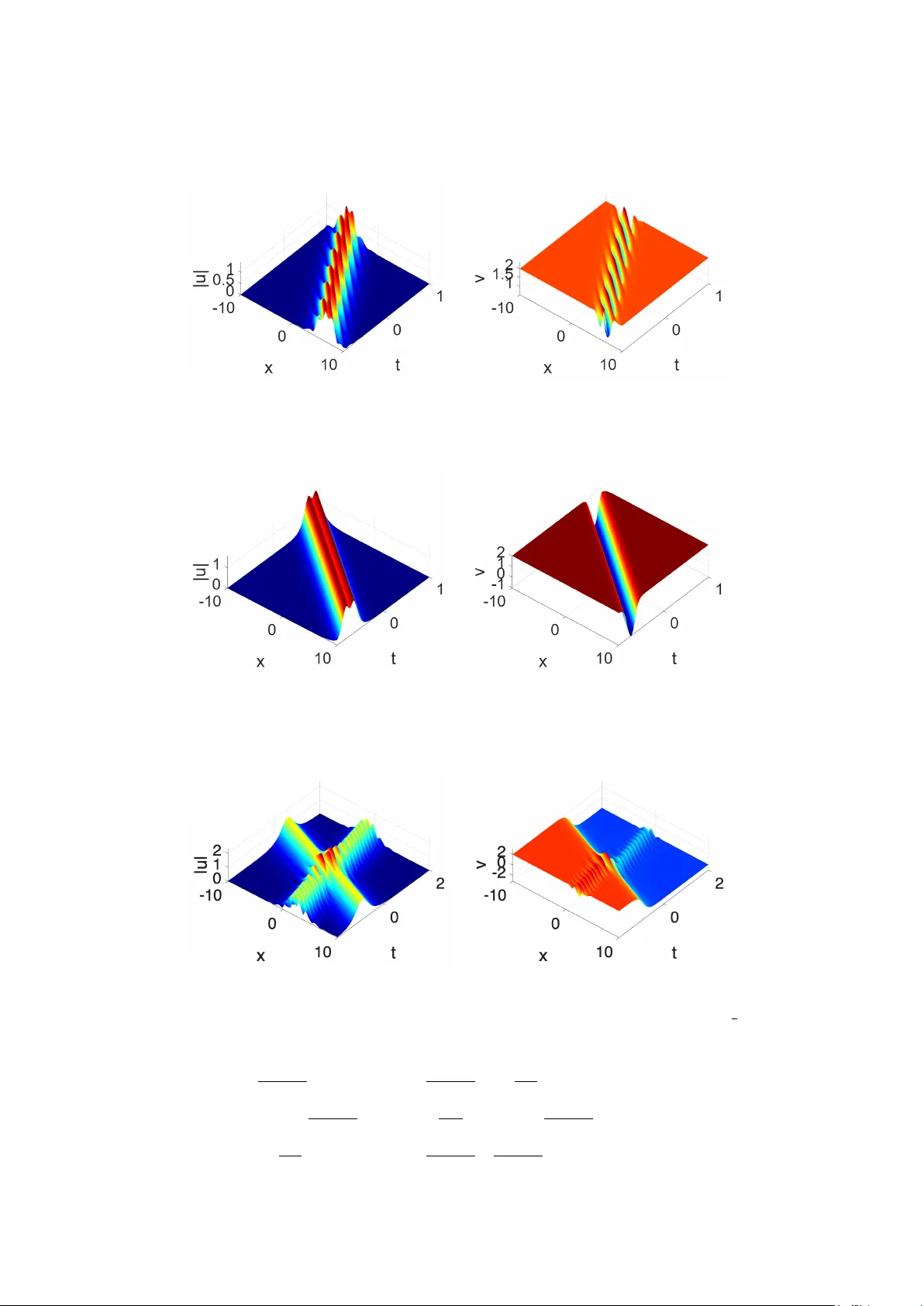
Soliton solutions to the coupled Sasa-Satsuma-mKdV equation Changy an Shi a , Bao-F eng F eng a, ∗ a Scho ol of Mathematic al and Statistic al Scienc es, The University of T exas R io Gr ande V al ley, 78539, Edinbur g, TX, USA Abstract W e consider the soliton solutions of a recently proposed coupled Sasa-Satsuma-mKdV equation using the Kadom tsev-P etviash vili reduction metho d. The system consists of a complex-v alued comp onen t coupled with a real-v alued one. Under zero or nonzero boundary conditions, we deriv e four distinct classes of soliton solutions: brigh t-bright, dark-dark, brigh t-dark, and dark-bright. These solutions are derived from the v ector Hirota equation, for whic h the bright, dark, and brigh t-dark soliton solutions are provided in the App endix. W e perform asymptotic analysis of soliton collisions for each class of solutions, in which inelastic collisions are observed b etw een bright-brigh t solitons. In the dark-dark case, w e iden tify soliton profiles similar to the Sasa-Satsuma equation, including double-hole, Mexican hat, and an ti-Mexican hat solutions; this study further explores the collisions b et ween these structures and hyperb olic tangen t shap ed kink solitons. Regarding the bright-dark case, b ey ond the exp ected soliton-kink in teractions, w e rep ort and analyze a notable collision o ccurring b et ween kink solitons. Keywor ds: Coupled Sasa-Satsuma-mKdV equation, T w o-comp onen t Sasa-Satsuma equation, vector Hirota equation, Kadom tsev-P etviash vili reduction metho d 1. In tro duction The study of the generalized nonlinear Sc hrö dinger equation by K o dama and Hasegaw a [1] i q ξ + α 1 q τ τ + α 2 | q | 2 q + i β 1 q τ τ τ + β 2 | q | 2 q τ + β 3 q | q | 2 τ = 0 , (1) represen ts an important step in the research of higher-order extensions to the nonlinear Sc hrö dinger (NLS) equation. Here the terms asso ciated with α 1 , α 2 are from the original NLS equation, whic h standing for group v elo cit y dispersion and self-phase modulation [2]. While β 1 , β 2 , β 3 describ e the third-order dispersion, self- frequency shift, and self-steepening, resp ectiv ely [3]. In particular, in the case ( α 1 , α 2 ) = ( 1 2 , 1) , ( β 1 , β 2 , β 3 ) = (1 , 6 , 3) , together with the transformation u ( x, t ) = q ( τ , ξ ) exp − i 6 τ − ξ 18 where x = τ − ξ 12 , t = − ξ , we ha ve the follo wing completely integrable system [4] u t = u xxx + 6 | u | 2 u x + 3 u | u | 2 x . (2) Eq.(2) is known as the Sasa-Satsuma (SS) equation. As an in tegrable higher-order extension to the physically significan t NLS equation [5, 6, 7, 8, 9, 10, 11], Eq. (2) was comprehensively studied through different ap- proac hes, including inv erse scattering transform [4, 12], Hirota’s bilinear metho d and Kadomtsev-P etviashvili (KP) reduction [13, 14, 15, 16], Darboux transformation [17, 18], Riemann-Hilb ert approac h [19, 20]. Similar ∗ Corresponding author Email addr ess: baofeng.feng@utrgv.edu (Bao-F eng F eng) to the NLS equation, the SS equation admits bright [14, 13, 16] and dark solitons [15, 18, 16], as well as breather [18, 21] and rogue wa ve solutions [22, 23, 17, 24, 25, 26]. Bey ond these, the SS equation features additional solutions than the NLS model, such as double-hump brigh t solitons [13, 16], double-hole dark solitons [15, 16], (an ti-)Mexican hat solitons [27, 16], and twisted rogue pairs [17, 21]. Multi-comp onen t generalizations to the NLS equation, such as the Manako v system [28], are required for studying different light p olarizations [29] in optical pulse propagation within birefringent fib ers [2, 30]. Similarly , the in tegrable multi-component SS equation has also been extensiv ely in vestigated, leading to the prop osal and analysis of v arious multi-component extensions [14, 31, 32]. The coupled Sasa-Satsuma (cSS) equation u 1 t = u 1 xxx − 6 c 1 | u 1 | 2 + c 2 | u 2 | 2 u 1 x − 3 u 1 c 1 | u 1 | 2 + c 2 | u 2 | 2 x , (3a) u 2 t = u 2 xxx − 6 c 1 | u 1 | 2 + c 2 | u 2 | 2 u 2 x − 3 u 2 c 1 | u 1 | 2 + c 2 | u 2 | 2 x , (3b) is one of the suc h m ulti-comp onen t extension to the SS equation firstly studied b y P orsezian et al. in Ref. [33]. Studies find (3a)-(3b) possesses v arious exact solutions including bright-brigh t [34, 35, 36, 37] and brigh t-dark soliton solutions [38, 39], as well as dark-dark soliton [40], breather [40] and rogue w av e solutions [41, 42]. Another coupled extension to Eq. (2), also known as the coupled Hirota (cHirota) equation [43, 33, 14] is of the form u 1 t = u 1 xxx − 3 c 1 | u 1 | 2 + c 2 | u 2 | 2 u 1 x − 3 u 1 ( c 1 u ∗ 1 u 1 x + c 2 u ∗ 2 u 2 x ) , (4a) u 2 t = u 2 xxx − 3 c 1 | u 1 | 2 + c 2 | u 2 | 2 u 2 x − 3 u 2 ( c 1 u ∗ 1 u 1 x + c 2 u ∗ 2 u 2 x ) , (4b) where ∗ denotes the complex conjugate. If u 2 = u ∗ 1 , c 2 = c 1 = − 1 , abov e system reduces to the SS equation (2). Prior researc hes ha ve derived the bright-brigh t soliton [44, 45, 46, 16], m ultiple higher-order p oles [47], dark-dark soliton [48, 49, 16], breather [50, 51, 52] and rogue wa ve [53, 54, 55, 56] solutions to (4a)-(4b). Moreo v er, in the mixed b oundary conditions, brigh t-dark soliton [57, 58, 16], bright-dark rogue wa ve [59] solutions to the cHirota equation ha v e b een derived. In addition to ab o ve cSS and cHirota equations, this study fo cuses on another t w o-comp onen t general- ization of the SS equation, whic h w as recently introduced by W ang et al. in Ref. [32]: u t = u xxx − 6 ε 1 | u | 2 u x − 3 ε 1 u | u | 2 x − 3 ε 2 v ( uv ) x , (5a) v t = v xxx − 6 ε 1 | u | 2 v x − 3 ε 1 v | u | 2 x − 6 ε 2 v 2 v x , (5b) where u is a complex-v alued function and v is real-v alued. It reduces to the SS equation (2) for v = 0 and to the mo dified Kortew eg-de V ries (mKdV) equation for u = 0 . This equation is named the coupled Sasa- Satsuma-mKdV (SS-mKdV) equation. Since the introduction of the SS-mKdV equation (5a)-(5b), v arious asp ects of this mo del hav e b een extensively inv estigated. F or instance, bright-brigh t soliton and oscillated soliton solutions w ere constructed via the Riemann-Hilb ert approach [32] and the Darb oux transformation [60], alongside rogue wa ve [60] and multiple p ole solutions [61]. Beyond exact solutions, researc hers hav e also explored the initial-b oundary v alue problems [62] and the long-time asymptotic b eha vior [63]. How- ev er, existing studies on the solutions to the SS-mKdV equation hav e primarily fo cused on zero b oundary condition, resulting in bright-brigh t and multiple-pole solitons; Soliton solutions under nonzero and mixed b oundary conditions remain unexplored. In this pap er, we aim to derive soliton solutions using the KP reduction metho d, which differs from the approaches used in previous studies. In particular, our approach yields solutions to (5a)-(5b) under v arious boundary conditions, such that components u, v satisfy one of the follo wing 1. Zero boundary condition: the functions u, v v anish as x → ±∞ . Soliton solutions in this category are referred to as brigh t solitons. 2. Nonzero b oundary condition: the magnitudes | u | , | v | approach p ositiv e constants ρ 1 , ρ 2 as x → ±∞ . These are classified as dark solitons. 2 Since u is complex-v alued and v is real-v alued, four distinct com binations of b oundary conditions can b e in- v estigated, leading to bright-brigh t, dark-dark, bright-dark, and dark-brigh t soliton solutions. F urthermore, considering the sp ecial dynamical behavior in SS equation suc h as double-h ump bright soliton, double-hole dark soliton, and (an ti-)Mexican-hat dark soliton solutions, w e are motiv ated to explore whether similar phenomena o ccur in the SS-mKdV equation. It should b e noted that ab o ve coupled extensions of SS equation (3a)-(3b), (4a)-(4b), and (5a)-(5b), are all sp ecial cases of the following v ector Hirota equation u k,t = u k,xxx − 3 M X l =1 ε l | u l | 2 ! u k,x − 3 u k M X l =1 ε l u ∗ l u l,x . (6) This vector equation, first studied in Refs. [64, 65], is completely in tegrable with a ( N + 1) × ( N + 1) Lax pair. Its bright soliton [44, 66], dark soliton [67, 66], rational rogue wa ves [68] and multiple p oles [69] solutions w ere deriv ed. T o derive the SS-mKdV equation, one sets M = 3 in (6) and employs the complex conjugate reduction u = u 1 = u ∗ 3 , v = u 2 = u ∗ 2 , c 1 = ε 1 = ε 3 , c 2 = ε 2 . (7) Similarly , (3a)-(3b) is obtained from (6) with M = 4 and the reduction u 1 = u ∗ 3 , u 2 = u ∗ 4 , c 1 = c 3 , c 2 = c 4 (see Ref. [40]), while (4a)-(4b) corresp onds to the case M = 2 (see Ref. [16]). Although the general N -bright and N -dark soliton solutions to Eq. (6) w ere constructed in [66], N -bright-dark soliton solution under mixed b oundary conditions remains op en. Our goal in this pap er is to deriv e and study the general soliton solutions to the SS-mKdV equation (5a)-(5b) by solving the vector Hirota equation (6) via the metho d of KP reduction. The present paper is organized as follows. In Section 2, w e derive the bilinear forms of the SS-mKdV equa- tion under four different kinds of b oundary conditions. In Section 3, we present the general N bright-brigh t, dark-dark, bright-dark, and dark-bright soliton solutions. The dynamical b eha viors of the aforementioned soliton solutions are presented in Section 4-Section 7. Finally , we pro vide bright, dark, and bright-dark soliton solutions to the v ector Hirota equation in Appendix A, with the corresp onding bilinear equations from the KP-T o da hierarch y presented in Appendix B. 2. Bilinearization of the coupled Sasa-Satsuma-mKdV equation This section w e list the result of bilinear forms to (5a)-(5b) under different b oundary conditions. 1. Zero b oundary condition, i.e., u, v → 0 as x → ±∞ . In this case, the transformation u = g 1 f , v = g 2 f . (8) con v erts Eq. (5a)-(5b) into f 2 D 3 x − D t g 1 · f − 3 D x g 1 · f D 2 x f · f + 4 c 1 | g 1 | 2 + 2 c 2 g 2 2 + 3 c 2 g 2 f D x g 1 · g 2 + 3 c 1 g 1 f D x g 1 · g ∗ 1 = 0 , f 2 D 3 x − D t g 2 · f − 3 D x g 2 · f D 2 x f · f + 4 c 1 | g 1 | 2 + 2 c 2 g 2 2 − 3 c 2 g ∗ 1 f D x g 1 · g 2 + 3 c 1 g 1 f D x g 2 · g ∗ 1 = 0 . where the identit y aD x b · c − bD x a · c = cD x b · a is utilized. In tro ducing auxiliary functions s 12 , s 13 and s 23 b y D x g 1 · g 2 = s 12 f , D x g 1 · g ∗ 1 = s 13 f , D x g 2 · g ∗ 1 = s 23 f , and set D 2 x f · f + 4 c 1 | g 1 | 2 + 2 c 2 g 2 2 = 0 , w e ha v e the follo wing lemma. 3 Lemma 2.1. Under tr ansformation (8) , e quation (5a) - (5b) is biline arize d into ( D 3 x − D t ) g 1 · f = − 3 c 2 g 2 s 12 − 3 c 1 g 1 s 13 , (9) ( D 3 x − D t ) g 2 · f = 3 c 2 g ∗ 1 s 12 − 3 c 1 g 1 s 23 , (10) D 2 x f · f + 4 c 1 | g 1 | 2 + 2 c 2 g 2 2 = 0 , (11) D x g 1 · g 2 = s 12 f , (12) D x g 1 · g ∗ 1 = s 13 f , (13) D x g 2 · g ∗ 1 = s 23 f . (14) 2. Nonzero b oundary condition, i.e., | u | → ρ 1 , | v | → ρ 2 as x → ±∞ , where ρ 1 , ρ 2 > 0 . In this case, the transformation u = ρ 1 h 1 f e i ( αx − ( α 3 +3 α ( 2 c 1 ρ 2 1 + c 2 ρ 2 2 )) t ) , v = ρ 2 h 2 f . (15) con v erts Eq. Eq. (5a)-(5b) in to f 2 D 3 x − D t + 3i αD 2 x − 3 α 2 + 4 c 1 ρ 2 1 + 2 c 2 ρ 2 2 D x − 6i c 1 αρ 2 1 − 3i c 2 αρ 2 2 h 1 · f − 3( D x h 1 · f + i αh 1 f ) D 2 x − 4 c 1 ρ 2 1 − 2 c 2 ρ 2 2 f · f + 4 c 1 ρ 2 1 | h 1 | 2 + 2 c 2 ρ 2 2 h 2 2 + 3 c 2 ρ 2 2 h 2 f ( D x h 1 · h 2 + i αh 1 h 2 ) + 3 c 1 ρ 2 1 h 1 f D x h 1 · h ∗ 1 + 2i α | h 1 | 2 = 0 , f 2 D 3 x − D t − 3 4 c 1 ρ 2 1 + 2 c 2 ρ 2 2 D x h 2 · f − 3( D x h 2 · f ) D 2 x − 4 c 1 ρ 2 1 − 2 c 2 ρ 2 2 f · f + 4 c 1 ρ 2 1 | h 1 | 2 + 2 c 2 ρ 2 2 h 2 2 − 3 c 1 ρ 2 1 h ∗ 1 f ( D x h 1 · h 2 + i αh 1 h 2 ) + 3 c 1 ρ 2 1 h 1 f ( D x h 2 · h ∗ 1 + i αh 2 h ∗ 1 ) = 0 . In tro ducing auxiliary functions r 12 , r 13 , r 23 b y D x h 1 · h 2 + i αh 1 h 2 = i αr 12 f , D x h 1 · h ∗ 1 + 2i α | h 1 | 2 = 2i αr 13 f , D x h 2 · h ∗ 1 + i αh 2 h ∗ 1 = i αr 23 f , and set D 2 x − 4 c 1 ρ 2 1 − 2 c 2 ρ 2 2 f · f + 4 c 1 ρ 2 1 | h 1 | 2 + 2 c 2 ρ 2 2 h 2 2 = 0 , w e ha v e the follo wing lemma. Lemma 2.2. Under tr ansformation (15) , e quation (5a) - (5b) is biline arize d into D 3 x − D t + 3i αD 2 x − 3 α 2 + 4 c 1 ρ 2 1 + 2 c 2 ρ 2 2 D x − 6i c 1 αρ 2 1 − 3i c 2 αρ 2 2 h 1 · f = − 3i αc 2 ρ 2 2 h 2 r 12 − 6i αρ 2 1 c 1 h 1 r 13 , (16) D 3 x − D t − 3 4 c 1 ρ 2 1 + 2 c 2 ρ 2 2 D x h 2 · f = 3i αc 1 ρ 2 1 h ∗ 1 r 12 − 3i αc 1 ρ 2 1 h 1 r 23 , (17) D 2 x − 4 c 1 ρ 2 1 − 2 c 2 ρ 2 2 f · f + 4 c 1 ρ 2 1 | h 1 | 2 + 2 c 2 ρ 2 2 h 2 2 = 0 , (18) D x h 1 · h 2 + i αh 1 h 2 = i αr 12 f , (19) D x h 1 · h ∗ 1 + 2i α | h 1 | 2 = 2i αr 13 f , (20) D x h 2 · h ∗ 1 + i αh 2 h ∗ 1 = i αr 23 f . (21) 3. Mixed boundary condition (i): u → 0 , | v | → ρ 2 as x → ±∞ , where ρ 2 > 0 . In this case, the bilinearization pro cess is similar to the ab ov e cases. Thus w e hav e the transformation Lemma 2.3. Under the tr ansformation u = g 1 f , v = ρ 2 h 2 f . (22) 4 Eq. (5a) - (5b) is biline arize d into ( D 3 x − D t − 6 c 2 ρ 2 2 ) g 1 · f = − 3 c 1 g 1 s 13 , (23) ( D 3 x − D t − 6 c 2 ρ 2 2 ) h 2 · f = 0 , (24) D 2 x − 2 c 2 ρ 2 2 f · f + 4 c 1 | g 1 | 2 + 2 c 2 ρ 2 2 g 2 2 = 0 , (25) D x g 1 · h 2 = 0 , (26) D x g 1 · g ∗ 1 = s 13 f , (27) D x h 2 · g ∗ 1 = 0 . (28) 4. Mixed b oundary condition (ii): | u | → ρ 1 , v → 0 as x → ±∞ , where ρ 1 > 0 . In this case, we ha ve the follo wing lemma Lemma 2.4. Under the tr ansformation u = ρ 1 h 1 f e i ( αx − ( α 3 +6 c 1 αρ 2 1 ) t ) , v = g 2 f . (29) Eq. (5a) - (5b) is biline arize d into D 3 x − D t + 3i αD 2 x − 3 α 2 + 4 c 1 ρ 2 1 D x − 6i c 1 αρ 2 1 h 1 · f = − 3i αc 2 g 2 r 12 − 6i αρ 2 1 c 1 h 1 r 13 , (30) D 3 x − D t − 12 c 1 ρ 2 1 D x g 2 · f = 3i αc 1 ρ 2 1 h ∗ 1 r 12 − 3i αc 1 ρ 2 1 h 1 r 23 , (31) D 2 x − 4 c 1 ρ 2 1 f · f + 4 c 1 ρ 2 1 | h 1 | 2 + 2 c 2 g 2 2 = 0 , (32) D x h 1 · g 2 + i αh 1 g 2 = i αr 12 f , (33) D x h 1 · h ∗ 1 + 2i α | h 1 | 2 = 2i αr 13 f , (34) D x g 2 · h ∗ 1 + i αg 2 h ∗ 1 = i αr 23 f . (35) 3. Soliton solutions to the coupled Sasa-Satsuma-mKdV equation Theorems in this section are derived from the soliton solution to the three-comp onen t Hirota equation in App endix A. The detailed reduction pro cess is similar to our previous researches [40, 16, 39, 66]. Theorem 3.1. Equation (5a) - (5b) admits the bright soliton solutions given by u = g 1 /f , v = g 2 /f with f , g 1 , g 2 define d as f = | M | , g 1 = M Φ − (Ψ) T 0 , g 2 = M Φ − (Υ) T 0 , (36) wher e M is an N × N matrix, Φ , ¯ Ψ , ar e N -c omp onent r ow ve ctors whose elements ar e define d r esp e ctively as m ij = 1 p i + p ∗ j e ξ i + ξ ∗ j + c i,j , ξ i = p i x + p 3 i t + ξ i 0 , (37) c i,j = − c 1 ( C i ) ∗ C j − c 1 C N +1 − i ( C N +1 − j ) ∗ − c 2 D ∗ i D j , (38) Φ = e ξ 1 , e ξ 2 , . . . , e ξ N T , Ψ = ( C 1 , C 2 , . . . , C N ) T , Υ = ( D 1 , D 2 , . . . , D N ) T , (39) Her e, p i , ξ i 0 , C i , D i ar e c omplex p ar ameters which satisfy the fol lowing r estrictions p ∗ N +1 − i = p i , ξ ∗ N +1 − i, 0 = ξ i, 0 , ( D i ) ∗ = D N +1 − i . (40) 5 Theorem 3.2. Equation (5a) - (5b) admits the dark soliton solutions given by u = ρ 1 h 1 f e i ( αx − ( α 3 +3 α ( 2 c 1 ρ 2 1 + c 2 ρ 2 2 )) t ) , v = ρ 2 h 2 f , (41) and f , h 1 , h 2 ar e define d as f = τ 0 , 0 , h 1 = τ 1 , 0 , h 2 = τ 0 , 1 , (42) wher e τ k,l is an N × N determinant define d as τ k,l = det δ ij d i e − ξ i − η j + 1 p i + q j − p i − i α q j + i α k − p i q j l ! , (43) with ξ i = p i ( x − 3(2 c 1 ρ 2 1 + c 2 ρ 2 2 ) t ) + p 3 i t + ξ i 0 , η i = q i ( x − 3(2 c 1 ρ 2 1 + c 2 ρ 2 2 ) t ) + q 3 i t + ξ i 0 . Her e α , α 2 , ρ 1 , ρ 2 ar e r e al p ar ameters, the p ar ameters d i , ξ i, 0 , p i , q i satisfy the fol lowing c omplex c onjugate r elation for e ach h = 0 , 1 , . . . , ⌊ N / 2 ⌋ d i = d N +1 − i ∈ R , ξ i, 0 = ξ N +1 − i, 0 ∈ R , for i = 1 , 2 , . . . , N , p i = p ∗ N +1 − i = q ∗ i = q N +1 − i , for i ∈ { Z | 1 ≤ i ≤ h } , p i = q N +1 − i ∈ R , p N +1 − i = q i ∈ R , for i ∈ { Z | h + 1 ≤ i ≤ ⌈ N / 2 ⌉} , (44) Mor e over, these p ar ameters ne e d to satisfy the c onstr aint G ( p i , q i ) = 0 , for i = 1 , 2 , . . . , N , wher e G ( p, q ) define d as G ( p, q ) = c 1 ρ 2 1 ( p i − i α )( q i + i α ) + c 1 ρ 2 1 ( p i + i α )( q i − i α ) + c 2 ρ 2 2 p i q i − 1 . (45) Theorem 3.3. Equation (5a) - (5b) admits the fol lowing bright-dark soliton solution, u = g 1 f , v = ρ 2 h 2 f (46) and f , g 1 , h 2 ar e determinants define d as f = | M 0 | , g 1 = M 0 Φ − (Ψ) T 0 , h 2 = | M 1 | , (47) wher e M q is N × N matrix, Φ and ¯ Ψ ( k ) ar e N -c omp onent ve ctors whose elements ar e define d as ( M q ) ij = 1 p i + p ∗ j − p i p ∗ j ! q e ξ i + ξ ∗ j + c i,j ! , (48) c i,j = c 1 ( C i ) ∗ C j + c 1 C N +1 − i ( C N +1 − j ) ∗ ( c 2 ρ 2 2 ) / ( p i p ∗ j ) − 1 , (49) ξ i = p i x − 3 c 2 ρ 2 2 t + p 3 i t + ξ i 0 , (50) Φ = e ξ 1 , e ξ 2 , . . . , e ξ N T , Ψ = ( C 1 , C 2 , . . . , C N ) T . (51) Her e, p i , ξ i 0 , C i ar e c omplex p ar ameters and p ∗ N +1 − i = p i , ξ ∗ N +1 − i, 0 = ξ i, 0 . (52) Theorem 3.4. Equation (5a) - (5b) admits the fol lowing dark-bright soliton solution, u = ρ 1 h 1 f e i ( αx − ( α 3 +6 c 1 αρ 2 1 ) t ) , v = g 2 f (53) 6 and f , h 1 , g 2 ar e determinants define d as f = | M 0 | , h 1 = | M 1 | , g 2 = M 0 Φ − (Ψ) T 0 , (54) wher e M q is N × N matrix, Φ and ¯ Ψ ar e N -c omp onent ve ctors whose elements ar e define d as ( M q ) ij = 1 p i + p ∗ j − p i − i α p ∗ j + i α ! q e ξ i + ξ ∗ j + c i,j ! , (55) c i,j = c 2 ( D i ) ∗ D j 2 c 1 ρ 2 1 ( p i p ∗ j + α 2 ) ( p 2 i + α 2 )(( p ∗ j ) 2 + α 2 ) − 1 , (56) ξ i = p i x − 6 c 1 ρ 2 1 t + p 3 i t + ξ i, 0 , (57) Φ = e ξ 1 , e ξ 2 , . . . , e ξ N T , Ψ = ( D 1 , D 2 , . . . , D N ) T . (58) Her e, p i , ξ i, 0 ar e c omplex p ar ameters and α l is a r e al numb er and p ∗ N +1 − i = p i , ξ ∗ N +1 − i, 0 = ξ i, 0 , ( D i ) ∗ = D N +1 − i . (59) 4. Dynamics of bright-brigh t solitons F or the following analysis, we take c 1 = c 2 = − 1 for simplicity . By taking N = 1 in Theorem 3.1, w e ha v e the one-brigh t soliton solution u = 2 C 1 p 1 q 2 | C 1 | 2 + | D 1 | 2 sec h p 3 1 t + p 1 x + ξ 1 , 0 − log q 2 | C 1 | 2 + | D 1 | 2 , (60) v = 2 D 1 p 1 q 2 | C 1 | 2 + | D 1 | 2 sec h p 3 1 t + p 1 x + ξ 1 , 0 − log q 2 | C 1 | 2 + | D 1 | 2 , (61) where p 1 , ξ 1 , 0 , D 1 ∈ R by (40). The coupled equations (5a)-(5b) can b e decoupled as follows: setting C 1 = 0 results in u = 0 , reducing the system to an equation where v satisfies the mKdV equation. Con v ersely , c ho osing D 1 leads to u b eing the solution to the Sasa-Satsuma equation. F or comp onen t v , if Re( p 1 ) C (1) 3 < 0 an ti-brigh t soliton is obtained, if Re( p 1 ) C (1) 3 > 0 , bright soliton is obtained. The in tensity of abov e solution is N ( u ) = Z + ∞ −∞ | u | 2 dx = 2 | Re( p 1 ) | | C 1 | 2 2 | C 1 | 2 + | D 1 | 2 , N ( v ) = Z + ∞ −∞ | v | 2 dx = 2 | Re( p 1 ) | | D 1 | 2 2 | C 1 | 2 + | D 1 | 2 The total in tensit y for all comp onen ts is N = 2 N ( u ) + N ( v ) = 2 Re( p 1 ) . The second order brigh t soliton solution tak es the form u = g 1 /f , v = g 2 /f with f = 1 p 1 + p ∗ 1 e ξ 1 + ξ ∗ 1 + c 1 , 1 2 − 1 2 p 1 e 2 ξ 1 + c 1 , 2 2 , g 1 = C 1 2 p 1 ( p 1 + p ∗ 1 ) (2 p 1 c 1 , 1 exp( ξ 1 ) − c 1 , 2 ( p 1 + p ∗ 1 ) exp( ξ ∗ 1 ) + exp(2 ξ 1 + ξ ∗ 1 )( p 1 − p ∗ 1 )) + C 2 2 p 1 ( p 1 + p ∗ 1 ) 2 p ∗ 1 c 1 , 1 exp( ξ ∗ 1 ) − c ∗ 1 , 2 ( p 1 + p ∗ 1 ) exp( ξ 1 ) + exp( ξ 1 + 2 ξ ∗ 1 )( p ∗ 1 − p 1 ) g 2 = 2 Re D 1 2 p 1 ( p 1 + p ∗ 1 ) (2 p 1 c 1 , 1 exp( ξ 1 ) − c 1 , 2 ( p 1 + p ∗ 1 ) exp( ξ ∗ 1 ) + exp(2 ξ 1 + ξ ∗ 1 )( p 1 − p ∗ 1 )) , 7 where ξ 1 = p 1 x + p 3 1 t + ξ 1 , 0 . It is noted that when Im( p 1 ) = 0 the oscillated soliton solution is obtained (see Fig. 2). When Im( p 1 ) = 0 , it reduces to the one-bright soliton solution. Ho wev er, w e cannot obtain double-h ump solution to (5a)-(5b), in spite of the fact that double-hump solution exists to the Sasa-Satsuma equation. This is b ecause the conditions c 1 , 2 = 2 ( C ∗ 1 C 2 ) + ( D ∗ 1 ) 2 = 0 , C 1 C 2 = 0 , lead to D 1 = 0 and v = 0 , which implies the SS equation. (a) (b) (c) Figure 1: One-bright-one-an ti-bright and one-brigh t-one-bright soliton solution to Eq. (5a)-(5b) with parameters (a-b) p 1 = 1 , C 1 = 1 + i , D 1 = − 3 , ξ 1 , 0 = 0 , (c) p 1 = 1 , C 1 = 1 + i , D 1 = 3 , ξ 1 , 0 = 0 . (a) (b) Figure 2: One-oscillated soliton solution to Eq. (5a)-(5b) with parameters p 1 = 1 +i , C 1 = 1 +1i , C 2 = 1 − 2i , D 1 = 1 +2i , ξ 1 , 0 = 0 . W e may observe collision b eha vior b et ween multi-soliton or multi-oscillated soliton in the higher order cases. F or N = 3 case, the condition (40) requires p 3 = p ∗ 1 , p 2 ∈ R , D 3 = D ∗ 1 , D 2 ∈ R . (62) If Im( p 1 ) = 0 , the collision b et ween oscillated soliton and trav eling soliton is obtained, see Fig. 3. On the other hand, if Im( p 1 ) = 0 , collision b et ween tw o trav eling solitons is obtained, see Fig. 4. W e aim to examine the asymptotic b eha vior of the third-order soliton solutions. T o b egin, we denote soliton 1 as the one corresp onding to ξ 1 = 0 and soliton 2 as ξ 2 = 0 . Note that ξ 2 = p 2 x + p 3 2 t + ξ 2 , 0 ∈ R , if we take p 2 > 0 without loss of generality , we hav e ξ 2 → ±∞ as t → ±∞ . In the following analysis, we fo cus on the case Im( p 1 ) = 0 . (1) Before collision, i.e., t → −∞ 8 Soliton 1 ( ξ 1 + ξ ∗ 1 ≈ 0 , ξ 2 → −∞ ) f ≃ det( M ) , g 1 ≃ M exp( ξ 1 ) 0 exp( ξ ∗ 1 ) − C 1 − C 2 − C 3 0 , g 2 ≃ M exp( ξ 1 ) 0 exp( ξ ∗ 1 ) − D 1 − D 2 − D ∗ 1 0 , M = 1 p 1 + p ∗ 1 e ξ 1 + ξ ∗ 1 + c 1 , 1 c 1 , 2 p 1 + p 2 1 2 p 1 e 2 ξ 1 + c 1 , 3 c ∗ 1 , 2 p ∗ 1 + p 2 c 2 , 2 2 p 2 c 2 , 3 p 1 + p 2 1 2 p ∗ 1 e 2 ξ ∗ 1 + c ∗ 1 , 3 c ∗ 2 , 3 p ∗ 1 + p 2 1 p 1 + p ∗ 1 e ξ 1 + ξ ∗ 1 + c 3 , 3 . Soliton 2 ( ξ 2 ≈ 0 , ξ 1 + ξ ∗ 1 → + ∞ ) f ≃ det( M ) , g 1 ≃ M 1 exp( ξ 2 ) 1 0 − C 2 0 0 , g 2 ≃ M 1 exp( ξ 2 ) 1 0 − D 2 0 0 , M = 1 p 1 + p ∗ 1 1 p 1 + p 2 e ξ 2 1 2 p 1 1 p ∗ 1 + p 2 e ξ 2 1 2 p 2 e 2 ξ 2 + c 2 , 2 1 p 1 + p 2 e ξ 2 1 2 p ∗ 1 1 p ∗ 1 + p 2 e ξ 2 1 p 1 + p ∗ 1 . (63) (2) After collision, i.e., t → + ∞ Soliton 1 ( ξ 1 + ξ ∗ 1 ≈ 0 , ξ 2 → + ∞ ) f ≃ det( M ) , g 1 ≃ M exp( ξ 1 ) 1 exp( ξ ∗ 1 ) − C 1 0 − C 3 0 , g 2 ≃ M exp( ξ 1 ) 1 exp( ξ ∗ 1 ) − D 1 0 − D ∗ 1 0 , M = 1 p 1 + p ∗ 1 e ξ 1 + ξ ∗ 1 + c 1 , 1 1 p 1 + p 2 e ξ 1 1 2 p 1 e 2 ξ 1 + c 1 , 3 1 p ∗ 1 + p 2 e ξ ∗ 1 1 2 p 2 1 p 1 + p 2 e ξ 1 1 2 p ∗ 1 e 2 ξ ∗ 1 + c ∗ 1 , 3 1 p ∗ 1 + p 2 e ξ ∗ 1 1 p 1 + p ∗ 1 e ξ 1 + ξ ∗ 1 + c 3 , 3 . Soliton 2 ( ξ 2 ≈ 0 , ξ 1 + ξ ∗ 1 → −∞ ) f ≃ det( M ) , g 1 ≃ M 0 exp( ξ 2 ) 0 − C 1 − C 2 − C 3 0 , g 2 ≃ M 0 exp( ξ 2 ) 0 − D 1 − D 2 − D ∗ 1 0 , M = c 1 , 1 p 1 + p ∗ 1 c 1 , 2 p 1 + p 2 c 1 , 3 2 p 1 c ∗ 1 , 2 p ∗ 1 + p 2 1 2 p 2 e 2 ξ 2 + c 2 , 2 c 2 , 3 p 1 + p 2 c ∗ 1 , 3 2 p ∗ 1 c ∗ 2 , 3 p ∗ 1 + p 2 c 3 , 3 p 1 + p ∗ 1 . 9 These limiting results suggest that imposing the following parameter constrain ts may lead to different outcomes: (i) C 1 = C 3 = 0 , (ii) C 2 = 0 , (iii) D 1 = 0 , (iv) D 2 = 0 . (64) The non trivial cases include: • Cho osing an y one of the conditions in (64), i.e., (i), (ii), (iii), or (iv). In this case, one can verify that one of the solitons in u or v v anishes either b efore or after the collision, leading to a Y-shap ed dynamic b eha vior. An example under condition (iv) is illustrated in Fig. 5: here, setting D 2 = 0 ensures that soliton 2 asymptotically approaches 0 in the v comp onen t b efore the collision, i.e., g 2 ≃ 0 as t → −∞ , ξ 1 → + ∞ , as shown in (63). • Cho osing any of the following pairs: (i,iv), (ii,iii), (i,iii), or (ii,iv) in whic h (i) and (ii) cannot o ccur sim ultaneously , as this w ould cause comp onen t u to v anish, effectively decoupling the system. A similar argumen t shows (iii) and (iv) cannot o ccur sim ultaneously . An example under condition (i,iv) is sho wn in Fig. 6. Next, we examine the case where p 1 ∈ R for N = 3 . Imp osing the parameter constraints from (64) does not alw ays result in a Y-shap ed collision. F or instance, setting p 1 = 2 / 3 while k eeping all other parameters the same as in Fig. 5 do es not yield a Y-shap ed solution (see Fig. 7). As analyzed earlier, w e hav e g 2 ≃ 0 as t → −∞ , ξ 1 → + ∞ , but when p 1 ∈ R , we also find that f ≃ 0 in this case. This implies that taking the limits of the numerator and denominator separately is not v alid; instead, we m ust consider the limit of g 2 /f . T o in terpret Fig. 7, we compute: lim ξ 1 → + ∞ g 2 f = − 192 e ξ 2 13 e 2 ξ 2 + 3472 . This explains the absence of a Y-shap ed solution under these parameter choices. (a) (b) Figure 3: Soliton solution to Eq. (5a)-(5b) with collision betw een oscillated soliton and trav eling soliton solution under param- eters p 1 = 1 + i , p 2 = 2 , C 1 = 1 + i , C 2 = 1 − 2i , C 3 = 2 + 2i , D 1 = 1 + 2i , D 2 = 2 , ξ 1 , 0 = ξ 2 , 0 = 0 . N = 4 would give us not only the collision b et ween oscillated soliton and trav eling soliton, but also the collision b et ween tw o oscillated solions, see Fig. 8. 10 (a) (b) Figure 4: Solution to Eq. (5a)-(5b) with collision b etw een trav eling solitons under parameters p 1 = 2 3 , p 2 = 1 , C 1 = C 2 = C 3 = 2 , D 1 = 1 + i , D 2 = 1 , ξ 1 , 0 = ξ 2 , 0 = 0 . (a) (b) Figure 5: Y-shap ed Solution to Eq. (5a)-(5b) under parameters p 1 = 2 3 + i , p 2 = 1 , C 1 = 1 + 2i , C 2 = 2 + 2i , C 3 = 3 − i , D 1 = 1 + 2i , D 2 = 0 , ξ 1 , 0 = ξ 2 , 0 = 0 . (a) (b) Figure 6: Bright soliton solution to Eq. (5a)-(5b) under parameters p 1 = 2 3 + i , p 2 = 1 , C 1 = C 3 = 0 , C 2 = 2 + 2i , D 1 = 1 + 2i , D 2 = 0 , ξ 1 , 0 = ξ 2 , 0 = 0 . 11 (a) (b) Figure 7: Bright soliton solution to Eq. (5a)-(5b) under parameters p 1 = 2 3 , p 2 = 1 , C 1 = 1 + 2i , C 2 = 2 + 2i , C 3 = 3 − i , D 1 = 1 + 2i , D 2 = 0 , ξ 1 , 0 = ξ 2 , 0 = 0 . (a) (b) Figure 8: Solution to Eq. (5a)-(5b) with collision b et ween oscillated solitons under parameters p 1 = 3 2 + i , p 2 = 2 − 3 4 i , C 1 = C 2 = C 3 = 2 , D 1 = D 2 = 1 , ξ 1 , 0 = ξ 2 , 0 = 0 . 5. Dynamics of dark-dark solitons The dark soliton solution is obtained from Theorem 3.2. F or the first order case, taking h = 0 or h = 1 giv e the same one-dark soliton solution as u = ρ 1 exp(i θ 1 ) p 1 + i α i α − p 1 tanh p 1 ( x − 3(2 c 1 ρ 2 1 + c 2 ρ 2 2 ) t ) + p 3 1 t + ξ 10 − log p 2 d 1 p 1 , v = − ρ 2 tanh p 1 ( x − 3(2 c 1 ρ 2 1 + c 2 ρ 2 2 ) t ) + p 3 1 t + ξ 10 − log p 2 d 1 p 1 , and | u | 2 can b e further simplified as | u | 2 = ρ 2 1 1 − p 2 1 | p 1 + i α | 2 sec h 2 p 1 ( x − 3(2 c 1 ρ 2 1 + c 2 ρ 2 2 ) t ) + p 3 1 t + ξ 10 − log p 2 d 1 p 1 . Here, ξ 1 = p 1 ( x − 3(2 c 1 ρ 2 1 + c 2 ρ 2 2 ) t ) + p 3 1 t + ξ 10 , p 1 = q 1 ∈ R , d 1 ∈ R , ξ 1 , 0 = η 1 , 0 ∈ R , and exp(i θ 1 ) is the plane w a v e solution for component u where θ 1 = αx − α 3 + 3 α 2 c 1 ρ 2 1 + c 2 ρ 2 2 t . Moreov er, the parameters need to satisfy c 1 ρ 2 1 | p 1 − i α | 2 + c 1 ρ 2 1 | p 1 + i α | 2 + c 2 ρ 2 1 p 2 1 = 1 . 12 As seen in Fig. 9, the shape of the one-dark solution for comp onen t | u | resem bles a regular dark soliton, while the shap e the solution for comp onen t v is a kink determined by a hyperb olic tangen t function. The bac kground in tensit y to ab o ve solution is calculated as N ( u ) = Z + ∞ −∞ | u | 2 − ρ 2 1 dx = − 2 p 1 | p 1 − i α | 2 , N ( v ) = Z + ∞ −∞ v 2 − ρ 2 2 dx = − 2 p 1 . (a) (b) Figure 9: One-dark soliton solution to Eq. (5a)-(5b) with parameters p 1 = q 1 2 (5 + √ 41) , d 1 = 1 , c 1 = c 2 = 1 , α = 1 , ρ 1 = 1 , ρ 2 = 2 , ξ 1 , 0 = 0 . The second order soliton solution is obtained by taking N = 2 in Theorem 3.2, which is expressed as u = ρ 1 exp(i θ 1 ) h 1 /f , v = ρ 2 h 2 /f and h 1 = d 1 exp( − ξ 1 − η 1 ) + 1 p 1 + q 1 − p 1 − i α q 1 + i α 1 p 1 + q 2 − p 1 − i α q 2 + i α 1 p 2 + q 1 − p 2 − i α q 1 + i α d 2 exp( − ξ 2 − η 2 ) + 1 p 2 + q 2 − p 2 − i α q 2 + i α , h 2 = d 1 exp( − ξ 1 − η 1 ) + 1 p 1 + q 1 − p 1 q 1 1 p 1 + q 2 − p 1 q 2 1 p 2 + q 1 − p 2 q 1 d 2 exp( − ξ 2 − η 2 ) + 1 p 2 + q 2 − p 2 q 2 , f = d 1 exp( − ξ 1 − η 1 ) + 1 p 1 + q 1 1 p 1 + q 2 1 p 2 + q 1 d 2 exp( − ξ 2 − η 2 ) + 1 p 2 + q 2 , where ξ i = p i ( x − 3 c (2 ρ 2 1 + ρ 2 2 ) t ) + p 3 i t + ξ i 0 , η i = q i ( x − 3 c (2 ρ 2 1 + ρ 2 2 ) t ) + q 3 i t + ξ i 0 , i = 1 , 2 and c 2 = c 1 ∈ R , ξ 2 , 0 = ξ 1 , 0 ∈ R . T aking N = 2 gives us tw o p ossible choices for h , which means parameters p 1 , p 2 , q 1 , q 2 need to satisfy one of the follo wing conditions h = 0 : q 2 = p 1 ∈ R , q 1 = p 2 ∈ R , h = 1 : p 1 = q ∗ 1 = p ∗ 2 = q 2 . F or h = 0 case, solutions suc h as Mexican hat, Anti-Mexican hat, dark, and anti-dark solitons are identifiable within the component u , while dark and an ti-dark solitons manifest within the component v (refer to Figs. 10 and 11). F or h = 1 , w e hav e double-hole and single-hole solitons for the comp onen t u , while single hole solitons app ear withi n the comp onen t v (refer to Fig. 12). The condition for obtaining Mexican hat, An ti-Mexican hat and double-hole soliton solutions is similar to the case of coupled Hirota equation and Sasa-Satsuma equation, see Refs. [16, 40] for details. 13 -5 5 x 0.5 1 1.5 2 2.5 |u| d 1 = -1 d 1 = 1 (a) -5 5 x -4 -2 0 2 v d 1 = -1 d 1 = 1 (b) Figure 10: Dark soliton solution to Eq. (5a)-(5b) with parameters p 1 = 1 , p 2 ≈ − 2 . 37026 , c 1 = c 2 = − 1 , α = 0 . 5 , ρ 1 = 1 , ρ 2 = 1 , ξ 1 , 0 = 0 and the value of d 1 is sho wn on the legend. -5 5 x 0.2 0.4 0.6 0.8 1 |u| d 1 = -1 d 1 = 1 (a) -5 5 x -4 -2 0 2 v d 1 = -1 d 1 = 1 (b) Figure 11: Dark soliton solution to Eq. (5a)-(5b) with parameters p 1 = 2 , p 2 ≈ − 0 . 42049 , c 1 = c 2 = − 1 , α = 2 , ρ 1 = 1 , ρ 2 = 1 , ξ 1 , 0 = 0 and the value of d 1 is sho wn on the legend. -1 1 x 0 0.2 0.4 0.6 0.8 1 |u| p 1 = z 1 p 1 = z 2 (a) -1 1 x 0 0.5 1 v p 1 = z 1 p 1 = z 2 (b) Figure 12: Dark soliton solution to Eq. (5a)-(5b) with parameters c 1 = c 2 = 20 , α = 1 , ρ 1 = 1 , ρ 2 = 1 , d 1 = 1 , ξ 1 , 0 = 0 and z 1 = 6 + 4 . 93905i , z 2 = 7 + 3 . 28749i . Next, let us consider the dynamics for N = 3 case. P arameters are required to satisfy the follo wing 14 restrictions ξ 1 , 0 = ξ 3 , 0 ∈ R , ξ 2 , 0 ∈ R , d 1 = d 3 ∈ R , d 2 ∈ R , q 2 = p 2 ∈ R , q 3 = p 1 , q 1 = p 3 and ab o ve p 1 , p 3 need to satisfy one of the follo wing condition ( h = 0 case ) p 1 , p 3 ∈ R , ( h = 1 case ) p 3 = p ∗ 1 . (65) Recall the definition of ξ i and η i in b oth h = 0 , h = 1 case, w e hav e η 1 = ξ 3 , η 2 = ξ 2 , η 3 = ξ 1 . W e would like to discuss the general form of solution expression without apply the condition (65). W e can denote soliton 1 as the one corresp onding to ξ 1 + ξ 3 = 0 and soliton 2 as ξ 2 = 0 . This setup allo ws us to analysis cases h = 0 and h = 1 together. W e assume soliton 1 is on the left of soliton 2 when t → −∞ . Denote A = ( p 1 − p 2 ) ( p 2 − p 3 ) ( p 1 + p 2 ) ( p 2 + p 3 ) , B = ( α + i p 1 ) ( α + i p 3 ) ( α − i p 1 ) ( α − i p 3 ) , C = ( p 1 − p 3 ) 2 p 1 p 3 ( p 1 + p 3 ) 2 , (1) Before collision, i.e., t → −∞ Soliton 1 ( ξ 1 + ξ 3 ≈ 0 , ξ 2 → −∞ ) h 1 f ≃ d 1 e − ξ 1 − ξ 3 + 1 p 1 + p 3 − 1 p 1 +i α d 1 e − ξ 1 − ξ 3 + 1 p 1 + p 3 − 1 p 3 +i α − B 4 p 1 p 3 d 1 e − ξ 1 − ξ 3 + 1 p 1 + p 3 2 − 1 4 p 1 p 3 , h 2 f ≃ 4 d 1 e − 2( ξ 1 + ξ 3 ) d 1 − e ξ 1 + ξ 3 ( p 2 1 + p 2 3 ) p 1 p 3 ( p 1 + p 3 ) − C 4 d 1 e − ξ 1 − ξ 3 + 1 p 1 + p 3 2 − 1 p 1 p 3 . Soliton 2 ( ξ 2 ≈ 0 , ξ 1 + ξ 3 → + ∞ ) h 1 f ≃ B p 2 + i α 4 d 2 p 2 2 A 2 e 2 ξ 2 + 2 d 2 p 2 − p 2 + i α , h 2 f ≃ 4 d 2 p 2 A 2 e 2 ξ 2 + 2 d 2 p 2 − 1 = tanh − 2 ξ 2 + 1 2 log (2 d 2 p 2 ) − 1 2 log( A 2 ) . (2) After collision, i.e., t → + ∞ Soliton 1 ( ξ 1 + ξ 3 ≈ 0 , ξ 2 → + ∞ ) h 1 f ≃ ( α + i p 2 ) − A 2 B C + 4 d 1 e − 2( ξ 1 + ξ 3 ) d 1 + Ae ξ 1 + ξ 3 ( 2 α 2 + p 2 1 + p 2 3 ) ( p 1 +i α )( p 1 + p 3 )( p 3 +i α ) ( α − i p 2 ) 4 d 1 e − 2( ξ 1 + ξ 3 ) d 1 − 2 Ae ξ 1 + ξ 3 p 1 + p 3 − A 2 C , h 2 f ≃ 4 Ad 1 e ξ 1 + ξ 3 ( p 1 + p 3 ) 2 p 1 p 3 A 2 C e 2( ξ 1 + ξ 3 ) ( p 1 + p 3 ) + 8 Ad 1 e ξ 1 + ξ 3 − 4 d 2 1 ( p 1 + p 3 ) − 1 . Soliton 2 ( ξ 2 ≈ 0 , ξ 1 + ξ 3 → −∞ ) h 1 f ≃ 1 ( p 2 + i α ) 4 d 2 p 2 2 2 d 2 p 2 + e 2 ξ 2 − p 2 + i α , h 2 f ≃ 4 d 2 p 2 2 d 2 p 2 + e 2 ξ 2 − 1 = tanh − 2 ξ 2 + 1 2 log (2 d 2 p 2 ) . It is particularly noted that, the asymptotic expression of soliton 2 in comp onen t v before and after collision is expressed b y a hyperb olic tangent function. Since v is a real-v alued function, we can observe the collision b eha vior b et ween the first order kink soliton and second order dark solitons: see examples for anti-Mexican- kink in teraction Fig. 13, single-hole-kink in teraction Fig. 14, and double-hole-kink interaction Fig. 15. F urthermore, illustrations for n = 4 is also obtained (see Figs. 16 and 17). 15 (a) (b) Figure 13: Dark soliton solution to Eq. (5a)-(5b) in h = 0 case with parameters c 1 = c 2 = 1 , d 1 = d 2 = 1 , α = 2 , p 1 = 1 , p 2 ≈ 3 . 90667 , p 3 ≈ − 1 . 22479 , ρ 1 = 3 , ρ 2 = 1 , ξ 1 , 0 = ξ 2 , 0 = 0 . (a) (b) Figure 14: Dark soliton solution to Eq. (5a)-(5b) in h = 1 case with parameters c 1 = c 2 = 1 , d 1 = d 2 = 1 , α = 1 , p 1 ≈ 1 + 2 . 1007i , p 2 ≈ 1 . 5538 , ρ 1 = 2 , ρ 2 = 1 , ξ 1 , 0 = ξ 2 , 0 = 0 . (a) (b) Figure 15: Dark soliton solution to Eq. (5a)-(5b) in h = 1 case with parameters c 1 = c 2 = 20 , d 1 = 1 , d 2 = 2 , α = 1 , p 1 ≈ 7 + 3 . 2875i , p 2 ≈ 7 . 7031 , ρ 1 = 2 , ρ 2 = 1 , ξ 1 , 0 = ξ 2 , 0 = 0 . 16 (a) (b) Figure 16: Dark soliton solution to Eq. (5a)-(5b) in h = 0 case with parameters c 1 = c 2 = 1 , d 1 = d 2 = 1 , α = 1 , p 1 = 1 , p 2 = 0 . 5 , p 3 ≈ − 2 . 20557 , p 4 = − 3 . 18546 , ρ 1 = 1 , ρ 2 = 1 , ξ 1 , 0 = ξ 2 , 0 = 0 . (a) (b) Figure 17: Dark soliton solution to Eq. (5a)-(5b) in h = 2 case with parameters c 1 = c 2 = 20 , d 1 = d 2 = 1 , α = 1 , p 1 ≈ 6 + 4 . 9390i , p 2 ≈ 7 + 3 . 2875i , ρ 1 = 2 , ρ 1 = 1 , ξ 1 , 0 = ξ 2 , 0 = 0 . 6. Dynamics of bright-dark solitons With brigh t-dark soliton solution giv en by Theorem 3.3. One-soliton solution ( N = 1 ) can b e expressed b y the follo wing form ula u = C 1 | C 1 | s 2 c 2 ρ 2 2 − p 2 1 c 1 sec h p 1 x − 3 c 2 ρ 2 2 t + p 3 1 t + ξ 1 , 0 − log s 2 c 1 | C 1 | 2 ( c 2 ρ 2 2 ) /p 2 1 − 1 ! , v = − ρ 2 tanh p 1 x − 3 c 2 ρ 2 2 t + p 3 1 t + ξ 1 , 0 − log s 2 c 1 | C 1 | 2 ( c 2 ρ 2 2 ) /p 2 1 − 1 ! , where p 1 , ξ 1 , 0 ∈ R . T o a void singularit y , we require 2 c 1 | C 1 | 2 ( c 2 ρ 2 2 ) /p 2 1 − 1 > 0 . The energy intensit y of ab ov e solution is N ( u ) = Z ∞ −∞ | u | 2 dx = c 2 ρ 2 2 − p 2 1 c 1 p 1 , N ( v ) = Z ∞ −∞ v 2 − ρ 2 dx = − 2 ρ 2 2 p 1 . An example is illustrated in Fig. 18. 17 (a) (b) Figure 18: One-bright-dark soliton solution to Eq. (5a)-(5b) with parameters c 1 = c 2 = 1 , p 1 = 1 , ρ 2 = 2 , C 1 = 1 + 2i . F rom (49), w e ha v e c ∗ i,j = c j,i and hence when N = 2 c 1 , 2 = c ∗ 2 , 1 = c 1 C ∗ 1 C 2 + c 1 C 2 C ∗ 1 ( c 2 ρ 2 2 ) / ( p 1 p ∗ 2 ) − 1 , c 1 , 1 = c 2 , 2 = c 1 | C 1 | 2 + c 1 | C 2 | 2 ( c 2 ρ 2 2 ) / | p 1 | 2 − 1 ∈ R . Th us, the second order brigh t-dark soliton can b e simplified as f = 1 p 1 + p ∗ 1 e ξ 1 + ξ ∗ 1 + c 1 , 1 2 − 1 | 2 p 1 | 2 e 2 ξ 1 +2 ξ ∗ 1 + c ∗ 1 , 2 e 2 ξ 1 + c 1 , 2 e 2 ξ ∗ 1 + | c 1 , 2 | 2 , g 1 = C 1 2 p 1 ( p 1 + p ∗ 1 ) (2 p 1 c 1 , 1 exp( ξ 1 ) − c 1 , 2 ( p 1 + p ∗ 1 ) exp( ξ ∗ 1 ) + ( p 1 − p ∗ 1 ) exp(2 ξ 1 + ξ ∗ 1 )) + C 2 2 p 1 ( p 1 + p ∗ 1 ) 2 p ∗ 1 c 1 , 1 exp( ξ ∗ 1 ) − c ∗ 1 , 2 ( p 1 + p ∗ 1 ) exp( ξ 1 ) + ( p ∗ 1 − p 1 ) exp( ξ 1 + 2 ξ ∗ 1 ) , h 2 = 1 p 1 + p ∗ 1 − p 1 p ∗ 1 e ξ 1 + ξ ∗ 1 + c 1 , 1 2 − 1 | 2 p 1 | 2 e 2 ξ 1 +2 ξ ∗ 1 − c ∗ 1 , 2 e 2 ξ 1 − c 1 , 2 e 2 ξ ∗ 1 + | c 1 , 2 | 2 , where ξ 1 = p 1 x − 3 c 2 ρ 2 2 t + p 3 1 t + ξ 1 , 0 , ξ 2 = p 2 x − 3 c 2 ρ 2 2 t + p 3 2 t + ξ 1 , 0 . Note that if p 1 is not real, we hav e oscillated soliton and breather in each of the comp onen ts u, v (see Fig. 19). C 1 = 0 or C 2 = 0 can lead to double-hump soliton in comp onen t u ( see Fig. 20). Similar to the brigh t-brigh t case, p 1 ∈ R reduces ab o v e solution to the first order one. When N = 3 , the parameter restrictions (52) gives p 1 = p ∗ 3 , p 2 ∈ R , and collision b et ween solitons can b e observ ed (see Fig. 21). T o discuss the asymptotic b eha vior in this case, we denote soliton 1 and soliton 2 corresp onding to solitons whic h determined by ξ 1 and ξ 2 resp ectiv ely . Assume soliton 1 is on the left of soliton 2 when t → −∞ . (1) Before collision, i.e., t → −∞ Soliton 1 ( ξ 1 + ξ ∗ 1 ≈ 0 , ξ 2 → −∞ ) f ≃ 1 p 1 + p ∗ 1 e ξ 1 + ξ ∗ 1 + c 1 , 1 c 1 , 2 p 1 + p 2 1 2 p 1 e 2 ξ 1 + c 1 , 3 c ∗ 1 , 2 p ∗ 1 + p 2 c 2 , 2 2 p 2 c 2 , 3 p 1 + p 2 1 2 p ∗ 1 e 2 ξ ∗ 1 + c ∗ 1 , 3 c ∗ 2 , 3 p ∗ 1 + p 2 1 p 1 + p ∗ 1 e ξ 1 + ξ ∗ 1 + c 3 , 3 , 18 (a) (b) Figure 19: Oscillated soliton and breather soliton solution to Eq. (5a)-(5b) with parameters c 1 = c 2 = − 1 , p 1 = 1 + 1 . 5i , ρ 2 = 2 , C 1 = 1 + 2i , C 2 = 1 . (a) (b) Figure 20: Double hump and dark soliton solution to Eq. (5a)-(5b) with parameters c 1 = c 2 = − 1 , p 1 = 1 + 0 . 25i , ρ 2 = 2 , C 1 = 1 + 2i , C 2 = 0 . (a) (b) Figure 21: Bright-dark soliton solution to Eq. (5a)-(5b) with parameters c 1 = c 2 = − 1 , p 1 = 1 + 2i , p 2 = 1 3 , ρ 2 = 2 , C 1 = 1 + i , C 2 = 2 − i , C 3 = 1 + 2i . g 1 ≃ 1 p 1 + p ∗ 1 e ξ 1 + ξ ∗ 1 + c 1 , 1 c 1 , 2 p 1 + p 2 1 2 p 1 e 2 ξ 1 + c 1 , 3 exp( ξ 1 ) c ∗ 1 , 2 p ∗ 1 + p 2 c 2 , 2 2 p 2 c 2 , 3 p 1 + p 2 0 1 2 p ∗ 1 e 2 ξ ∗ 1 + c ∗ 1 , 3 c ∗ 2 , 3 p ∗ 1 + p 2 1 p 1 + p ∗ 1 e ξ 1 + ξ ∗ 1 + c 3 , 3 exp( ξ ∗ 1 ) − C 1 − C 2 − C 3 0 , 19 h 2 ≃ 1 p 1 + p ∗ 1 − p 1 p ∗ 1 e ξ 1 + ξ ∗ 1 + c 1 , 1 c 1 , 2 p 1 + p 2 1 2 p 1 − e 2 ξ 1 + c 1 , 3 c ∗ 1 , 2 p ∗ 1 + p 2 c 2 , 2 2 p 2 c 2 , 3 p 1 + p 2 1 2 p ∗ 1 − e 2 ξ ∗ 1 + c ∗ 1 , 3 c ∗ 2 , 3 p ∗ 1 + p 2 1 p 1 + p ∗ 1 − p ∗ 1 p 1 e ξ 1 + ξ ∗ 1 + c 3 , 3 . Soliton 2 ( ξ 2 ≈ 0 , ξ 1 + ξ ∗ 1 → + ∞ ) u = g 1 f ≃ e ξ 2 C 1 e 2 ξ 2 A 1 + B 1 = C 1 r B 1 A 1 sec h ξ 2 + log r A 1 B 1 ! , v = ρ 2 h 2 f ≃ ρ 2 − e 2 ξ 2 A 1 + B 1 e 2 ξ 2 A 1 + B 1 = − ρ 2 tanh ξ 2 + log r A 1 B 1 ! , (66) where A 1 = ( p 1 − p 2 ) 2 ( p ∗ 1 − p 2 ) 2 , B 1 = c 2 , 2 ( p 1 + p 2 ) 2 ( p ∗ 1 + p 2 ) 2 , C 1 = 2 C 2 p 2 ( p 2 − p 1 )( p 1 + p 2 )( p 2 − p ∗ 1 )( p ∗ 1 + p 2 ) . (2) After collision, i.e., t → + ∞ Soliton 1 ( ξ 1 + ξ ∗ 1 ≈ 0 , ξ 2 → + ∞ ) f ≃ 1 p 1 + p ∗ 1 e ξ 1 + ξ ∗ 1 + c 1 , 1 1 p 1 + p 2 e ξ 1 1 2 p 1 e 2 ξ 1 + c 1 , 3 1 p ∗ 1 + p 2 e ξ ∗ 1 1 2 p 2 1 p 1 + p 2 e ξ 1 1 2 p ∗ 1 e 2 ξ ∗ 1 + c ∗ 1 , 3 1 p ∗ 1 + p 2 e ξ ∗ 1 1 p 1 + p ∗ 1 e ξ 1 + ξ ∗ 1 + c 1 , 1 , g 1 ≃ 1 p 1 + p ∗ 1 e ξ 1 + ξ ∗ 1 + c 1 , 1 1 p 1 + p 2 e ξ 1 1 2 p 1 e 2 ξ 1 + c 1 , 3 exp( ξ 1 ) 1 p ∗ 1 + p 2 e ξ ∗ 1 1 2 p 2 1 p 1 + p 2 e ξ 1 1 1 2 p ∗ 1 e 2 ξ ∗ 1 + c ∗ 1 , 3 1 p ∗ 1 + p 2 e ξ ∗ 1 1 p 1 + p ∗ 1 e ξ 1 + ξ ∗ 1 + c 3 , 3 exp( ξ ∗ 1 ) − C 1 0 − C 3 0 , h 2 ≃ 1 p 1 + p ∗ 1 − p 1 p ∗ 1 e ξ 1 + ξ ∗ 1 + c 1 , 1 − p 1 p 2 1 p 1 + p 2 e ξ 1 1 2 p 1 − e 2 ξ 1 + c 1 , 3 − p 2 p ∗ 1 1 p ∗ 1 + p 2 e ξ ∗ 1 − 1 2 p 2 − p 2 p 1 1 p 1 + p 2 e ξ 1 1 2 p ∗ 1 − e 2 ξ ∗ 1 + c ∗ 1 , 3 − p ∗ 1 p 2 1 p ∗ 1 + p 2 e ξ ∗ 1 1 p 1 + p ∗ 1 − p ∗ 1 p 1 e ξ 1 + ξ ∗ 1 + c 3 , 3 . Soliton 2 ( ξ 2 ≈ 0 , ξ 1 + ξ ∗ 1 → −∞ ) u = g 1 f ≃ e ξ 2 C 2 e 2 ξ 2 A 2 + B 2 = C 2 r B 2 A 2 sec h ξ 2 + log r A 2 B 2 ! , v = ρ 2 h 2 f ≃ ρ 2 − e 2 ξ 2 A 2 + B 2 e 2 ξ 2 A 2 + B 2 = − 2 ρ 2 tanh ξ 2 + log r A 2 B 2 ! , 20 where A 2 = 1 2 p 2 c 1 , 1 c 3 , 3 ( p 1 + p ∗ 1 ) 2 − c 1 , 3 c 3 , 1 4 p 1 p ∗ 1 , B 2 = c 2 , 2 A − c ∗ 1 , 2 p ∗ 1 + p 2 c 1 , 2 c 3 , 3 ( p 1 + p ∗ 1 )( p 1 + p 2 ) − c 1 , 3 c ∗ 2 , 3 2 p 1 ( p ∗ 1 + p 2 ) − c 2 , 3 p 1 + p 2 c 1 , 1 c ∗ 2 , 3 ( p 1 + p ∗ 1 )( p ∗ 1 + p 2 ) − c 1 , 2 c 3 , 1 2 p ∗ 1 ( p 1 + p 2 ) , C 2 = C 1 c 1 , 3 c ∗ 2 , 3 2 p 1 ( p ∗ 1 + p 2 ) − C 1 c 1 , 2 c 3 , 3 ( p 1 + p ∗ 1 )( p 1 + p 2 ) − C 2 c 1 , 3 c 3 , 1 4 p 1 p ∗ 1 + C 2 c 1 , 1 c 3 , 3 ( p 1 + p ∗ 1 ) 2 + C 3 c 1 , 2 c 3 , 1 2 p ∗ 1 ( p 1 + p 2 ) − C 3 c 1 , 1 c ∗ 2 , 3 ( p 1 + p ∗ 1 )( p ∗ 1 + p 2 ) . Unlik e the case of bright-brigh t soliton solution, we cannot hav e the Y-shap ed solutions by taking C 1 = 0 or C 3 = 0 in abov e brigh t-dark soliton solution. Instead, the breather can c hange in to brigh t soliton b y in teracting with kink (see Fig. 22). F or example, taking C 1 = 0 , soliton 2 after collision b ecomes u ≃ − 2 C 3 e ξ ∗ 1 p 1 ( p 1 + p ∗ 1 )( p 1 + p 2 )( p ∗ 1 − p 2 ) e ξ 1 + ξ ∗ 1 ( p 1 − p ∗ 1 ) | p 1 − p 2 | 2 − 2 p ∗ 1 c 1 , 1 | p 1 + p 2 | 2 4 | p 1 | 2 | p 1 + p 2 | 2 ( c 1 , 1 + c 3 , 3 ) e ξ 1 + ξ ∗ 1 | p 1 − p 2 | 2 + c 1 , 1 c 3 , 3 | p 1 + p 2 | 2 − e 2( ξ 1 + ξ ∗ 1 ) ( p 1 − p ∗ 1 ) 2 | p 1 − p 2 | 4 , v ≃ ρ 2 4 | p 1 + p 2 | 2 e ξ 1 + ξ ∗ 1 | p 1 − p 2 | 2 p 2 1 c 3 , 3 + ( p ∗ 1 ) 2 c 1 , 1 − | p 1 | 2 c 1 , 1 c 3 , 3 | p 1 + p 2 | 2 + e 2( ξ 1 + ξ ∗ 1 ) ( p 1 − p ∗ 1 ) 2 | p 1 − p 2 | 4 4 | p 1 | 2 | p 1 + p 2 | 2 ( c 1 , 1 + c 3 , 3 ) e ξ 1 + ξ ∗ 1 | p 1 − p 2 | 2 + c 1 , 1 c 3 , 3 | p 1 + p 2 | 2 − e 2( ξ 1 + ξ ∗ 1 ) ( p 1 − p ∗ 1 ) 2 | p 1 − p 2 | 4 , note that ab o ve u is in a similar form to the single/double hump soliton solution in [4, 16]. (a) (b) Figure 22: Bright-dark soliton solution to Eq. (5a)-(5b) with parameters c 1 = c 2 = − 1 , p 1 = 1 + 2i , p 2 = 1 3 , ρ 2 = 2 , C 1 = 0 , C 2 = 2 − i , C 3 = 1 + 2i . No w, let us discuss the case for p 1 ∈ R . It is particularly noted that, soliton 1 of comp onen t v reduced to the first order solution, i.e., a hyperb olic tangent shap ed soliton. W e hav e an interaction b et ween tw o kinks (see Fig. 23). Let us take the follo wing parameters for example, p 1 = 2 , p 2 = 1 3 , c 1 = c 2 = − 1 , ρ 2 = 2 , C 1 = 1 + i , C 2 = 2 − i , C 3 = 1 + 2i , (67) and the asymptotic expression of soliton 1 and soliton 2 b eing (1) Before collision, i.e., t → −∞ 21 Soliton 1 ( ξ 1 + ξ ∗ 1 ≈ 0 , ξ 2 → −∞ ) u ≃ (88800 + 30600i) e ξ 1 19604 e 2 ξ 1 + 28125 = (88800 + 30600i) r 19604 28125 sec h ξ 1 + log r 19604 28125 ! , v ≃ ρ 2 28125 − 19604 e 2 ξ 1 19604 e 2 ξ 1 + 28125 = − ρ 2 tanh ξ 1 + log r 19604 28125 ! . Soliton 2 ( ξ 2 ≈ 0 , ξ 1 + ξ ∗ 1 → + ∞ ) u ≃ − (129500 − 126910i) e ξ 2 135975 e 2 ξ 2 + 29406 = − (129500 − 126910i) 3 r 45325 9802 sec h ξ 2 + log r 45325 9802 ! , v ≃ ρ 2 45325 e 2 ξ 2 − 9802 45325 e 2 ξ 2 + 9802 = ρ 2 tanh ξ 2 + log r 45325 9802 ! . (2) After collision, i.e., t → + ∞ Soliton 1 ( ξ 1 + ξ ∗ 1 ≈ 0 , ξ 2 → + ∞ ) u ≃ 840i e ξ 1 100 e 2 ξ 1 + 441 = 840i r 100 441 sec h ξ 1 + log r 100 441 ! , v ≃ ρ 2 100 e 2 ξ 1 − 441 100 e 2 ξ 1 + 441 = ρ 2 tanh ξ 1 + log r 100 441 ! . Soliton 2 ( ξ 2 ≈ 0 , ξ 1 + ξ ∗ 1 → −∞ ) u ≃ (88800 + 30600i) e ξ 1 19604 e 2 ξ 1 + 28125 = (88800 + 30600i) r 19604 30600 sec h ξ 2 + log r 19604 30600 ! , v ≃ ρ 2 28125 − 19604 e 2 ξ 1 19604 e 2 ξ 1 + 28125 = − ρ 2 tanh ξ 2 + log r 19604 30600 ! . (a) (b) Figure 23: Bright-dark soliton solution to Eq. (5a)-(5b) with parameters c 1 = c 2 = − 1 , p 1 = 2 , p 2 = 1 3 , ρ 2 = 2 , C 1 = 1 + i , C 2 = 2 − i , C 3 = 1 + 2i . 22 7. Dynamics of dark-bright solitons The follo wing first order dark-brigh t soliton solution can b e obtained from Theorem 3.4 for N = 1 u = ρ 1 exp(i θ 1 ) p 1 + i α i α − p 1 tanh p 1 ( x − 3(2 c 1 ρ 2 1 + c 2 ρ 2 2 ) t ) + p 3 1 t + ξ 1 , 0 − log s c 2 D 2 1 ( p 2 1 + α 2 ) 2 c 1 ρ 2 − p 2 1 − α 2 !! , v = − D 1 | D 1 | 2 p 1 √ c 2 s 2 c 1 ρ 2 p 2 1 + α 2 − 1 sec h p 1 ( x − 3(2 c 1 ρ 2 1 + c 2 ρ 2 2 ) t ) + p 3 1 t + ξ 1 , 0 − log s c 2 D 2 1 ( p 2 1 + α 2 ) 2 c 1 ρ 2 − p 2 1 − α 2 ! . Where p 1 , ξ 0 , 1 , D 1 ∈ R and θ = αx − α 3 + 6 c 1 αρ 2 1 t . The background in tensity of components u , v are N ( u ) = Z ∞ −∞ | u | 2 − ρ 2 1 dx = − 2 ρ 2 1 p 1 p 2 1 + α 2 , N ( v ) = Z ∞ −∞ v 2 dx = 2 p 1 c 2 2 c 1 ρ 2 1 p 2 1 + α 2 − 1 . (a) (b) Figure 24: One-dark-one-bright soliton solution to Eq. (5a)-(5b) with parameters c 1 = c 2 = 1 , p 1 = 1 , ρ 1 = 1 , α = 1 , D 1 = 1 . An example is illustrated in Fig. 24. F or N = 2 case, we ha ve breather u -comp onen t and oscillated soliton in v -component (see Fig. 25). The solution is expressed as f = 1 p 1 + p ∗ 1 e ξ 1 + ξ ∗ 1 + c 1 , 1 2 − 1 | 2 p 1 | 2 e 2 ξ 1 +2 ξ ∗ 1 + c ∗ 1 , 2 e 2 ξ 1 + c 1 , 2 e 2 ξ ∗ 1 + | c 1 , 2 | 2 , (68) h 1 = 1 ( p 1 + p ∗ 1 ) 2 − p 1 − i α p ∗ 1 + i α e ξ 1 + ξ ∗ 1 + c 1 , 1 2 − 1 | 2 p 1 | 2 p 1 − i α p ∗ 1 + i α 2 e 2 ξ 1 +2 ξ ∗ 1 − c ∗ 1 , 2 p 1 − i α p 1 + i α e 2 ξ 1 − c 1 , 2 p ∗ 1 − i α p ∗ 1 + i α e 2 ξ ∗ 1 + | c 1 , 2 | 2 , (69) g 2 = D 1 2 p 1 ( p 1 + p ∗ 1 ) (2 p 1 c 1 , 1 exp( ξ 1 ) − c 1 , 2 ( p 1 + p ∗ 1 ) exp( ξ ∗ 1 ) + ( p 1 − p ∗ 1 ) exp(2 ξ 1 + ξ ∗ 1 )) (70) + D ∗ 1 2 p 1 ( p 1 + p ∗ 1 ) 2 p ∗ 1 c 1 , 1 exp( ξ ∗ 1 ) − c ∗ 1 , 2 ( p 1 + p ∗ 1 ) exp( ξ 1 ) + ( p ∗ 1 − p 1 ) exp( ξ 1 + 2 ξ ∗ 1 ) (71) where c 1 , 1 = c 2 | D 1 | 2 2 c 1 ( | p 1 | 2 + α 2 ) ρ 2 1 | p 2 1 + α 2 | 2 − 1 ∈ R , c 1 , 2 = c 2 ( D ∗ 1 ) 2 2 c 1 ρ 2 1 p 2 1 + α 2 − 1 . 23 Note that if we take p 1 ∈ R , abov e solution do es not degenerate to N = 1 form, instead, we hav e trivial solution u = − p 1 − i α p 1 + i α ρ 1 e i θ 1 , v = 0 . (a) (b) Figure 25: Breather and oscillated soliton solution to Eq. (5a)-(5b) with parameters c 1 = c 2 = 1 , p 1 = 1 + 2i , ρ 1 = 2 , α = 1 , D 1 = 2 + 1i . Next, let us consider the N = 3 case, where the collision b et ween breather/oscillated soliton and regular soliton is observed (see Fig. 26). W e would lik e to p erform the asymptotic analysis to in v estigate this solution. Denote soliton 1 and soliton 2 corresp onding to solitons which determined by ξ 1 and ξ 2 resp ectiv ely , and assume soliton 1 is on the left of soliton 2 when t → −∞ . (1) Before collision, i.e., t → −∞ Soliton 1 ( ξ 1 + ξ ∗ 1 ≈ 0 , ξ 2 → −∞ ) f ≃ 1 p 1 + p ∗ 1 e ξ 1 + ξ ∗ 1 + c 1 , 1 c 1 , 2 p 1 + p 2 1 2 p 1 e 2 ξ 1 + c 1 , 3 c ∗ 1 , 2 p ∗ 1 + p 2 c 2 , 2 2 p 2 c 2 , 3 p 1 + p 2 1 2 p ∗ 1 e 2 ξ ∗ 1 + c ∗ 1 , 3 c ∗ 2 , 3 p ∗ 1 + p 2 1 p 1 + p ∗ 1 e ξ 1 + ξ ∗ 1 + c 3 , 3 g 1 ≃ 1 p 1 + p ∗ 1 − p 1 − i α p ∗ 1 + i α e ξ 1 + ξ ∗ 1 + c 1 , 1 c 1 , 2 p 1 + p 2 1 2 p 1 − p 1 − i α p 1 + i α e 2 ξ 1 + c 1 , 3 c ∗ 1 , 2 p ∗ 1 + p 2 c 2 , 2 2 p 2 c 2 , 3 p 1 + p 2 1 2 p ∗ 1 − p ∗ 1 − i α p ∗ 1 + i α e 2 ξ ∗ 1 + c ∗ 1 , 3 c ∗ 2 , 3 p ∗ 1 + p 2 1 p 1 + p ∗ 1 − p ∗ 1 − i α p 1 + i α e ξ 1 + ξ ∗ 1 + c 3 , 3 , h 2 ≃ 1 p 1 + p ∗ 1 e ξ 1 + ξ ∗ 1 + c 1 , 1 c 1 , 2 p 1 + p 2 1 2 p 1 e 2 ξ 1 + c 1 , 3 exp( ξ 1 ) c ∗ 1 , 2 p ∗ 1 + p 2 c 2 , 2 2 p 2 c 2 , 3 p 1 + p 2 0 1 2 p ∗ 1 e 2 ξ ∗ 1 + c ∗ 1 , 3 c ∗ 2 , 3 p ∗ 1 + p 2 1 p 1 + p ∗ 1 e ξ 1 + ξ ∗ 1 + c 3 , 3 exp( ξ ∗ 1 ) − D 1 − D 2 − D ∗ 1 0 . 24 Soliton 2 ( ξ 2 ≈ 0 , ξ 1 + ξ ∗ 1 → + ∞ ) f ≃ 1 p 1 + p ∗ 1 1 p 1 + p 2 e ξ 2 1 2 p 1 1 p ∗ 1 + p 2 e ξ 2 1 2 p 2 e 2 ξ 2 + c 2 , 2 1 p 1 + p 2 e ξ 2 1 2 p ∗ 1 1 p ∗ 1 + p 2 e ξ 2 1 p 1 + p ∗ 1 g 1 ≃ − p 1 − i α p ∗ 1 + i α 1 p 1 + p ∗ 1 − p 1 − i α p 2 + i α 1 p 1 + p 2 e ξ 2 − p 1 − i α p 1 + i α 1 2 p 1 − p 2 − i α p ∗ 1 + i α 1 p ∗ 1 + p 2 e ξ 2 1 2 p 2 − p 2 − i α p 2 + i α e 2 ξ 2 + c 2 , 2 − p 2 − i α p 1 + i α 1 p 1 + p 2 e ξ 2 − p ∗ 1 − i α p ∗ 1 + i α 1 2 p ∗ 1 − p ∗ 1 − i α p 2 + i α 1 p ∗ 1 + p 2 e ξ 2 − p ∗ 1 − i α p 1 + i α 1 p 1 + p ∗ 1 , h 2 ≃ 1 p 1 + p ∗ 1 1 p 1 + p 2 e ξ 2 1 2 p 1 1 1 p ∗ 1 + p 2 e ξ 2 1 2 p 2 e 2 ξ 2 + c 2 , 2 1 p 1 + p 2 e ξ 2 exp( ξ 2 ) 1 2 p ∗ 1 1 p ∗ 1 + p 2 e ξ 2 1 p 1 + p ∗ 1 1 0 − D 2 0 0 . (2) After collision, i.e., t → + ∞ Soliton 1 ( ξ 1 + ξ ∗ 1 ≈ 0 , ξ 2 → + ∞ ) f ≃ 1 p 1 + p ∗ 1 e ξ 1 + ξ ∗ 1 + c 1 , 1 1 p 1 + p 2 e ξ 1 1 2 p 1 e 2 ξ 1 + c 1 , 3 1 p ∗ 1 + p 2 e ξ ∗ 1 1 2 p 2 1 p 1 + p 2 e ξ 1 1 2 p ∗ 1 e 2 ξ ∗ 1 + c ∗ 1 , 3 1 p ∗ 1 + p 2 e ξ ∗ 1 1 p 1 + p ∗ 1 e ξ 1 + ξ ∗ 1 + c 1 , 1 , g 1 ≃ 1 p 1 + p ∗ 1 − p 1 − i α p ∗ 1 + i α e ξ 1 + ξ ∗ 1 + c 1 , 1 − p 1 − i α p 2 + i α 1 p 1 + p 2 e ξ 1 1 2 p 1 − p 1 − i α p 1 + i α e 2 ξ 1 + c 1 , 3 − p 2 − i α p ∗ 1 + i α 1 p ∗ 1 + p 2 e ξ ∗ 1 − p 2 − i α p 2 + i α 1 2 p 2 − p 2 − i α p 1 + i α 1 p 1 + p 2 e ξ 1 1 2 p ∗ 1 − p ∗ 1 − i α p ∗ 1 + i α e 2 ξ ∗ 1 + c ∗ 1 , 3 − p ∗ 1 − i α p 2 + i α 1 p ∗ 1 + p 2 e ξ ∗ 1 1 p 1 + p ∗ 1 − p ∗ 1 − i α p 1 + i α e ξ 1 + ξ ∗ 1 + c 3 , 3 , h 2 ≃ 1 p 1 + p ∗ 1 e ξ 1 + ξ ∗ 1 + c 1 , 1 1 p 1 + p 2 e ξ 1 1 2 p 1 e 2 ξ 1 + c 1 , 3 exp( ξ 1 ) 1 p ∗ 1 + p 2 e ξ ∗ 1 1 2 p 2 1 p 1 + p 2 e ξ 1 1 1 2 p ∗ 1 e 2 ξ ∗ 1 + c ∗ 1 , 3 1 p ∗ 1 + p 2 e ξ ∗ 1 1 p 1 + p ∗ 1 e ξ 1 + ξ ∗ 1 + c 3 , 3 exp( ξ ∗ 1 ) − D 1 0 − D ∗ 1 0 25 Soliton 2 ( ξ 2 ≈ 0 , ξ 1 + ξ ∗ 1 → −∞ ) f ≃ c 1 , 1 p 1 + p ∗ 1 c 1 , 2 p 1 + p 2 c 1 , 3 2 p 1 c ∗ 1 , 2 p ∗ 1 + p 2 1 2 p 2 e 2 ξ 2 + c 2 , 2 c 2 , 3 p 1 + p 2 c ∗ 1 , 3 2 p ∗ 1 c ∗ 2 , 3 p ∗ 1 + p 2 c 3 , 3 p 1 + p ∗ 1 , g 1 ≃ 1 p 1 + p ∗ 1 − p 1 − i α p ∗ 1 + i α e ξ 1 + ξ ∗ 1 + c 1 , 1 − p 1 − i α p 2 + i α 1 p 1 + p 2 e ξ 1 1 2 p 1 − p 1 − i α p 1 + i α e 2 ξ 1 + c 1 , 3 − p 2 − i α p ∗ 1 + i α 1 p ∗ 1 + p 2 e ξ ∗ 1 − p 2 − i α p 2 + i α 1 2 p 2 − p 2 − i α p 1 + i α 1 p 1 + p 2 e ξ 1 1 2 p ∗ 1 − p ∗ 1 − i α p ∗ 1 + i α e 2 ξ ∗ 1 + c ∗ 1 , 3 − p ∗ 1 − i α p 2 + i α 1 p ∗ 1 + p 2 e ξ ∗ 1 1 p 1 + p ∗ 1 − p ∗ 1 − i α p 1 + i α e ξ 1 + ξ ∗ 1 + c 3 , 3 , h 2 ≃ c 1 , 1 p 1 + p ∗ 1 c 1 , 2 p 1 + p 2 c 1 , 3 2 p 1 0 c ∗ 1 , 2 p ∗ 1 + p 2 1 2 p 2 e 2 ξ 2 + c 2 , 2 c 2 , 3 p 1 + p 2 exp( ξ 2 ) c ∗ 1 , 3 2 p ∗ 1 c ∗ 2 , 3 p ∗ 1 + p 2 c 3 , 3 p 1 + p ∗ 1 0 − D 1 − D 2 − D ∗ 1 0 (a) (b) Figure 26: Dark-bright soliton solution to Eq. (5a)-(5b) with parameters c 1 = c 2 = 1 , p 1 = 1 + 2i , p 2 = 2 , ρ 2 = 2 , α = 1 , D 1 = 2 + 1 i, D 2 = 1 . A ckno wledgements B.F. F eng’s w ork is partially supp orted by the U.S. Department of Defense (DoD), Air F orce for Scien tific Researc h (AF OSR) under gran t No. W911NF2010276. References [1] Y. Kodama, A. Hasegaw a, Nonlinear pulse propagation in a monomo de dielectric guide, IEEE J. Quan- tum Electron. 23 (1987) 510–524. [2] G. P . Agraw al, Nonlinear fib er optics, in: Nonlinear Science at the Dawn of the 21st Century , Springer, 2000, pp. 195–211. 26 [3] M. T rippenbac h, Y. Band, Effects of self-steepening and self-frequency shifting on short-pulse s plitting in disp ersiv e nonlinear media, Phys. Rev. A 57 (1998) 4791. [4] N. Sasa, J. Satsuma, New-t yp e of solutions for a higher-order nonlinear evolution equation, J. Phys. So c. Jpn. 60 (1991) 409–417. [5] A. Hasegaw a, F. T app ert, T ransmission of stationary nonlinear optical pulses in disp ersiv e dielectric fib ers. I I. Normal disp ersion, Appl. Phys. Lett. 23 (1973) 171–172. [6] G. Fibic h, The nonlinear Sc hrödinger equation, V ol. 192, Springer, 2015. [7] F. Dalfov o, S. Giorgini, L. P . Pitaevskii, S. Stringari, Theory of Bose-Einstein condensation in trapp ed gases, Rev. Mo d. Phys. 71 (1999) 463. [8] L. Pitaevskii, S. Stringari, Bose-Einstein Condensation Oxford Univ ersit y Press, USA, 2003. [9] V. E. Zakharo v, et al., Collapse of Langm uir wa v es, So v. Ph ys. JETP 35 (1972) 908–914. [10] T. Kato, Nonlinear schrödinger equations, in: Schrödinger Op erators: Pro ceedings of the Nordic Sum- mer School in Mathematics Held at Sandb jerg Slot, Sønderb org, Denmark, August 1–12, 1988, Springer, 2005, pp. 218–263. [11] D. Benney , A. C. New ell, The propagation of nonlinear wa ve env elop es, J. Math. Ph ys. 46 (1967) 133–139. [12] D. Mihalache, L. T orner, F. Moldov eanu, N.-C. Panoiu, N. T ruta, In v erse-scattering approach to fem- tosecond solitons in monomo de optical fib ers, Phys. Rev. E 48 (1993) 4699. [13] Y. Jiang, B. Tian, M. Li, P . W ang, Brigh t h ump solitons for the higher-order nonlinear Schrödinger equation in optical fib ers, Nonlinear Dyn. 74 (2013) 1053–1063. [14] C. Gilson, J. Hietarin ta, J. Nimmo, Y. Ohta, Sasa-Satsuma higher-order nonlinear Schrödinger equation and its bilinearization and m ultisoliton solutions, Ph ys. Rev. E 68 (2003) 016614. [15] Y. Oh ta, Dark soliton solution of Sasa-Satsuma equation, AIP Conf. Pro c. 1212 (2010) 114–121. [16] C. Shi, B. Liu, B.-F. F eng, General soliton solutions to the coupled Hirota equation via the Kadomtsev– P etviash vili reduction, Chaos, Solitons & F ractals 197 (2025) 116400. [17] S. Chen, T wisted rogue-w a v e pairs in the Sasa-Satsuma equation, Phys. Rev. E 88 (2013) 023202. [18] T. Xu, D. W ang, M. Li, H. Liang, Soliton and breather solutions of the Sasa–Satsuma e quation via the Darb oux transformation, Phys. Scr. 89 (2014) 075207. [19] J. Xu, Q. Zhu, E. F an, The initial-b oundary v alue problem for the Sasa-Satsuma equation on a finite in terv al via the F ok as metho d, J. Math. Phys. 59 (2018). [20] L. W en, E. F an, Y. Chen, The Sasa-Satsuma equation on a non-zero background: the inv erse scattering transform and m ulti-soliton solutions, A cta Math. Sci. 43 (2023) 1045–1080. [21] C. W u, B. W ei, C. Shi, B.-F. F eng, Multi-breather solutions to the Sasa–Satsuma equation, Pro c. R. So c. A 478 (2022) 20210711. [22] U. Bandelow, N. Akhmediev, Sasa-Satsuma equation: Soliton on a background and its limiting cases, Ph ys. Rev. E 86 (2012) 026606. [23] U. Bandelow, N. Akhmediev, Persistence of rogue wa ves in extended nonlinear Schrödinger equations: In tegrable Sasa–Satsuma case, Ph ys. Lett. A 376 (2012) 1558–1561. 27 [24] N. Akhmediev, J. M. Soto-Cresp o, N. Devine, N. Hoffmann, Rogue w av e sp ectra of the Sasa–Satsuma equation, Ph ysica D 294 (2015) 37–42. [25] B.-F. F eng, C. Shi, G. Zhang, C. W u, Higher-order rogue wa ve solutions of the Sasa–Satsuma equation, J. Ph ys. A 55 (2022) 235701. [26] C. W u, G. Zhang, C. Shi, B.-F. F eng, General rogue w a v e solutions to the Sasa–Satsuma equation, IMA J. Appl. Math. 89 (2024) 953–975. [27] T. Xu, M. Li, L. Li, An ti-dark and Mexican-hat solitons in the Sasa-Satsuma equation on the con tinuous w a v e bac kground, EPL 109 (2015) 30006. [28] S. V. Manak ov, On the theory of t wo-dimensional stationary self-fo cusing of electromagnetic wa ves, So v. Ph ys. JETP 38 (1974) 248–253. [29] A. Gelash, A. Rask o v alo v, V ector breathers in the Manak o v system, Stud. Appl. Math. 150 (2023) 841–882. [30] A. Maimisto v, A. Basharo v, Nonlinear optical wa v es, V ol. 104, Springer Science & Business Media, 2013. [31] S. Sako vic h, T. T suchida, Symmetrically coupled higher-order nonlinear Schrödinger equations: singu- larit y analysis and in tegrabilit y , J. Ph ys. A 33 (2000) 7217. [32] J. W ang, T. Su, X. Geng, R. Li, Riemann–Hilb ert approach and N-soliton solutions for a new t wo- comp onen t Sasa–Satsuma equation, Nonlinear Dyn. 101 (2020) 597–609. [33] K. Porsezian, P . Sundaram Shanmugha, A. Mahalingam, Coupled higher-order nonlinear Schrödinger equations in nonlinear optics: Painlevé analysis and in tegrability, Ph ys. Rev. E 50 (1994) 1543. [34] X. Lü, Brigh t-soliton collisions with shap e c hange by in tensit y redistribution for the coupled Sasa– Satsuma system in the optical fib er comm unications, Comm un. Nonlinear Sci. Numer. Sim ul. 19 (2014) 3969–3987. [35] T. Xu, X.-M. Xu, Single-and double-hump femtosecond vector solitons in the coupled Sasa-Satsuma system, Ph ys. Rev. E 87 (2013) 032913. [36] L. Liu, B. Tian, H.-M. Yin, Z. Du, V ector bright soliton in teractions of the coupled Sasa–Satsuma equations in the birefringen t or t w o-mo de fib er, W av e Motion 80 (2018) 91–101. [37] Y. Liu, W.-X. Zhang, W.-X. Ma, Riemann–Hilb ert problems and s oliton solutions for a generalized coupled Sasa–Satsuma equation, Comm un. Nonlinear Sci. Numer. Simul. 118 (2023) 107052. [38] L. Liu, B. Tian, Y.-Q. Y uan, Z. Du, Dark-brigh t solitons and semirational rogue w av es for the coupled Sasa-Satsuma equations, Ph ys. Rev. E 97 (2018) 052217. [39] C. Shi, X. Chen, G. Zhang, C. W u, B.-F. F eng, Soliton solutions to the coupled Sasa-Satsuma equation under mixed b oundary conditions, arXiv preprint arXiv:2603.08686 (2026). [40] G. Zhang, C. Shi, C. W u, B.-F. F eng, Dark Soliton and Breather Solutions to the Coupled Sasa–Satsuma Equation, J. Nonlinear Sci. 35 (2025) 7. [41] L.-C. Zhao, Z.-Y. Y ang, L. Ling, Lo calized w av es on contin uous wa ve bac kground in a t wo-mode nonlinear fib er with high-order effects, J. Phys. Soc. Jpn. 83 (2014) 104401. [42] G. Zhang, X. Chen, B.-F. F eng, C. W u, Rogue wa ve solutions to the coupled Sasa–Satsuma equation, Ph ysica D 474 (2025) 134549. 28 [43] R. T asgal, M. Potasek, Soliton solutions to coupled higher-order nonlinear Sc hrödinger equations, J. Math. Ph ys. 33 (1992) 1208–1215. [44] Z.-Z. Kang, T.-C. X ia, Construction of multi-soliton solutions of the N-coupled Hirota equations in an optical fib er, Chin. Phys. Lett. 36 (2019) 110201. [45] X.-Y. Xie, X.-B. Liu, Elastic and inelastic collisions of the semirational solutions for the coupled Hirota equations in a birefringen t fib er, Appl. Math. Lett. 105 (2020) 106291. [46] P . W ang, T.-P . Ma, F.-H. Qi, Analytical solutions for the coupled Hirota equations in the firebringen t fib er, Appl. Math. Comput. 411 (2021) 126495. [47] X. Zhao, L. W ang, Nonlinear b eha viors of coupled Hirota equations in the presence of m ultiple higher- order p oles, Nonlinear Dyn. 113 (2025) 28039–28053. [48] S. Bindu, A. Mahalingam, K. P orsezian, Dark soliton solutions of the coupled Hirota equation in nonlinear fib er, Phys. Lett. A 286 (2001) 321–331. [49] Z. Jiang, L. Ling, Asymptotic analysis of m ulti-v alley dark soliton solutions in defo cusing coupled Hirota equations, Comm un. Theor. Ph ys. 75 (2023) 115005. [50] H.-X. Xu, Z.-Y. Y ang, L.-C. Zhao, L. Duan, W.-L. Y ang, Breathers and solitons on tw o differen t bac kgrounds in a generalized coupled Hirota system with four wa ve mixing, Phys. Lett. A 382 (2018) 1738–1744. [51] H.-P . Chai, B. Tian, Z. Du, Lo calized w a v es for the mixed coupled Hirota equations in an optical fib er, Comm un. Nonlinear Sci. Numer. Sim ul. 70 (2019) 181–192. [52] L. Pan, L. W ang, L. Liu, Super-regular breathers induced b y the higher-order effects in coupled Hirota equations, Ph ys. Rev. A 110 (2024) 023523. [53] S. Chen, L.-Y. Song, Rogue w a v es in coupled Hirota systems, Phys. Rev. E 87 (2013) 032910. [54] S. Chen, Dark and comp osite rogue wa v es in the coupled Hirota equations, Ph ys. Lett. A 378 (2014) 2851–2856. [55] X. Huang, Rational solitary w av e and rogue w av e solutions in coupled defocusing Hirota equation, Phys. Lett. A 380 (2016) 2136–2141. [56] H. Chan, K. Chow, Rogue wa ves for an alternativ e system of coupled Hirota equations: Structural robustness and mo dulation instabilities, Stud. Appl. Math. 139 (2017) 78–103. [57] X. W ang, Y. Li, Y. Chen, Generalized Darb oux transformation and lo calized wa ves in coupled Hirota equations, W a v e Motion 51 (2014) 1149–1160. [58] L. Liu, B. Tian, W.-R. Sun, X.-Y. W u, Mixed-type soliton solutions for the N -coupled Hirota system in an optical fib er, Comput. Math. Appl. 72 (2016) 807–819. [59] X. W ang, Y. Chen, Rogue-wa v e pair and dark-bright-rogue wa ve solutions of the coupled Hirota equa- tions, Chin. Ph ys. B 23 (2014) 070203. [60] X. Geng, Y. Li, J. W ei, Y. Zhai, Darboux transformation of a t wo-component generalized Sasa–Satsuma equation and explicit solutions, Math. Metho ds Appl. Sci. 44 (2021) 12727–12745. [61] X. Zhao, L. P an, L. W ang, N. Liu, Dynamics of Multiple Higher-Order Pole Solutions of A T w o- comp onen t Sasa–Satsuma Equation based on Riemann–Hilb ert Approach and PINN algorithm, Com- m un. Nonlinear Sci. Numer. Sim ul. (2025) 109346. 29 [62] B. Hu, L. Zhang, J. Lin, The initial-b oundary v alue problems of the new t w o-comp onen t generalized Sasa–Satsuma equation with a 4 × 4 matrix Lax pair, Anal. Math. Phys. 12 (2022) 109. [63] X. Zhao, L. W ang, A tw o-comp onen t Sasa–Satsuma equation: Large-time asymptotics on the line, J. Nonlinear Sci. 34 (2024) 38. [64] J. Kim, Q.-H. Park, H. Shin, Conserv ation la ws in higher-order nonlinear Sc hrödinger equations, Phys. Rev. E 58 (1998) 6746. [65] K. Nakk eeran, Exact soliton solutions for a family of N coupled nonlinear Schrödinger equations in optical fib er media, Phys. Rev. E 62 (2000) 1313. [66] C. Shi, A Study on a V ector Complex Mo dified Kortew eg-De V ries Equation, Master’s thesis, The Univ ersit y of T exas Rio Grande V alley (2024). [67] H.-Q. Zhang, S.-S. Y uan, General N-dark v ector soliton solution for multi-component defo cusing Hirota system in optical fib er media, Commun. Nonlinear Sci. Numer. Sim ul. 51 (2017) 124–132. [68] W. W eng, G. Zhang, L. W ang, M. Zhang, Z. Y an, Rational vector rogue wa v es for the n-comp onen t Hirota equation with non-zero bac kgrounds, Ph ysica D 427 (2021) 133005. [69] Y.-C. W ei, H.-Q. Zhang, V ector m ulti-p ole solutions in the r-coupled Hirota equation, W a ve Motion 112 (2022) 102959. App endix A. Results on v ector Hirota equation In this section, w e present bilinear form and soliton solutions to the v ector Hirota equation (6). Soliton solutions in this section are derived from the KP-T oda hierarch y listed in App endix B. Detailed proof of Theorem App endix A.1 and Theorem App endix A.2 can b e found in Ref. [66], and pro of of Theorem Ap- p endix A.3 is similar to Ref. [39]. Theorem App endix A.1 (Brigh t soliton solution to Eq. (6)) . Under the tr ansformation u k = g k f e quation (6) is biline arize d into ( D 3 x − D t ) g k · f = 3 M X l =1 s kl g ∗ l , (A.1) D 2 x f · f − 2 M X l =1 | g l | 2 = 0 , (A.2) D x g k · g l = s kl f . (A.3) wher e k , l = 1 , 2 , . . . , M , s kl = − s lk . In this c ase, (6) admits the bright soliton solutions given by f = | M | , g k = M Φ − ¯ Ψ ( k ) T 0 , (A.4) wher e M is an N × N mat rix, Φ , ¯ Ψ , ar e N -c omp onent r ow ve ctors whose elements ar e define d r esp e ctively as m ij = 1 p i + p ∗ j e ξ i + ξ ∗ j − M X n =1 ε n C ( n ) i ∗ C ( n ) j ! , ξ i = p i x + p 3 i t + ξ i 0 , (A.5) Φ = e ξ 1 , e ξ 2 , . . . , e ξ N T , ¯ Ψ ( k ) = C ( k ) 1 , C ( k ) 2 , . . . , C ( k ) N T , (A.6) 30 Her e, p i , ξ i 0 , C ( k ) i ar e c omplex p ar ameters. Theorem App endix A.2 (Dark soliton solution to Eq. (6)) . Under tr ansformation u k = ρ k h k f e i α k x − α 3 k +3 ε k α k M P l =1 ρ 2 l +3 M P l =1 ε l ρ 2 l α l t , e quation (6) is biline arize d into " D 3 x − D t + 3i α k D 2 x − 3 α 2 k + 2 M X l =1 ε l ρ 2 l ! D x − 3i ε k α k M X l =1 ρ 2 l + 3i M X l =1 ε l ρ 2 l α l # h k · f = − 3i M X l =1 ε l ( α k − α l ) ρ 2 l r kl h ∗ l , (A.7) D 2 x − 2 M X l =1 ε l ρ 2 l ! f · f + 2 M X l =1 ε l ρ 2 l | h l | 2 = 0 , (A.8) [ D x + i( α k − α l )] h k · h l = i( α k − α l ) r kl f , (A.9) wher e k , l = 1 , 2 , . . . , M . And (6) admits the dark soliton solutions given by f = τ 0 , h k = τ e k , (A.10) wher e τ n is an N × N determinant define d as τ n = det δ ij d i e − ξ i − η j + 1 p i + q j M Y n =1 − p i − i α n q j + i α n k n ! , (A.11) with ξ i = p i ( x − 3 P M l =1 ε l ρ 2 l t )+ p 3 i t + ξ i 0 , η i = q i ( x − 3 P M l =1 ε l ρ 2 l t )+ q 3 i t + ξ i 0 . Wher e n = ( k 1 , k 2 , . . . , k M ) ∈ Z M and 0 , e k ar e zer o ve ctor and standar d unit ve ctor in Z M . ξ i 0 , α 1 , α 2 , ρ 1 , ρ 2 ar e r e al p ar ameters, p i , q i ar e c omplex p ar ameters. F or e ach h = 0 , 1 , . . . , ⌊ N / 2 ⌋ , the p ar ameters satisfy the fol lowing c omplex c onjugate r elation p i = q ∗ i , p N +1 − i = q ∗ N +1 − i , and d i , d N +1 − i , ξ i, 0 , ξ N +1 − i, 0 ∈ R , for i ∈ { Z | 1 ≤ i ≤ h } , p i = q ∗ N +1 − i , p N +1 − i = q ∗ i , d i = d N +1 − i ∈ R , ξ i, 0 = ξ N +1 − i, 0 ∈ R , for i ∈ { Z | h + 1 ≤ i ≤ ⌈ N / 2 ⌉} . (A.12) Mor e over, these p ar ameters also ne e d to satisfy the e quation G ( p i , q i ) = 0 , for i = 1 , 2 , . . . , N , wher e G ( p, q ) define d as G ( p, q ) = M X l =1 ε l ρ 2 l ( p − i α l )( q + i α l ) − 1 . (A.13) Theorem App endix A.3 (Brigh t-dark soliton solution to Eq. (6)) . Under tr ansformation u k = g k f exp − 3i M X i = m +1 ρ 2 i ε i α i t ! , for k = 1 , . . . , m, u l = ρ l h l f exp i α l x − α 3 l + 3 M X i = m +1 ε i α i ρ 2 i + 3 ε l M X i = m +1 α i ρ 2 i ! t !! , for l = m + 1 , . . . , M , 31 e quation (6) is biline arize d into " D 3 x − D t − 6 M X l = m +1 ε l ρ 2 l ! D x + 3i M X l = m +1 ε l α l ρ 2 l !# g k · f = − 3 m X i =1 ε i g ∗ i s ki + 3i M X i = m +1 ε i α i ρ 2 i h ∗ i r ki , (A.14) " D 3 x − D t + 3i α l D 2 x − 3 α 2 l + 2 M X i = m +1 ε i ρ 2 i ! D x − 3i ε l α l M X i = m +1 ρ 2 i + 3i M X i = m +1 ε i α i ρ 2 i # h l · f = − 3i m X i =1 ε i α i g ∗ i r li − 3i M X i = m +1 ε i ( α l − α i ) ρ 2 i h ∗ i r li , (A.15) D 2 x − 2 M X l = m +1 ε l ρ 2 l ! f · f + 2 m X k =1 ε k | g k | 2 + 2 M X l = m +1 ε l ρ 2 l | h l | 2 = 0 , (A.16) D x g k · g i = s ki f , for i = 1 , . . . , m, (A.17) ( D x − i α i ) g k · h i = − α i r ki f , for i = m + 1 , . . . , M , (A.18) [ D x + i( α l − α i )] h l · h i = i( α l − α i ) r li f , for i = m + 1 , . . . , M , (A.19) wher e k = 1 , 2 , . . . , m , l = m + 1 , . . . , M , and s ki = − s ik for i = 1 , . . . , m , r li = r il for i = 1 , . . . , M . In this c ase, Eq. (6) admits the fol lowing m -bright- ( M − m ) -dark soliton solution, wher e 0 < m < M , and the bright soliton solution u k and dark soliton solution u l ar e given by f = | M 0 | , g k = M 0 Φ − ¯ Ψ ( k ) T 0 , h l = | M e l | (A.20) wher e M e k is N × N matrix, Φ and ¯ Ψ ( k ) ar e N -c omp onent ve ctors whose elements ar e define d as ( M e k ) ij = 1 p i + p ∗ j e ξ i + ξ ∗ j M Y n = m +1 − p i − i α n q j + i α n k n + m P l =1 ε l C ( l ) i ∗ C ( l ) j ( p i + p ∗ j ) M P l = m +1 ε l ρ 2 l ( p i − i α l )( p ∗ j + i α l ) − 1 ! , (A.21) ξ i = p i x − 3 n X l = m +1 ε l ρ 2 l t ! + p 3 i t + ξ i 0 , (A.22) Φ = e ξ 1 , e ξ 2 , . . . , e ξ N T , Ψ ( k ) = C ( k ) 1 , C ( k ) 2 , . . . , C ( k ) N T . (A.23) Her e, p i , ξ i 0 , C ( k ) i ar e c omplex p ar ameters and α l is a r e al numb er. App endix B. Corresp onding bilinear equations and τ -functions from KP-T o da hierarch y F rom the KP-T o da hierarch y , we ha ve the follo wing lemmas. Lemma App endix B.1. The biline ar e quations D 3 x 1 + 3 D x 1 D x 2 − 4 D x 3 g k · f = 0 , (B.1) D y ( k ) 1 D x 1 f · f = − 2 g k ¯ g k , (B.2) D x 1 g k · g l = s kl f , (B.3) D y ( k ) 1 D 2 x 1 − D x 2 g k · f = − 4 s kl ¯ g l , (B.4) 32 wher e k , l = 1 , . . . , M , ar e satisfie d by the fol lowing τ functions f , s kl , g k , ¯ g k , f = | M | , (B.5) g k = M Φ − ¯ Ψ ( k ) T 0 , ¯ g k = M Ψ ( k ) − ¯ Φ T 0 , (B.6) s kl = M Φ ∂ x 1 Φ − ¯ Ψ ( l ) T 0 0 − ¯ Ψ ( k ) T 0 0 , (B.7) wher e M is a N × N matrix, Φ , ¯ Φ , Ψ ( k ) , and ¯ Ψ ( k ) , ar e N -c omp onent r ow ve ctors whose elements ar e define d r esp e ctively as m ij = 1 p i + ¯ p j e ξ i + ¯ ξ j + M X n =1 ˜ C ( n ) i ¯ C ( n ) j q ( n ) i + ¯ q ( n ) j e η ( n ) i + ¯ η ( n ) j , (B.8) Φ = e ξ 1 , e ξ 2 , . . . , e ξ N T , ¯ Φ = e ¯ ξ 1 , e ¯ ξ 2 , . . . , e ¯ ξ N T , (B.9) Ψ ( k ) = ˜ C ( k ) 1 e η ( k ) 1 , ˜ C ( k ) 2 e η ( k ) 2 , . . . , ˜ C ( k ) N e η ( k ) N T , (B.10) ¯ Ψ ( k ) = ¯ C ( k ) 1 e ¯ η ( k ) 1 , ¯ C ( k ) 2 e ¯ η ( k ) 2 , . . . , ¯ C ( k ) N e ¯ η ( k ) N T , (B.11) ξ i = p i x 1 + p 2 i x 2 + p 3 i x 3 + ξ i 0 , ¯ ξ i = ¯ p i x 1 − ¯ p 2 i x 2 + ¯ p 3 i x 3 + ¯ ξ i 0 , (B.12) η ( k ) i = q i y ( k ) 1 , ¯ η ( k ) i = ¯ q i y ( k ) 1 . (B.13) Note that with ab ove define d τ function, we have s kl = − s lk by exchanging two r ows in a determinant. And D x 1 g k · g l = − D x 1 g l · g k by the definition of D -op er ator. In p articular, when k = l , we have s kk = 0 and D x 1 g k · g k = 0 . Lemma App endix B.2. The fol lowing biline ar e quations D x ( k ) − 1 D x − 2 τ n · τ n = − 2 τ n + e k τ n − e k , (B.14) D 2 x − D y + 2 a k D x τ n + e k · τ n = 0 , (B.15) D 3 x + 3 D x D y − 4 D t + 3 a k D 2 x + D y + 6 a 2 k D x τ n + e k · τ n = 0 , (B.16) D x ( l ) − 1 D 2 x − D y + 2 a k D x − 4 ( D x + a k − a l ) τ n + e k · τ n + 4( a k − a l ) τ n + e k + e l · τ n − e l = 0 , (B.17) ( D x + a k − a l ) τ n + e k · τ n + e l = ( a k − a l ) τ n + e k + e l τ n , (B.18) wher e k , l = 1 , . . . , M , n ∈ Z M and e k is the k -th standar d unit ve ctor in Z M , is satisfie d by the τ function define d as τ n = det m n ij 1 ≤ i,j ≤ N , (B.19) wher e n = ( k 1 , k 2 , . . . , k M ) ∈ Z M , N and M ar e p ositive inte ger. And the matrix element is define d as m n ij = c ij + e ξ i + η j p i + q j M Y n =1 − p i − a n q j + a n k n , ξ i = p i x + p 2 i y + p 3 i t + M X n =1 1 p i − a n x ( n ) − 1 + ξ i 0 , η i = q i x − q 2 i y + q 3 i t + M X n =1 1 q i + a n x ( n ) − 1 + η i 0 . Her e c ij , p i , q j , ξ i 0 , η j 0 , and a n ar e c onstants. 33 Lemma App endix B.3. Denote index sets I 1 = { i ∈ Z | 1 ≤ i ≤ m } , I 2 = { i ∈ Z | 1 ≤ i ≤ M − m } . Denote arbitr ary ve ctor fr om Z M − m by n = ( k 1 , k 2 , . . . , k M − m ) , and denote e j to b e the j -th standar d unit ve ctor in Z M − m . F or k , i ∈ I 1 , l ∈ I 2 , we have the fol lowing biline ar e quations ab out τ -functions τ ( k ) n and τ (0) n , D 3 x 1 + 3 D x 1 D x 2 − 4 D x 3 τ ( k ) n · τ (0) n = 0 , (B.20) D y ( i ) 1 D 2 x 1 − D x 2 τ ( k ) n · τ (0) n = − 4 τ ( k,i ) n ¯ τ ( i ) n , (B.21) D x ( l ) − 1 D 2 x 1 − D x 2 − 4( D x 1 − a l ) τ ( k ) n · τ (0) n − 4 a l τ ( k ) n + e l τ (0) n − e l = 0 , (B.22) D y ( k ) 1 D x 1 τ (0) n · τ (0) n = − 2 τ ( k ) n ¯ τ ( k ) n . (B.23) F or k ∈ I 1 , l , j ∈ I 2 , we have the fol lowing biline ar e quations ab out τ -functions τ (0) n + e l and τ (0) n D 2 x 1 − D x 2 + 2 a l D x 1 τ (0) n + e l · τ (0) n = 0 , (B.24) D 3 x 1 + 3 D x 1 D x 2 − 4 D x 3 + 3 a l D 2 x 1 + D x 2 + 6 a 2 l D x 1 τ (0) n + e l · τ (0) n = 0 , (B.25) D x ( j ) − 1 D 2 x 1 − D x 2 + 2 a l D x 1 − 4 ( D x 1 + a l − a j ) τ (0) n + e l · τ (0) n + 4( a l − a j ) τ (0) n + e l + e j · τ (0) n − e j = 0 , (B.26) D y ( k ) 1 D 2 x 1 − D x 2 + 2 a l D x 1 τ (0) n + e l · τ (0) n + 4 a l τ ( k ) n + e l ¯ τ ( k ) n = 0 , (B.27) D x ( l ) − 1 D x 1 − 2 τ (0) n · τ (0) n = − 2 τ (0) n + e l τ (0) n − e l . (B.28) F or k , i ∈ I 1 , l , j ∈ I 2 , we have the fol lowing biline ar e quations D x 1 τ ( k ) n · τ ( i ) n = τ ( k,i ) n τ (0) n , (B.29) ( D x 1 + a l ) τ (0) n + e l · τ ( k ) n = a l τ ( k ) n + e l τ (0) n , (B.30) ( D x 1 + a l − a j ) τ (0) n + e l · τ (0) n + e j = ( a l − a j ) τ (0) n + e l + e j τ (0) n . (B.31) A b ove biline ar e quations (B.20) - (B.31) ar e satisfie d by the fol lowing τ -functions τ (0) n = | M n | , τ ( k ) n = M n Φ n − ¯ Ψ ( k ) T 0 , ¯ τ ( k ) n = M n Ψ ( k ) − ¯ Φ n T 0 , τ ( k,i ) n = M n Φ n ∂ x 1 Φ n − ¯ Ψ ( i ) T 0 0 − ¯ Ψ ( k ) T 0 0 (B.32) 34 wher e M n is a N × N matrix, Φ n , ¯ Φ n , Ψ ( k ) , ¯ Ψ ( k ) ar e N -c omp onent ve ctors whose elements ar e define d as m n ij = e ξ i + ¯ ξ j p i + ¯ p j M − m Y n =1 − p i − a n ¯ p j + a n k n + m X n =1 ˜ C ( n ) i ¯ C ( n ) j q ( n ) i + ¯ q ( n ) j e η ( n ) i + ¯ η ( n ) j , (B.33) Φ n = e ξ 1 M − m Y n =1 1 − p 1 a n k n , e ξ 2 M − m Y n =1 1 − p 2 a n k n , . . . , e ξ N M − m Y n =1 1 − p N a n k n ! T , (B.34) ¯ Φ n = e ¯ ξ 1 M − m Y n =1 1 + ¯ p 1 a n k n , e ¯ ξ 2 M − m Y n =1 1 + ¯ p 2 a n k n , . . . , e ¯ ξ N M − m Y n =1 1 + ¯ p N a n k n ! T , (B.35) Ψ ( k ) = ˜ C ( k ) 1 e η ( k ) 1 , ˜ C ( k ) 2 e η ( k ) 2 , . . . , ˜ C ( k ) N e η ( k ) N T , (B.36) ¯ Ψ ( k ) = ¯ C ( k ) 1 e ¯ η ( k ) 1 , ¯ C ( k ) 2 e ¯ η ( k ) 2 , . . . , ¯ C ( k ) N e ¯ η ( k ) N T , (B.37) ξ i = p i x 1 + p 2 i x 2 + p 3 i x 3 + M − m X n =1 1 p i − a n x ( n ) − 1 + ξ i 0 , (B.38) ¯ ξ i = ¯ p i x 1 − ¯ p 2 i x 2 + ¯ p 3 i x 3 + M − m X n =1 1 ¯ p i + a n x ( n ) − 1 + ¯ ξ i 0 , (B.39) η ( k ) i = q ( k ) i y ( k ) 1 , ¯ η ( k ) i = ¯ q ( k ) i y ( k ) 1 . (B.40) 35
Original Paper
Loading high-quality paper...
Comments & Academic Discussion
Loading comments...
Leave a Comment