RIS-Aided E2E Multi-Path Uplink Transmission Optimization for 6G Time-Sensitive Services
The Access Traffic Steering, Switching, and Splitting (ATSSS) defined in the latest 3GPP Release 19 enables traffic flow over the multiple access paths to achieve the lower-latency End-to-end (E2E) delivery for 6G time-sensitive services. However, th…
Authors: Liu Cao, Zisheng Gong, Ziyue Xiao
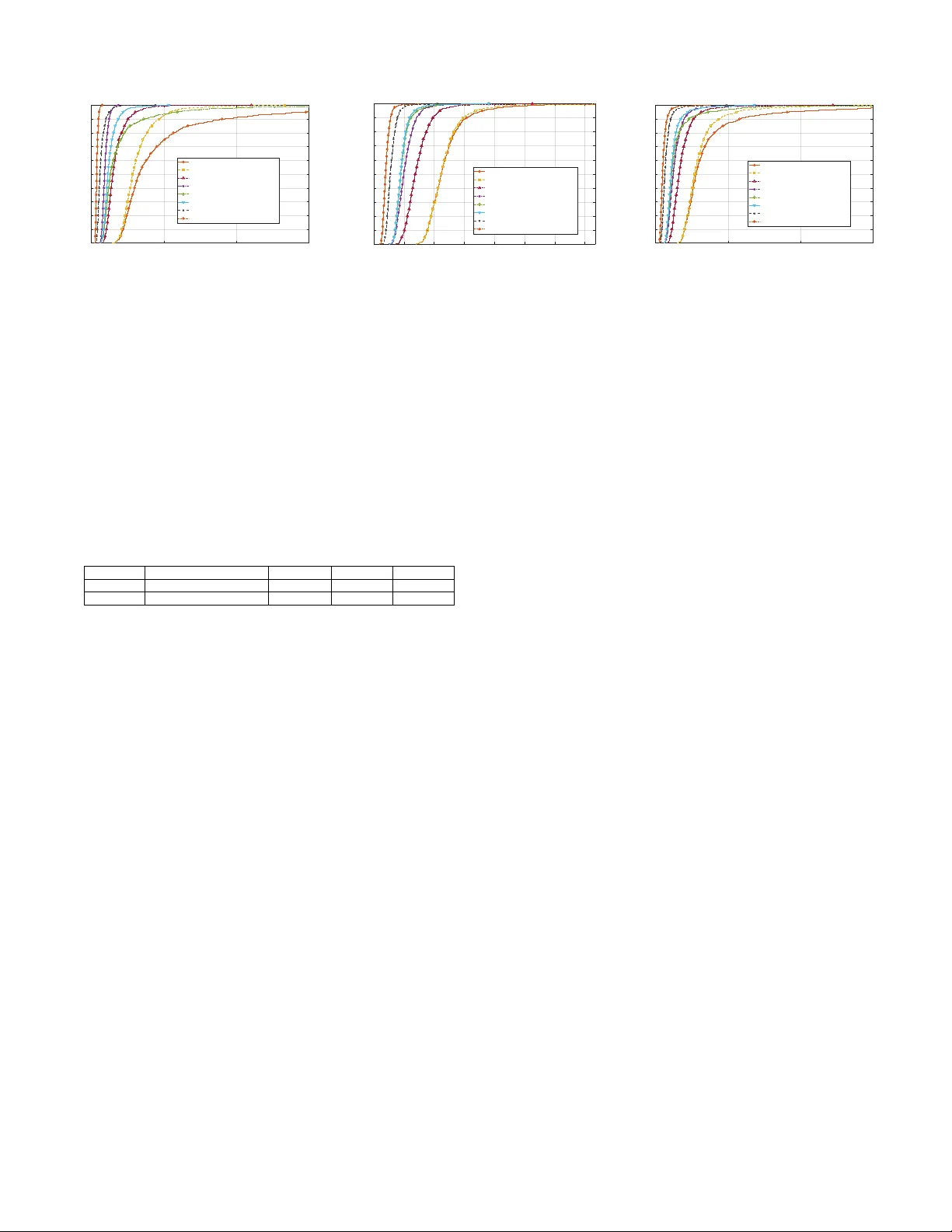
RIS-Aided E2E Multi-P ath Uplink T ransmission Optimization for 6G T ime-Sensiti ve Services Liu Cao ∗ , Zisheng Gong ∗ , Ziyue Xiao, Zhaoyu Liu, Houtianfu W ang, L yutianyang Zhang Abstract —The Access T raffic Steering, Switching, and Splitting (A TSSS) defined in the latest 3GPP Release 19 enables traffic flow over the multiple access paths to achieve the lower -latency End- to-end (E2E) delivery f or 6G time-sensitive ser vices. Howev er , the existing E2E multi-path operation often falls short of more stringent QoS requirements for 6G time-sensitive services. This work proposes a Reconfigurable Intelligent Surfaces (RIS)-aided E2E multi-path uplink (UL) transmission architectur e that ex- plicitly accounts for both radio link latency and N3 backhaul latency , via the coupled designs of the UL traffic-splitting ratio, transmit power , recei ve combining, and RIS phase shift under practical constraints to achieve the minimum a verage E2E latency . W e dev elop an alternating optimization framework that updates the above target parameters to be optimized. The simulations were conducted to compare the effectiv eness of the proposed E2E optimization framework that lowers the average E2E latency up to 43% f or a single user and 32% for the whole system compared with baselines in our prior work [1]. Index T erms —A TSSS, E2E, Multi-path, RIS, Latency , 6G. I . I N T RO D U C T I O N W ith the rapid gro wth of Internet-of-Things (IoT) devices tow ards 6G networks, time-sensiti ve mobile services ha ve placed tremendous pressure on existing wireless networks [2]. Advanced technologies such as Multi-access Edge Comput- ing (MEC), network slicing, and Ultra-Reliable Low-Latenc y Communications (URLLC) were lev eraged to satisfy the strin- gent quality of service (QoS) requirements for 5G services. Among these, the End-to-end (E2E) multi-path transmission scheme has emerged as a promising solution to mitigate the E2E multi-path latency for URLLC traffic in dynamic and div erse wireless environments [1]. T raditional cellular netw orks rely on single E2E path, which howe v er struggle with handling the latency issues. While the E2E multi-path framework utilizes multiple 3GPP accesses (e.g. 5G NR Uu) or non-3GPP accesses (e.g., WLAN 802.11), within the context of Access T raffic Steering, Switching and Splitting (A TSSS) rule [2], [3], to ef fectiv ely mitigate such issues in the 5G/5G-A era [1]. The authors in [4] in vestigated This paper has been presented in part at the IEEE International Conference on Communications in China [1]. ∗ Both authors contributed equally to this work. Liu Cao, Zisheng Gong, Ziyue Xiao, and Zhaoyu Liu are with both City University of Hong Kong (Dongguan), Dongguan, China, and City University of Hong Kong, Hong K ong (e-mail: { liu.cao, 72404185, 72405391, 72515198 } @cityu-dg.edu.cn). Houtianfu W ang is with the Department of Engineering, University of Cam- bridge, Cambridge, UK (email:hw680@cam.ac.uk). L yutian yang Zhang is with the School of Microelectronics and Communication Engineering, Chongqing Univ ersity , Chongqing, China (email: zhanglyutianyang@cqu.edu.cn). (Corre- sponding author: L yutianyang Zhang.) This work was supported by the Y outh Innovation T alent Project of Guangdong Provincial Universities (Grant No. 2025KQNCX17). an optimization problem for traffic scheduling in NR and WLAN aggregation (NW A) for enhanced mobile broadband (eMBB) services. The literature [5] studied an E2E multi-path transmission control protocol (MPTCP) scheduler for latency- sensitiv e applications. A joint power control and channel allocation scheme was dev eloped in [6] to reduce the inter- ference adaptively . Ho wev er , 6G time-sensitive services typi- cally are characterized with more stringent QoS requirements, meanwhile, 6G wireless en vironments with more complex PHY/MA C impairments fundamentally bound the achiev able E2E latenc y mitigation, thereby limiting the effecti veness of existing E2E multi-path schemes. In this context, Reconfigurable Intelligent Surface (RIS) in- troduces a novel PHY -layer controllability by activ ely shaping the wireless environment [7]–[10], enabling the construction of more fa vorable and stable E2E links. Moreov er , recent space- time-coding metasurf ace e xperiments ha ve demonstrated si- multaneous independent multi-beamforming and multi-channel transmission across different spatial directions and frequencies [11], suggesting that a shared programmable aperture can concurrently support multiple wireless links. This additional degree of freedom motiv ates RIS-assisted E2E multi-path op- timization, where traffic control across multiple accesses can be jointly designed with propagation-aw are link enhancement, offering a viable pathway toward meeting the lower E2E multi- path latency requirements for 6G networks. Inspired by the aforementioned issues, we propose a RIS- assisted E2E multi-path (UL) transmission architecture that outperforms the existing optimized E2E multi-path approaches. T o the best kno wledge of authors, this is the first w ork that inte- grates both benefits of the RIS and the standardized E2E multi- path architecture that well aligned with the new solution to the lower latency characteristics of 6G time-sensitive services. Compared with our preliminary conference version [1], this paper provides a substantial extension in sev eral aspects. First, while [1] considered a single-UE tw o-path E2E multi-path transmission setting, this work develops a RIS-assisted multi- BS multi-UE uplink framework for 6G time-sensitiv e services. Second, beyond the abstract path-lev el latency model in [1], this paper explicitly incorporates the RIS-assisted channels, BS receiv e combining, inter-user interference, and the unit- modulus RIS constraint into the E2E latency-aw are design. Third, a new joint optimization of traffic splitting, transmit power , receive combining, and RIS phase shifts is formulated and solved via an alternating optimization framework. Finally , new simulation results are provided to quantify the additional latency reduction achieved by RIS ov er the prior E2E multi- PUSCH DM-RS SRS 1 slot PUCCH RS PUCCH PUCCH RS Guard PUSCH Channel gain t … Slot 1 … Block 1 Block T UE 1 UE N . . . BS 1 BS M UPF AS . . . E2E Path 1 E2E Path M RIS-aided Path RIS Radio link N3 link N6 link Slot 2 Slot P Block 2 Slot 1 Slot 2 … Slot P � � � … … … … … … PUCCH PUCCH PUCCH RBs for BS 1 RBs for BS M Slot 1 … Slot 2 Slot P PUFCH Fig. 1: RIS-aided E2E Multi-path UL T ransmission Architecture. path baselines. The remainder of this paper is organized as follo ws: Section II presents the overall system architecture, Section III provides the problem formulation with the solution, Section IV details the simulation results, and Section V draws the conclusions for this paper . I I . S Y S T E M A R C H I T E C T U R E As Fig. 1 shows, we consider an E2E multi-path UL transmission netw ork assisted by an Uniform Planar Array (UP A)-based RIS with K x × K y passiv e reflecting elements. The system serves N = { 1 , . . . , N } user equipments (UEs) with each having single transmit (TX) antenna, within the cov erage of M = { 1 , . . . , M } base stations (BSs) of which each has L receiv e (RX) antennas. Each BS is connected to the User Plane Function (UPF) via an N3 link. Then the UPF is further connected to the Application Server (AS) via an N6 link. Meanwhile, each UE transits Q = { 1 , . . . , Q } UL traf fic types from the user side to the UPF side, and the traffic of each type is split o ver the M E2E paths shown in Fig.1. T o minimize the E2E latency that is the sum of the latency ov er the radio link and the N3 link based on the proposed E2E Multi-path UL transmission architecture, a centralized controller determines: 1) the traffic splitting ratio and the UL transmit power for each UE; 2) the phase-shift for the RIS; and 3) the receive beamforming vectors for each BS. W e consider block-fading channels where the Direct UE–BS UL Channel h d,n,m ( t ) , UE–RIS UL Channel h r,n ( t ) , and RIS–BS Channel G m ( t ) between the n th ( n ∈ N ) UE and the m th ( m ∈ M ) BS in the t th ( t ∈ T ) block are assumed to be constant within a block and v ary independently o ver the T = { 1 , . . . , T } blocks. Each block consists of P consecutive slots with each duration being determined by the 6G numerol- ogy . Accordingly , the joint decisions in terms of traffic splitting ratio, UL transmit po wer , and RIS phase shift are made at the beginning of each block and kept fixed for the whole block. W ithin each slot, the resource Blocks in the Pysical UL Shared Channel (PUSCH) are equally allocated to multiple BSs for the UL traffic, while the decision information as part of the control information is transmitted in the Pysical UL Control Channel (PUCCH). All the relev ant feedback to UEs including Channel State Information (CSI) and the decision information (before UEs’ UL traf fic transmission) is transmitted in the Pysical UL Feedback Channel (PUFCH). Note that as all UEs are within the common coverage of the M BSs, each UE will reuse the same RBs allocated for each BS, thereby incurring the inter- user interferences in the UL transmission. I I I . S Y S T E M M O D E L In this section, we formulate a problem formulation with the algorithm solution for the proposed RIS-aided E2E multi-path framew ork. The UL channel consists of a direct component and an RIS-assisted cascaded component. Let h d,n,m ( t ) ∈ C L × 1 denote the direct UL channel from UE n to BS m , which is gi ven by h d,n,m ( t ) = p β d,n,m η n,m h LOS n,m + ¯ η n,m h NLOS n,m , (1) where η n,m = q κ n,m κ n,m +1 and ¯ η n,m = q 1 κ n,m +1 , β d,n,m is the large-scale fading coefficient (pathloss and shadowing), and κ n,m ≥ 0 is the Rician K -factor . The LOS component is modeled by the BS array response vector h LOS n,m ( t ) = e j φ n,m a BS θ AoA n,m , (2) where θ AoA n,m is the AoA at BS m and a BS ( · ) ∈ C L × 1 is the BS array response. For an L -element ULA, it is gi ven by a BS ( θ ) = 1 √ L h 1 , e − j 2 πd λ sin θ , . . . , e − j 2 πd λ ( L − 1) sin θ i T , (3) where d is the inter -element spacing and λ is the wav elength. The NLOS component accounts for rich scattering and spatial correlation h NLOS n,m = R BS n,m 1 2 g n,m , (4) where g n,m ∼ C N ( 0 , I L ) and R BS n,m ∈ C L × L is the receive correlation matrix at BS m . Let h r,n ( t ) ∈ C K × 1 denote the UL channel from UE n to the RIS. A geometry-based finite-path model is adopted as h r,n ( t ) = p β r,n S r X s =1 ξ n,s a RIS φ AoA n,s , θ AoA n,s , (5) where β r,n is the large-scale fading on the UE–RIS link, S r is the number of resolv able paths, ξ n,s is the complex gain of path s , and a RIS ( · ) ∈ C K × 1 is the RIS array response. For a K x × K y UP A, the RIS array response is given by a RIS ( φ, θ ) = a x ( φ, θ ) ⊗ a y ( φ, θ ) , (6) with a x ( φ, θ ) = 1 √ K x h 1 , e − j 2 πd x λ u x , . . . , e − j 2 πd x λ ( K x − 1) u x i T , (7) a y ( φ, θ ) = 1 p K y 1 , e − j 2 πd y λ u y , . . . , e − j 2 πd y λ ( K y − 1) u y T , (8) where u x = sin θ cos φ and u y = sin θ sin φ , d x and d y are the inter-element spacings along the x - and y -ax es of the RIS, respectiv ely . Let G m ( t ) ∈ C L × K denote the channel from the RIS to BS m . W e adopt a finite-path geometric channel model as G m ( t ) = p β G,m S G X s =1 ρ m,s a BS ϑ AoA m,s a H RIS φ AoD m,s , θ AoD m,s , (9) where β G,m is the large-scale fading on the RIS–BS link, S G is the number of paths, ρ m,s is the complex gain, and ϑ AoA m,s is the AoA at BS m . φ AoD m,s and θ AoD m,s are the pitch and azimuth AoD from the RIS, respectiv ely . The RIS is modeled by a diagonal phase-shift matrix as Φ ( t ) = diag ϕ 1 ( t ) , . . . , ϕ K ( t ) , (10) where ϕ k ( t ) = e j θ k ( t ) denotes the reflection coefficient of the k -th element. Since the RIS is passive, it satisfies the unit- modulus constraint | ϕ k ( t ) | = 1 , ∀ k . Accordingly , the RIS- aided ef fectiv e UL channel from UE n to BS m is h n,m ( t ) = h d,n,m ( t ) + G m ( t ) Φ ( t ) h r,n ( t ) . (11) Let x n,m ( t ) denote the unit-power UL stream from UE n intended for BS m with E [ | x n,m ( t ) | 2 ] = 1 , and let p n,m ( t ) ≥ 0 be the corresponding transmit power allocated to link ( n, m ) . Then the received signal at BS m is y m ( t ) = N X n =1 q p n,m ( t ) h n,m ( t ) x n,m ( t ) + z m ( t ) , (12) where z m ( t ) ∼ C N ( 0 , σ 2 I L ) is the receiver noise. Since each UE transmits the sub-flow destined for BS m on orthogonal time–frequency resources associated with that BS, as is shown in Fig. 1, the symbol x n,m ( t ) is only observed on BS m ’ s resource, and there is no intra-UE cross-path interference. For each BS m , define the receive combining matrix W m ( t ) ≜ w m, 1 ( t ) , . . . , w m,N ( t ) ∈ C L × N . Let W ( t ) ≜ { W m ( t ) } m ∈M denote the collection of all receive combiners. In this work, W ( t ) is updated using the Minimum Mean Square Error (MMSE) receiv e combiner based on the current α n,m,q ( t ) , p n,m ( t ) , and Φ ( t ) . Particularly , BS m uses w m,n ( t ) to decode UE n ’ s uplink stream as follows: ˆ x n,m ( t ) = w H m,n ( t ) y m ( t ) . (13) The SINR at the BS m from the UE n is γ n,m ( t ) = p n,m ( t ) w H m,n ( t ) h n,m ( t ) 2 P j = n p j,m ( t ) w H m,n ( t ) h j,m ( t ) 2 + σ 2 ∥ w m,n ( t ) ∥ 2 , (14) Accordingly , the achie vable UL rate (bits/second) from the UE n to the BS m is R n,m ( t ) = B m log 2 1 + γ n,m ( t ) . (15) where B m denotes the bandwidth of the UL resource associated with BS m . According to Fig. 1, the latency on each E2E path includes the latency ov er the radio link and the N3 link. Suppose the number of arriv ed packets of traffic type q at UE n in block t is a random variable λ n,q ( t ) follo wing a Poisson distribution with mean E [ λ n,q ( t )] = ¯ λ n,q . Each packet of traffic type q has a fixed size of M q bits, and all packets with the same type share the same size. Meanwhile, let n n,q ( t ) denote the number of queueing packets of type q at UE n at the be ginning of block t , which also follows a Poisson distribution with mean E [ n n,q ( t )] = ¯ n n,q . W e denote the fraction of type q UL traf fic from UE n routed to BS m is α n,m,q ( t ) , satisfying 0 ≤ α n,m,q ( t ) ≤ 1 and P M m =1 α n,m,q ( t ) = 1 , ∀ n ∈ N , ∀ q ∈ Q . Therefore, the corresponding propagation latency for traffic type q over the radio link from UE n to BS m is obtained by τ UL n,m,q ( t ) = α n,m,q ( t ) λ n,q ( t ) + n n,q ( t ) M q R n,m ( t ) , (16) The backhaul latency for traf fic type q over N3 link from BS m to UPF is giv en by τ BH n,m,q ( t ) = α n,m,q ( t ) λ n,q ( t ) + n n,q ( t ) M q c n,m,q ( t ) , (17) where c n,m,q ( t ) follo ws a uniform distribution based on the QoS flow characteristics. As a result, the estimated instant E2E latency for traf fic q ∈ Q via the E2E path m of the UE n at the block t is u n,m,q ( t ) = τ UL n,m,q ( t ) + τ BH n,m,q ( t ) . (18) Our objectiv e is to minimize the instant E2E UL latency per block of all UEs with all traf fic types based on the proposed architecture in Fig.1. Accordingly , we formulate a joint optimization problem that minimizes the E2E latency per block in terms of UE configurations including traf fic splitting and transmit power , the RIS configuration, and the BS configuration as below: Problem 1 (RIS-aided E2E Multi-path UL Optimization) . argmin α n,m,q ( t ) , p n,m ( t ) , W ( t ) , Φ ( t ) f = X n ∈N X q ∈Q max m ∈M u n,m,q ( t ) s . t . C1 : 0 ≤ α n,m,q ( t ) ≤ 1 , n ∈ N , m ∈ M , q ∈ Q , C2 : M X m =1 α n,m,q ( t ) = 1 , n ∈ N , q ∈ Q , C3 : 0 ≤ p n,m ( t ) ≤ P tot n , n ∈ N , m ∈ M , C4 : M X m =1 p n,m ( t ) = P tot n , n ∈ N , C5 : ∥ w m,n ( t ) ∥ 2 ≤ 1 , m ∈ M , n ∈ N , C6 : Φ ( t ) = diag e j θ 1 ( t ) , . . . , e j θ k ( t ) , | ϕ k ( t ) | = 1 , ∀ k ∈ { 1 , . . . , K } , C7 : 0 ≤ u n,m,q ( t ) ≤ T max q , q ∈ Q , (19) where P tot n is the total UL transmit power for UE n . T max q is the latency budget of traffic type q . Remark 1. Pr oblem 1 is non-con ve x due to the coupled SINR and UL rate expr essions in Eq. (14) – (15) and the unit- modulus RIS constraint in C6. Specifically , the SINR in Eq. Algorithm 1: Alternating Optimization (A O) for Prob- lem 1 Input: R max , I max , ϵ AO , ϵ SCA ; Output: W ⋆ , α ⋆ , p ⋆ , Φ ⋆ ; Init: Feasible ( α 0 , p 0 , Φ 0 ) ; W 0 ← M M S E ( p 0 , Φ 0 ) ; f 0 ← f ( α 0 , p 0 , W 0 , Φ 0 ) for r = 0 to R max − 1 do W r +1 ← M M S E ( p r , Φ r ) ; for i = 0 to I max − 1 do ( α i +1 , p i +1 ) ← SCA ( W r +1 , Φ r , α i , p i ) ; if ∥ α i +1 − α i ∥ 2 + ∥ p i +1 − p i ∥ 2 max n 1 , ∥ α i ∥ 2 + ∥ p i ∥ 2 o ≤ ϵ SCA then break ; ( α r +1 , p r +1 ) ← ( α i +1 , p i +1 ) ; V r +1 ← S D R ( W r +1 , α r +1 , p r +1 ) ; ˜ v r +1 ← Gaussian-Randomization ( V r +1 ) ; v r +1 ← ˜ v r +1 ← Entry-wise projection; Φ r +1 ← diag e j ∠ v r +1 ← Unit-modulus projection; f r +1 ← f ( α r +1 , p r +1 , w r +1 , Φ r +1 ) ; if | f r +1 − f r | max { 1 , | f r |} ≤ ϵ AO then break ; retur n { w r +1 , α r +1 , p r +1 , Φ r +1 } ; (14) couples the r eceive combining vectors W ( t ) , the RIS phase-shift matrix Φ ( t ) , and the UL transmit power { p n,m ( t ) } thr ough multiplicative terms in both the desired signal and interfer ence components. Meanwhile, the achie vable UL rate in Eq. (15) intr oduces a nonlinear mapping from SINR to the UL rate, and the E2E latency further contains in verse- rate type terms (e .g., tr affic amount divided by ac hievable rate) that strengthens the non-conve xity . F inally , the constraint | ϕ k ( t ) | = 1 in C6 r enders the feasible set of RIS coefficients non-con vex. Motiv ated by Remark 1, we propose an alternating optimiza- tion (A O) framework that iterativ ely updates W ( t ) , α ( t ) , p ( t ) , and Φ ( t ) to solve Problem 1. For notational con venience, we omit the index of block t , UE n , BS m , traffic type q and unless otherwise stated. Specifically , W is updated by the MMSE receiv e combiner , ( α, p ) is updated by solving an Successiv e Con ve x Approximation (SCA)-based con ve x subproblem with at most I max inner iterations (tolerance ϵ SCA ), and Φ is updated via the Semidefinite Program (SDP) optimization. The Semidefinite Relaxation (SDR) step leads to a SDP , which can be efficiently solved by standard con vex solvers. The A O iterations stop when the objective improvement between two successiv e iterations is below a prescribed threshold ϵ AO , or when the maximum number of A O iterations R max is reached. The overall procedure is summarized in Algorithm 1 [7], [12], [13]. As a result, the average E2E UL latency over all T blocks per UE shown in Fig.1 is expressed as ¯ U = 1 N T X t ∈T f ( α ⋆ , p ⋆ , W ⋆ , Φ ⋆ , t ) , (20) where T should be large enough to estimate the conv erged one. I V . S I M U L A T I O N In this section, simulations are conducted in Matlab with CVX T oolbox to quantify the performance gain of the proposed E2E multi-path architecture with algorithm. W e consider a scenario of 3 BSs and 3 UEs, where the 3 BSs are placed in a triangular layout, forming spatially div erse access paths for the UEs, and each UE is within the coverage of the 3 BSs thereby the traffic can be split among the 3 E2E paths. The RIS is implemented as a 10×10 UP A with half-wav elength spacing, and the RIS-assisted paths are modeled using a Rician fading channel with K factor equal to 10. Although the RIS is able to assist multiple E2E paths for each UE simultaneously , the achie vable gain is heterogeneous across different paths due to distance-dependent propagation and the common use of phase-shift configuration within each block. T o f acilitate a clear ablation study of RIS assistance more distinguishable, the RIS is deployed close to BS 1. In this deployment, the RIS phase shifts are configured to provide constructi ve signal combining for the overall network rather than being dedicated to a specific BS-UE pair . As a result of the geometric proximity between the RIS and BS 1, Path 1 naturally experiences more pronounced RIS-assisted gains for the BS 1-UE 1 radio link compared with other BSs. Meanwhile, UE 2 and UE 3 are placed closer to BS 2 and BS 3, respectiv ely , resulting in different dominant access paths. T ABLE I: Main Simulation Parameters. Parameter V alue Parameter V alue Traf fic types q { 1 , 2 } Packet size M q (bytes) T1: 10000 T2: 20000 Arriv al rate λ n,q (pkts/s) T1: 50 T2: 10 Latency budget T max q (s) T1: 0.9 T2: 1.0 Noise PSD N 0 (dBm/Hz) − 174 Carrier frequency f c (GHz) 2 . 6 T otal bandwidth B tot (MHz) 100 Uplink transmit power P tot (dBm) 23 Pathloss model UMa NLoS [14] UE speed(m/s) 1 Block duration t s (ms) 50 Simulation time T sim (s) 500 GBR Path 1 Q 1 (Mb/s) T1: [100,150] T2: [180,220] GBR Path 2 Q 2 (Mb/s) T1: [110,140] T2: [190,200] GBR Path 3 Q 3 (Mb/s) T1: [105,130] T2: [170,210] RIS location (m) (50,86.6,20) BS location(m) (0,0,25); (433,0,25); (216.5,375,25) UE location (m) (151.6,93.8,1.8); (368.1,56.3,1.8); (66.5,318.8,1.8) CPU Intel Core i7 @ 2.6 GHz The main simulation setup is summarized in T able I, where the two traf fic types hav e different latency budget characteris- tics. W e further propose three baselines for comparison: • Single-path (SP) : Each UE transmits all traffic through a fixed access path for all traffic in all blocks. • Path-selection (PS) : Each UE dynamically selects a better single E2E path in each block and transmits all traffic through the selected path. • Multi-path (MP) without RIS : Each UE optimally splits its traf fic across all available E2E paths using the approach in prior work [1], without the RIS assistance. W e first analyze the performance gain of each UE in the system. Fig. 2 shows the cumulativ e distrib ution function (CDF) of the instant E2E latenc y per block for the two traffic types with different approaches. For UE 1 in Fig. 2(a), the RIS- assisted MP scheme consistently exhibits a left-shifted CDF , indicating the lower instant E2E multi-path latency in most blocks compared with other baselines. Specifically , the average E2E latency for UE 1 using the MP without RIS is 16.82 ms Latency(ms) 0 50 100 150 CDF 0 0.1 0.2 0.3 0.4 0.5 0.6 0.7 0.8 0.9 1 Traf fic1-Single-path(Path1) Traf fic1-Pathselection Traf fic1-Multi-path(NoRIS) Traf fic1-Multi-path(RIS) Traf fic2-Single-path(Path1) Traf fic2-Pathselection Traf fic2-Multi-path(NoRIS) Traf fic2-Multi-path(RIS) (a) UE 1. Latency(ms) 0 10 20 30 40 50 60 70 CDF 0 0.1 0.2 0.3 0.4 0.5 0.6 0.7 0.8 0.9 1 T raff ic1-Single -path(Path2) T raff ic1-Pathsele ction T raff ic1-Multi-path(No RIS) T raff ic1-Multi-path(RIS) T raff ic2-Single -path(Path2) T raff ic2-Pathsele ction T raff ic2-Multi-path(No RIS) T raff ic2-Multi-path(RIS) (b) UE 2. Latency(ms) 0 50 100 150 CDF 0 0.1 0.2 0.3 0.4 0.5 0.6 0.7 0.8 0.9 1 T raff ic1-Single -path(Path3) T raff ic1-Pathsele ction T raff ic1-Multi-path(No RIS) T raff ic1-Multi-path(RIS) T raff ic2-Single -path(Path3) T raff ic2-Pathsele ction T raff ic2-Multi-path(No RIS) T raff ic2-Multi-path(RIS) (c) UE 3. Fig. 2: The CDF of Instant E2E Latency per Block for Each UE. and 6.72 ms for T raf fic 1 and 2, respecti vely , which are reduced to 9.49 ms and 3.79 ms when the RIS is enabled with latenc y reduction of 43.56% and 43.58%. Note that the SP exhibits a pronounced long-tail behavior due to the sev ere radio links in some blocks. Due to the geometric proximity between the RIS, BS 1, and UE 1, the RIS-assisted multi-path scheme exhibits a more noticeable left shift in Fig. 2(a). In contrast, for UE 2 and UE 3 shown in Fig. 2(b) and (c), the latency curves of the MP with and without RIS almost overlap, indicating that the performance gain with RIS becomes weak when the RIS is too far away from the UE or the BS in the proposed system architecture. T ABLE II: A verage E2E Latency (ms) per T raf fic T ype. Traf fic MP with RIS (Ours) MP [1] SP PS 1 11.283 16.587 39.766 28.786 2 4.494 6.630 15.896 11.506 W e further in vestigate the performance gain of the whole system based on ¯ U in Eq.(20). W e track the a verage E2E latency of traffic 1 and 2 respectively , which are summarized in T able II. The MP achieves the lower average latency than both SP and PS for the two traffic types. Moreov er , enabling the RIS for MP can further reduce the av erage E2E latency , confirming the effecti veness of RIS. Specifically , the MP with RIS reduces the average E2E latency by approximately 32.0% for Traf fic 1 and 32.2% for T raf fic 2, compared with the MP without RIS. In addition, compared with the SP , the MP with RIS reduces the av erage E2E latency up to 64% for both T raffic 1 and 2. Overall, the numerical results demonstrate that while the E2E multi-path architecture is the key factor in reducing the E2E latency , the RIS is also able to primarily provide additional performance gain especially when more fa vorable RIS-assisted radio links are present, leading to an around 32% performance gain in the in vestigated scenario. V . C O N C L U S I O N This paper proposed a RIS-assisted E2E multi-path UL transmission optimization approach to achiev e the minimum av erage E2E latency that accounts for wireless and backhaul delays for 6G time-sensiti ve services. W e formulate an opti- mization problem by jointly optimizing the UL traf fic-splitting ratio, UL transmit power , receiv e combining vector , and RIS phase shift. An alternating optimization approach combining with the SCA and SDR approaches is then developed to solve the non-con ve x problem. Finally , the numerical results from simulation demonstrate that the proposed E2E MP architec- ture outperforms the baselines such as SP and PS schemes, meanwhile, the RIS aided for MP yields further gains by lowering the av erage E2E latency up to 43% for a single user and 32% for the whole system, which supports the UL transmission of 6G time-sensiti ve services with more stringent QoS requirements. R E F E R E N C E S [1] L. Cao, A. Kiani, A. Xiang, K. John, T . Saboorian, and L. Zhang, “Latency-aw are E2E multi-path data transmission optimization tow ards next-gen mobile networks, ” in 2025 IEEE/CIC International Conference on Communications in China (ICCC W orkshops) . IEEE, 2025, pp. 1–5. [2] 3GPP , “Study on scenarios and requirements for next generation ac- cess technologies, ” The 3rd Generation Partnership Project, T ech. Rep. TR38.913, Oct. 2025. [3] ——, “Study on enhancement of Ultra-Reliable Low-Latency Commu- nication (URLLC) support in the 5G Core network (5GC), ” The 3rd Generation Partnership Project, T ech. Rep. TR23.725, Jun. 2019. [4] X. Ba, L. Jin, Z. Li, J. Du, and S. Li, “Multiservice-based traffic schedul- ing for 5G access traffic steering, switching and splitting, ” Sensors , vol. 22, no. 9, p. 3285, 2022. [5] P . Hurtig, K.-J. Grinnemo, A. Brunstrom, S. Ferlin, ¨ O. Alay , and N. Kuhn, “Low-latency scheduling in MPTCP, ” IEEE/ACM T ransactions on Networking , vol. 27, no. 1, pp. 302–315, 2018. [6] G. Zhao, Y . Li, C. Xu, Z. Han, Y . Xing, and S. Y u, “Joint power control and channel allocation for interference mitigation based on reinforcement learning, ” IEEE Access , vol. 7, pp. 177 254–177 265, 2019. [7] Q. W u, S. Zhang, B. Zheng, C. Y ou, and R. Zhang, “Intelligent reflecting surface-aided wireless communications: A tutorial, ” IEEE T ransactions on Communications , vol. 69, no. 5, pp. 3313–3351, 2021. [8] K. Shafique and M. Alhassoun, “Going beyond a simple RIS: Trends and techniques paving the path of future ris, ” IEEE Open Journal of Antennas and Pr opagation , vol. 5, no. 2, pp. 256–276, 2024. [9] Z. Zhu, Z. Li, Z. Chu, Y . Guan, Q. W u, P . Xiao, M. Di Renzo, and I. Lee, “Intelligent reflecting surface assisted mmwave integrated sensing and communication systems, ” IEEE Internet of Things Journal , vol. 11, no. 18, pp. 29 427–29 437, 2024. [10] E. Shi, J. Zhang, H. Du, B. Ai, C. Y uen, D. Niyato, K. B. Letaief, and X. Shen, “Ris-aided cell-free massiv e mimo systems for 6G: Fundamen- tals, system design, and applications, ” Proceedings of the IEEE , vol. 112, no. 4, pp. 331–364, 2024. [11] H. W . Tian, C. Song, D. J. W ang, Q. Zhu, T . J. Cui, and W . X. Jiang, “ Ambient-ener gy-driv en space-time-coding metasurface for space-frequency-di vision multiplexing wireless communications, ” Opto- Electr onic Advances , 2026. [12] G. Scutari and Y . Sun, “Parallel and distributed successive con vex approximation methods for big-data optimization, ” in Multi-Agent Op- timization: Cetrar o, Italy 2014 . Springer, 2018, pp. 141–308. [13] Q. W u and R. Zhang, “Intelligent reflecting surface enhanced wireless network via joint active and passiv e beamforming, ” IEEE T ransactions on W ireless Communications , vol. 18, no. 11, pp. 5394–5409, 2019. [14] 3GPP , “Study on channel model for frequencies from 0.5 to 100 GHz, ” The 3rd Generation Partnership Project, T ech. Rep. TS38.901, Mar . 2024.
Original Paper
Loading high-quality paper...
Comments & Academic Discussion
Loading comments...
Leave a Comment