(H)ALPing the 511 keV line: A thermal DM interpretation of the 511 keV emission
We propose a novel framework where MeV-scale Dirac Dark Matter annihilates into axion-like particles, providing a natural explanation for the 511 keV gamma-ray line observed in the Galactic Center. The relic abundance is determined by p-wave annihilation into two axion-like particles, while s-wave annihilation into three axion-like particles, decaying into $e^+ e^-$ pairs, accounts for the line intensity. Remarkably, this model, assuming a standard Navarro-Frenk-White profile, reproduces the observed emission morphology, satisfies in-flight annihilation and cosmological bounds, and achieves the correct relic density, offering a compelling resolution to this longstanding anomaly.
💡 Research Summary
The authors present a novel thermal dark‑matter framework that naturally explains the long‑standing 511 keV gamma‑ray line observed toward the Galactic Center. The model introduces a MeV‑scale Dirac dark‑matter particle χ and an axion‑like particle (ALP) a. The key idea is that χ annihilates predominantly via two distinct channels: a p‑wave process χχ → aa, which sets the relic abundance during freeze‑out, and an s‑wave process χχ → aaa, which dominates today in the low‑velocity environment of the Galactic bulge and provides the positrons that produce the 511 keV line.
The p‑wave annihilation cross section scales as ⟨σv⟩ ∝ g_χ⁴ v²/(m_χ²…) and, because the relative velocity in the early universe is sizable, it yields the correct thermal relic density for couplings g_χ≈2.5×10⁻³ √(m_χ/MeV). This channel is governed solely by the dark‑sector coupling g_χ, while the coupling to electrons g_e plays no role in the relic calculation.
The s‑wave channel, χχ → aaa, is proportional to g_χ⁶ and essentially velocity‑independent. In the Galactic bulge, where v≈10⁻³c, the ratio η = σ(χχ→aaa)/σ(χχ→aa) ≈ 0.23 g_χ²/v² becomes much larger than unity, so the three‑ALP final state dominates the present‑day annihilation rate. Each ALP subsequently decays almost exclusively to e⁺e⁻ (tree‑level) because the chosen mass hierarchy 2 m_χ > 3 m_a > 6 m_e forces this decay mode. The electron coupling g_e is constrained to be extremely small (g_e ≲ 5×10⁻¹³) by supernova cooling, beam‑dump experiments, and recent nova‑production limits, ensuring that ALPs have a mean free path ≲ 1 pc and inject positrons essentially instantaneously.
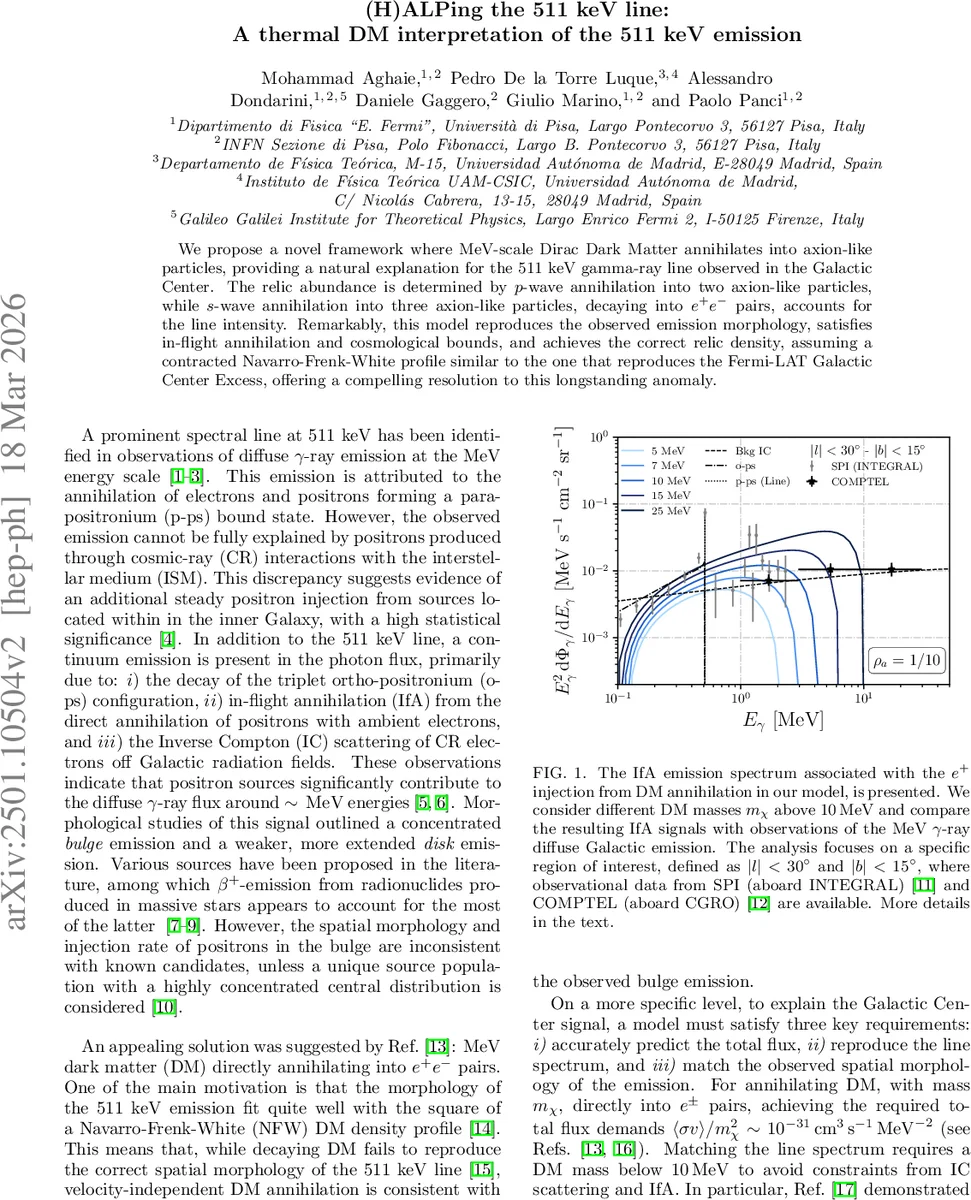
Kinematically, the three‑ALP decay chain χχ → 3a → 3(e⁺e⁻) yields positrons with kinetic energies of order m_χ/3, far below the DM mass itself. This low injection energy dramatically suppresses the In‑Flight Annihilation (IfA) continuum that would otherwise overproduce MeV‑scale gamma rays, a problem that ruled out earlier direct χχ → e⁺e⁻ scenarios. By choosing a benchmark (m_χ ≈ 10 MeV, ρ_a ≡ m_a/(2 m_χ) = 0.1), the maximum positron kinetic energy is kept below ~5 MeV, comfortably satisfying IfA constraints while still providing enough low‑energy positrons to form para‑positronium and generate the observed 511 keV line.
The authors embed the dark matter in a generalized Navarro‑Frenk‑White (NFW) halo with inner slope γ allowed to vary (contracted profiles with γ≈1.2–1.4). Because the annihilation rate scales as ρ_χ², the resulting 511 keV morphology matches the observed bulge‑dominated emission and the weaker disk component. The model reproduces the spatial profile measured by INTEGRAL/SPI without invoking additional astrophysical sources.
Cosmological constraints are carefully examined. The dark sector decouples from the Standard Model well above the electroweak scale, leading to a lower dark‑sector temperature T′ = (g_^SM/g_^dark)^{1/3} T. Freeze‑out proceeds within this colder sector, and the required g_χ values respect perturbative unitarity (g_χ < √(8π/3)) and self‑interaction limits (σ/m ≲ 1 cm²/g). Big‑Bang Nucleosynthesis and Planck measurements of ΔN_eff impose m_χ ≲ 10 MeV at the 2σ level, consistent with the benchmark. CMB energy‑injection bounds from DM annihilation are also satisfied because the dominant s‑wave channel produces only low‑energy e⁺e⁻ pairs, whose impact on recombination is negligible.
In summary, the paper delivers a coherent, testable scenario that simultaneously (i) yields the correct thermal relic abundance, (ii) explains the total flux, spectrum, and morphology of the 511 keV line, (iii) evades In‑Flight Annihilation, BBN, CMB, and self‑interaction constraints, and (iv) does so with a minimal extension of the Standard Model (one Dirac fermion and one ALP). This represents a significant advance over earlier MeV‑scale dark‑matter proposals that required fine‑tuned annihilation cross sections or exotic astrophysical assumptions. The work opens new avenues for probing MeV dark matter through future MeV gamma‑ray missions, precision cosmology, and dedicated laboratory searches for ultra‑weakly coupled ALPs.
Comments & Academic Discussion
Loading comments...
Leave a Comment