Unexpected consequences of Post-Quantum theories in the graph-theoretical approach to correlations
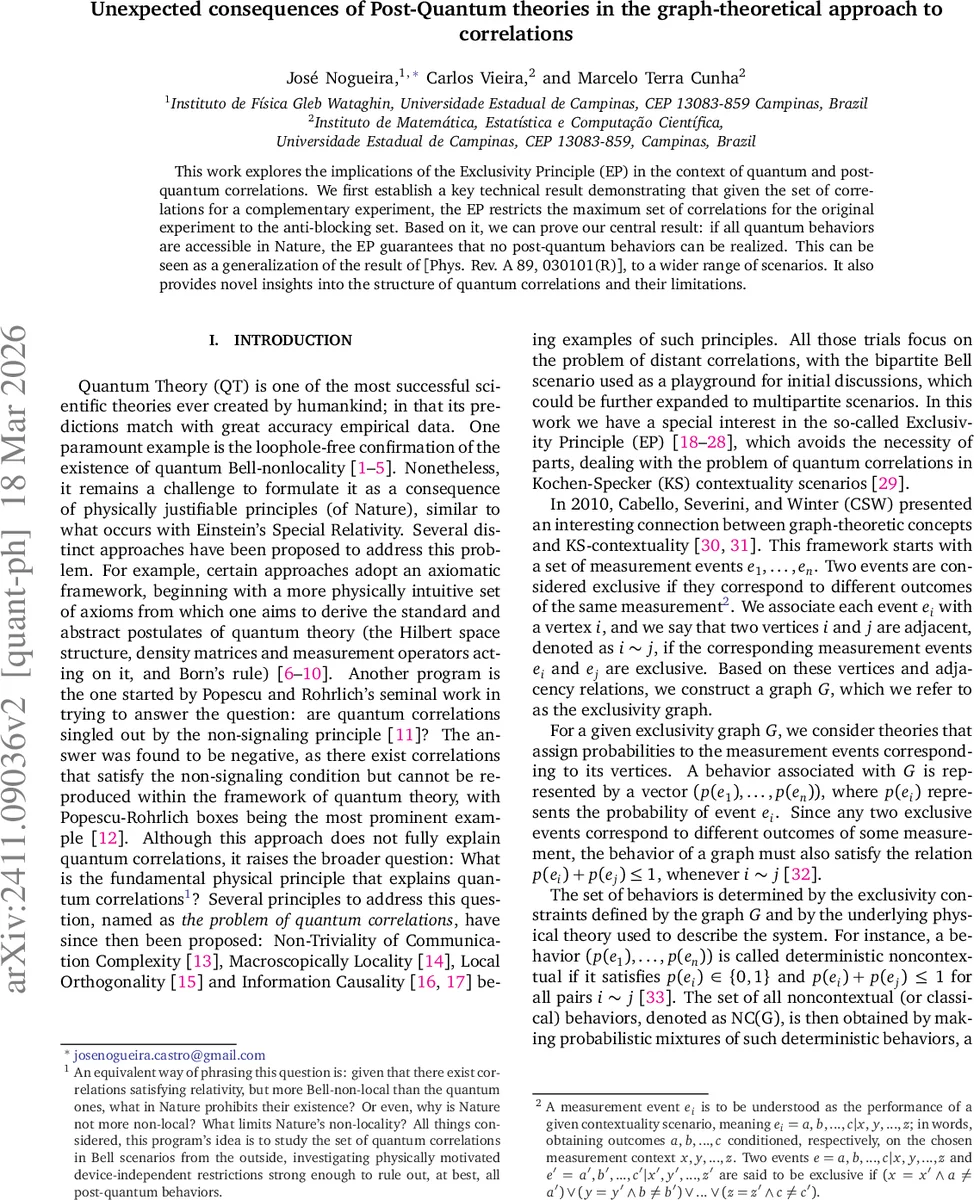
This work explores the implications of the exclusivity principle (EP) in the context of quantum and postquantum correlations. We first establish a key technical result demonstrating that given the set of correlations for a complementary experiment, the EP restricts the maximum set of correlations for the original experiment to the antiblocking set. Based on it, we can prove our central result: if all quantum behaviors are accessible in Nature, the EP guarantees that no postquantum behaviors can be realized. This can be seen as a generalization of the result of B. Amaral et al. [Phys. Rev. A 89, 030101(R) (2014)], to a wider range of scenarios. It also provides novel insights into the structure of quantum correlations and their limitations.
💡 Research Summary
This paper presents a rigorous analysis of the constraining power of the Exclusivity Principle (EP) on quantum and post-quantum correlations, using the graph-theoretical framework developed by Cabello, Severini, and Winter (CSW). The central aim is to understand whether and how the EP, a principle stating that the sum of probabilities for any set of pairwise exclusive measurement events cannot exceed 1, can single out the set of quantum correlations and rule out post-quantum ones.
The research is situated within the broader program of deriving quantum theory from physically motivated principles. While quantum theory is empirically successful, the quest for principles that explain its specific structural limits, particularly regarding nonlocality and contextuality, remains active. The EP has emerged as a promising candidate in this pursuit, especially within the contextuality-focused CSW approach. In this framework, a set of measurement events and their exclusivity relations are represented by a graph G. The sets of classical noncontextual (NC(G)), quantum (Q(G)), and single-copy EP-compliant (E1(G)) behaviors correspond to well-studied graph-theoretic objects: the stable set (STAB), the theta body (TH), and the quasi-stable set (QSTAB), respectively.
The investigation leverages a powerful tool known as Yan’s construction. It considers a given experiment, described by an exclusivity graph G, and its complementary experiment, described by the graph complement ȲG. By forming composite events from these two independent experiments and applying the EP to them, one derives a linear constraint: ∑_i p(e_i) p(e’_i) ≤ 1, where p and p’ are behaviors for G and ȲG, respectively. This constraint implies that the achievable behaviors in one experiment can restrict those in the other, even under the assumption of their independence.
The first major technical contribution of the paper is Proposition 1. It formally establishes that if the set of achievable behaviors for the complementary experiment is X(ȲG), then the EP restricts the maximum allowed set for the original experiment G to the anti-blocking set of X(ȲG), denoted abl X(ȲG). The anti-blocking operation is a concept from combinatorial optimization, and this connection provides a precise mathematical language for the EP’s action.
From this proposition, several key insights follow. Corollary 1 explores two extreme cases: 1) If the complementary experiment can achieve the largest EP-allowed set E1(ȲG), then the EP forces the original experiment into the classical set NC(G). 2) Conversely, if only classical behaviors NC(ȲG) are possible for the complement, then the original experiment can achieve the full E1(G) set. This demonstrates that the restrictive power of the EP is not absolute but depends on the resources available in the complementary scenario—more non-classical resources in the complement lead to stricter classical limits in the original experiment.
Furthermore, Proposition 1 naturally recovers an earlier result by Amaral, Terra, and Cabello (2014): assuming the complementary experiment realizes the quantum set Q(ȲG), the EP singles out Q(G) for the original experiment.
Building on this foundation, the paper arrives at its main result. It demonstrates that if Nature allows for the realization of all quantum behaviors (i.e., Q is accessible) and the EP holds, then no post-quantum behaviors (sets strictly larger than Q) can be realized. The proof assumes the complementary experiment can achieve Q(ȲG). By Proposition 1, the allowed set for G is then abl Q(ȲG). A fundamental result in graph theory states that the quantum set is its own anti-blocking dual (abl Q = Q). Therefore, the allowed set for G is precisely Q(G). This means the joint assumptions of “quantum completeness” and the EP logically preclude any post-quantum correlations.
This conclusion generalizes a prior result by Amaral et al., which was limited to self-complementary graphs, to any possible exclusivity graph G. Methodologically, the paper’s approach is notably streamlined compared to a more complex 2019 proof by Cabello that required considering infinite copies of experiments. By skillfully employing Yan’s original construction coupled with anti-blocking theory, this work achieves the same level of generality with greater conceptual clarity and simplicity, offering novel insights into the structural relationship between the Exclusivity Principle and the boundaries of the quantum set.
Comments & Academic Discussion
Loading comments...
Leave a Comment