On the algebraic lower bound for the radius of spatial analyticity for the Zakharov-Kuznetsov and modified Zakharov-Kuznetsov equations
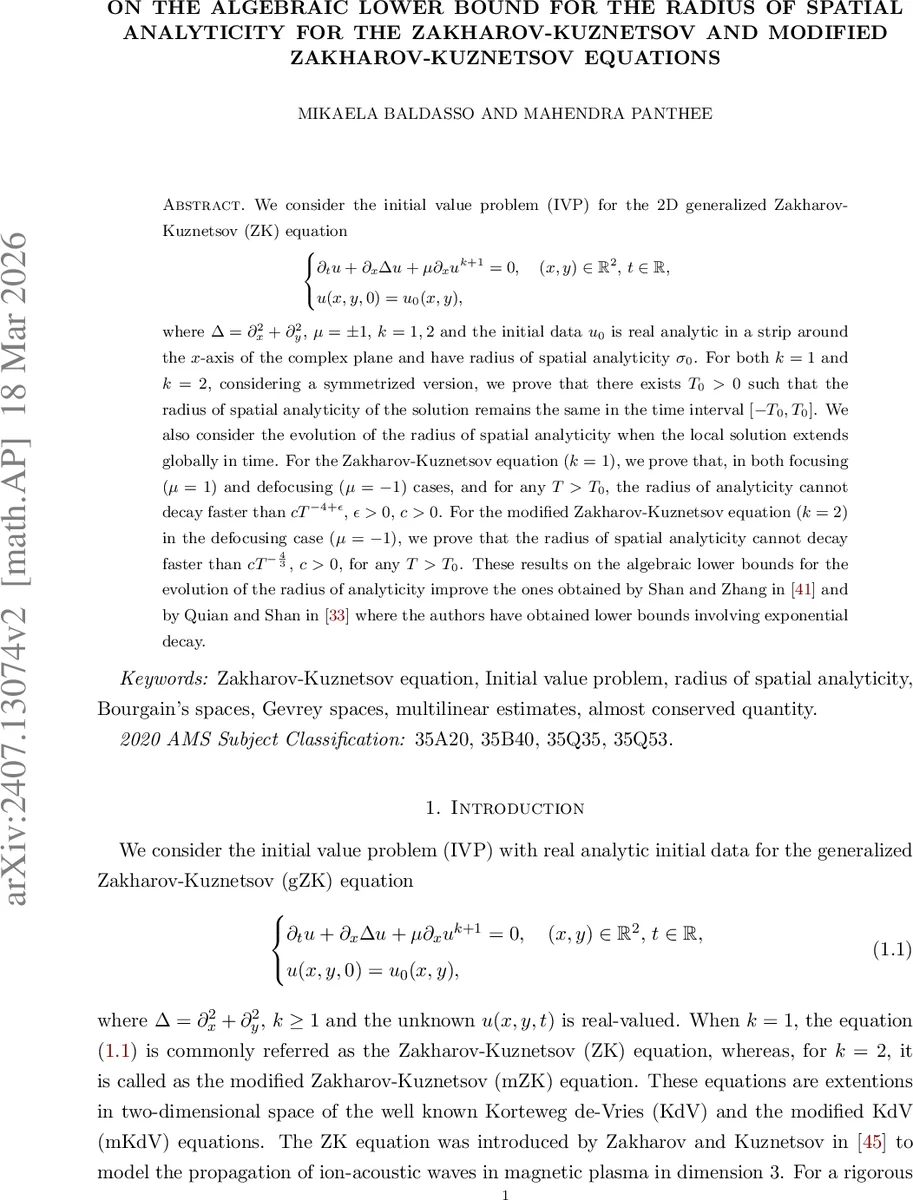
We consider the initial value problem (IVP) for the 2D generalized Zakharov-Kuznetsov (ZK) equation \begin{equation} \begin{cases} \partial_{t}u+\partial_{x}Δu+μ\partial_{x}u^{k+1}=0, ,;; (x, y) \in \mathbb{R}^2, , t \in \mathbb{R},\ u(x,y,0)=u_0(x,y), \end{cases} \end{equation} where $Δ=\partial_x^2+\partial_y^2$, $μ=\pm 1$, $k=1,2$ and the initial data $u_0$ is real analytic in a strip around the $x$-axis of the complex plane and have radius of spatial analyticity $σ_0$. For both $k=1$ and $k=2$ we prove that there exists $T_0>0$ such that the radius of spatial analyticity of the solution remains the same in the time interval $[-T_0, T_0]$. We also consider the evolution of the radius of spatial analyticity when the local solution extends globally in time. For the Zakharov-Kuznetsov equation ($k=1$), we prove that, in both focusing ($μ=1$) and defocusing ($μ=-1$) cases, and for any $T> T_0$, the radius of analyticity cannot decay faster than $cT^{-4+ε}$, $ε>0$, $c>0$. For the modified Zakharov-Kuznetsov equation ($k=2)$ in the defocusing case ($μ=-1$), we prove that the radius of spatial analyticity cannot decay faster than $cT^{-\frac{4}{3}}$, $c>0$, for any $T>T_0$. These results on the algebraic lower bounds for the evolution of the radius of analyticity improve the ones obtained by Shan and Zhang in [J. Math. Anal. Appl., 501 (2021) 125218] and by Quian and Shan in [Nonlinear Analysis, 235 (2023) 113344] where the authors have obtained lower bounds involving exponential decay.
💡 Research Summary
The paper investigates the initial value problem for the two‑dimensional generalized Zakharov‑Kuznetsov (ZK) equation
∂ₜu + ∂ₓΔu + μ∂ₓu^{k+1}=0, k=1 (ZK) or k=2 (modified ZK, mZK), with μ=±1. The authors assume that the initial datum u₀ is real‑analytic in a complex strip of width σ₀, i.e. u₀ belongs to a Gevrey space G_{σ₀,s}(ℝ²).
The main contributions are twofold. First, by applying a linear change of variables that symmetrizes the linear part to ∂ₓ³+∂y³, the authors are able to work within Bourgain’s X^{s,b} framework. They then introduce Gevrey‑Bourgain spaces X{σ,s,b} (the usual X^{s,b} norm multiplied by the exponential weight e^{σ|γ|}) and prove the necessary embedding, time‑continuity and cut‑off lemmas.
Second, they establish sharp multilinear estimates in these spaces. For the ZK case (k=1) a new bilinear estimate (see (2.17)) is proved; for the mZK case (k=2) a trilinear estimate is derived. These estimates allow a contraction‑mapping argument to obtain local well‑posedness for data in G_{σ₀,s} with s>−1/4 (ZK) and s≥1/4 (mZK). The existence time is T₀≈c₀(1+‖u₀‖{G{σ₀,s}}²)^{d} with d>1, and the solution stays analytic in the same strip for |t|≤T₀.
To treat global solutions, the authors construct “almost conserved quantities” at the L²‑level for ZK (using mass conservation) and at the H¹‑level for the defocusing mZK (using a modified energy). These quantities are shown to vary only by a small amount over each short time interval, thanks to the multilinear bounds. By decomposing a long interval
Comments & Academic Discussion
Loading comments...
Leave a Comment