Schrödinger operators with concentric $δ$--shell interactions
We study Schrödinger operators on $\mathbb R^3$ with finitely many concentric spherical $δ$-shell interactions. The operators are defined by the quadratic form method and are described by continuity across each shell together with the usual jump cond…
Authors: Masahiro Kaminaga
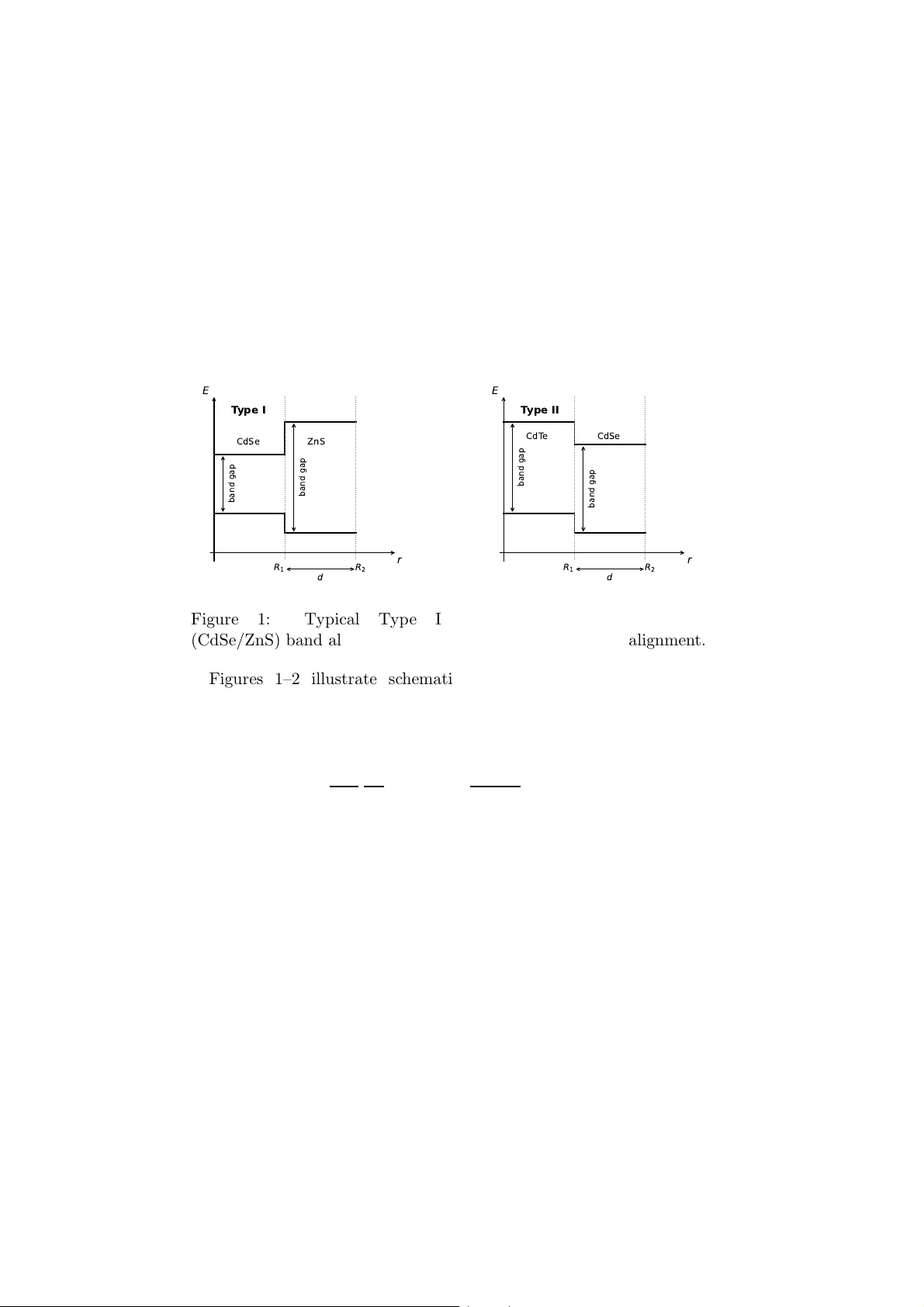
Sc hr¨ odinger op erators with concen tric δ –shell in teractions Masahiro Kaminaga ∗ Department of Information T e chnolo gy , F acult y of Enginee r ing, T oho k u Gakuin Univ ersity , Senda i, Japa n Abstract W e study Schr¨ odinger op erators on R 3 with finitely many con- centric spher ical δ –shell int eractions. The operato rs are defined via quadratic forms and c haracter iz e d by contin uity acro ss eac h s hell to- gether with the s t andard jump co ndit ion for the nor mal deriv ative. Using a b o undary in tegr al approa c h ba sed on the free Green kernel and single– la yer po ten tials, we der iv e an explicit resolven t formula for an arbitra ry num b er of shells with b ounded coupling strengths. This yields a concrete Kre ˘ ın–type representation and a b oundary opera tor whose noninvertibilit y characterizes the discrete s pectrum, a nd it is compatible with partial–wav e reductio n under rotational symmetry . W e then specia liz e to the t wo–shell ca se with constant co uplings and obtain a detailed description of the negative sp ectrum. In par tic- ular, we prove th at the gro und state, when it ex ists, lies in the s –wa ve sector and derive an explicit secular equation for b ound states. F or large shell s e paration, each b ound level a pproach es the corresp onding single–shell level with exp onen tially sma ll correc tio ns, while a genuine tunneling splitting a ppears when the single–shell lev els are tuned to coincide. As a simple c a libration, w e relate the t wo–shell parameters to r epresen ta t ive core– shell quantum dot sca les and iden tify the qual- itative distinction betw e e n Type I and T y pe I I configura tions. Keyw ords. δ –shell interaction; s ingular p erturbation; r esolv ent for- m ula; Kre ˘ ın–t y pe formula; partial–wav e decompo sition; tunneling splitting Mathematics Sub ject Classification (2020). 35J10 ; 35P 15; 47A10; 47 F05 1 In tro duction Surface–supp orted singular p erturbations of the Laplacian p ro vide a stan- dard class of solv a ble Sc hr¨ odinger op erators. A general extension–theoretic ∗ Corresponding author. Email: k aminaga@mail.tohoku-gakuin.ac.jp 1 framew ork for solv able mo dels, including p oint interacti ons, can b e found in Alb ev erio et al. [2]. F or singular in teractions supp orted on hyp ersur- faces, b oundary in tegral an d la y er p oten tial appr o ac hes were dev elop ed b y Brasc he–Exner–Kup erin– ˇ Seba [7 ], including an abstract Kre ˘ ın–t yp e resol- v ent form ula in a general measure–v alued framework. F or r a dially sy m met ric p enetrable wall mo dels, Ikebe and Sh i mada [16] studied th e sp ec tral and scattering th e ory in detail, and Sh i mada obtained further r esults on appro ximation b y short–range Hamiltonians [25], lo w– energy scattering [26], and analytic con tinuation of th e scattering kernel [27]. More recen tly , essentia l self–adjoin tness f o r systems with sev eral (p ossibly infinitely man y) concen tric s h el ls w as pro v ed by Alb ev erio, Kostenk o, Mala - m u d, and Neidh a rdt [3]. The rigorous treatment of δ –in teractions sup ported on a sphere w as ini- tiated by An toine, Gesz tesy , and Shabani [4], w here the single–shell case w as analyzed within an extension–theoreti c fr a mew ork. In the sp ecific s e t- ting of finitely many concen tric spherical shells with δ – t yp e in teractions, Shabani [24] in vestig ated the mo del by an explicit reduction to radial one– dimensional problems. In particular, for constant shell strengths the matc h- ing conditions at the inte rfaces lead to a finite–dimensional determinant con- dition in eac h p artia l wa v e, so that the b ound state problem can b e treat ed in a fu ll y explicit manner. T hese w ork s provide closely related p rece den ts for the present stud y , as they address essen tially the same geometric con- figuration and exh ib it , already at the lev el of partial–w av e r ed ucti on, the c haracteristic coupling mec hanism ind u ce d b y multiple s hell s. While Sha- bani’s analysis pro ceeds via a reduction to one–dimensional radial ODEs and finite–dimensional matc hin g conditions in eac h p a rtial w av e (in particular for constan t shell strengths), our appr o ac h kee p s the problem in thr e e dimen- sions and yields a b oundary–in tegral resolv ent represent ation that remains v alid for arbitrary N and nonconstan t surf a ce strengths α j ∈ L ∞ ( S j ; R ). Our approac h is complemen tary . Rather than revisiting the op erator– theoretic construction, w e allo w non constant strengths α j ∈ L ∞ ( S j ; R ) for arbitrary N and derive a concrete b oundary int egral Kre ˘ ın–t yp e resolve n t form u la directly in terms of the free Green k ern e l and sin g le–la y er p oten tials. In the constant t wo– sh ell case we then pro vid e a detaile d large– separation analysis, in c luding the tun ed tunneling splitting on the scale e − κ 0 d . This form u la tion m a kes explicit the connection b et w een the b oundary inte gral picture and th e partial–w av e secular equations und er rotational symmetry . Related develo p men ts on the scattering side for fin itely man y concentric sphere int eractions were later obtained by Hounk on n ou, Hounkp e, and Sha- bani [15]. Building on these w orks, we consider Sc h r¨ odinger op erators on R 3 with finitely man y concen tric spherical δ –sh ell in teractions. Let 0 < R 1 < R 2 < · · · < R N and set S j := { x ∈ R 3 : | x | = R j } for j = 1 , 2 , . . . , N . F or eac h j w e allo w a b ou n ded measurable surface strength α j ∈ L ∞ ( S j ; R ). F ormally , 2 the mo del is H N = − ∆ + N X j =1 α j δ ( | x | − R j ) , (1.1) where α j acts b y m u lt iplication on the trace of a function on S j . W e define H N rigorously by the quadratic form method. A t an abstract lev el, w e n ote that resolv ent repr e sen tations for self–adjoint extensions are we ll-known. F or a wid e class of singular p erturbations, w e can express ( H N − z ) − 1 in terms of the fr ee resolv ent and an op erator–v a lued b oundary term of Kr e ˘ ın t yp e. F or example, w e refer to the extension theoretic framew ork in [2] and to related form u la tions for singular int eractions in [7]. See also [22] for Kre ˘ ın–t yp e resolv ent formula s in a general s i ngular p erturbation framew ork. F or δ – and δ ′ –in teractions supp orted on hyp ersurfaces, includin g analogues of the Birman–Sc hwinger pr inciple and a v arian t of Kre ˘ ın’s formula, we r efer to [5 ] . The main result of this pap er is an explicit b oundary in tegral repr ese n tation for concentric spherical δ –shell int eractions, written directly in terms of the free Green kernel and single–la ye r p oten tials, without inv oking b oundary triple mac h inery . More precisely , w e derive an explicit resolv ent form u la for H N in terms of la yer p oten tials on the shells. Here S 2 = { ω ∈ R 3 : | ω | = 1 } denotes th e unit sp here, and this representat ion yields a b oundary op erator K N ( z ) on L N j =1 L 2 ( S 2 ) such that, for z ∈ C \ [0 , ∞ ), the eigen v alues of H N in C \ [0 , ∞ ) are c h a racterized by the nonin v ertibility of K N ( z ). W e th en relat e this represent ation to the partial–w a ve reduction and pro vid e a detailed sp ectral analysis in the t w o–shell case. After esta blishing the N –shell resolv ent framework, we sp ecializ e to the tw o–shell case N = 2, H = − ∆ + α 1 δ ( | x | − R 1 ) + α 2 δ ( | x | − R 2 ) , 0 < R 1 < R 2 , (1.2) whic h alrea dy e xhibits a non trivial coupling mec hanism b et wee n distinct in terfaces. F or explicit closed form u la s and a partial–w a ve reduction, we further restrict, f rom that p oin t on, to the r otationally symmetric setting where α 1 and α 2 are constan ts. In this case w e obta in a detailed d e scription of the nega tiv e sp ectrum, including a detail ed description of the s –w av e eigen v alues E = − κ 2 < 0. Dep ending on the signs of α 1 and α 2 , the s – w av e sector supp orts zero, one, or t wo b ound states. In the near–decoupling regime of large shell s e paration d = R 2 − R 1 , eac h b ound lev el is close to the corresp onding single–shell lev el. Moreo ver, when the parameters are tuned so that the t wo single– shell lev els coincide in this limit, sa y at a common energy E 0 = − κ 2 0 < 0, wh e re κ 0 > 0 denotes th e deca y rate of the corresp onding on e–shell b ound state, the resulting pair of eigen v alues exhibits a tu n neling sp lit ting w ith an exp onen tially small gap of order e − κ 0 d . A motiv ation fo r this a n al ysis comes from semiconductor core–shell nano crystals. The firs t o bserv ation of size qu a n tizatio n w as r eported by Ekimo v and On u s hc henk o [12], follo w ed b y the effectiv e–mass theory of 3 Efros and Efros [11] and the c hemical stud ies of Rossetti, Nak ahara, and Brus [8]. T yp e I Cd Se/ ZnS core–shell nano crystals [14] realize a structure in whic h b oth carriers remain confined in the core, w hile Type I I systems with spatially separated electrons and holes were realized later and show distinct excitonic b eha vior [18, 21]. In the effect ive–mass picture [11], con- finement is pro duced by ban d offsets at heteroint erfaces, and our δ –shell idealizati on reflects this mec hanism through the signs and p ositions of the in terface parameters. A r e lated viewp o in t app ears in the tunneling theory of BenDaniel and Duk e [6], where abrupt c hanges of the effectiv e mass and band ed ge across a hetero junction are enco ded in the BenDaniel–Duk e matc hing conditions. In the effectiv e–mass literature (see, f o r exa mple, [13]), these conditions are regarded as s t andard int erface rules for ve ry thin hetero ju n ct ions. When the int rinsic width of an inte r fac e is m uc h smaller than the de Broglie wa v e- length, its effect can b e compressed in to a surface term, and δ –t yp e interac- tions p ro vide a natural effectiv e description. In b o th the BenDaniel–D uk e mo del and the present δ –shell idealization, the wa v e fun ct ion is con tinuous across the in terface, while the normal deriv ativ e ma y jump . In the former case this jump is caused b y a c hange of effectiv e mass, whereas in the lat ter it is pr o duced b y a sin g u la r interface p oten tial. In the present work we keep a constant effectiv e mass and absorb interfac ial microph ysics in to effecti v e surface s t rengths α j . Since the bulk p oten tial is tak en to b e zero a w ay from the sh el ls, a purely repulsiv e in terface ( α > 0) d oes not by itself pro duce L 2 b ound states in this idealization, and realistic confin e men t is primarily d u e to finite ban d offsets (finite w ells/barriers) and finite in terface wid t hs. Ac- cordingly , the discrete eigen v alues analyzed b elo w should b e understo o d as an idealized limit capturing the relev an t scales/ trends (and tunneling split- tings) of effectiv e, p ossibly qu asi– b ound , lev els rather than as quan titativ e optical transition energies. F or the rotationally s y m met ric t wo–shell setting with constant surface strengths, one can distinguish the T yp e I and T yp e I I sign patterns familia r from core–shell quantum dots. In this idealized case, Type I sy s t ems corre- sp ond to α 1 < 0 < α 2 [14], while T yp e I I sys t ems corresp ond to α 1 > 0 > α 2 [21]. Th is corresp ondence is meant only in the constan t–strength s etting and at the level of sign patterns. Throughout this pap er, the Typ e I/I I termi- nology is used only in the constan t case of α j . The pap er is organized as f o llows. In Section 2 we constru ct H N b y quadratic forms and establish basic b ounds. In S e ction 3 w e deriv e the b oundary in tegral resolv ent formula and the eigen v alue condition in terms of K N ( z ). In Sections 4–7 we sp ecializ e to tw o s h el ls with constan t couplings, pro ve that the ground state is an s –w a ve, and analyze b ound states, lev el splitting, and tunneling effects for large separation. Ap pend ix A con tains a brief order–of–magnitude calibratio n for represen tativ e core–shell quantum dot scales, and App endix B collects explicit partial–w av e matrices used in 4 the rotationally symmetric setting. 2 F orm metho d and op erato r domain W e fix an integ er N ≥ 1 and radii 0 < R 1 < · · · < R N . F or eac h j ∈ { 1 , . . . , N } w e set S j := { x ∈ R 3 : | x | = R j } . Let α j b e a real-v alued f unction on S j suc h that α j ∈ L ∞ ( S j ). W e consider the formal Schr¨ odinger op erator H N = − ∆ + N X j =1 α j δ ( | x | − R j ) . (2.1) F or j = 1 , . . . , N , let dσ j denote the surf ace measure on S j := { x ∈ R 3 : | x | = R j } . F or u, v ∈ H 1 ( R 3 ) we define the quadratic form h N [ u, v ] = Z R 3 ∇ u · ∇ v dx + N X j =1 Z S j α j ( y ) u ↾ S j ( y ) v ↾ S j ( y ) dσ j ( y ) . (2.2 ) Its form domain is D [ h N ] = H 1 ( R 3 ). Since α j ∈ L ∞ ( S j ) and the trace map H 1 ( R 3 ) → L 2 ( S j ) is b ounded, eac h su rface term is b ounded on H 1 ( R 3 ). Hence h N is closed and lo wer semib ounded and d efi nes a uniqu e self–adjoin t op erato r (wh ic h w e still denote b y H N ). T o sim p lify notation, w e pull ev erythin g bac k to S 2 . F or u ∈ H 1 ( R 3 ) we define the trace m a p s τ j : H 1 ( R 3 ) → L 2 ( S 2 ) by ( τ j u )( ω ) := u ( R j ω ) , ω ∈ S 2 . W e also d e fine the pulled–back coefficien t e α j ( ω ) := α j ( R j ω ) , ω ∈ S 2 . Since dσ j ( R j ω ) = R 2 j dω , the surface con tribu ti on can b e written as Z S j α j ( y ) u ( y ) v ( y ) dσ j ( y ) = R 2 j Z S 2 e α j ( ω ) ( τ j u )( ω ) ( τ j v )( ω ) dω . W e set Ω 1 = | x | < R 1 , Ω k = R k − 1 < | x | < R k , k = 2 , . . . , N , Ω N +1 = | x | > R N . 5 Moreo v er, the operator domain D ( H N ) is c haracterized b y the usu a l in terface r ules: u is con tinuous across eac h S j , and the radial deriv ativ e satisfies ∂ r u ( R j + 0 , ω ) − ∂ r u ( R j − 0 , ω ) = e α j ( ω ) u ( R j , ω ) , ω ∈ S 2 , j = 1 , . . . , N . (2.3) More precisely , D ( H N ) = n u ∈ L 2 ( R 3 ) u ↾ Ω k ∈ H 2 (Ω k ) for k = 1 , . . . , N + 1 , u is con tin u ou s across eac h S j , and satisfies (2.3) o . (2.4) On eac h region Ω k the op erato r acts as ( H N u ) ↾ Ω k = − ∆( u | Ω k ). W e b egin with a simple obs e rv ation excluding p ositiv e eige nv alues. Theorem 1. L et H N b e the Schr¨ odinger op er ator on R 3 with finitely many c onc entric sph eric al δ –shel l inter actions (2.1) , wher e α j ∈ L ∞ ( S j ; R ) . Then H N has no eigenvalues i n (0 , ∞ ) . Pr o of. Fix E = k 2 > 0 and assum e that H N u = E u for some u ∈ L 2 ( R 3 ). Then u ∈ D ( H N ). In particular, u ∈ H 2 (Ω k ) on eac h region Ω k a wa y from the shells, and the traces u | S j and ∂ ± r u ↾ S j are we ll-defined. F or almost every r > 0, the function u ( r , · ) b e longs to L 2 ( S 2 ). W e therefore expand u ( r , ω ) = ∞ X ℓ =0 ℓ X m = − ℓ f ℓm ( r ) r Y ℓm ( ω ) , f ℓm ( r ) = r Z S 2 u ( r , ω ) Y ℓm ( ω ) dω , (2.5) where { Y ℓm } is an orth o n ormal basis o f L 2 ( S 2 ). See [1] . By P arsev al’s iden tity , r 2 Z S 2 | u ( r , ω ) | 2 dω = X ℓ,m | f ℓm ( r ) | 2 for a.e. r > 0 , (2.6) and consequent ly Z | x | >R N | u ( x ) | 2 dx = Z ∞ R N X ℓ,m | f ℓm ( r ) | 2 dr . (2.7) Aw ay from the shells r = R 1 , . . . , R N the equation reduces to ( − ∆ − k 2 ) u = 0. Substituting (2.5) (equiv ale ntly , pro jecting ( − ∆ − k 2 ) u = 0 on to the spherical harmon ics) sh ows that eac h f ℓm satisfies − f ′′ ℓm ( r ) + ℓ ( ℓ + 1) r 2 f ℓm ( r ) = k 2 f ℓm ( r ) (2.8) on ev ery in terv al n o t con taining an y R j . 6 F or r > R N the general solution of (2.8) can b e w ritte n as f ℓm ( r ) = A ℓm r h (1) ℓ ( k r ) + B ℓm r h (2) ℓ ( k r ) , (2.9) where h (1) ℓ and h (2) ℓ are the spherical Hank el functions. Using the asymp- totics r h (1) ℓ ( k r ) = e ik r ik + O ( r − 1 ) , r h (2) ℓ ( k r ) = − e − ik r ik + O ( r − 1 ) , r → ∞ , w e obtain f ℓm ( r ) = p ℓm e ik r + q ℓm e − ik r + O ( r − 1 ) , r → ∞ , (2.10) for suitable constant s p ℓm , q ℓm . Assume that u do es n ot v anish identical ly in the exterior region ( R N , ∞ ). Then there exists ( ℓ 0 , m 0 ) such that f ℓ 0 m 0 is not identi cally zero on ( R N , ∞ ). W rite f = f ℓ 0 m 0 and g ( r ) = pe ik r + q e − ik r with M := | p | 2 + | q | 2 > 0. By (2.10) there exist C > 0 and R 0 > R N suc h that | f ( r ) − g ( r ) | ≤ C /r f o r r ≥ R 0 . F or ev ery R ≥ R 0 w e ha ve Z R + π /k R | g ( r ) | 2 dr = Z R + π /k R M + 2Re( p q e 2 ikr ) dr = π k M , since R R + π /k R e 2 ikr dr = 0. Moreo v er, using | a + b | 2 ≥ 1 2 | a | 2 − | b | 2 , we obtain Z R + π /k R | f ( r ) | 2 dr ≥ 1 2 Z R + π /k R | g ( r ) | 2 dr − Z R + π /k R | f ( r ) − g ( r ) | 2 dr ≥ π 2 k M − C 2 π k R 2 . Cho osing R so large that C 2 /R 2 ≤ M / 4, we obtain Z R + π /k R | f ( r ) | 2 dr ≥ π 4 k M = : c > 0 . Summing o ver the disjoint in terv als [ R + nπ /k , R + ( n + 1) π /k ] yields Z ∞ R | f ( r ) | 2 dr = ∞ . Using (2.7) and P ℓ,m | f ℓm ( r ) | 2 ≥ | f ( r ) | 2 , w e conclude that Z | x | >R N | u ( x ) | 2 dx = ∞ , con tradicting u ∈ L 2 ( R 3 ). T herefore u ≡ 0 for r > R N . 7 By con tinuit y , u | S N = 0, and since u v anishes identic ally in the exterior region we also hav e ∂ + r u | S N = 0. The jump condition (2.3) on S N implies ∂ − r u | S N = 0. Hence f ℓm ( R N ) = 0 for all ℓ, m . Moreo ver, since u ∈ H 2 (Ω N ) ∩ H 2 (Ω N +1 ), we hav e f ′ ℓm ( R N ± 0) = R N Z S 2 ∂ ± r u ( R N , ω ) Y ℓm ( ω ) dω , and thus f ′ ℓm ( R N ) = 0 for all ℓ, m . Uniqueness for the second–order ODE (2.8) yields f ℓm ≡ 0 on ( R N − 1 , R N ). Rep eating the argument across the r e maining shells shows that u ≡ 0 on R 3 , a con tr a d ict ion. Thus there are no p ositiv e eigen v alues. When the sur fac e strengths are constants, r o tational symmetry allo w s a partial–w a ve decomp osit ion. A t the zero–energy th r eshold E = 0, eac h an- gular momentum c hannel r e duces to a fi nite –dimensional algebraic condition on the shell v alues, wh ich can b e written explicitly . Theorem 2 (Zer o–energy threshold) . Fix an inte ger N ≥ 1 and r adii 0 < R 1 < · · · < R N . Assume that the surfac e str engths ar e c onstants α 1 , . . . , α N ∈ R . L et ℓ ∈ { 0 , 1 , 2 , . . . } b e the angular–m omentum index. (i) In the s –wave c ase ℓ = 0 , the p oint E = 0 is not an L 2 eigenvalue for any finite α 1 , . . . , α N . (ii) F or e ach fixe d ℓ ≥ 1 , define the N × N matrix A ℓ = ( a ( ℓ ) ij ) N i,j =1 by a ( ℓ ) ij := δ ij + α j 2 ℓ + 1 R ℓ +1 min( i,j ) R ℓ max( i,j ) , i, j = 1 , . . . , N , (2.11) wher e R min( i,j ) := min( R i , R j ) and R max( i,j ) := max( R i , R j ) . Then E = 0 is an L 2 eigenvalue in the ℓ –th p artial wave if and only if det A ℓ = 0 . (2.12) Mor e over, the multiplicity of E = 0 c ontribute d by the ℓ –th p artial w ave e quals (2 ℓ + 1) dim Ker A ℓ . Pr o of. Fix ℓ ≥ 0 and write ψ ( x ) = u ( r ) r Y ℓm ( ω ) , r = | x | , ω = x/r, so that on eac h region the r a d ia l fun c tion satisfies − u ′′ ( r ) + ℓ ( ℓ + 1) r 2 u ( r ) = E u ( r ) , r 6 = R 1 , . . . , R N . 8 Moreo v er, since { Y ℓm } is an orthonormal basis of L 2 ( S 2 ), w e h a v e k ψ k 2 L 2 ( R 3 ) = R ∞ 0 | u ( r ) | 2 dr . T he δ –shell interface conditions for ψ are equiv- alen t to the con tinuit y of u at eac h R j and to the jump conditions u ′ ( R j + 0) − u ′ ( R j − 0) = α j u ( R j ) , j = 1 , . . . , N . W e consider E = 0. (i) Let ℓ = 0. Then − u ′′ ( r ) = 0 on eac h in terv al, so on the exterior region r > R N w e hav e u ( r ) = ar + b . S ince R ∞ R N | u ( r ) | 2 dr < ∞ , it follo ws that a = b = 0 and h e nce u ≡ 0 on ( R N , ∞ ). By con tin uity , u ( R N ) = 0, and the jump condition at R N yields u ′ ( R N − 0) = u ′ ( R N + 0) = 0. Since − u ′′ ( r ) = 0 on ( R N − 1 , R N ), these t wo b oundary conditions imp ly that u ≡ 0 on ( R N − 1 , R N ). Iterating th is argumen t across the r ema ining sh el ls, w e obtain u ≡ 0 on (0 , ∞ ), hence ψ ≡ 0, a contradict ion. Th erefo re E = 0 cannot b e an L 2 eigen v alue in the s –w av e sector. (ii) Assum e ℓ ≥ 1. Consider the h o mogeneous equation − w ′′ ( r ) + ℓ ( ℓ + 1) r 2 w ( r ) = 0 ( r 6 = s ) , whose indep endent solutions are r ℓ +1 and r − ℓ . Let r < := min( r , s ) and r > := max( r, s ) and define G ℓ ( r , s ) := 1 2 ℓ + 1 r ℓ +1 < r − ℓ > . (2.13) Then G ℓ ( · , s ) is co n tinuous, solv es the homogeneous equation for r 6 = s , deca ys lik e r − ℓ as r → ∞ , is regular at r = 0, and satisfies G ′ ℓ ( s + 0 , s ) − G ′ ℓ ( s − 0 , s ) = − 1 . Consequen tly , for an y constan ts c 1 , . . . , c N , the fun c tion w ( r ) := − N X j =1 c j G ℓ ( r , R j ) is cont in u o us on (0 , ∞ ), solv es the homogeneous equation a wa y from the shells, and has deriv ativ e jumps w ′ ( R j + 0) − w ′ ( R j − 0) = c j . Let ψ be an L 2 solution at E = 0 in the ℓ –th partial w a ve and set U j := u ( R j ). Defin e e u ( r ) := − N X j =1 α j U j G ℓ ( r , R j ) . By the preceding prop erties of G ℓ , the fu nctio n e u is con tinuous, solve s the radial equation for r 6 = R j , and satisfies e u ′ ( R j + 0 ) − e u ′ ( R j − 0 ) = α j U j . Hence v := u − e u solv es the homogeneous equation on (0 , ∞ ), is con tin u ou s with no deriv ativ e jump s at an y R j , is regular at 0, a nd b elongs to L 2 (0 , ∞ ). 9 Therefore v ≡ 0, and thus u = e u . Ev aluating at r = R i giv es, for i = 1 , . . . , N , U i = − N X j =1 α j U j G ℓ ( R i , R j ) = − N X j =1 α j U j 1 2 ℓ + 1 R ℓ +1 min( i,j ) R ℓ max( i,j ) . This is exactly the linear system A ℓ U = 0 with A ℓ as in (2.11). Hence a non tr ivi al L 2 solution exists if and only if Ker A ℓ 6 = { 0 } , equiv alen tly (2.12) holds. Finally , the radial equation and the int erface conditions do not dep end on m , so eac h ind epend e n t radial solution pro duces (2 ℓ + 1) linearly inde- p enden t eigenfunctions by v arying m . Th is giv es the multiplicit y form ula (2 ℓ + 1) dim K er A ℓ . R emark 1 . F or N = 2 with 0 < R 1 < R 2 and constant s α 1 , α 2 ∈ R , the matrix A ℓ in (2.11) tak es th e form A ℓ = 1 + α 1 R 1 2 ℓ + 1 α 2 2 ℓ + 1 R ℓ +1 1 R ℓ 2 α 1 2 ℓ + 1 R ℓ +1 1 R ℓ 2 1 + α 2 R 2 2 ℓ + 1 . Th us the condition d e t A ℓ = 0 b ecomes α 1 α 2 R 2 ℓ +2 1 R − 2 ℓ 2 = α 1 R 1 + 2 ℓ + 1 α 2 R 2 + 2 ℓ + 1 . 3 Resolv en t F orm ula In this section we derive an explicit resolv ent form u la for the N –shell Hamil- tonian b y us in g the f ree Green ke rnel and single–la y er p ote n tials. W e do not use b oundary triples or more abstract extension theory . Th r o ughout, w e tak e the p rincipal branc h so th a t Im √ z > 0, and we set k = √ z . Fix z ∈ C \ [0 , ∞ ) and write G z ( x, y ) = e ik | x − y | 4 π | x − y | , ( R 0 ( z ) f )( x ) = Z R 3 G z ( x, y ) f ( y ) dy . F or u ∈ H 1 ( R 3 ) we d efine the pulled–bac k trace m a ps τ j : H 1 ( R 3 ) → L 2 ( S 2 ) b y ( τ j u )( ω ) = u ( R j ω ) , ω ∈ S 2 . Under th e parametrization y = R j ω , ω ∈ S 2 , one has dσ j ( y ) = R 2 j dω , hence Z S j | u ( y ) | 2 dσ j ( y ) = R 2 j Z S 2 | ( τ j u )( ω ) | 2 dω . 10 W e also wr it e e α j ( ω ) = α j ( R j ω ) , ω ∈ S 2 . F or ϕ ∈ L 2 ( S 2 ) we defin e the single–la y er p oten tials sup p orted on S j b y (Γ j ( z ) ϕ )( x ) = Z S 2 G z x, R j ω ϕ ( ω ) dω , x ∈ R 3 . (3.1) W e introd u ce the b ound ary Hilb ert space K N := N M j =1 L 2 ( S 2 ) , (3.2) whose elemen ts are written as t ( ϕ 1 , . . . , ϕ N ) w ith ϕ j ∈ L 2 ( S 2 ). On K N w e consider the N × N op erator matrix m ( z ) = ( m ij ( z )) N i,j =1 defined by m ij ( z ) : L 2 ( S 2 ) → L 2 ( S 2 ) , ( m ij ( z ) ϕ )( ω ) = Z S 2 G z R i ω , R j ω ′ ϕ ( ω ′ ) dω ′ . (3.3) W e also wr it e Γ( z ) = (Γ 1 ( z ) , . . . , Γ N ( z )) as a column op erator Γ( z ) : K N → L 2 ( R 3 ) , Γ( z ) t ( ϕ 1 , . . . , ϕ N ) = N X j =1 Γ j ( z ) ϕ j . Finally w e define a b ounded diagonal op erator Θ on K N b y (Θ t ( ϕ 1 , . . . , ϕ N )) j ( ω ) = R 2 j e α j ( ω ) ϕ j ( ω ) , j = 1 , . . . , N , (3.4 ) and set K N ( z ) = I + m ( z )Θ . (3.5) Lemma 3. L et R > 0 and z ∈ C \ [0 , ∞ ) with Im √ z > 0 . Define ( e Γ( z ) ϕ )( x ) = Z S 2 G z ( x, Rω ) ϕ ( ω ) dω , ϕ ∈ L 2 ( S 2 ) . Then e Γ( z ) : L 2 ( S 2 ) → L 2 ( R 3 ) is a Hilb ert–Schmidt op er ator . Pr o of. The Hilb ert–Sc hmidt norm is k e Γ( z ) k 2 HS = Z R 3 Z S 2 G z ( x, Rω ) 2 dω dx. Let c = Im √ z > 0. S ince G z ( x, y ) ≤ 1 4 π e − c | x − y | | x − y | ( x 6 = y ) , 11 w e obtain k e Γ( z ) k 2 HS ≤ 1 (4 π ) 2 Z R 3 Z S 2 e − 2 c | x − Rω | | x − Rω | 2 dω dx. W rite r = | x | and let θ b e the angle b et w een x/ | x | and ω . Then ρ = | x − Rω | = √ r 2 + R 2 − 2 r R cos θ , and dω = 2 π sin θ dθ with sin θ dθ = ( ρ/ ( rR )) dρ . Hence Z S 2 e − 2 c | x − Rω | | x − R ω | 2 dω = 2 π r R Z r + R | r − R | e − 2 cρ ρ dρ. Using dx = 4 π r 2 dr and F ubini–T onelli, w e get k e Γ( z ) k 2 HS ≤ 1 (4 π ) 2 Z ∞ 0 2 π r R Z r + R | r − R | e − 2 cρ ρ dρ ! 4 π r 2 dr = 1 2 R Z ∞ 0 r Z r + R | r − R | e − 2 cρ ρ dρ dr . The domain is D = n ( r , ρ ) : r ≥ 0 , | r − R | ≤ ρ ≤ r + R o = n ( r , ρ ) : ρ ≥ 0 , | R − ρ | ≤ r ≤ R + ρ o . Exc hanging the order of inte gration yields k e Γ( z ) k 2 HS ≤ 1 2 R Z ∞ 0 e − 2 cρ ρ Z R + ρ | R − ρ | r dr ! dρ = Z ∞ 0 e − 2 cρ dρ = 1 2 c < ∞ . Lemma 4. L et z ∈ C \ [0 , ∞ ) and Im √ z > 0 . Then the fol lowing statements hold. (a) Each Γ j ( z ) : L 2 ( S 2 ) → L 2 ( R 3 ) is a Hilb ert–Schmidt op er ator, and in p articular Γ( z ) i s H ilb ert–Schmidt. (b) F or every i, j the op er ator m ij ( z ) is b ounde d on L 2 ( S 2 ) and one has m ij ( ¯ z ) = m j i ( z ) ∗ . Mor e over, the identity τ i Γ j ( z ) = m ij ( z ) holds in L 2 ( S 2 ) . (c) The adjoint satisfies Γ j ( ¯ z ) ∗ = τ j R 0 ( z ) as an op er ator fr om L 2 ( R 3 ) to L 2 ( S 2 ) . Pr o of. (a) follo ws from Lemma 3 with R = R j . (b) T h e op erator m ij ( z ) is an integral op erator with k ern e l K z ij ( ω , ω ′ ) = G z ( R i ω , R j ω ′ ). Let c = Im √ z > 0. Then K z ij ( ω , ω ′ ) ≤ 1 4 π e − c | R i ω − R j ω ′ | | R i ω − R j ω ′ | ( ω 6 = ω ′ ) . F or fi xe d ω , the map ω ′ 7→ | R i ω − R j ω ′ | − 1 is integrable on S 2 , and similarly with ω and ω ′ in terchanged. Hence the S c h ur test yields b ound edness of 12 m ij ( z ) on L 2 ( S 2 ). T he symmetry G ¯ z ( x, y ) = G z ( y , x ) implies m ij ( ¯ z ) = m j i ( z ) ∗ . T o pro ve τ i Γ j ( z ) = m ij ( z ), let φ ∈ L 2 ( S 2 ). The estimate ab o v e implies absolute in tegrabilit y on S 2 × S 2 , hence F ubini–T onelli app lies and , for a.e. ω ∈ S 2 , ( τ i Γ j ( z ) φ )( ω ) = Z S 2 G z ( R i ω , R j ω ′ ) φ ( ω ′ ) dω ′ = ( m ij ( z ) φ )( ω ) . (c) Let f ∈ L 2 ( R 3 ) and φ ∈ L 2 ( S 2 ). Using F ubini–T onelli (justified b y Cauc hy–Sc h w arz and (a)), we compute (Γ j ( ¯ z ) φ, f ) L 2 ( R 3 ) = Z R 3 Z S 2 G ¯ z ( x, R j ω ) φ ( ω ) f ( x ) dω dx = Z S 2 φ ( ω ) Z R 3 G ¯ z ( x, R j ω ) f ( x ) dx dω = Z S 2 φ ( ω ) Z R 3 G z ( R j ω , x ) f ( x ) dx dω = ( φ, τ j R 0 ( z ) f ) L 2 ( S 2 ) . Hence Γ j ( ¯ z ) ∗ = τ j R 0 ( z ). W e recall the quadratic form h N from Section 2, h N [ u, v ] = Z R 3 ∇ u · ∇ v dx + N X j =1 Z S j α j ( x ) u ( x ) v ( x ) dσ j ( x ) , D [ h N ] = H 1 ( R 3 ) , (3.6) whic h defines a self–adjoin t op erato r H N in L 2 ( R 3 ). While Kre ˘ ın–t yp e resolve n t formulas are a v ailable in abstract extension theory , w e pr esent here a self–con tained b oundary integ r a l deriv ation tai- lored to concen tric spher es, whic h yields an explicit N × N op erator matrix K N ( z ) on K N = L N j =1 L 2 ( S 2 ) and is d irec tly compatible w it h the subse- quen t partial–w a ve reduction. W e are no w in a p osition to state the resolv ent formula for H N , w h ic h is one of the main r e sults of this p a p er. Theorem 5. L et H N b e as ab ove and let z ∈ C \ [0 , ∞ ) with Im √ z > 0 . Assume that K N ( z ) = I + m ( z )Θ on L N j =1 L 2 ( S 2 ) is inve r tible, wher e Θ i s given in (3.4) . Define a b ounde d op er ator R ( z ) on L 2 ( R 3 ) by R ( z ) = R 0 ( z ) − Γ( z ) Θ K N ( z ) − 1 Γ( ¯ z ) ∗ . (3.7) Then R ( z ) = ( H N − z ) − 1 , in p articular z ∈ ρ ( H N ) , and the r esolvent dif- fer enc e ( H N − z ) − 1 − R 0 ( z ) is a tr ac e class op er ator. 13 Pr o of. Assume that K N ( z ) is inv ertible and d efine R ( z ) b y (3.7 ). Let f ∈ L 2 ( R 3 ) and set u := R ( z ) f . (3.8) W e sho w that u ∈ D ( H N ) and ( H N − z ) u = f . W e fi rst v erify that u ∈ H 1 ( R 3 ). Since R 0 ( z ) : L 2 ( R 3 ) → H 2 ( R 3 ) ⊂ H 1 ( R 3 ), w e hav e R 0 ( z ) f ∈ H 1 ( R 3 ). Eac h trace map τ j : H 1 ( R 3 ) → H 1 / 2 ( S 2 ) is b ound ed, and w e use the conti n u ous em b eddin g H 1 / 2 ( S 2 ) ֒ → L 2 ( S 2 ) to regard τ j as a b ounded op erator int o L 2 ( S 2 ). Hence τ j : H 1 ( R 3 ) → L 2 ( S 2 ) is b ounded, and its adjoin t τ ∗ j : L 2 ( S 2 ) → H − 1 ( R 3 ) is b ounded. F o r z ∈ C \ [0 , ∞ ) the fr e e resolv ent extends b oundedly as R 0 ( z ) : H − 1 ( R 3 ) → H 1 ( R 3 ). By Lemma 4, one has the iden tit y R 0 ( z ) τ ∗ j = Γ j ( z ). Since R 0 ( z ) : H − 1 ( R 3 ) → H 1 ( R 3 ) is b ounded, it fol- lo ws that Γ j ( z ) m a p s L 2 ( S 2 ) b ound e dly in to H 1 ( R 3 ). Hence (3.8) implies u ∈ H 1 ( R 3 ). S e t g := K N ( z ) − 1 Γ( ¯ z ) ∗ f ∈ N M j =1 L 2 ( S 2 ) , g = t ( g 1 , . . . , g N ) . Using again Lemma 4, namely Γ j ( ¯ z ) ∗ = τ j R 0 ( z ), w e obtain u = R 0 ( z ) f − N X j =1 Γ j ( z ) (Θ g ) j , (Θ g ) j ( ω ) = R 2 j e α j ( ω ) g j ( ω ) . T aking traces and u sing τ i Γ j ( z ) = m ij ( z ) from Lemma 4(b), we obtain τ i u = τ i R 0 ( z ) f − N X j =1 m ij ( z ) (Θ g ) j , i = 1 , . . . , N . In v ector form, with τ u = t ( τ 1 u, . . . , τ N u ), this reads τ u = Γ( ¯ z ) ∗ f − m ( z )Θ g . Since K N ( z ) = I + m ( z )Θ and K N ( z ) g = Γ( ¯ z ) ∗ f , w e obtain τ u = K N ( z ) g − m ( z )Θ g = g . Let ϕ ∈ H 1 ( R 3 ) and let H 0 := − ∆ b e the free S c hr¨ odin g er op erator. Since ( H 0 − z ) R 0 ( z ) f = f , we ha v e ( ∇ R 0 ( z ) f , ∇ ϕ ) L 2 ( R 3 ) − z ( R 0 ( z ) f , ϕ ) L 2 ( R 3 ) = ( f , ϕ ) L 2 ( R 3 ) . Moreo v er, for h ∈ L 2 ( S 2 ) one has ( H 0 − z )Γ j ( z ) h = τ ∗ j h in H − 1 ( R 3 ), hence ( ∇ Γ j ( z ) h, ∇ ϕ ) L 2 ( R 3 ) − z (Γ j ( z ) h, ϕ ) L 2 ( R 3 ) = ( h, τ j ϕ ) L 2 ( S 2 ) . 14 Applying this with h = (Θ g ) j and summing o ver j , w e obtain ( ∇ u, ∇ ϕ ) L 2 ( R 3 ) − z ( u, ϕ ) L 2 ( R 3 ) = ( f , ϕ ) L 2 ( R 3 ) − N X j =1 ((Θ g ) j , τ j ϕ ) L 2 ( S 2 ) . On the other h a nd, b y (3.6) and dσ j = R 2 j dω , h N [ u, ϕ ] − z ( u, ϕ ) L 2 ( R 3 ) = ( ∇ u, ∇ ϕ ) L 2 ( R 3 ) − z ( u, ϕ ) L 2 ( R 3 ) + N X j =1 ((Θ τ u ) j , τ j ϕ ) L 2 ( S 2 ) . Since τ u = g , we ha v e Θ τ u = Θ g , and hence h N [ u, ϕ ] − z ( u, ϕ ) L 2 ( R 3 ) = ( f , ϕ ) L 2 ( R 3 ) ( ∀ ϕ ∈ H 1 ( R 3 )) . Since h N is closed and lo wer semib ounded, by th e representat ion theorem (with w := f + z u ∈ L 2 ( R 3 )) this implies that u ∈ D ( H N ) and ( H N − z ) u = f . Th erefore R ( z ) = ( H N − z ) − 1 . Finally , b y Lemma 4(a), b oth Γ( z ) and Γ( ¯ z ) ∗ are Hilb e rt–Sc hm i dt op erato rs. Since Θ and K N ( z ) − 1 are b ounded, th e comp osition Γ( z )Θ K N ( z ) − 1 Γ( ¯ z ) ∗ is a trace class op erato r , by the ideal prop ert y of the Schat ten–v on Neumann classes. Consequen tly , the resolv en t difference ( H N − z ) − 1 − R 0 ( z ) is trace class. Lemma 6. F or e ach z ∈ C \ [0 , ∞ ) the op er ator m ( z ) acts b ounde d ly on L N j =1 L 2 ( S 2 ) , dep ends analytic al ly on z , and is c omp act. Henc e K N ( z ) = I + m ( z )Θ is an analytic F r e dholm family of index zer o. In p articular, if K N ( z 0 ) is invertible for some z 0 ∈ C \ [0 , ∞ ) , then K N ( z ) − 1 exists an d dep ends mer omo rphic al ly on z , and the set of p oints wher e K N ( z ) is not invertible is discr ete. These p oints c oincide with the p oles of the r esolvent of H N ; se e The or em 5 to gether with the r esolvent identity (3.7) . Pr o of. Eac h blo c k m ij ( z ) is an integral op erator with kernel G z ( R i ω , R j ω ′ ) on the compact set S 2 × S 2 . If i 6 = j , then | R i ω − R j ω ′ | ≥ | R i − R j | > 0, so the ke rnel is con tinuous on S 2 × S 2 for Im √ z > 0. Hence m ij ( z ) is Hilb ert–Sc hmidt and in particular compact. F or i = j , w e w rite m ii ( z ) = m ii (0) + m ii ( z ) − m ii (0) . The difference G z − G 0 has a remo v able singularity at the diagonal, since e i √ z r − 1 4 π r = i √ z 4 π + O ( r ) ( r → 0) . Th us the kernel of m ii ( z ) − m ii (0) extends contin uously to S 2 × S 2 , so m ii ( z ) − m ii (0) is Hilb ert–Sc hm i dt and h e nce compact. On the other hand, m ii (0) 15 is the Laplace single–la y er operator on S 2 . It maps L 2 ( S 2 ) contin uously in to H 1 ( S 2 ), and the emb e dding H 1 ( S 2 ) ֒ → L 2 ( S 2 ) is compact. T herefore m ii (0) is compact on L 2 ( S 2 ), and so is m ii ( z ). Hence all blo c ks m ij ( z ) are compact and m ( z ) is compact on K N . An- alyticit y in z follo ws from the explicit k ern e l dep endence for Im √ z > 0. Since Θ is b ounded, m ( z )Θ is compact and K N ( z ) = I + m ( z )Θ is an ana- lytic F redh o lm family of index zero. T he remaining statemen ts follo w from the analytic F redholm theorem (applied once K N ( z 0 ) is in vertible for some z 0 ∈ C \ [0 , ∞ )) together with Th eorem 5 and (3.7). The follo wing prop osition characte rizes the eigen v alues of H N in terms of the b oundary op erat or K N ( z ). Prop o sition 7. L et z ∈ C \ [0 , ∞ ) . Then z b elongs to the p oint sp e ctrum of H N if and only if K N ( z ) is not invertible. Mor e over, if K N ( z ) is not invertible, then dim Ker( H N − z ) = dim K e r K N ( z ) . Pr o of. If K N ( z ) is in vertible, th en Theorem 5 implies z ∈ ρ ( H N ), hence z is not an eigen v alue. Assume that K N ( z ) is not inv ertible and tak e 0 6 = g ∈ Ker K N ( z ). Set u := − Γ( z )Θ g . As in the pr o of of Theorem 5, we hav e u ∈ H 1 ( R 3 ). Moreo ver, by Lemma 4(b), τ u = − m ( z )Θ g , and K N ( z ) g = 0 is equiv alen t to g = − m ( z )Θ g , hence τ u = g . R ep eating the form computation in the pro of of Theorem 5 with f = 0 giv es h N [ u, ϕ ] − z ( u, ϕ ) L 2 ( R 3 ) = 0 ( ∀ ϕ ∈ H 1 ( R 3 )) . Th us u ∈ D ( H N ) and ( H N − z ) u = 0, so z is an eigen v alue. Con versely , let 0 6 = u ∈ K e r( H N − z ) and set g := τ u . Arguing as in the pro of of T heorem 5 with f = 0 (i.e., us ing the identit y (3.7) for the resolv ent difference) sho ws that u = − Γ( z )Θ g and K N ( z ) g = 0, hence K N ( z ) is not in vertible; cf. Lemma 4 and the form charac terization (3.6). Finally , the maps g 7→ u = − Γ ( z )Θ g and u 7→ τ u restrict to inv erse bijections b et wee n Ker K N ( z ) and Ker( H N − z ), and th e refore dim Ker( H N − z ) = dim Ker K N ( z ). Before tur ning to r otational symmetry , w e note that trace class p er- turbations of the resolv ent are closel y r e lated to scattering theory . In the present setting T heorem 5 s h o ws that ( H N − z ) − 1 − R 0 ( z ) is of trace class for all z ∈ ρ ( H N ) with z ∈ C \ [0 , ∞ ). By the Birman–Kuro da theorem [23], this implies existence and completeness of the wa v e op erators and u nita ry 16 equiv alence of the absolutely cont in u o us parts. As a consequence, the abs o - lutely cont in u o us and essen tial sp ectra of H N can b e iden tified explicitly , as stated in the follo wing theorem. Theorem 8. The absolutely c ontinuous and essential sp e ctr a of H N c oincide with those of the fr e e Hamiltonian: σ ac ( H N ) = [0 , ∞ ) , σ ess ( H N ) = [0 , ∞ ) . Mor e over, the ne gative sp e ctrum of H N is pur ely discr ete and c onsists of eigenvalues of finite multiplicity; the onl y p ossible ac cumulation p oint of the ne gative eigenvalues is 0 . R emark 2 . The op erator K N ( z ) acts on an infinite–dimensional Hilb ert space, so in general a global determinan t is n ot defined . The correct sp ec- tral cond ition is the non–inv ertibilit y of K N ( z ). If we assu me rotational symmetry , namely that eac h α j is a constan t, then Θ acts only on the shell index and the k ernels of m ij ( z ) are rotat ion inv arian t. In that case one ca n reduce K N ( z ) by the spherical harmonic decomp osition and obtain finite– dimensional secular equations in eac h an gu lar m omentum c h a n nel. In the r e mainder of the pap er, w h en w e discuss explicit closed formulas and partial– w av e reduction, w e assume rotat ional symmetry , that is, α j are constan ts. R emark 3 . Under rotational symmetry the ℓ –c hann el blo c k m ℓ ( z ) admits an explicit closed form in terms of sph erica l Bessel and Hank el fun c tions. F or the reader’s co n v enience w e reco rd the formula in Ap pend ix B, together with the examples N = 2 and ℓ = 0 , 1. Lemma 9. L et { Y ℓm : − ℓ ≤ m ≤ ℓ } b e a c omplete orthonormal b asis of spheric al har monics on S 2 , and set K N = N M j =1 L 2 ( S 2 ) = ∞ M ℓ =0 H ⊕ N ℓ , H ℓ = span { Y ℓm : − ℓ ≤ m ≤ ℓ } . Supp ose that the entries of m ( z ) have r otation–inva riant kernels k ij ( ω · ω ′ ) , 1 ≤ i, j ≤ N , and that Θ acts only on the shel l index. Then for e ach ℓ ≥ 0 ther e i s an N × N matrix m ℓ ( z ) such that m ( z ) H ⊕ N ℓ = m ℓ ( z ) ⊗ I H ℓ . In p art icular, K N ( z ) fails to b e invertible if and only if det I N + m ℓ ( z )Θ = 0 for some ℓ ≥ 0 , and the c orr e sp onding eigensp ac e has dimension (2 ℓ + 1) dim Ker I N + m ℓ ( z )Θ . 17 Pr o of. The spherical harmonic addition theorem (see, e.g., [1]) states that P ℓ ( ω · ω ′ ) = 4 π 2 ℓ + 1 ℓ X m = − ℓ Y ℓm ( ω ) Y ℓm ( ω ′ ) , ω , ω ′ ∈ S 2 , where P ℓ is the Legendre p olynomial of d eg r ee ℓ . If w e expand eac h rotation– in v ariant k ern el k ij in Legendre p olynomials and use the addition theorem, then m ( z ) is d ia gonal in the spherical harmonic basis and do es n o t mix differen t v alues of ℓ or m . More precisely , m ( z ) lea v es H ⊕ N ℓ in v ariant and acts there as m ( z ) H ⊕ N ℓ = m ℓ ( z ) ⊗ I H ℓ , where m ℓ ( z ) acts on the shell index. Since Θ acts only on the shell ind ex, it h a s the form Θ ⊗ I H ℓ on H ⊕ N ℓ , and hence K N ( z ) H ⊕ N ℓ = I N + m ℓ ( z )Θ ⊗ I H ℓ . Th us K N ( z ) is not inv ertible if and only if I N + m ℓ ( z )Θ is not inv ertible for some ℓ ≥ 0, that is, if and only if det I N + m ℓ ( z )Θ = 0 for some ℓ . Moreo v er, Ker I N + m ℓ ( z )Θ ⊗ I H ℓ = Ker I N + m ℓ ( z )Θ ⊗ H ℓ , and therefore the stated d imension form ula follo ws. R emark 4 . Equiv alen tly , eac h H ℓ is an irreducible repr esentati on of SO(3), and every rotation–in v arian t op erator acts as a scalar multiple of th e iden- tit y on H ℓ . In th i s language the N –shell b oundary space H ⊕ N ℓ is a direct sum of N equ iv alen t irreducible representat ions . Here Comm( · ) denotes th e comm utant, th a t is, the algebra of all b ounded op erators comm uting with the SO(3)–actio n . By Sc hur’s lemma, the comm utant b ecomes isomorphic to M N ( C ) acting on the shell index and tensored with the iden tit y on the represent ation space. That is, Comm H ⊕ N ℓ = M N ( C ) ⊗ I H ℓ . 4 V ariational preliminaries and higher partial w a v es F rom this section on w e sp ecial ize to the rotationally symmetric tw o–shell setting. That is, w e fix radii 0 < R 1 < R 2 and take constant couplings 18 α 1 , α 2 ∈ R . W e wr ite H := H 2 for the corresp onding doub le δ –shell Hamil- tonian constru c ted by the quadratic f o rm metho d in S ec tion 2. The p urp ose of this sectio n is to show that higher angular momen tum c hann el s cannot pro duce more negativ e eigen v alues than the s –w av e c hann el, and that the ground state, if it exists, lies in the sector ℓ = 0. Since th e int eraction is r a dial, H comm utes with rotations and admits a partial–w a ve decomp osit ion. W e first recall a standard v ariational compar- ison lemma and then app ly it to the radial quadratic forms. Lemma 10. L et X b e a Hilb ert sp ac e and let T 0 and T b e self–adjoint op er- ators in X which ar e b ounde d fr om b elow and have the same close d form domain Q . Assume that the sp e ctrum of e ach op er ator b elow its essen- tial sp e ctrum is discr ete so th at { λ n ( · ) } n ≥ 1 is wel l-define d. Denote their quadr atic forms by q 0 and q . A ssume that q [ f ] ≥ q 0 [ f ] , f ∈ Q. Then the eigenvalues of T and T 0 , c ounte d with multiplicity and liste d in nonde cr e asing or der, satisfy λ n ( T ) ≥ λ n ( T 0 ) for al l n ≥ 1 , and i n p articular N − ( T ) ≤ N − ( T 0 ) , wher e N − ( S ) denotes the numb er of ne gative eigenvalues of a self–adjoint op er ator S . Pr o of. By the min–max prin ciple (see e.g., [17]) one has λ n ( T ) = sup L ⊂ Q dim L = n − 1 inf f ∈ Q f ⊥ L, k f k =1 q [ f ] , λ n ( T 0 ) = sup L ⊂ Q dim L = n − 1 inf f ∈ Q f ⊥ L, k f k =1 q 0 [ f ] . Since q ≥ q 0 on Q , the inner infi mum in the min–max formula satisfies inf f ∈ Q f ⊥ L, k f k =1 q [ f ] ≥ inf f ∈ Q f ⊥ L, k f k =1 q 0 [ f ] for ev ery su bspace L ⊂ Q with dim L = n − 1. T aking the sup rem um ov er all suc h L giv es λ n ( T ) ≥ λ n ( T 0 ). T o compare the num b ers of negativ e eigen v alues, let N := N − ( T 0 ). If N = ∞ , th e n the claim is trivial. Otherwise λ N +1 ( T 0 ) ≥ 0 by defin it ion of N − ( T 0 ), and hence λ N +1 ( T ) ≥ λ N +1 ( T 0 ) ≥ 0 . Therefore T has at most N negativ e eigen v alues, that is, N − ( T ) ≤ N − ( T 0 ). 19 W e recall the standard partial–w av e decomp osition of L 2 ( R 3 ) with re- sp ect to the action of th e r o tation group, under whic h the Hamiltonian H reduces to a direct sum of one–dimensional radial op er ators lab eled by the angular momen tum ℓ . Theorem 11. Fix r adii 0 < R 1 < R 2 and c ouplings α 1 , α 2 ∈ R , and let H b e the double δ –shel l Hamiltonian c onstructe d in Se ction 2. L et h ℓ denote the r ad ial op er ator in the ℓ –th p artial wave. Th en for every ℓ ≥ 1 , λ k ( h ℓ ) ≥ λ k ( h 0 ) for al l k ≥ 1 , and c onse quently N − ( h ℓ ) ≤ N − ( h 0 ) . Pr o of. W e recall the standard partial–w a ve decomp osition (see, for example, [2, Sec. I I.2]). Let { Y ℓm } ℓ ≥ 0 , − ℓ ≤ m ≤ ℓ b e an orthonormal b a sis of spherical harmonics in L 2 ( S 2 ). T hen L 2 ( R 3 ) decomp oses as the orthogonal sum L 2 ( R 3 ) = ∞ M ℓ =0 ℓ M m = − ℓ H ℓm , H ℓm = n u ( x ) = f ( r ) r Y ℓm ( ω ) : f ∈ L 2 (0 , ∞ ) o , with x = r ω , r = | x | , ω ∈ S 2 . Since the interact ion is radial, H comm utes with r o tations and lea v es eac h H ℓm in v ariant. On H ℓm the op erator H is unitarily equiv alen t to a one–dimensional r a d ia l operator h ℓ acting in L 2 (0 , ∞ ), whose quadratic form is q ℓ [ f ] = Z ∞ 0 | f ′ ( r ) | 2 + ℓ ( ℓ + 1) r 2 | f ( r ) | 2 dr + α 1 | f ( R 1 ) | 2 + α 2 | f ( R 2 ) | 2 , f ∈ H 1 (0 , ∞ ) with f (0) = 0 . Here the p oin t v alues f ( R j ) are well defin e d for f ∈ H 1 (0 , ∞ ). In p a r ti cular, for eac h ℓ the negativ e eigenv alues of H in the ℓ –th partial wa v e coincide, with multiplicit y , with those of h ℓ . Moreo ver, h ℓ do es not dep end on m , so eac h eigenv alue of h ℓ app ears in H with multiplicit y 2 ℓ + 1. F or ℓ ≥ 1 the cen trifugal term is nonnegativ e, and therefore q ℓ [ f ] = q 0 [ f ] + Z ∞ 0 ℓ ( ℓ + 1) r 2 | f ( r ) | 2 dr ≥ q 0 [ f ] , f ∈ H 1 (0 , ∞ ) . Since q ℓ ≥ q 0 on the common form domain H 1 (0 , ∞ ) with f (0) = 0, Lemma 10 implies λ k ( h ℓ ) ≥ λ k ( h 0 ) for all k ≥ 1 , and hence N − ( h ℓ ) ≤ N − ( h 0 ). 20 R emark 5 . Theorem 11 reduces the con trol of n eg ative eigen v alues in all partial wa v es to the s –wa v e c hannel ℓ = 0. On c e the s –wa v e problem is analyzed and N − ( h 0 ) is b ound e d, the same b ound au tomatically holds for all ℓ ≥ 1. As an immediate consequence, any negativ e eigen v alue of low est energy m u st o ccur in the ℓ = 0 c h a n nel. Corollary 12. Under the assumptions of The or em 11, if H has at le ast one ne gative eigenvalue (cf. The or em 5 and the tr ac e class pr op erty of ( H − z ) − 1 − R 0 ( z ) ), then the lowest eigenvalue b elongs to the s –wave se c tor ℓ = 0 . Pr o of. Let h ℓ b e the radial op erator in the ℓ –th partial wa v e. F or eac h ℓ ≥ 1 w e ha ve q ℓ ≥ q 0 on H 1 (0 , ∞ ) with f (0) = 0, hen c e the min–max principle giv es λ 1 ( h ℓ ) ≥ λ 1 ( h 0 ) . Therefore th e s mal lest n e gativ e ei gen v alue among all p artia l w a ve s is at- tained in the s –w a ve sector ℓ = 0, and th e ground state of H b elongs to ℓ = 0. 5 The t w o–shell c a se: detailed analysis of the s – w a v e ( ℓ = 0 ) In the t w o–shell case N = 2, the resolv en t framew ork of Section 3 y ields the sp ectral condition that the b ound a ry op erator K ( z ) = I + m ( z )Θ f a ils to b e in vertible. On the other hand, the same eigen v alue problem adm it s a direct reduction to a one–dimensional radial ODE, leading to the usu a l coefficien t matc hing conditions in eac h partial wa v e. The next lemma connects these t wo viewp oint s : it redu ces the op erator condition to a finite–dimensional secular equation in ev ery angular momen tum c hannel and sho ws that this secular equation is equiv alen t to the r a dial matc hin g condition. Lemma 13. L et m ( z ) = ( m ij ( z )) i,j =1 , 2 b e the b oundary inte gr al op er ator on L 2 ( S 2 ) ⊕ L 2 ( S 2 ) with kernel G z ( R i ω , R j ω ′ ) , and let Θ = diag ( α 1 R 2 1 , α 2 R 2 2 ) . Assume Im √ z > 0 , that is, z ∈ C \ [0 , ∞ ) on the princip al br anch. Then the fol lowing statements ar e e quivalent. (i) z is an eigenvalue of H . Equivalently, K ( z ) = I + m ( z )Θ is not invertible; cf. P r op osition 7. (ii) Ther e exists ℓ ∈ N ∪ { 0 } such that det I + m ℓ ( z )Θ = 0 , wher e m ℓ ( z ) is the 2 × 2 matrix describing the action of m ( z ) on H ℓ ⊕ H ℓ , that is, I + m ℓ ( z )Θ = 1 + α 1 R 2 1 m (11) ℓ ( z ) α 2 R 2 2 m (12) ℓ ( z ) α 1 R 2 1 m (21) ℓ ( z ) 1 + α 2 R 2 2 m (22) ℓ ( z ) ! . 21 Mor e over, for e ach fixe d ℓ , the c onditio n det I + m ℓ ( z )Θ = 0 is e quivalent to the eige nva lue c ond i tion obtaine d fr om the c orr esp ond ing r ad ial pr oblem in the ℓ –channel. Pr o of. The k ernel G z ( R i ω , R j ω ′ ) d epend s on ly on ω · ω ′ and is therefore rotation inv ariant. Hence m ( z ) comm utes with the n a tu ral acti on of SO(3) on L 2 ( S 2 ) ⊕ L 2 ( S 2 ). C o n sequen tly , eac h sph e rical harmonic subspace H ℓ := span { Y ℓm : − ℓ ≤ m ≤ ℓ } is in v arian t, and m ( z ) acts on H ℓ ⊕ H ℓ as a 2 × 2 matrix m ℓ ( z ) on the shell index. Equ iv alent ly , m ( z ) is blo c k diagonal with resp ect to L 2 ( S 2 ) ⊕ L 2 ( S 2 ) = ∞ M ℓ =0 ℓ M m = − ℓ C Y ℓm ⊕ C Y ℓm , and on eac h blo c k it acts as m ℓ ( z ) = m (11) ℓ ( z ) m (12) ℓ ( z ) m (21) ℓ ( z ) m (22) ℓ ( z ) ! . Therefore K ( z ) = I + m ( z )Θ is u n ita r ily equ i v alen t to th e orthogonal direct sum of the matrices I + m ℓ ( z )Θ, where eac h blo c k app ears with m ul- tiplicit y 2 ℓ + 1. Sin c e m ( z ) is compact b y Lemma 6, the op erator K ( z ) is F redholm of ind ex zero. If det( I + m ℓ ( z )Θ) 6 = 0 f o r ev er y ℓ , then eac h blo c k I + m ℓ ( z )Θ is in vertible and hence Ker K ( z ) = { 0 } . F or a F redholm op erator of index zero, injectivit y implies surjectivit y , so K ( z ) is in vertible. Con versely , if det( I + m ℓ ( z )Θ) = 0 for some ℓ , then the corresp onding blo c k h as a nontrivia l k ernel, and so do es K ( z ). Thus K ( z ) is not inv ertible if and only if there exists ℓ suc h that det( I + m ℓ ( z )Θ) = 0, which pro v es the equiv alence of (i) and (ii). W e no w relate the condition d et ( I + m ℓ ( z )Θ) = 0 to the eigen v alue condition arising from the co efficien t matc hing in the radial problem. Let g = t ( g 1 , g 2 ) 6 = 0 satisfy ( I + m ℓ ( z )Θ) g = 0 and defi ne u = − 2 X j =1 Γ j ( z ) (Θ g ) j , (Θ g ) j = α j R 2 j g j . Then u solv es ( − ∆ − z ) u = 0 aw a y from S 1 ∪ S 2 . Since g j ∈ H ℓ , the angular dep endence of u lies in H ℓ and is pr o p ortional to Y ℓm for some m . W e represent u in the form u ( x ) = u ℓ ( r ) r Y ℓm ( ω ) , x = r ω . The mapp ing prop erties of Γ j ( z ) th e n imp ly that on eac h interv al (0 , R 1 ), ( R 1 , R 2 ), and ( R 2 , ∞ ) the function u ℓ is a linear com bination of the s t andard 22 radial solutions of ( − ∆ − z ) u = 0, exp ressed in terms of spher ical Bessel and Hank el f unctio ns. T aking tr a ces on S 1 and S 2 and u s i ng the δ – shell j ump la ws, w e recall that u is contin uous at r = R j and satisfies ∂ r u ( R j + 0 , ω ) − ∂ r u ( R j − 0 , ω ) = α j u ( R j , ω ) , j = 1 , 2 . Moreo v er, b y the trace id e n tit y τ i Γ j ( z ) = m ij ( z ) and the standard jump relations for single–la y er p oten tials (cf. Lemma 6 and the pr o of of Prop o- sition 7), the resulting matc hing conditions yield a homogeneous linea r system for the ℓ –c hann e l b oundary data. By th e defin it ion of m ℓ ( z ) (see App endix B, in p a rticular Lemma 18), this b oundary system is exact ly ( I + m ℓ ( z )Θ) g = 0. Thus a nontrivial vect or g in Ker( I + m ℓ ( z )Θ) pro duces a non trivial radial solution satisfying the matc hing co nditions, and con ve rsely ev ery suc h r a dial solution pro duces a nontrivia l g . Hence det( I + m ℓ ( z )Θ) = 0 is equ iv alent to the radial matc hing secular equation in the ℓ –c hannel. W e now sp ecialize to the s –w av e s ector ℓ = 0 and d e riv e an explicit eigen v alue condition b y solving the corresp onding radial problem. Prop o sition 14. L et 0 < R 1 < R 2 , α 1 , α 2 ∈ R , and set d = R 2 − R 1 . In the s –wave se ctor ( ℓ = 0 ) we write u ( r ) = r f ( r ) . Then u satisfies − u ′′ ( r ) = E u ( r ) for r 6 = R 1 , R 2 , u (0) = 0 , u ∈ L 2 (0 , ∞ ) , (5.1) to gether with the interfac e c onditions u i s c ontinuous at R j , u ′ ( R j + 0) − u ′ ( R j − 0) = α j u ( R j ) , j = 1 , 2 . (5.2) F or E = − κ 2 < 0 the s –wave eig e nva lues ar e pr e cise ly those numb ers E = − κ 2 with κ > 0 which satisfy F d ( κ ) := h γ 1 ( κ ) + ( α 2 + κ ) i cosh( κd ) + h κ + γ 1 ( κ ) + α 2 γ 1 ( κ ) κ i sinh( κd ) = 0 , (5.3) wher e γ 1 ( κ ) = α 1 + κ coth( κR 1 ) . (5.4) Equivalently, nontrivial solutions exist if and only if det M ( κ ; d ) = 0 , wher e M ( κ ; d ) = − γ 1 ( κ ) κ ( α 2 + κ ) cosh( κd ) + κ sin h( κd ) ( α 2 + κ ) sinh( κd ) + κ cosh( κd ) ! . (5.5) 23 Pr o of. W e tak e E = − κ 2 < 0 with κ > 0. The general solution of (5.1) in the three regions 0 < r < R 1 , R 1 < r < R 2 , and r > R 2 can b e written as u ( r ) = A sinh( κr ) , 0 < r < R 1 , B e κr + C e − κr , R 1 < r < R 2 , D e − κr , r > R 2 , (5.6) with constan ts A, B , C , D ∈ C . C o ntin uity at R 1 and R 2 giv es A sinh( κR 1 ) = B e κR 1 + C e − κR 1 , (5.7) D e − κR 2 = B e κR 2 + C e − κR 2 . (5.8) Differen tiating (5.6) yields u ′ 1 ( R 1 ) = Aκ cosh( κR 1 ) , u ′ 2 ( R 1 ) = κ B e κR 1 − C e − κR 1 , u ′ 2 ( R 2 ) = κ B e κR 2 − C e − κR 2 , u ′ 3 ( R 2 ) = − κDe − κR 2 . (5.9) Using the jump conditions (5.2) at R 1 and R 2 w e obtain κ B e κR 1 − C e − κR 1 − Aκ cosh( κR 1 ) = α 1 B e κR 1 + C e − κR 1 , (5.10) − κD e − κR 2 − κ B e κR 2 − C e − κR 2 = α 2 B e κR 2 + C e − κR 2 . (5.11) F rom (5.7) we eliminate A and D and obtain A = B e κR 1 + C e − κR 1 sinh( κR 1 ) , D e − κR 2 = B e κR 2 + C e − κR 2 . (5.12) Substituting (5.1 2) into (5.10) yields κ B e κR 1 − C e − κR 1 = α 1 + κ coth( κR 1 ) B e κR 1 + C e − κR 1 , (5.13) κ B e κR 2 − C e − κR 2 = − α 2 + κ B e κR 2 + C e − κR 2 . (5.14) W e now in tro duce the com b i nations X ( r ) = B e κr + C e − κr , Y ( r ) = B e κr − C e − κr . (5.15) Then (5.13) can b e rewritten as κY ( R 1 ) = γ 1 ( κ ) X ( R 1 ) , κY ( R 2 ) = − ( α 2 + κ ) X ( R 2 ) , (5.16) where γ 1 ( κ ) is giv en b y (5.4 ) . Bet w een R 1 and R 2 the pair ( X , Y ) satisfies X ( R 2 ) = cosh( κd ) X ( R 1 ) + sin h ( κd ) Y ( R 1 ) , (5.17) Y ( R 2 ) = sinh( κd ) X ( R 1 ) + cosh( κd ) Y ( R 1 ) . (5.18) 24 F rom (5.16) at R 1 w e ha ve Y ( R 1 ) = γ 1 ( κ ) κ X ( R 1 ) . (5.19) Substituting (5.1 9) into (5.17) and (5.18) yields X ( R 2 ) = cosh( κd ) + γ 1 ( κ ) κ sinh( κd ) X ( R 1 ) , (5.20) Y ( R 2 ) = sinh( κd ) + γ 1 ( κ ) κ cosh( κd ) X ( R 1 ) . (5.21) Applying the bou n dary condition at R 2 in (5.16), w e obta in a h o mogeneous linear system for X ( R 1 ) and Y ( R 1 ), M ( κ ; d ) X ( R 1 ) Y ( R 1 ) ! = 0 , with M ( κ ; d ) as in (5.5). There exists a nont rivial solution if and on ly if det M ( κ ; d ) = 0. A direct computation of the determinan t giv es (5.3), and the statemen t follo ws. 6 Coun ting of s –w a v e b oun d states for large shell separation In this section w e restrict to the s –wa v e sector ℓ = 0 and study how the n u m- b er of negativ e eigen v alues b eha v es w h en the sh e ll sep a r a tion d = R 2 − R 1 b ecomes large. When the t wo δ –shells are far apart, b ound states originating from attract iv e single shells interac t only we akly and the coupling is exp o- nen tially small in d . As a result, the num b er of negativ e s –wa v e eigen v alues stabilizes and can b e read off fr om th e corresp onding one–shell p roblems. Prop o sition 15. L et H b e the double δ – shel l Hamiltonian with r adii 0 < R 1 < R 2 and c ouplings α 1 , α 2 ∈ R . In the s –wave su bsp ac e, the ne gative eigenvalues E = − κ 2 ar e in one–to–one c orr esp ondenc e with the p ositive r o ots κ > 0 of the se cular e quation (5.3) . The asso ci ate d s –wave qu a dr atic form is given by q 0 [ f ] = Z ∞ 0 | f ′ ( r ) | 2 dr + α 1 | f ( R 1 ) | 2 + α 2 | f ( R 2 ) | 2 , f ∈ H 1 (0 , ∞ ) . Henc e the ne gative p art of q 0 dep ends only on th e two p oint ev a lu ations f 7→ f ( R 1 ) and f 7→ f ( R 2 ) . As a c onse quenc e, the s –wave r adial op er ator c an have at most two ne gative eigenvalues (c ounte d with multiplicity), and ther efor e the se cular e quation (5.3) admits at most two p ositive r o ot s. 25 Pr o of. By Prop osition 1 4 th e negativ e s –w av e eig env alues E = − κ 2 are c haracterized b y the p ositiv e ro ots κ > 0 of F d ( κ ) = 0, where F d is giv en in (5.3). W e therefore study the f unctio n F d ( κ ). The s –wa v e secular equation has the form F d ( κ ) = A ( κ ) cosh ( κd ) + B ( κ ) sinh( κd ) , κ > 0 , where A ( κ ) = γ 1 ( κ ) + α 2 + κ, B ( κ ) = κ + γ 1 ( κ ) + α 2 γ 1 ( κ ) κ , γ 1 ( κ ) = α 1 + κ coth( κR 1 ) . Using cosh t = 1 2 ( e t + e − t ) and sinh t = 1 2 ( e t − e − t ), w e ob tain F d ( κ ) = 1 2 F ∞ ( κ ) e κd + G ( κ ) e − κd , (6.1) where F ∞ ( κ ) = ( κ + γ 1 ( κ ))(2 κ + α 2 ) κ , G ( κ ) = α 2 1 − γ 1 ( κ ) κ . (6.2) W e first show that the s –wa v e radial op erat or has at most t wo negativ e eigen v alues. Assume for con tradiction that it h a s at least three negativ e eigen v alues a nd let L b e the span of th ree corresp onding eigenfunctions. Then dim L = 3 and q 0 [ f ] = ( h 0 f , f ) L 2 (0 , ∞ ) < 0 for all 0 6 = f ∈ L. The linear map f 7→ ( f ( R 1 ) , f ( R 2 )) ∈ C 2 cannot b e injectiv e on L , hence there exists 0 6 = f ∈ L s uc h that f ( R 1 ) = f ( R 2 ) = 0. F or this f we ha v e q 0 [ f ] = Z ∞ 0 | f ′ ( r ) | 2 dr > 0 , since R ∞ 0 | f ′ ( r ) | 2 dr = 0 would imply that f is constan t, and the conditions f ( R 1 ) = f ( R 2 ) = 0 w ould force f ≡ 0. This con tradiction sho ws N − ( h 0 ) ≤ 2, and therefore F d ( κ ) = 0 has at most t wo p ositiv e r o ots, coun ted with m u lt ip lic ity . (i) W e first consid er the case α 1 , α 2 ≥ 0. Then γ 1 ( κ ) ≥ 0, A ( κ ) > 0, and B ( κ ) ≥ 0 for all κ > 0. Since cosh( κd ) > 0 and sinh( κd ) > 0 for all κ > 0 and d > 0, we ha v e F d ( κ ) > 0 for all κ > 0. Hence, there is no p ositiv e ro ot of F d , and therefore no negativ e s –wa v e eigen v alue. (ii) Next we assume th at exactly one shell is attract iv e and that the corre- sp onding one–shell problem supp orts an s –w av e b ound state. 26 Case 1: α 1 < 0 ≤ α 2 and α 1 < − 1 /R 1 . Then, there exists a unique κ in > 0 satisfying κ + γ 1 ( κ ) = 0 , that is, α 1 + κ coth( κR 1 ) + κ = 0 . A t κ = κ in one has F ∞ ( κ in ) = 0. Moreo ver F ′ ∞ ( κ in ) 6 = 0. In deed, 2 κ in + α 2 > 0 and κ in + γ 1 ( κ in ) = 0 imply F ′ ∞ ( κ in ) > 0. Expandin g (6.1) near κ in yields κ ( d ) = κ in − G ( κ in ) F ′ ∞ ( κ in ) e − 2 κ in d + O ( e − 4 κ in d ) , so f o r all su ffi c ien tly large d th e re exists exactly one p ositiv e ro ot of F d . The corresp onding eige nv alue giv es the un ique negativ e s –w av e eigen v alue in this case. Case 2: α 2 < 0 ≤ α 1 and α 2 < − 1 /R 2 . F or the sin g le outer shell at r = R 2 , the s –wa v e b ound state cond it ion is α 2 < − 1 /R 2 , and the corresp onding ro ot is giv en by the unique p ositiv e zero of 2 κ + α 2 , namely κ out = − α 2 2 > 0 . A t κ = κ out w e hav e F ∞ ( κ out ) = 0. Moreo v er F ′ ∞ ( κ out ) = 2 κ out + γ 1 ( κ out ) κ out 6 = 0 , and sin ce α 1 ≥ 0 implies γ 1 ( κ out ) > 0, w e ha ve F ′ ∞ ( κ out ) > 0. E xpanding (6.1) near κ out yields κ ( d ) = κ out − G ( κ out ) F ′ ∞ ( κ out ) e − 2 κ out d + O ( e − 4 κ out d ) . Th us, we again obtain exactly one p ositiv e ro ot for all sufficient ly large d . This ro ot giv es th e u nique negat iv e s –wa v e eigen v alue in this case. (iii) Finally w e consider the case when b oth shells are attractiv e, α 1 < 0 and α 2 < 0. Assu me that eac h one–shell su bsystem su pp o r ts an s –wa v e b ound state, that is, α j < − 1 /R j for j = 1 , 2. Let κ in , κ out > 0 b e the corresp onding isolated r oots, that is, the zeros of κ + γ 1 ( κ ) and 2 κ + α 2 , resp ectiv ely . Then F ∞ ( κ in ) = 0 , F ∞ ( κ out ) = 0 . Assume that these zeros are simple, that is, F ′ ∞ ( κ in ) 6 = 0 and F ′ ∞ ( κ out ) 6 = 0. (If one of them is n o t simple, then the corresp onding critical tuning is treated separately in the tunneling regime.) F or large d the ro ots are only sligh tly p erturb ed, and w e can write δ in ( d ) = − G ( κ in ) F ′ ∞ ( κ in ) e − 2 κ in d + O ( e − 4 κ in d ) , δ out ( d ) = − G ( κ out ) F ′ ∞ ( κ out ) e − 2 κ out d + O ( e − 4 κ out d ) , 27 so for all sufficien tly large d there are tw o distinct p o sitiv e ro ots of F d , namely κ in + δ in ( d ) and κ out + δ out ( d ). F or general v alues of d , the n u m b er of p ositiv e ro ots in (0 , ∞ ) can change only when F d has a multiple ro ot κ 0 > 0, that is, ( A ( κ 0 ) cosh( κ 0 d ) + B ( κ 0 ) sinh( κ 0 d ) = 0 , ( A ′ ( κ 0 ) + dB ( κ 0 )) cosh( κ 0 d ) + ( B ′ ( κ 0 ) + dA ( κ 0 )) sinh( κ 0 d ) = 0 . (6.3) W e exclude h e re the threshold κ = 0. This giv es a co dimension–one con- dition on th e parameters ( α 1 , α 2 , d ). In the generic situation the t wo ro ots p ersist and merge only at isolated cr itical v alues of ( α 1 , α 2 , d ). Corollary 16. Assume that exactly one of α 1 , α 2 is ne gative and that the c orr esp onding single δ –shel l do es no t supp ort an s – wave b ound state, tha t is, α 1 ≥ − 1 R 1 if α 2 ≥ 0 , or α 2 ≥ − 1 R 2 if α 1 ≥ 0 . Then the s –wave se cular e quation (5.3) has no p ositive r o ot. Conse quently, H has no ne gative eigenvalue. Pr o of. W e first s ho w that the s –w a ve secular equatio n h as no p osit iv e ro ot. Case 1: α 1 < 0 ≤ α 2 and α 1 ≥ − 1 /R 1 . F or κ > 0 one has κ coth( κR 1 ) ≥ 1 /R 1 , hence γ 1 ( κ ) = α 1 + κ coth( κR 1 ) ≥ 0. Therefore A ( κ ) = γ 1 ( κ ) + α 2 + κ > 0 , B ( κ ) = κ + γ 1 ( κ ) + α 2 γ 1 ( κ ) κ ≥ 0 , and since cosh( κd ) > 0 and sinh( κd ) > 0 for d > 0 we obtain F d ( κ ) > 0 for all κ > 0. Th u s (5.3) h a s no p ositiv e root. Case 2: α 2 < 0 ≤ α 1 and α 2 ≥ − 1 /R 2 . Let q 0 b e the s –wa v e q u adratic form, q 0 [ f ] = Z ∞ 0 | f ′ ( r ) | 2 dr + α 1 | f ( R 1 ) | 2 + α 2 | f ( R 2 ) | 2 , f ∈ H 1 (0 , ∞ ) . Since α 1 ≥ 0, we ha ve q 0 [ f ] ≥ Z ∞ 0 | f ′ ( r ) | 2 dr + α 2 | f ( R 2 ) | 2 =: q out [ f ] . The form q out is the s – w av e form for the s i ngle outer sh e ll at r = R 2 , and the h yp othesis α 2 ≥ − 1 /R 2 means that this one–shell problem has no negativ e s –w av e eigen v alue. By Lemma 10 it follo ws that the double–shell s –w a ve op erato r h 0 also has n o negativ e eigen v alue. He n ce (5.3) has no p ositiv e ro ot in this case. 28 Ha ving excluded negativ e eigen v alues in the s –wa v e c h an n el , we tr e at higher partial w a ve s. F or ℓ ≥ 1 the radial quadratic form is q ℓ [ f ] = Z ∞ 0 | f ′ ( r ) | 2 dr + ℓ ( ℓ + 1) Z ∞ 0 | f ( r ) | 2 r 2 dr + α 1 | f ( R 1 ) | 2 + α 2 | f ( R 2 ) | 2 , so q ℓ [ f ] ≥ q 0 [ f ] for all f ∈ H 1 (0 , ∞ ). Another app lic ation of Lemma 10 giv es N − ( h ℓ ) ≤ N − ( h 0 ) = 0 for every ℓ ≥ 1. Th er efore H has no negativ e eigen v alue. R emark 6 . In the outer–attractiv e case α 2 < 0 ≤ α 1 , the one–shell threshold − 1 /R 2 tends to 0 − as R 2 = R 1 + d → ∞ . Hence an y fixed α 2 < 0 ev entually satisfies α 2 < − 1 /R 2 , and for all su fficie ntly large d the s –wa v e secular equation acquires a p ositiv e ro ot an d pr oduces a negativ e s –w a ve eigenv alue as in Prop osition 15(ii). 7 T unn e ling S pli tting of Eigen v alues In this section we analyze the tunn e ling splitting of th e lo west s –wa v e eigen- v alues for the d ouble δ –shell op erator in th e regime of large sh e ll separation. As shown in S e ction 6, when the t wo shells are w ell separated and the cor- resp onding one–shell eigen v alues are distinct, eac h s –w av e eigen v alue con- v erges to its one–shell counterpart w it h an exp onen tially s m a ll correction of order e − 2 κd . T o isolate a genuine tunneling effect, w e tune the parameters so th at the limiting one–shell eigen v alues coincide at a common energy E 0 = − κ 2 0 < 0. In this critical situation, the standard p erturbativ e picture b reaks do wn and the interac tion b et ween the tw o s hell s pro duces a pair of eigen v alues whose splitting o ccurs on the larger sca le e − κ 0 d . This regime is analog ous to the symmetric doub le –w ell situation in one–dimensional quan tu m mec h a nics and pro vid es a natural setting in whic h to compare the exact splitting with the p redicti on based on Agmon d i stances. W e no w establish this splitting explicitly within th e pr ese n t solv able mo d el. Theorem 17 (T unneling splitting of s –wa v e eigen v alues) . L et R 1 > 0 and α 1 , α 2 ∈ R . Assume that ther e exists κ 0 > 0 such that γ 1 ( κ 0 ) + κ 0 = 0 , α 2 + 2 κ 0 = 0 , (7.1) wher e γ 1 ( κ ) = α 1 + κ coth( κR 1 ) . Then, as d = R 2 − R 1 → ∞ , the se cular e quation adm its two solutions κ ± ( d ) ne ar κ 0 , and they satisfy κ ± ( d ) = κ 0 ± C e − κ 0 d + o ( e − κ 0 d ) , (7.2) with the c onstant C = − 2 G ( κ 0 ) F ′′ ∞ ( κ 0 ) 1 / 2 > 0 . (7.3) 29 Conse quently, E ± ( d ) = − κ ± ( d ) 2 , E + ( d ) − E − ( d ) = 4 κ 0 C e − κ 0 d + o ( e − κ 0 d ) . (7.4) Pr o of. W e use the r e present ation (6.1), F d ( κ ) = 1 2 F ∞ ( κ ) e κd + G ( κ ) e − κd , F ∞ ( κ ) = ( κ + γ 1 ( κ ))(2 κ + α 2 ) κ , where G is giv en in (6.2) . Th e tun ing co n ditio ns (7.1) imply κ 0 + γ 1 ( κ 0 ) = 0 , 2 κ 0 + α 2 = 0 , and therefore F ∞ ( κ 0 ) = 0. Differen tiating F ∞ and using the fact th a t b o th fac tors v anish at κ 0 , w e obtain F ′ ∞ ( κ 0 ) = 0, so κ 0 is at least a double zero of F ∞ . Moreo v er, γ ′ 1 ( κ ) = coth( κR 1 ) − κR 1 csc h 2 ( κR 1 ) = sinh(2 t ) − 2 t 2 sinh 2 t > 0 , t = κR 1 > 0 , and hence F ′′ ∞ ( κ 0 ) = 4 (1 + γ ′ 1 ( κ 0 )) κ 0 > 0 . F urthermore, by (6.2) and 2 κ 0 + α 2 = 0 we ha ve G ( κ 0 ) = α 2 1 − γ 1 ( κ 0 ) κ 0 = α 2 1 − ( − 1) = 2 α 2 = − 4 κ 0 < 0 . Therefore − 2 G ( κ 0 ) F ′′ ∞ ( κ 0 ) > 0 , and the constan t C in (7.3) is w ell defined and strictly p ositiv e. Since F ∞ ( κ 0 ) = F ′ ∞ ( κ 0 ) = 0 and F ′′ ∞ ( κ 0 ) > 0, the zero of F ∞ at κ 0 has m u lti plicit y exactly t wo. Existenc e of two r o ots ne ar κ 0 for lar g e d . Fix δ 0 ∈ (0 , κ 0 / 2) so that F ∞ and G are C 3 on [ κ 0 − δ 0 , κ 0 + δ 0 ]. T hen the T a ylor r ema inder F ∞ ( κ 0 + δ ) = 1 2 F ′′ ∞ ( κ 0 ) δ 2 + O ( δ 3 ) (7.5) holds uniformly for | δ | ≤ δ 0 , and G ( κ ) = G ( κ 0 ) + O ( δ ) h o lds uniform ly on the same int erv al. W rite κ = κ 0 + δ and introd uce the scaling δ = η e − κ 0 d , | η | ≤ M , where M > 0 is fixed. F or all su fficie n tly large d w e ha ve | δ | ≤ δ 0 . F rom (6.1) w e can rewr it e F d ( κ ) = 0 as F ∞ ( κ ) + G ( κ ) e − 2 κd = 0 . (7.6) 30 Multiplying (7.6) b y e 2 κ 0 d and using δ d = η de − κ 0 d = o (1) un i formly f o r | η | ≤ M , w e obtain e 2 κ 0 d F ∞ ( κ 0 + η e − κ 0 d ) + G ( κ 0 ) e − 2 δd + o (1) = 0 ( d → ∞ ) , where the o (1) term is uniform for | η | ≤ M . Using (7.5) with δ = η e − κ 0 d and e − 2 δd = 1 + o (1) uniformly for | η | ≤ M , we arriv e at H d ( η ) := e 2 κ 0 d F ∞ ( κ 0 + η e − κ 0 d ) + G ( κ 0 ) = Q ( η ) + r d ( η ) , (7.7 ) where Q ( η ) := 1 2 F ′′ ∞ ( κ 0 ) η 2 + G ( κ 0 ) , sup | η | ≤ M | r d ( η ) | → 0 ( d → ∞ ) . The p olynomial Q has exactly t wo simple real zeros η = ± C , where C = − 2 G ( κ 0 ) /F ′′ ∞ ( κ 0 ) 1 / 2 . Cho ose ε ∈ (0 , C ) so that Q ( C − ε ) and Q ( C + ε ) ha ve opp osite signs, and likewise Q ( − C − ε ) and Q ( − C + ε ) ha v e opp osite signs. By (7.7) and the un ifo rm con ve r g ence H d → Q on the t wo compact in terv als [ C − ε, C + ε ] and [ − C − ε, − C + ε ], the same sign pattern holds for H d for all sufficiently large d . Hence, b y the in termediate v alue theorem, there exist η + ( d ) ∈ ( C − ε, C + ε ) , η − ( d ) ∈ ( − C − ε, − C + ε ) suc h that H d ( η ± ( d )) = 0. T o sho w η ± ( d ) → ± C , ta k e an y sequence d n → ∞ . Sin ce η + ( d n ) ∈ [ C − ε, C + ε ], th er e exists a su b sequence η + ( d n k ) → η ∗ with η ∗ ∈ [ C − ε, C + ε ]. Because H d n k ( η + ( d n k )) = 0 and H d n k → Q unif orm ly on [ C − ε, C + ε ], w e obtain Q ( η ∗ ) = 0, hen ce η ∗ = C . Th us η + ( d ) → C , and similarly η − ( d ) → − C . Define κ ± ( d ) := κ 0 + η ± ( d ) e − κ 0 d , δ ± ( d ) := κ ± ( d ) − κ 0 . Then F d ( κ ± ( d )) = 0 and η ± ( d ) = ± C + o (1). T herefore δ ± ( d ) = ± C e − κ 0 d + o ( e − κ 0 d ) , whic h pro ves (7.2 ). Finally , E ± ( d ) = − κ ± ( d ) 2 = − κ 0 + δ ± ( d ) 2 = − κ 2 0 − 2 κ 0 δ ± ( d ) + O ( δ ± ( d ) 2 ) , and hence E + ( d ) − E − ( d ) = − 2 κ 0 δ + ( d ) − δ − ( d ) + o ( e − κ 0 d ) = − 4 κ 0 C e − κ 0 d + o ( e − κ 0 d ) , whic h is equiv ale n t to (7.4 ) . 31 R emark 7 (Agmon distance heuristic) . I t is instru ctive to compare the ex- p onen tial factor in (7.4) with the standard tu nneling heuristics based on Agmon met rics. F or a S c hr¨ odinger op er ator − ∆ + V ( x ) and an energy E < inf V , the Agmon d i stance b et we en tw o p oin ts x and y is defin ed by d E ( x, y ) = in f γ Z 1 0 p ( V ( γ ( t )) − E ) + | ˙ γ ( t ) | dt, ( · ) + = max( · , 0) . In the presen t mo del the p ot en tial v anishes in th e gap region, so V = 0 b et w een the sh ells, while E = − κ 2 0 < 0. Hence V − E = κ 2 0 in the gap and the in tegrand b ecomes the constant √ − E = κ 0 . Th er efore the Agmon action across ( R 1 , R 2 ) equals d E ( R 1 , R 2 ) = Z R 2 R 1 κ 0 dr = κ 0 d, and the sp litting s cale exp( − d E ( R 1 , R 2 )) = exp ( − κ 0 d ) agrees with the ex- plicit asymptotics in T heo rem 17. Here exp ( − 2 d E ) corresp onds to a tun- neling probabilit y (a squared amplitude), while the energy splitting is pro- p ortional to an o ve r la p amplitude and therefore h a s the scale exp( − d E ). Ac kno wledgemen ts The author is grateful to Professor P av el Exner for d ra wing h i s atten tion to earlier results on concen tric δ – shell in teractions obtained b y J. Sh a bani and collab orato r s. This commen t led to a substan tial clarification of the historical con text and to an impro vemen t of the in tro duction. App endix A Calibration with semiconductor quan tum dots This app endix p ro vides a scale and trend chec k for the double δ –shell mo del based on represen tativ e p a rameters for core–shell quan tum dots. It is n o t in tend e d as a quan titativ e fit to an y sp ecific sample. W e focu s on the conduction–band profile for the elec tron. Optical transition energies, ho w- ev er, d epend on additional ingredien ts su ch as th e v alence– b and structure, excitonic Coulom b at traction, and p o larizatio n or self–energy effects, which are not captured by the presen t mo del. In realistic core–shell structures, the relev an t confinement lev els may in fact b e qu asi– b ound once finite we lls or barriers and further b and–structure effects are tak en into accoun t. Accordingly , the comparison presented here is mean t on ly to captur e order–of–magnitude estimates and qu al itativ e trends. 32 In t e rf a c e modeling and relat io n to BDD. Band edges v ary across a few atomic la y ers ( ∼ 0 . 3 nm), w h ic h is thin compared w ith nano crystal length scales; see, e.g., [9, 20]. Hence w e appro ximate a thin interfac ial step by a surf a ce δ –in teraction. In BDD–t yp e effectiv e mass mo dels one imp oses con tinuit y of ψ and of the flu x (1 /m ∗ ) ∂ n ψ ; see, for example, [13]. Here w e k eep a constan t m ∗ in eac h calibration and absorb int erfacial physics into an effe ctive coupling α ; it should not b e in terpreted as a microscopic BDD parameter. r E T ype I CdSe ZnS R 1 R 2 d band gap band gap Figure 1: Typical T yp e I (CdSe/ZnS) band alignment. r E T ype II CdT e CdSe R 1 R 2 d band gap band gap Figure 2: T yp ic al T yp e I I (CdT e/CdSe) band alignmen t. Figures 1–2 illustrate sc hematic Type I (CdSe/ZnS ) and Type I I (CdT e/CdSe) alignmen ts; representa tive offsets can b e found in [19] (see also [10] for t yp ic al core–shell systems). Appro ximating a thin step of heigh t ∆ V and width w by ∆ V w δ ( | x | − R ), we obtain the dimensionless strength α ≃ ∆ V E 0 w L 0 , E 0 = ~ 2 2 m ∗ L 2 0 , L 0 = 1 nm . (A.1) Th us sign( α ) = sign(∆ V ). F or Typ e I w e u se α 1 < 0 (attracti v e inner w all) and α 2 > 0 (outer barr ie r), while for Typ e I I w e reverse the signs: α 1 > 0 and α 2 < 0. T yp e I (CdSe/ZnS): strong confinement. T ake m ∗ ≃ 0 . 13 m 0 (CdSe), so E 0 ≃ 0 . 29 eV [20]. Cho ose a represen tativ e geometry R 1 = 2 . 5 nm, d = 1 . 0 n m ( R 2 = 3 . 5 nm), consisten t with t yp ic al exp eriment al ranges [14, 21, 10]. Fi x α 1 < 0 so that the single–shel l problem at R 1 supp orts an s – wa v e b ound state at a t ypical scale κ ∼ π/R 1 (hence | α 1 | = O (1)). F or the outer interfac e, (A.1) with a represen tativ e offset (e.g. ∆ V ≃ 0 . 7 eV and w ≃ 0 . 3 nm) give s α 2 = O (1). A represen tativ e set R 1 = 2 . 5 , R 2 = 3 . 5 , α 1 ≃ − 2 . 5 , α 2 ≃ 0 . 7 yields an s –w av e b ound state with a confinemen t scale ∆ E conf of order 10 − 1 eV (in ph ysical units), i.e. a strongly confined elect ron lev el. Optical 33 shifts are r educed by Coulom b and p olarizat ion/self–energy corrections, eac h t ypically ∼ 0 . 1 eV f o r radii of a few nanometers [9], so a b l ue sh if t of ord er 10 − 1 eV is plausible, without aiming at a quan titativ e fit. T yp e I I (CdT e/CdSe): shallo w outer–shell stat e. T ake m ∗ ≃ 0 . 11 m 0 (CdT e/CdSe), so E 0 ≃ 0 . 35 eV [20]. With the same geometry and the T yp e I I s ign pattern, (A.1) with a representa tiv e do wnw ard offset (e.g. ∆ V ≃ − 0 . 8 eV , w ≃ 0 . 35 nm) giv es α 2 = O (1) < 0, while a mod erat e inner barrier α 1 = O (1) > 0 is natural. F or instance, R 1 = 2 . 5 , R 2 = 3 . 5 , α 1 ≃ +2 . 5 , α 2 ≃ − 0 . 8 t ypically pro duces (when an s –wa v e b ound s tate exists) a v ery small κ and hence a shallo w lev el on the m e V s cale, lo calize d mainly in the outer sh el l. This captures the qualitativ e T yp e I I picture: weak elec tr o n confinement. Observe d T yp e I I optical red shifts (often a few 10 − 1 eV) dep end crucially on band g ap differences and excitonic/p ol arization effects b ey ond the pr e sen t effectiv e surface–in teraction mo del. Conclusion. This calibration is only a magnitude/trend c hec k: Typ e I yields a strongly confined s – state, wh erea s the Type II sign p at tern yields a shallo w outer–shell state. Quantit ativ e optical predictions r equire a multi- band/exciton mo del and are b ey ond the scope of this pap er. B Explicit partial–w a v e matrices In this app endix w e record an explicit closed form of the partial–w a ve ma- trices m ℓ ( z ) app ea ring in Lemma 9. Th e formula f ollo ws from the standard spherical–w av e expansion of the free resolve n t kernel. Let k = √ z w it h Im k > 0. In the present pap er we ev aluate the free resolv ent k ernel G z only at p oi n ts of the form x = R i ω and y = R j ω ′ with i, j ∈ { 1 , 2 } and 0 < R 1 < R 2 . In this case the radial facto rs dep end only on R min( i,j ) and R max( i,j ) , so the mixed terms with i 6 = j are symm e tric in ( i, j ). The corresp onding spherical–w a ve expans ion r ea d s G z ( R i ω , R j ω ′ ) = ik ∞ X ℓ =0 ℓ X m = − ℓ j ℓ k R min( i,j ) h (1) ℓ k R max( i,j ) Y ℓm ( ω ) Y ℓm ( ω ′ ) , for every ω , ω ′ ∈ S 2 , wh e re j ℓ and h (1) ℓ denote th e spherical Bessel and Hank el fun ctions, and { Y ℓm } are the standard sph eric al h arm o nics formin g an orthonormal basis of L 2 ( S 2 , dω ). Lemma 18. Assume 0 < R 1 < R 2 . F or i, j ∈ { 1 , 2 } let m ij ( z ) b e the single–layer op er ators with ke r nel G z ( R i ω , R j ω ′ ) , that is, ( m ij ( z ) ϕ )( ω ) = Z S 2 G z ( R i ω , R j ω ′ ) ϕ ( ω ′ ) dω ′ . 34 Then e ach spheric al harmonic Y ℓm is an eigenfunction of m ij ( z ) . M or e pr e c isely, m ij ( z ) Y ℓm = µ ( ℓ ) ij ( z ) Y ℓm , with µ ( ℓ ) 11 ( z ) = ik j ℓ ( k R 1 ) h (1) ℓ ( k R 1 ) , µ ( ℓ ) 22 ( z ) = ik j ℓ ( k R 2 ) h (1) ℓ ( k R 2 ) , and µ ( ℓ ) 12 ( z ) = µ ( ℓ ) 21 ( z ) = ik j ℓ ( k R 1 ) h (1) ℓ ( k R 2 ) . Conse quently, the 2 × 2 blo ck in L emma 9 is m ℓ ( z ) = ik j ℓ ( k R 1 ) h (1) ℓ ( k R 1 ) ik j ℓ ( k R 1 ) h (1) ℓ ( k R 2 ) ik j ℓ ( k R 1 ) h (1) ℓ ( k R 2 ) ik j ℓ ( k R 2 ) h (1) ℓ ( k R 2 ) ! . References [1] M. Abramowitz, I. A. Stegun (eds.): Handb o ok of mathematical functions with for m ulas, gra phs and mathematical tables. Dover, New Y ork (19 65) [2] S. Alb ev erio, F. Gesztesy , R. Høeg h-Krohn, H. Holden: Solv a ble mo dels in quantum mechanics. 2nd edn. AMS Chelsea Publishing, Providence, RI (200 5) [3] S. Alb ev erio , A. Kos tenko, M. Malamud, H. Neidhar dt: Spherical Schr¨ o dinger op erators with δ –t yp e interactions. J. Math. Phys. 54 , 05 2103 (2013) DOI: htt ps://doi.o rg/10.1063/1.4803708 [4] J. P . Antoine, F. Gesztesy , a nd J . Shabani: Ex actly s olv a ble mo dels o f s phere int eractions in quantum mechanics. J. Phys. A: Math. Gen. 20, 3687 – 3712 (1987). DOI: htt ps://doi.o rg/10.1088/0305- 4470/20/12/022 [5] J. Behrndt, M. Langer, V. Loto r eic hik: Schr¨ oding e r op erators with δ and δ ′ – po ten tials supp orted on hypersurfa ces. Ann. Henri Poincar´ e 14, 3 85–423 (2013) DOI: htt ps://doi.o rg/10.1007/s00023- 012- 0189- 5 [6] D. J . BenDaniel, C. B. Duke: Space–charge effects on electron tunneling. Phys. Rev. 152 , 683– 692 (1966 ) DOI: htt ps://doi.o rg/10.1103/PhysRev.152.683 [7] J. F. Bras c he, P . E x ner, Y u. A. Kup erin, P . ˇ Seba: Schr¨ odinger op erators with singular interactions. J. Math. Anal. Appl. 184, 1 12–139 (199 4) DOI: htt ps://doi.o rg/10.1006/jmaa.1994.1188 [8] R. Rossetti, S. Nak aha ra, L. E. Br us: Quantum size effects in the redox po - ten tials, r esonance Raman spectr a, and electro nic s pectra of CdS crystallites in aqueous solution. J. Chem. Phys. 7 9, 1 086–1088 (198 3) DOI: htt ps://doi.o rg/10.1063/1.445834 [9] L. E. Brus: Electron–e lectron and electron– hole in teractions in small semicon- ductor cr ystallites: The size dep endence of the low e st excited electr o nic sta te. J. Chem. Ph ys. 80, 4 403–4409 (198 4) DOI: htt ps://doi.o rg/10.1063/1.447218 35 [10] B. O . Dabb ousi, J. Ro driguez-Viejo, F. V. Mikulec, J. R. Heine, H. Mattoussi, R. Ob er, K. F. Jensen, and M. G. Baw endi: (CdSe)ZnS Core–Shell Qua n tum Dots: Synthesis and Characteriza t ion of a Size Series of Highly Luminescent Nano crystallites. J. Phys. Chem. B 1 01 (46), 9463– 9475 (199 7) DOI: htt ps://doi.o rg/10.1021/jp971091y [11] A. L. E fros, Al. L. Efros: Interband abso rption of light in a se mico nductor sphere. Sov. Phys. Se mico nd. 16, 772 –775 (198 2) [12] A. I. Ekimov, A. A. Onushc henko: Qua n tum size effect in three-dimensional microscopic se m iconductor cry stals. JETP Lett. 34, 345–349 (1981) [13] P . Harr ison, A. V a la v anis: Qua n tum w ells, wires and dots: Theoretical and computatio nal ph ysics of semiconductor nanostructur es. 4th edn. Wiley , Chichester (2016 ) DOI: htt ps://doi.o rg/10.1002/9781118923337 [14] M. A. Hines, P . Guyot-Sionnest: Synthesis a nd characteriza tio n of s tr ongly lu- minescing ZnS-capp ed CdSe nano crystals. J. Phys. Chem. 100 , 468 – 471 (1996) DOI: htt ps://doi.o rg/10.1021/jp9530562 [15] M. N. Hounkonnou, M. Hounkp e, J. Shabani: Scattering theo ry for finitely many sphere in tera ctions supp orted by concen tr ic spheres. J. Math. P h ys. 38 (6), 283 2–2850 (199 7). DOI: htt ps://doi.o rg/10.1063/1.532022 [16] T. Ikebe, S. Shimada: Spectra l and scattering theory for the Schr¨ o ding er op er- ators with p enetrable wall p oten tials. J. Math. Kyoto Univ. 3 1, 219–2 58 (1991) DOI: htt ps://doi.o rg/10.1215/kjm/1250519902 [17] T. Ka to: Perturbation theor y for linear op erators. 2nd e dn. Springer , Berlin (1976) DOI: htt ps://doi.o rg/10.1007/978- 3- 642- 66282- 9 [18] S. Kim, B. Fisher, H.-J. Eisle r, and M. G. Baw endi: T yp e–II qua n tum dots: CdT e/CdSe(co re/shell) and CdSe/ZnT e(core/shell) heterostr uctures. J. Am. Chem. So c. 125 (38), 114 66–11467 (2003) DOI: htt ps://doi.o rg/10.1021/ja0361749 [19] Y. H. Li, A. W alsh, S. Chen, W. J . Yin, J. H. Y ang, J. Li, J. L. F. Da Silv a, X. G. Gong, a nd S. H. W ei: Revised ab initio natural band o ffsets of all g roup IV, II– VI, and II I–V semico nduct ors. Appl. Ph ys . Lett. 94 (21), 2 12109 (20 09) DOI: htt ps://doi.o rg/10.1063/1.3143626 [20] O. Ma delung: Semiconducto rs: Data Handb ook , 3 rd ed. Spring er, B erlin Hei- delbe r g (2 0 04) DOI: htt ps://doi.o rg/10.1007/978- 3- 642- 18865- 7 [21] D. Or on, M. Kazes, U. Banin: Multiexcitons in type-I I colloida l semiconductor quantum dots. Ph ys. Rev. B 75, 03533 0 (2 007) DOI: htt ps://doi.o rg/10.1103/PhysRevB.75.035330 [22] A. P osilicano: A Kre in–lik e fo rm ula for singular per turbations of self–adjoint op erators and applications. J. F unct. Anal. 183, 10 9–147 (2001 ) DOI: htt ps://doi.o rg/10.1006/jfan.2000.3730 36 [23] M. Reed, B. Simo n: Metho ds of mo dern ma thema t ical physics. V ol. I II: Scat- tering theor y . Academic P ress, New Y ork (1979) [24] J. Shabani: Finitely many δ in tera ctions with supp orts on concentric spher es. J. Math. Ph ys. 29 (3), 660– 664 (19 88). DOI: htt ps://doi.o rg/10.1063/1.528005 [25] S. Shimada: The appr o ximation o f the Sc hr¨ odinger op erators with p enetrable wall p oten tials in terms o f short ra nge Hamiltonians. J. Math. Kyoto Univ. 32, 583 –592 (199 2) DOI: htt ps://doi.o rg/10.1215/kjm/1250519494 [26] S. Shimada: Low ener g y scatter ing with a p enetrable wall interaction. J. Math. Kyoto Univ. 34, 95–14 7 (1 994) DOI: htt ps://doi.o rg/10.1215/kjm/1250519065 [27] S. Shimada: The analytic contin uation of the sca t tering kernel asso ciated with the Schr¨ o ding er opera tor with a penetra ble wall int eraction. J. Math. Ky oto Univ. 3 4, 171– 190 (1994 ) DOI: htt ps://doi.o rg/10.1215/kjm/1250519067 37
Original Paper
Loading high-quality paper...
Comments & Academic Discussion
Loading comments...
Leave a Comment