Another look at $p$-adic Fourier-theory
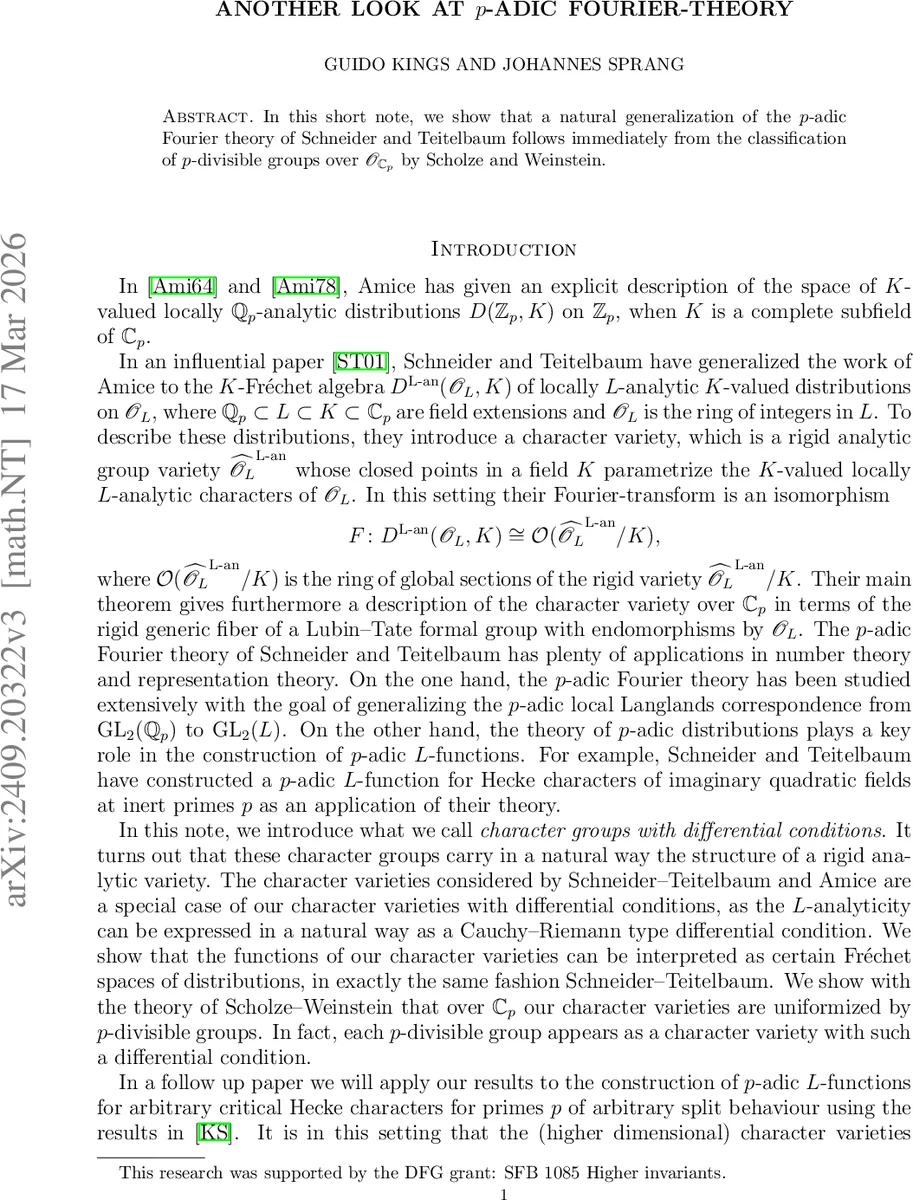
In this short note, we show that a natural generalization of the $p$-adic Fourier theory of Schneider and Teitelbaum follows immediately from the classification of $p$-divisible groups over $\cal{O}_{\mathbb{C}_p}$ by Scholze and Weinstein. This paper has been superseded by [arXiv:2603.15446], where the results are extended and generalized.
💡 Research Summary
In this short note the authors revisit the p‑adic Fourier theory originally developed by Amice and later generalized by Schneider‑Teitelbaum. The central idea is to introduce “character groups with differential conditions”. Starting with a free ℤₚ‑module T of finite rank, they consider the space C^{an}(T,K) of locally Qₚ‑analytic K‑valued functions (K a complete extension of ℚₚ). A differential operator d:C^{an}(T,K)→C^{an}(T,K)⊗{ℚₚ}t^{∨} is defined, where t = T⊗{ℤₚ}ℚₚ is the Lie algebra of T. For a chosen ℚₚ‑subspace L⊂K and an L‑subspace W⊂Hom_{ℤₚ}(T,L), they define the subspace C^{an}_W(T,K) consisting of functions whose differential lands in the tensor product with W, and the associated character group b_T^W(K) = b_T(K)∩C^{an}_W(T,K).
Lemma 2.1 shows that a character χ belongs to b_T^W(K) precisely when its differential at the identity lies in W, so the condition can be checked at a single point. Theorem 2.2 constructs a rigid analytic group variety b_T^W over L by taking the Cartesian product of the universal character space Hom_{ℤₚ}(T,ℤₚ)⊗𝔾ₘ^{rig} with the affine line A¹, imposing the differential condition via a cartesian diagram. The K‑valued points of this variety are exactly the characters b_T^W(K).
Next the authors introduce distribution algebras. The usual distribution algebra D(T,K) is the strong dual of C^{an}(T,K); its “W‑restricted” version D_W(T,K) is defined as the dual of C^{an}_W(T,K). Proposition 3.3 proves that a distribution λ∈D_W(T,K) is zero iff its Fourier transform vanishes on b_T^W(K). Consequently the kernel I_W of the natural surjection D(T,K)→D_W(T,K) consists precisely of those distributions whose Fourier transform vanishes on b_T^W(K) (Corollary 3.4).
Using the Lie algebra t = Lie(T), the authors define an embedding ι:t→D(G,K) by evaluating the action of Lie elements on analytic functions at the identity. Lemma 3.5 identifies the orthogonal complement W^⊥⊂t and shows that b_T^W(K) is cut out inside b_T(K) by the equations F_{ι}(X)=0 for all X∈W^⊥. Thus the character variety b_T^W is a closed rigid subspace defined by linear equations in the Fourier side.
The main theorem (Theorem 3.7) establishes that the Fourier transform induces a Fréchet algebra isomorphism
F_W : D_W(T,K) ≅ O(b_T^W/K),
extending Amice’s theorem (the case W = Hom_{ℤₚ}(T,L)) and Schneider‑Teitelbaum’s theorem (the case where T = O_L and W consists of L‑linear maps). Corollaries recover the classical results: for W = Hom_{ℤₚ}(T,L) we obtain the original Amice isomorphism, for W = {0} we get the identification of locally constant distributions with the completed group ring K⟦T⟧, and for the Lubin–Tate setting we recover Schneider‑Teitelbaum’s L‑analytic Fourier theory.
A crucial conceptual input is the recent classification of p‑divisible groups over 𝒪_{ℂₚ} by Scholze and Weinstein. The authors note that over ℂₚ each character variety b_T^W is uniformized by a p‑divisible group with CM by 𝒪_L. In other words, the rigid analytic spaces arising from differential conditions are not abstract constructions but are analytically isomorphic to the generic fibers of explicit p‑divisible groups.
Finally, the note points toward future work: the authors intend to apply this framework to construct p‑adic L‑functions for arbitrary critical Hecke characters, even when the prime p exhibits arbitrary splitting behavior. They also acknowledge parallel independent work by van Hoften, Howe, and Graham.
Overall, the paper provides a clean and conceptual generalization of p‑adic Fourier theory: by imposing linear differential constraints on characters, one obtains a family of rigid analytic character varieties that are naturally uniformized by p‑divisible groups, and the associated distribution algebras admit a Fourier transform isomorphism onto global sections of these varieties. This unifies and extends previous results, and opens new avenues for applications in p‑adic L‑functions and the p‑adic Langlands program.
Comments & Academic Discussion
Loading comments...
Leave a Comment