iDaVIE v1.0: A virtual reality tool for interactive analysis of astronomical data cubes
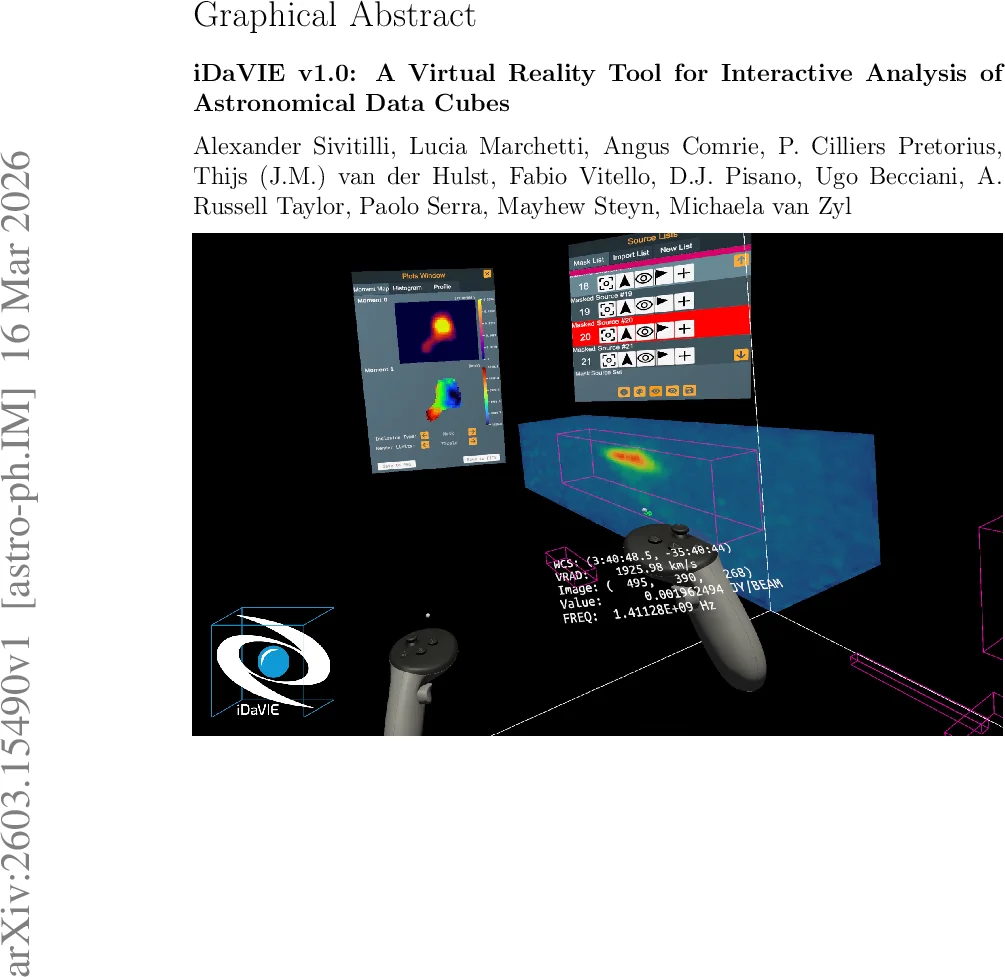
As modern astronomy confronts unprecedented data volumes, automated pipelines and machine-learning techniques have become essential for processing and analysis. As these workflows grow more complex, astronomers also require input and inspection tools that can keep pace. To address challenges in navigating multidimensional datasets for quality control and scientific interpretation, we present the immersive Data Visualisation Interactive Explorer (iDaVIE), a virtual reality (VR) software suite developed in collaboration with the astronomy community. iDaVIE enables users to import and render large 3D data cubes within a VR environment, offering real-time tools for selection, cropping, catalogue overlays, and exporting results back into existing pipelines. Built on the Unity engine and SteamVR, the system uses custom plug-ins for efficient data parsing, downsampling, and statistical calculations. The software has already been integrated into workflows such as verifying HI data cubes from MeerKAT, ASKAP, and APERTIF, refining detection masks, and identifying new sources. Its intuitive interface aims to reduce the cognitive load associated with higher-dimensional data, allowing researchers to focus more directly on scientific goals. As an open-source, scalable, and adaptable platform, iDaVIE supports continued development and integration with other tools. Version 1.0 marks a significant milestone, with planned enhancements including subcube loading, advanced rendering modes, video-generation scripts, and collaborative capabilities. By pairing immersive visualisation with robust interaction tools, iDaVIE seeks to transform how researchers engage with complex datasets and enhance productivity in the era of big data.
💡 Research Summary
The paper presents iDaVIE v1.0, a virtual‑reality (VR) software suite designed to enable interactive exploration and analysis of large three‑dimensional astronomical data cubes. Built on the Unity game engine and integrated with the SteamVR ecosystem, iDaVIE leverages custom C# plug‑ins to efficiently parse FITS files, handle World Coordinate System (WCS) metadata, and stream data to the GPU using texture compression and dynamic loading. This architecture allows users to load cubes of tens of gigabytes and render them in real time at frame rates exceeding 60 fps, while keeping memory consumption under 4 GB.
The user interface is fully immersive: hand gestures and controller buttons provide six‑degree‑of‑freedom navigation (translation, rotation, zoom, pitch, roll) and a suite of selection tools, including lasso, volumetric selection, and spectral‑slice picking. Once a region of interest is defined, basic statistics (mean, standard deviation, peak intensity) are computed on the fly and displayed on a heads‑up display. Masks can be edited in situ and exported as FITS or binary mask files, enabling seamless reintegration into existing reduction pipelines.
A distinctive feature is the catalogue overlay capability. External source lists are visualised as 3‑D point clouds that can be aligned with the data cube using the same WCS framework. Researchers can directly compare catalogue positions with emission structures, refine detection masks, and even discover previously missed sources. The tool has already been applied to HI data cubes from MeerKAT, ASKAP, and APERTIF, where it has accelerated quality‑control tasks, mask refinement, and new source identification.
The authors compare iDaVIE with several established tools—CARTA, SlicerAstro, VisIVO, and FRELLED—highlighting that those solutions are primarily 2‑D screen‑based and rely on mouse/keyboard interaction, which imposes a high cognitive load when navigating multi‑dimensional data. In contrast, iDaVIE exploits depth cues, motion parallax, and natural hand‑based interaction to reduce mental reconstruction effort and improve pattern recognition. Performance benchmarks demonstrate that iDaVIE can handle an 8 GB HI cube with smooth interactivity, whereas traditional tools often suffer from I/O bottlenecks and limited frame rates.
Future development plans include sub‑cube streaming (loading only selected spectral ranges), advanced rendering modes such as volumetric lighting and multi‑contour isosurfaces, automated video‑generation scripts for publication‑ready visualisations, and collaborative multi‑user sessions. The open‑source nature of the project, together with a well‑documented plug‑in API, invites contributions from other domains (e.g., integral‑field spectroscopy, medical imaging) and ensures long‑term extensibility.
In summary, iDaVIE demonstrates that immersive VR environments can fundamentally improve the way astronomers interact with big data, lowering cognitive overhead, speeding up quality control, and facilitating more intuitive scientific discovery. The platform represents a significant step toward integrating advanced visualisation directly into modern astronomical workflows.
Comments & Academic Discussion
Loading comments...
Leave a Comment