On the Nonasymptotic Bounds of Joint Source-Channel Coding with Hierarchical Sources
In this paper we study the nonasymptotic bounds of a special Joint Source-Channel Coding system with hierarchical source, where an observable source and an unobservable indirect source are required to be reconstructed. Namely, we focus on the achievable and converse bounds of the excess distortion probability in the finite blocklength regime. The main challenge arises from the hierarchical source structure, which requires simultaneous reconstruction of both sources. This setup demands a coding scheme which satisfy the demand of encoding both source for the achievability bound, and a method to characterize the joint excess-distortion probability of two correlated events for the converse bound.
💡 Research Summary
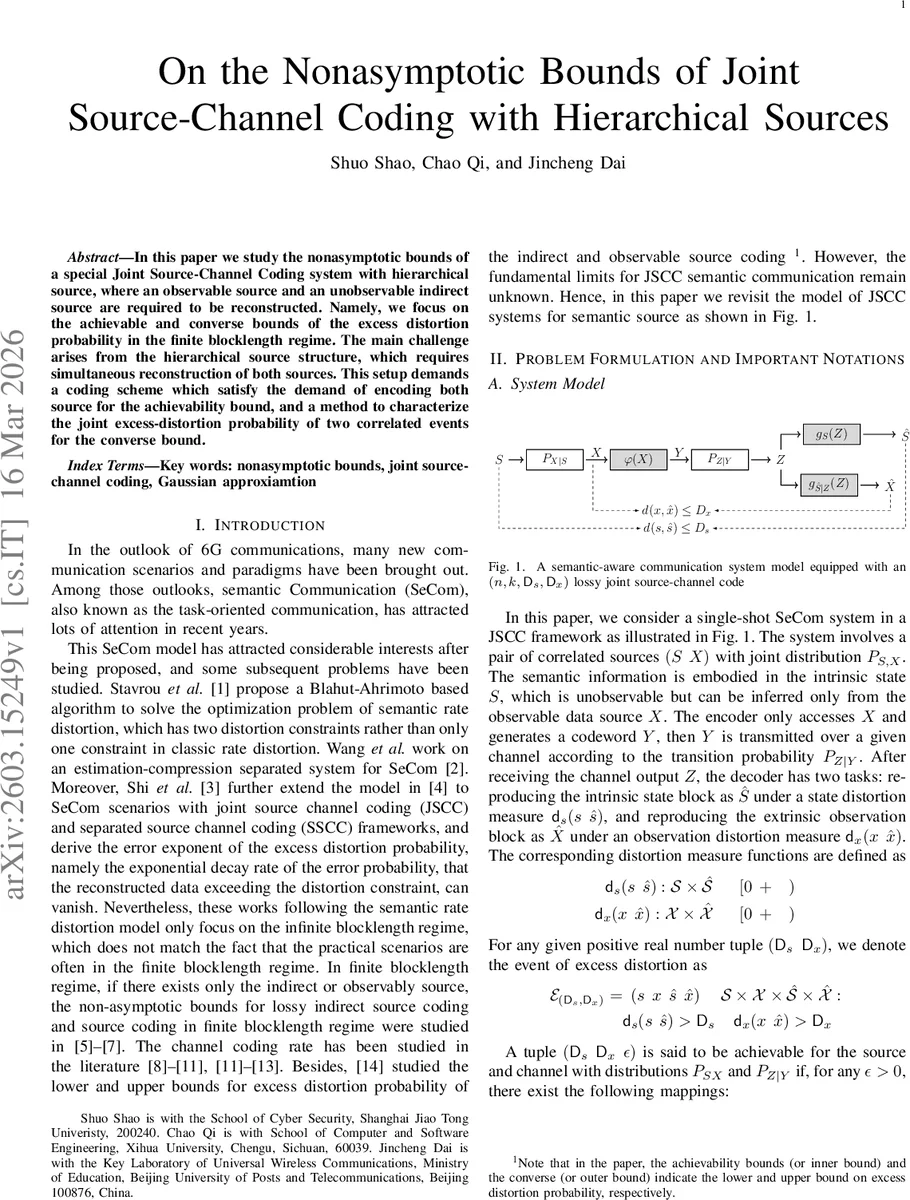
This paper investigates the finite‑blocklength (non‑asymptotic) performance limits of a joint source‑channel coding (JSCC) system in which the source has a hierarchical structure: an observable data block (X) and an unobservable semantic state (S) that must both be reconstructed at the receiver. The authors focus on bounding the excess‑distortion probability, i.e., the probability that either the semantic distortion (d_s(S,\hat S)) exceeds a prescribed threshold (D_s) or the observation distortion (d_x(X,\hat X)) exceeds (D_x).
System model.
The source pair ((S,X)) follows a joint distribution (P_{S,X}). The encoder has access only to (X) and maps it to a channel input (Y) via a (possibly random) mapping (P_{Y|X}). The channel is described by a transition law (P_{Z|Y}). After observing the channel output (Z), the decoder produces two reconstructions: (\hat S) (semantic) and (\hat X) (observable). The performance metric is the excess‑distortion event
\
Comments & Academic Discussion
Loading comments...
Leave a Comment