Uniformization problems in the plane: A survey
In this survey we present the history and recent progress on several fundamental (quasi)conformal uniformization problems in the complex plane. Uniformization refers to the process of mapping a space to a canonical model by means of a well-behaved tr…
Authors: Dimitrios Ntalampekos
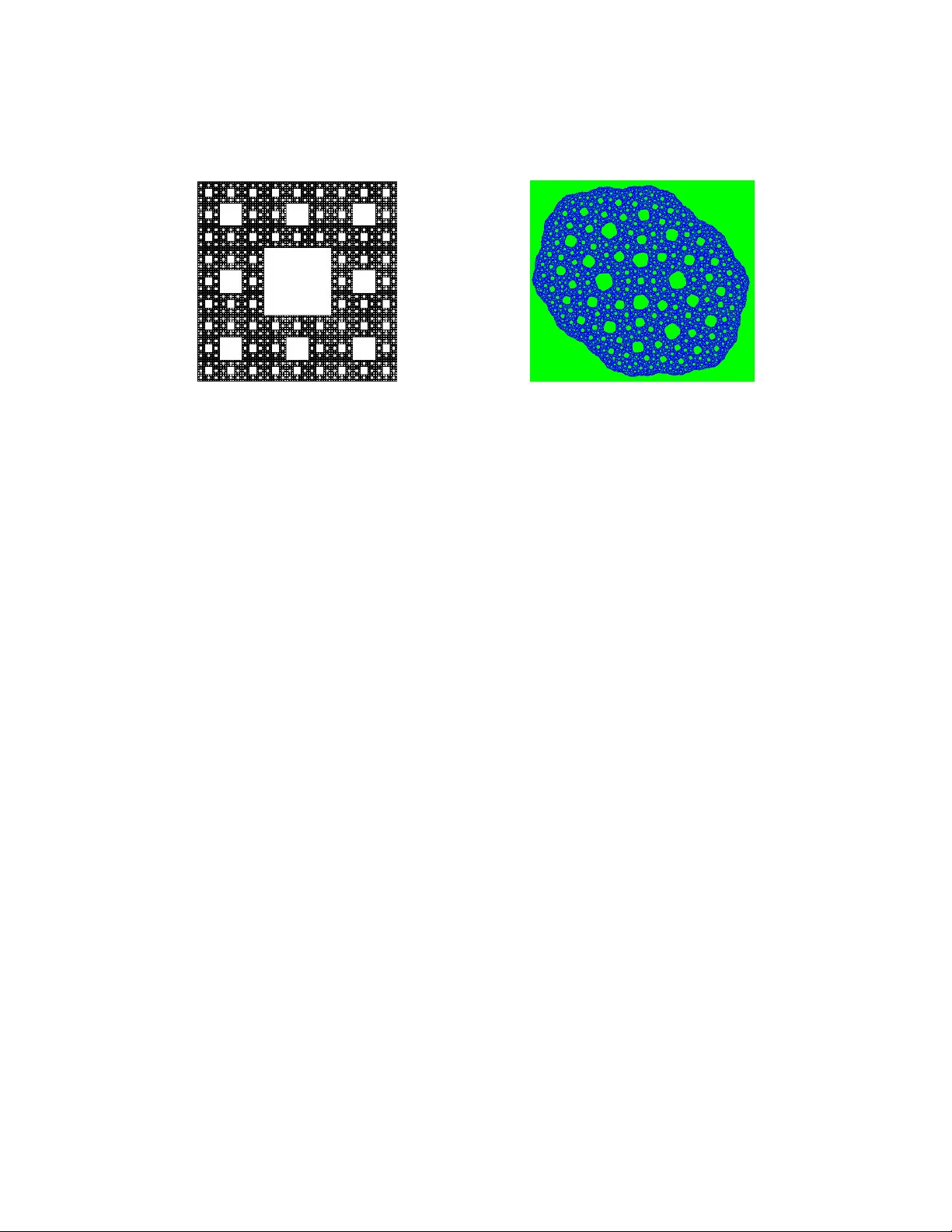
UNIF ORMIZA TION PR OBLEMS IN THE PLANE: A SUR VEY DIMITRIOS NT ALAMPEKOS Abstract. In this survey w e present the history and recent progress on sev- eral fundamental (quasi)conformal uniformization problems in the complex plane. Uniformization refers to the pro cess of mapping a space to a canonical model b y means of a w ell-behav ed transformation that preserv es the geometry and distorts shap es in a controlled fashion. A central problem in the area is Koeb e’s conjecture, which remains open after almost 120 years and predicts that each planar domain can be conformally mapp ed to a cir cle domain —that is, a domain whose complemen tary comp onents are p oints or closed disks. W e trace the history of the conjecture, outline recent developmen ts, and examine the associated uniqueness problem. W e also discuss v arian ts, with particular emphasis on the question whether a compact set can be mapp ed by a quasi- conformal self-map of the plane to a Schottky set —that is, a set in the plane whose complement is the union of disjoint open disks. Contents 1. In tro duction 2 Ac knowledgmen ts 3 2. Conformal uniformization by circle domains 4 2.1. Ko eb e conjecture 4 2.2. Uniformization by other types of domains 5 2.3. Geometric conditions for uniformization 6 2.4. Conformal rigidity 10 2.5. Uniformization by exhaustion 13 3. Quasiconformal uniformization by Sc hottky sets 15 3.1. Quasiconformal maps 15 3.2. Quasidisks 16 3.3. Quasiconformal annuli 16 3.4. Sc hottky sets 18 3.5. Characterization of Schottky sets 24 3.6. Quasiconformal annuli revisited 25 References 28 Date : March 17, 2026. 2020 Mathematics Subje ct Classific ation. Primary 30C20, 30C35, 30C62, 30C65, 30F10, 30F45, 37F10, 37F31, 37F32; Secondary 30L10, 30F99. Key words and phr ases. uniformization, circle domain, conformal, Ko eb e’s conjecture, uni- form domain, cofat domain, cospread domain, Gromov hyperb olic, exhaustion, conformal rigidit y , conformal remov ability , quasiconformal, quasidisk, quasicircle, quasiannulus, tangent quasicircles, Schottky set, Sierpi ´ nski carpet, gasket, Julia set, relative hyperb olic distance. The author was partially supp orted by the ERC Starting Grant, Grant Agreement no. 101214615, GRComP aS. 1 2 DIMITRIOS NT ALAMPEKOS 1. Introduction The ob ject of this surv ey is to presen t the history and recen t dev elopmen ts of uniformization problems in the complex plane. The term “uniformization” origi- nates from w ork of Ko eb e [Ko e07c, Ko e07a, Ko e07b], where the classic al uniformiza- tion the or em is prov ed: ev ery simply connected Riemann surface is conformally equiv alent to the Riemann sphere, the complex plane, or the unit disk. The term also app ears in another work of Ko eb e [Ko e08, Ko e20] in relation with the Kr eis- normierungspr oblem or else Ko eb e’s c onje ctur e , which asserts that ev ery domain in the Riemann sphere is conformally equiv alen t to a circle domain. W e discuss this problem in detail in Section 2. Therefore, according to Ko eb e, “uniformization” refers to the conformal transformation of a surface or domain to a canonical ob ject. More generally , we may use other types of maps b ey ond the class of conformal maps. W e are led to the following general problem for subsets of the plane or the sphere, which is the central ob ject of the present w ork. Problem 1.1. Can we tr ansform a subset of the plane or the spher e into a c anon- ic al set with b etter ge ometric pr op erties in a c ontr ol le d way , without exc essive distortion? Informally , the problem asks if a set can b e transformed, as if it w ere made out of rubb er, into a well-understoo d smo other set. F or example, a c anonic al set could b e a disk, a circle, a line, an annulus, etc. One instance of such a result is the R iemann mapping the or em , whic h asserts that every simply connected domain that is a prop er subset of the complex plane can b e transformed to the unit disk with a conformal map. Among its many im- p ortan t consequences, this classical theorem allows one to define harmonic measure on an arbitrary simply connected domain. Therefore, the existence of well-behav ed transformations as in Problem 1.1 enables us to study the original set using to ols that are av ailable in the canonical, smo other set. In Problem 1.1 w e need to specify what it means to transform a set in a c on- tr ol le d way . This essentially amounts to sp ecifying the t yp e of map used in the transformation. The most appropriate class of maps dep ends on the set under consideration. F or instance, one could use bi-Lipschitz maps, which quasi-preserve lengths, or conformal maps, which preserve angles. Ho wev er, these maps are not suitable for transforming a non-smo oth fractal set, p ossibly of infinite length, into a smo other set. F or this purp ose, we need to switc h to more general classes of maps. F or example, we might use quasiconformal maps, which distort angles in a con trolled manner, or quasisymmetric maps, whic h distort shapes in a controlled manner. More details about the latter t w o classes are presented in the follo wing sections. W e study Problem 1.1 in tw o general directions. In Section 2 w e consider the problem of c onformal ly transforming a domain in the plane to a canonical domain, suc h as a disk, an annulus, or more generally a circle domain. This problem is kno wn as Ko eb e’s conjecture, as mentioned earlier. W e present several partial results tow ards the conjecture in historical order. W e also discuss the uniqueness of suc h conformal transformations, a problem that is related to the c onformal rigidity of circle domains and to the rigidity c onje ctur e of He and Schramm. Finally , we discuss p otential approaches to w ards the general case of Ko eb e’s conjecture. UNIFORMIZA TION PROBLEMS IN THE PLANE: A SUR VEY 3 Figure 1. A circle domain. Its boundary can ha v e isolated circles, circles conv erging to points, isolated p oints, p oints conv erging to circles, Cantor sets, etc. In Section 3 w e present the problem of quasic onformal ly transforming a set in the plane to a canonical set, such as a circle, a disk, a line, an annulus, or more generally a Schottky set, that is, a set whose complemen tary comp onents are disks. W e b egin from the classical theorem of Ahlfors, which geometrically characterizes sets that are quasiconformally equiv alen t to circles, and w e conclude with a recen t result of the author that characterizes sets quasiconformally equiv alent to Schottky sets. A fundamental difference exists b et ween the tw o t yp es of problems discussed in Sections 2 and 3. First, in the case of conformal uniformization (Section 2), w e note that a simply connected domain may p ossess a highly irregular or even fractal b oundary . Nevertheless, the Riemann mapping theorem guarantees the existence of a conformal map from such a domain on to the unit disk, whose b oundary is smo oth. Therefore, in this setting the fo cus is on maps with nice b ehavior in the in terior of a domain, but without imp osing any con trol near the b oundary . On the other hand, in the case of quasiconformal uniformization (Section 3), w e use exclusively quasiconformal maps defined in the en tire plane or sphere. As a consequence, these maps distort the geometry in a controlled fashion globally . In particular, not every simply connected domain can b e mapp ed to the unit disk with a quasiconformal self-map of the plane. A necessary and sufficient condition, expressed in terms of the geometry of the b oundary , was established in a ground- breaking work of Ahlfors, which w e present b elow. Finally , we remark that uniformization by circle domains or Schottky sets is of in terest to several areas b eyond classical complex analysis, including the theory of h yp erb olic surfaces, geometric group theory , complex dynamics, analysis on metric spaces, and probabilit y theory . W e discuss some of these connections in the next sections. Ac kno wledgmen ts. The author would lik e to thank Kai Ra jala, Matthew Rom- ney , and Malik Y ounsi for their comments and corrections, which improv ed the presen tation. 4 DIMITRIOS NT ALAMPEKOS Figure 2. Illustration of Ko eb e’s uniformization theorem for finitely connected domains. Note that a homeomorphism b etw een domains preserves the num ber of b oundary comp onents. 2. Conformal uniformiza tion by cir cle domains 2.1. Ko eb e conjecture. The Riemann sphere is denoted by b C = C ∪ {∞} . A domain in b C is a connected op en set. A domain Ω in the Riemann sphere b C is called a cir cle domain if the connected components of ∂ Ω are p oints and circles; see Figure 1. The simplest instances of circle domains are the unit disk D = { z ∈ C : | z | < 1 } and the entire plane C , whose b oundary consists of a single p oint at ∞ . W e say that tw o domains U, V ⊂ b C are c onformal ly e quivalent if there exists a conformal map f from U onto V . Koeb e p osed the following deep problem, known as Ko eb e’s conjecture or as the Kreisnormierungsproblem [Ko e08]. Conjecture 2.1 (Ko eb e conjecture, 1908) . Every domain in the Riemann spher e is c onformal ly e quivalent to a cir cle domain. The conjecture has an affirmative answ er in the case of simply connected do- mains, a result known as the Riemann m apping theorem. Theorem 2.2 (Riemann mapping theorem, 1851) . Every simply c onne cte d domain Ω ⊊ C is c onformal ly e quivalent to D . Mor e over, for any two c onformal maps f , g fr om Ω onto D the c omp osition f ◦ g − 1 is a M¨ obius tr ansformation. Observ e that M¨ obius transformations of b C , namely functions of the form f ( z ) = az + b cz + d , map circles to circles and p oints to points. Thus, they map circle domains to circle domains. The next result generalizes the Riemann mapping theorem to the setting of finitely connected domains, a result due to Ko eb e [Ko e20]. See Figure 2. Theorem 2.3 (Ko eb e uniformization theorem, 1920) . Every finitely c onne cte d do- main Ω ⊂ b C is c onformal ly e quivalent to a cir cle domain. Mor e over, for any two c onformal maps f , g fr om Ω onto cir cle domains the c omp osition f ◦ g − 1 is a M¨ obius tr ansformation. Pro ofs can b e found in [Con95, Theorem 15.7.9] and in [Gol69, Section V.6]. The conjecture was subsequently prov ed for certain symmetric domains b y Ko eb e [Ko e22] and for domains whose “limit b oundary comp onents” satisfy certain condi- tions by Denneb erg [Den32], Gr¨ otzsch [Gr¨ o35], Sario [Sar48], Mesc howski [Mes51, Mes52], Streb el [Str51, Str53], Bers [Ber61], Sibner [Sib68], Haas [Haa84] and others. The most significant result tow ards the conjecture so far was established in a seminal work of He and Schramm [HS93]. UNIFORMIZA TION PROBLEMS IN THE PLANE: A SUR VEY 5 Theorem 2.4 (He–Sc hramm uniformization theorem, 1993) . Every c ountably c on- ne cte d domain Ω ⊂ b C is c onformal ly e quivalent to a cir cle domain. Mor e over, for any two c onformal maps f , g fr om Ω onto cir cle domains the c omp osition f ◦ g − 1 is a M¨ obius tr ansformation. Alternativ e pro ofs of the theorem hav e b een obtained by Schramm [Sch95] and Ra jala [Ra j25c]. Remark ably , in [Sch95] Schramm in troduces the transb oundary mo dulus, a notion that has b een prov ed to b e of paramount importance for recent dev elopments in uniformization and rigidity problems in the complex plane. W e observe that in the ab o v e theorems, whic h establish sp ecial cases of Koeb e’s conjecture, we also hav e a uniqueness statement. Namely , up to p ostcomp osition with M¨ obius transformations, there exists a unique conformal map from Ω onto a circle domain. How ever, in the case of uncountably connected domains, uniqueness can fail. W e discuss this phenomenon in Section 2.4. 2.2. Uniformization b y other types of domains. There are several results in the spirit of Ko eb e’s conjecture that provide conformal transformation of a domain in to sp ecial types of domains, b eyond circle domains. W e briefly discuss some of them. A domain Ω ⊂ b C is a slit domain if it contains ∞ and the complementary comp onen ts of Ω are p oints or rectilinear slits in a direction sp ecified by an angle θ ∈ [0 , π ). The following classical result was prov ed by Hilb ert [Hil09] for finitely connected domains and generalized to infinitely connected domains by Gr¨ otzsc h [Gr¨ o31]. Pro ofs can b e found in [Cou77, Section I I.3] and [Gol69, Theorem V.2.1]. Theorem 2. 5. Every domain in the Riemann spher e is c onformal ly e quivalent to a slit domain. Therefore, the analogue of Ko eb e’s conjecture is true in this case. W e note that the conformal map onto a slit domain is not unique. How ev er, the conformal map pro vided in the pro of of Theorem 2.5 arises as the unique solution of a certain extremal problem. This fact motiv ates attempts to prov e Ko eb e’s conjecture by constructing and solving certain extremal problems, whic h automatically give rise to the desired conformal map. One such problem is considered b y Schramm [Sch93b] and pro vides an alternative proof of the conjecture in the coun tably connected case. A very general uniformization result for finitely connected domains w as prov ed b y Brandt–Harrington [Bra80, Har82]. This result allows one to prescrib e all non- degenerate complementary comp onents of the target domain up to homothety, i.e., a map of the form z 7→ az + b , where a > 0 and b ∈ C . The formulation giv en b elow is taken from [Sch95, Theorem 4.1]. Theorem 2.6 ([Bra80, Har82]) . L et Ω ⊂ b C b e a finitely c onne cte d domain. F or e ach c omplementary c omp onent b of Ω , let P b ⊂ C b e a c omp act set that c ontains mor e than a single p oint such that b C \ P b is c onne cte d. Then ther e exists a c onformal map f fr om Ω onto a domain D such that if b is a non-de gener ate c omplementary c omp onent of Ω , then it c orr esp onds under f to a homothetic image of P b . This result implies Ko eb e’s uniformization theorem (Theorem 2.3). Moreov er, it implies that each finitely connected domain can b e conformally mapp ed to a squar e domain , i.e., a domain whose non-degenerate complemen tary comp onents are squares with sides parallel to the co ordinate axes. Thanks to a result of 6 DIMITRIOS NT ALAMPEKOS Sc hramm [Sch95, Theorem 4.2], Koeb e’s conjecture is equiv alen t to the state- men t that each domain is conformally equiv alent to a square domain (or a domain b ounded by equilateral triangles, etc.). Th us, one may attempt to approach Ko eb e’s conjecture by studying conformal uniformization b y square domains. Such domains app ear more naturally than cir- cle domains in extremal problems [Sc h93a, Sc h93b, Bon16, Nta20]. Sp ecifically , the recen t work of Bonk [Bon16] introduces a simple extremal problem for finitely con- nected domains whose solution gives a conformal map onto a square domain. This result is generalized by Solynin–Vidanage [SV20] to domains b ounded b y rectangles. It would b e interesting to extend these results to coun tably connected domains. 2.3. Geometric conditions for uniformization. Ko eb e’s conjecture has b een established under some geometric conditions on a domain. W e present here an incomplete collection of results in this spirit. 2.3.1. Uniform domains. A domain Ω ⊂ C is called a uniform domain if there exists a constan t A ≥ 1 suc h that for any tw o p oin ts z , w ∈ Ω there exists curve γ : [ a, b ] → Ω with γ ( a ) = z , γ ( b ) = w , ℓ ( γ ) ≤ A | z − w | , and min { ℓ ( γ | [ a,t ] ) , ℓ ( γ | [ t,b ] ) } ≤ A dist( γ ( t ) , ∂ Ω) for every t ∈ [ a, b ]. Here we use the Euclidean metric and top ology and ℓ ( γ ) denotes the length of γ . Uniform domains were introduced indep endently b y Martio–Sarv as [MS79] and Jones [Jon81] and app ear now ada ys in sev eral problems of geometric function the- ory . They constitute a well-studied class that enjo ys fa v orable geometric properties, similar to the strong prop erties of the unit disk [Geh87]. The definition of a uniform domain implies that any tw o points can b e connected b y a twisted cone of ap erture uniformly b ounded from b elow. Geometrically , uni- form domains are not allow ed to ha v e any inw ard or out w ard cusps. Martio and Sarv as [MS79, Theorem 2.24] pro ved that each non-degenerate complementary com- p onen t of a uniform domain is a quasidisk, an ob ject with v ery strong geometric prop erties that resembles the unit disk from several viewp oints; w e define and dis- cuss quasidisks in detail in Section 3.2. Ko eb e’s conjecture w as established for uniform domains b y Herron and Kosk ela [HK90], generalizing an earlier result of Herron [Her87]. Theorem 2.7 ([HK90, NY20]) . Every uniform domain Ω ⊂ C is c onformal ly e quiv- alent to a cir cle domain. Mor e over, for any two c onformal maps f , g fr om Ω onto cir cle domains the c omp osition f ◦ g − 1 is a M¨ obius tr ansformation. The uniqueness part of the theorem was established muc h more recently b y the author and Y ounsi [NY20] and we discuss it in Section 2.4. 2.3.2. Cofat domains. As mentioned ab o ve, each non-degenerate complementary comp onen t of a uniform domain has nice geometry and in particular it is a quasidisk. Quasidisks satisfy the following strong geometric prop erty . A set A ⊂ b C is fat if there exists a constant τ > 0 suc h that for every z ∈ A ∩ C and for every ball B ( z , r ) that do es not contain A w e hav e Area( A ∩ B ( z , r )) ≥ τ r 2 . In this case we say that A is τ -fat. Note that each p oint is trivially τ -fat for all τ > 0. A domain Ω ⊂ b C is c ofat if there exists τ > 0 such that eac h connected comp onent UNIFORMIZA TION PROBLEMS IN THE PLANE: A SUR VEY 7 Figure 3. The Julia set of the p olynomial z 2 + i is an example of an η -spread set b ecause it contains η -quasitrip ods in all lo cations and scales. of b C \ Ω is τ -fat. Schramm prov ed that eac h quasidisk is fat [Sch95, Corollary 2.3]. In com bination with the ab o ve men tioned result of Martio–Sarv as, we obtain that eac h uniform domain is cofat. Sc hramm generalized the result of Herron–Kosk ela and prov ed Ko eb e’s conjecture for cofat domains [Sch95]. Theorem 2.8 ([Sch95]) . Every c ofat domain Ω ⊂ b C is c onformal ly e quivalent to a cir cle domain. Unlik e the previous results, we remark that uniqueness can fail in this case. Sp ecifically , if E = b C \ Ω is a Can tor set then it is cofat trivially . If, in addition, E has p ositive area, then we sho w in Prop osition 2.12 b elow that uniqueness fails. In the same work Sc hramm in tro duced the notion of transb oundary modulus and used it, in combination with cofat domains, to provide an alternative pro of of the He–Sc hramm uniformization theorem (Theorem 2.4). Since then, transboundary mo dulus has become a standard to ol in mo dern geometric function theory , with n umerous applications to uniformization and rigidit y problems in the complex plane and metric spaces. The ma jority of the results presented in this survey rely on this notion. 2.3.3. Cospr e ad domains. V ery recently , Esma yli and Ra jala [ER26] obtained an affirmativ e answ er to Ko eb e’s conjecture for domains whose complemen tary compo- nen ts a satisfy a different t ype of a uniform geometric condition. Before stating the theorem we give the necessary definitions. A homeomorphism ϕ : ( X , d X ) → ( Y , d Y ) b et ween metric spaces is called quasisymmetric if there exists a homeomorphism η : [0 , ∞ ) → [0 , ∞ ) such that for every triple of distinct p oints x, y , z ∈ X we hav e d Y ( ϕ ( x ) , ϕ ( y )) d Y ( ϕ ( x ) , ϕ ( z )) ≤ η d X ( x, y ) d X ( x, z ) . In this case we say that ϕ is η -quasisymmetric. The homeomorphism η is called a distortion function . F rom a geometric p oint of view, quasisymmetric maps preserv e relativ e sizes and shap es. In some instances, e.g., when X = Y = C , quasisym- metric maps coincide with quasiconformal maps, defined in Section 3.1. In general, quasisymmetric maps can b e regarded as a generalization of quasiconformal maps in metric spaces. 8 DIMITRIOS NT ALAMPEKOS Figure 4. Left: A geo desic triangle in a Gromo v hyperb olic space with the δ -neighborho o d of tw o sides containing the third side. Righ t: A geodesic triangle in the Euclidean plane, which is not Gromo v hyperb olic. The standar d trip o d T 0 ⊂ C is the union of the three segmen ts from 0 to e 2 π ik/ 3 , k = 0 , 1 , 2. A set T ⊂ C is an η - quasitrip o d if there exists an η -quasisymmetric homeomorphism ϕ : T 0 → T . A set A ⊂ b C is called η -spread if for every z ∈ A ∩ C and ev ery ball B ( z , r ) that do es not contain A there is an η -quasitrip o d T ⊂ A ∩ B ( z , r ) with diam( T ) ≥ r /η (1). A domain Ω ⊂ b C is c ospr e ad if there exists a distortion function η such that every comp onent of b C \ Ω is η -spread. W e no w state [ER26, Corollary 1.6]. Theorem 2.9 ([ER26]) . Every c ospr e ad domain Ω ⊂ b C is c onformal ly e quivalent to a cir cle domain. W e remark that uniqueness might fail here as in the case of Schramm’s theorem ab o ve. The pro of of Theorem 2.9 relies on Schramm’s transb oundary modulus, whic h is used in the pro of of Theorem 2.8. How ev er, unlike cofat domains, whose non-degenerate complem en tary comp onen ts ha ve p ositiv e area, in cospread domains the complementary comp onents can b e very thin and may hav e v anishing area; see Figure 3. This mak es the pro of significantly more in volv ed than that of Schramm’s theorem. 2.3.4. Gr omov hyp erb olic domains. Observ e that the geometric conditions of The- orems 2.7, 2.8, and 2.9 are not conformally inv ariant. That is, if Ω satisfies one of the conditions in these theorems, then conformal images of Ω need not satisfy the same condition. F or instance, if Ω = D , then all we can sa y ab out conformal images of Ω is that they are simply connected, but they need not satisfy an y strong Euclidean geometric condition. Recently , Karafyllia and the author [KN25] prov ed Ko eb e’s conjecture for the class of Gromov hyperb olic domains, which is a confor- mally inv ariant class that contains all finitely connected domains. W e now give the formal definition. A geo desic metric space X is Gr omov hyp erb olic if there exists δ > 0 suc h that for ev ery geo desic triangle in X each side is within the δ -neighborho o d of the union of the other tw o sides; see Figure 4. Despite the simplicity of this definition, Gromov [Gro87] prov ed that several features of hyperb olic space can b e reco vered by this condition. Gromov hyperb olic spaces are an ob ject of study in mo dern geometric group theory in connection with the uniformization problem; see the surv ey articles [Bon06, Kle06, Nta25c]. Bonk, Heinonen and Koskela [BHK01] studied domains in the Riemann sphere that are Gromov hyperb olic when equipp ed with the quasihyperb olic metric. Let Ω ⊊ b C b e a domain, equipped with the spherical metric. The quasihyp erb olic metric UNIFORMIZA TION PROBLEMS IN THE PLANE: A SUR VEY 9 Figure 5. Simply connected domains ha v e w ell-b eha ved hyper- b olic geometry , thanks to the Riemann mapping theorem, but their Euclidean geometry may b e highly irregular. On the other hand, the unit disk enjoys b oth well-behav ed Euclidean and hyperb olic geometry . This analogy extends to Gromov h yp erb olic and uni- form domains by Theorem 2.11. on Ω is defined as k Ω ( z , w ) = inf γ Z γ 1 dist σ ( z , ∂ Ω) 2 | dz | 1 + | z | 2 , where the infimum is taken ov er all rectifiable curv es γ with endp oints z , w ; here σ denotes the spherical metric. W e say that Ω is Gromov hyperb olic if the metric space (Ω , k Ω ) is Gromov h yp erb olic. By a result of Buc kley and Herron [BH20, Theorem B], for h yp erb olic domains in C (i.e., with at least tw o boundary p oints in C ) an equiv alen t condition is that the space (Ω , h Ω ) is Gromov hyperb olic, where h Ω is the hyperb olic metric on Ω. F rom this result w e obtain immediately the conformal inv ariance of Gromo v hyperb olicity; see also [KN25, Theorem 4.1] for an alternativ e approach. Examples of Gromo v h yp erb olic domains include all simply connected domains, all finitely connected domains, and all uniform domains. Intuitiv ely , Gromo v hy- p erb olic domains need not hav e go o d Euclidean geometry (for example, think of an arbitrary simply connected domain), but they ha v e go o d h yp erb olic geometry . F or example, it is shown in [BHK01, Section 7] that each Gromov hyperb olic domain Ω has the Gehring–Hayman pr op erty : there exists a constant C ≥ 1 suc h that if γ is a geo desic in the space (Ω , k Ω ), then any curve β in Ω with the same endp oints as γ has spherical length ℓ σ ( β ) ≥ C − 1 ℓ σ ( γ ) . Th us, quasih yp erb olic geo desics hav e almost minimal length. A characterization of Gromov hyperb olic domains that inv olves the Gehring–Ha yman prop erty and a separation prop erty is established by Balogh and Buc kley in [BB03]. W e now state the main theorem of recent work of Karafyllia and the author [KN25], which establishes Ko eb e’s conjecture for Gromov h yp erb olic domains. Theorem 2.10 ([KN25]) . Every Gr omov hyp erb olic domain Ω ⊂ b C is c onformal ly e quivalent to a uniform cir cle domain. Mor e over, for any two c onformal maps f , g fr om Ω onto cir cle domains the c omp osition f ◦ g − 1 is a M¨ obius tr ansformation. The uniqueness statemen t follo ws from [NY20] as in the case of uniform domains in Theorem 2.7. This theorem gives a further insigh t. Although Gromo v h yp erb olic domains do not necessarily ha ve goo d Euclidean geometry , they can be conformally transformed to uniform domains, whic h satisfy very strong geometric prop erties, as 10 DIMITRIOS NT ALAMPEKOS T yp es of domains Existence Uniqueness Simply connected ✓ Riemann ✓ Finitely connected ✓ Koeb e [Ko e20] ✓ Koeb e [Ko e20] Countably connected ✓ He–Schramm [HS93] ✓ He–Schramm [HS93] Uniform ✓ Herron–Koskela [Her87] ✓ Ntalampekos–Y ounsi [NY20] Cofat ✓ Schramm [Sch95] ✗ Proposition 2.12 Cospread ✓ Esmayli–Rajala [ER26] ✗ Proposition 2.12 Gromov hyperb olic ✓ Karafyllia–Ntalampekos [KN25] ✓ Ntalampekos–Y ounsi [NY20] T able 1. Existence and uniqueness results on Ko eb e’s conjecture. discussed in Section 2.3.1; see Figure 5. Con versely , it w as earlier shown b y Bonk– Heinonen–Kosk ela [BHK01, Theorem 1.11] that uniform domains and conformal images of such domains are Gromo v hyperb olic. Th us, we obtain the following consequence. Theorem 2.11 ([BHK01, KN25]) . Gr omov hyp erb olic domains in b C ar e pr e cisely the c onformal images of uniform domains. W e note that analogues of Koeb e’s conjecture ha ve b een studied on domains con tained in metric surfaces, that is, top ological surfaces equipp ed with a metric [MW13, RR21, Reh22, HL23, LR25]. These results go b eyond the scop e of the present surv ey . In T able 1 we summarize the results presented in this section. 2.4. Conformal rigidity . A circle domain D is c onformal ly rigid if every confor- mal map from Ω onto another circle domain is the restriction of a M¨ obius transfor- mation. Note that if there exists a conformal map f from a domain Ω on to a circle domain D , then f is unique up to p ostcomp osition with M¨ obius transformations if and only if the circle domain D is conformally rigid; see Figure 6. Therefore, conformally rigid circle domains are closely related to the uniqueness of conformal maps as in Ko eb e’s conjecture. Based on Theorem 2.4, every countably connected circle domain is conformally rigid. Ho w ev er, not every circle domain is conformally rigid. In the next statement w e see that circle domains whose b oundary is a Cantor set of p ositive area are not rigid. Prop osition 2.12. L et E ⊂ C b e a total ly disc onne cte d c omp act set with p ositive ar e a. Ther e exists a home omorphism f : C → C that is c onformal in C \ E but it is not a M¨ obius tr ansformation. Pr o of. According to a result of Uy [Uy79], if E has positive area, then there exists a non-constan t b ounded analytic function g : C \ E → C that is Lipsc hitz contin uous; in particular, there exists L > 0 suc h that | g ( z ) − g ( w ) | ≤ L | z − w | for all z , w ∈ C \ E . Since E is totally disconnected, g extends contin uously to a function in C that satisfies | g ( z ) − g ( w ) | ≤ L | z − w | . W e now define f ( z ) = z + 1 2 L g ( z ) , z ∈ C . Ob viously , f is analytic in C \ E . If f were a M¨ obius transformation, then g would b e analytic in C and hence c onstan t b y Liouville’s theorem, a contradiction. Thus, UNIFORMIZA TION PROBLEMS IN THE PLANE: A SUR VEY 11 non-M¨ obius Figure 6. Two conformal maps from a domain to circle domains. These conformal maps do not differ by a M¨ obius transformation if and only if the circle domains are not conformally rigid. f is not a M¨ obius transformation. Note that | f ( z ) − f ( w ) | ≥ | z − w | − 1 2 L | g ( z ) − g ( w ) | ≥ 1 2 | z − w | for z , w ∈ C , so f is injective and in fact it is a homeomorphism of C . □ More generally , using the tec hnique of quasiconformal deformation of Schottky groups, introduced by Sibner [Sib68], it can b e shown that any circle domain whose b oundary has p ositive area is not conformally rigid. See also [Y ou16, Lemma 18] for another pro of based on Sibner’s technique. The conformal rigidit y problem was studied thoroughly b y He and Schramm [HS94], who gav e a sufficien t condition for rigidity inv olving the size of the boundary of a circle domain. Theorem 2.13 ([HS94]) . If Ω ⊂ b C is a cir cle domain whose b oundary has σ -finite length, then Ω is c onformal ly rigid. Here, the length of a set is the Hausdorff 1-measure; see [F ol99, Section 11.2] or [Hei01, Section 8.3] for the definition. Obviously , there are at most countably man y circles in the b oundary of a circle domain, so their total length is σ -finite. Ho wev er, the p oint comp onents in the b oundary of a circle domain can form a very large set; for example, a Cantor set of p ositiv e area could b e part of the b oundary . Th us, the obstacle for the rigidity of a circle domain seems to b e the size of this set. He and Schramm posed the follo wing conjecture. Conjecture 2.14 (Rigidity conjecture, 1994) . A cir cle domain Ω is c onformal ly rigid if and only if its b oundary ∂ Ω is c onformal ly r emovable. Here a compact set E ⊂ b C is c onformal ly r emovable if every homeomorphism of b C that is conformal in b C \ E is a M¨ obius transformation. Conformally remo v able sets 12 DIMITRIOS NT ALAMPEKOS include sets of σ -finite length due to Besico vitc h [Bes31] and b oundaries of uniform domains due to Jones [Jon95]. See also [JS00, KN05, Y ou16, Nta23b, Nta25a] for other sufficient geometric conditions. Non-remov able sets include the Sierpi ´ nski gask et and Sierpi ´ nski carp ets [Nta19, Nta21]. W e direct the reader to the surveys [Y ou15, Bis26] for further details and op en problems on remov ability . Some positive evidence tow ards Conjecture 2.14 was provided b y Y ounsi [Y ou16]. F urther evidence was provided b y the author and Y ounsi [NY20]. Theorem 2.15 ([NY20]) . L et Ω ⊂ b C b e a cir cle domain and supp ose that for a p oint z 0 ∈ Ω we have R Ω k Ω ( z 0 , z ) 2 d Σ( z ) < ∞ . Then Ω is c onformal ly rigid. Here Σ denotes the spherical Leb esgue measure. The condition of the theorem had b een shown b y Jones and Smirnov [JS00] to imply the conformal remov ability of ∂ Ω. Moreov er, this condition holds for uniform circle domains, thus Theorem 2.15 implies the uniqueness statements in Theorem 2.7 and Theorem 2.10. In [Nta23b] the author introduced the notion of sets that are c ountably ne gligible for extr emal distanc e , abbreviated as CNED sets, and prov ed that suc h sets are conformally remov able. This notion resembles and generalizes the classical notion of sets that are ne gligible for extr emal distanc e , abbreviated as NED sets, which w ere studied by Ahlfors and Beurling [AB50]. In order to av oid technicalities, w e do not define these notions. In [Nta24] the author show ed that the class of CNED se ts includes sets of σ -finite length and b oundaries of domains satisfying the condition of Theorem 2.15. Finally , in [Nta23c], he show ed the rigidity of circle domains whose b oundary is a CNED set, a result that we state b elow. Theorem 2.16 ([Nta23c]) . L et Ω ⊂ b C b e a cir cle domain whose b oundary is a CNED set. Then Ω is c onformal ly rigid. This result implies Theorem 2.13, Theorem 2.15, and pro vides strong evidence for Conjecture 2.14. Nevertheless, Conjecture 2.14 was subsequently disprov ed b y Ra jala [Ra j25b]. Theorem 2.17 ([Ra j25b]) . Ther e exists a c onformal ly rigid cir cle domain whose b oundary is not c onformal ly r emovable. W e note that if Ω is a conformally rigid circle domain with totally disconnected b oundary , then its b oundary is remov able, as an immediate consequence of the definitions. So, an y example that disprov es this direction of the conjecture, as the one given by Ra jala, must ha v e b oundary that contains b oth circles and p oints. The rigidity of the circle domain constructed by Ra jala inv olv es a metric char- acterization of conformal maps established b y the author [Nta23b]. The fact that the b oundary is not remo v able follows from a theorem of W u [W u98], which states that the pro duct of a Cantor set E ⊂ R with a sufficiently thic k Cantor set F ⊂ R is not remov able. W e remark that the rev erse direction of Conjecture 2.14 remains op en. The author has conjectured in [Nta24] that conformal remov ability is equiv alen t to the CNED condition. If this conjecture is true, then in Conjecture 2.14 the remo v ability of ∂ Ω implies the rigidity of Ω. In T able 2 we summarize several results related to the conformal rigidity of a circle domain Ω and the remov ability of ∂ Ω. UNIFORMIZA TION PROBLEMS IN THE PLANE: A SUR VEY 13 T yp es of circle domains Ω rigid ∂ Ω remov able Simply connected ✓ ✓ Morera Finitely connected ✓ Koeb e [Ko e20] ✓ Morera Countably connected ✓ He–Schramm [HS93] ✓ Besicovitc h [Bes31] Boundary has σ -finite length ✓ He–Schramm [HS94] ✓ Besicovitc h [Bes31] Uniform ✓ Ntalampekos–Y ounsi [NY20] ✓ Jones [Jon95] Quasihyperbolic distance in L 2 ✓ Ntalampekos–Y ounsi [NY20] ✓ Jones–Smirnov [JS00] Boundary is CNED ✓ Ntalampekos [Nta23c] ✓ Ntalampekos [Nta23b] Boundary has positive area ✗ Sibner [Sib68] ✗ Prop osition 2.12 Ra jala’s example ✓ Ra jala [Ra j25b] ✗ W u [W u98] T able 2. Results related to the conformal rigidity of a circle do- mains and the remov ability of its b oundary . 2.5. Uniformization b y exhaustion. W e discuss some approac hes to wards the general case in Ko eb e’s conjecture. The central idea, which has b een utilized for proving several cases of the conjec- ture, is to appro ximate a given domain Ω by a sequence of finitely connected circle domains { Ω n } n ∈ N , and then use Ko eb e’s uniformization theorem (Theorem 2.3) to find a sequence of conformal maps f n from Ω n on to a finitely connected circle domain D n , n ∈ N . The circle domains Ω n , n ∈ N , are taken so that they conv erge to the original domain Ω in the sense of kernel c onver genc e of Car ath´ eo dory with resp ect to a fixed base p oint. W e recall this notion of con vergence. Let z 0 ∈ Ω and let { Ω n } n ∈ N b e a sequence of domains suc h that z 0 ∈ Ω n for all n ∈ N . W e say that Ω is the z 0 - kernel of { Ω n } n ∈ N if Ω is the largest domain with the prop ert y that z 0 ∈ Ω and eac h compact set K ⊂ Ω is contained in Ω n for all sufficiently large n ∈ N . W e say that { Ω n } n ∈ N c onver ges to Ω in the Car ath ´ eo dory sense with b ase at z 0 if Ω is the z 0 -k ernel of every subsequence of { Ω n } n ∈ N . No w, suppose that { Ω n } n ∈ N is as ab ov e and for each n ∈ N we ha ve a conformal map f n : Ω n → D n on to a finitely connected circle domain D n . If the sequence { f n } n ∈ N is appropriately normalized, then by normality criteria w e may pass to a subsequence that con v erges lo cally uniformly to a conformal map f on Ω. By a v er- sion of Carath ´ eo dory’s k ernel con vergence theorem (see [Gol69, Theorem V.5.1]) for m ultiply connected domains, we hav e f (Ω) = D , where D is the Carath ´ eo dory limit of { D n } n ∈ N with base at f ( z 0 ). The last step tow ards proving Ko eb e’s conjecture is to verify that the domain D is a circle domain. This is actually a highly nontrivial task and a naiv e approac h do es not work b ecause a sequence of circle domains need not conv erge to a circle domain in the Carath ´ eo dory sense! See Figure 7 for an illustration of this phenomenon. Therefore, in order to ensure that the limit D is a circle domain one needs to imp ose further requirements on the sequence { Ω n } n ∈ N that approximates the origi- nal domain Ω. The pro ofs of He–Schramm [HS93] and Schramm [Sc h95] of Ko eb e’s conjecture for countably connected domains pro ceed by external ly approximating the domain Ω; that is, the appro ximating sequence { Ω n } n ∈ N satisfies Ω n ⊃ Ω for eac h n ∈ N . Ev en under this condition, the sequence of circle domains { D n } n ∈ N need not conv erge to a circle domain and one has to imp ose further conditions. F or example, in the work of Karafyllia and the author for the pro of of Theorem 2.10, 14 DIMITRIOS NT ALAMPEKOS D 1 D 2 D Figure 7. A sequence of circle domains con vergin g to a domain that contains a line segment in the boundary and hence is not a circle domain. the approximating domains { Ω n } n ∈ N satisfy a strong geometric condition, called inner uniformity . Recen tly , Ra jala [Ra j25c] approached the conjecture using instead internal ap- pro ximations, or else, exhaustions of Ω. An exhaustion of Ω is a sequence of domains { Ω n } n ∈ N , each b ounded b y finitely many Jordan curv es that are contained in Ω, suc h that Ω n ⊂ Ω n +1 ⊂ Ω for each n ∈ N and Ω = [ n ∈ N Ω n . Ra jala gav e an alternativ e pro of of the He–Sc hramm uniformization theorem (The- orem 2.4) by using exhaustions. The metho d of using exhaustions app ears in the problem of mapping conformally a domain onto a domain b ounded by horizontal slits, as in Theorem 2.5. Sp ecifically , if { Ω n } n ∈ N is any exhaustion of a domain Ω and, for eac h n ∈ N , f n is a conformal map from Ω n on to a domain b ounded by finitely many horizontal slits, then after appropriate normalizations and passing to a subsequence, { f n } n ∈ N con verges to a conformal map from Ω onto a horizontal slit domain [Cou77, Theorem 2.1, p. 54]. In sharp con trast, when uniformizing b y circle domains, Ra jala observ ed that the exhaustions hav e to b e chosen carefully , b ecause the phenomenon of Figure 7 can app ear in this setting as well. Generalizing the metho d of Ra jala, the author and Ra jala [NR25] prov ed that the metho d of exhaustions can b e used in all domains that satisfy Ko eb e’s conjecture; in other words, if the conjecture is true, it can b e pro ved b y exhaustions. Theorem 2.18 ([NR25]) . L et Ω ⊂ b C b e a domain that is c onformal ly e quivalent to a cir cle domain. Then ther e exists an exhaustion { Ω n } n ∈ N of Ω and for e ach n ∈ N a c onformal map f n fr om Ω n onto a finitely c onne cte d cir cle domain D n such that the se quenc e { f n } n ∈ N c onver ges lo c al ly uniformly in Ω to a c onformal map onto a cir cle domain. Ra jala [Ra j25a] studied other sp ecial conditions that must b e true for domains that satisfy Ko eb e’s conjecture. Therefore, in an attempt to dispro ve the conjecture, it suffices to find a domain that do es not satisfy the conclusion of Theorem 2.18 or the conditions of Ra jala [Ra j25a]. UNIFORMIZA TION PROBLEMS IN THE PLANE: A SUR VEY 15 z B ( z , r ) f f ( z ) B ( f ( z ) , H R ) R Figure 8. The metric definition of quasiconformality . 3. Quasiconformal uniformiza tion by Schottky sets 3.1. Quasiconformal maps. An orien tation-preserving homeomorphism f : U → V b etw een op en subsets of C is quasic onformal if f lies in the Sob olev space W 1 , 2 loc ( U ) and there exists K ≥ 1 such that ∥ D f ( z ) ∥ 2 ≤ K J f ( z ) (3.1) for a.e. z ∈ U ; here ∥ D f ( z ) ∥ denotes the op erator norm of the differential of f at z and J f is the Jacobian determinan t of D f . In this case w e say that f is K -quasiconformal. This is known as the analytic definition of quasiconformality . A homeomorphism f : U → V b etw een op en subsets of the Riemann sphere b C is quasiconformal if f | U \{∞ ,f − 1 ( ∞}} is quasiconformal in the ab ov e sense. There are several equiv alent definitions of quasiconformal maps. According to the metric definition of quasiconformalit y , an orien tation-preserving homeomor- phism f : U → V betw een op en subsets of C is quasiconformal if for eac h z ∈ U and for ev ery sufficien tly small r > 0 (depending on z ), there exists R > 0 such that B ( f ( z ) , R ) ⊂ f ( B ( z , r )) ⊂ B ( f ( z ) , H R ) , where H ≥ 1 is a uniform constant; see Figure 8. Informally , f maps infinitesimal balls to sets of b ounded eccen tricity . Compare this prop erty to the corresp onding prop ert y of conformal maps, which map infinitesimal balls to infinitesimal balls. Another geometric interpretation of smo oth quasiconformal maps is that they dis- tort angles in a bounded w ay , as opposed to conformal maps, which preserve angles. Th us, we ma y regard quasiconformal maps as a more flexible class than conformal maps, but with some distortion control imp osed. W e include some fundamental prop erties of quasiconformal maps. Ev ery 1- quasiconformal map is conformal and vice versa. Note, though, that quasiconformal maps are not analytic or smo oth in general. The inv erse of a K -quasiconformal map is K -quasiconformal. Also, the comp osition of a K 1 -quasiconformal map with a K 2 - quasiconformal map is K 1 K 2 -quasiconformal. In particular, the composition of a K -quasiconformal map with a conformal map is K -quasiconformal. W e direct the reader to [Ahl06, V¨ ai71, L V73, AIM09] for further background. In this section w e work almost exclusiv ely with quasiconformal maps of the entire sphere b C . Henceforth, w e say that tw o sets E , F are quasic onformal ly e quivalent if there exists a quasiconformal homeomorphism of b C that maps E onto F . Compare this with the notion of conformal equiv alence of domains that we define in Section 2.1. 16 DIMITRIOS NT ALAMPEKOS z w diam E ≤ L | z − w | Figure 9. Left: The von Ko ch sno wflake is a quasicircle. Right: The Julia set of z 2 + c for c ∈ C close to 0 is a quasicircle. If A is a p ositive parameter or collection of parameters, w e use the notation C ( A ) for a p ositive constan t that dep ends only on A . 3.2. Quasidisks. A set U ⊂ b C is a quasidisk if it is the image of the unit disk D (or equiv alently of any other disk) under a quasiconformal map f : b C → b C . If f is K -quasiconformal for some K ≥ 1, then U is called a K -quasidisk. An intriguing problem since the early dev elopmen t of the theory of quasiconformal maps had b een to provide a geometric c haracterization of quasidisks. This problem was resolved in a seminal work of Ahlfors [Ahl63]. Theorem 3.1 ([Ahl63]) . A Jor dan r e gion U ⊂ C is a quasidisk if and only if ∂ U is a quasicir cle, quantitatively. A Jordan curve J ⊂ C is a quasicir cle if there exists a constant L ≥ 1 suc h that for every tw o p oints z , w ∈ J there exists an arc E ⊂ J connecting z , w such that diam E ≤ L | z − w | . In this case we say that J is an L -quasicircle. One may define quasicircles in the sphere b C by using the spherical metric in the ab ov e definition (see the discussion in [Nta26, Section 2.4]); Ahlfors’ theorem remains true in this setting. The statement of Theorem 3.1 is quantitative in the sense that if U is a K -quasidisk, then ∂ U is an L -quasicircle for some L that dep ends only on K , and vice versa. Geometrically , quasicircles do not hav e cusps. It is straightforw ard to establish that several fractal sets, esp ecially self-similar ones, are quasicircles; hence, by the theorem of Ahlfors, they can b e mapp ed to the unit circle via a quasiconformal map. See Figure 9 for examples of quasicircles and Figure 10 for a curv e that is not a quasicircle. 3.3. Quasiconformal annuli. Thanks to Theorem 3.1, we hav e a complete un- derstanding of the quasiconformal uniformization problem for Jordan curves. It is natural to ask whether a pair of disjoint Jordan curv es can b e mapped quasiconfor- mally to a pair of circles in a controlled manner. Namely , if J 1 , J 2 are Jordan curv es, w e wish to map them to circles with a K -quasiconformal homeomorphism of the sphere so that K dep ends only on the geometric features of J 1 and J 2 . By Theorem 3.1 it is necessary that J 1 and J 2 are quasicircles, quan titatively dep ending on K . Is this condition sufficient? UNIFORMIZA TION PROBLEMS IN THE PLANE: A SUR VEY 17 z w diam E ≫ | z − w | Figure 10. Quasicircles do not hav e cusps. The curve shown is the Julia set of a rational map that has cusps, so it is not a quasi- circle. As a motiv ating example, note that each op en square in the plane is a L - quasidisk. Suppose that any pair of disjoint squares can b e mapp ed to a pair of disjoint disks with a K -quasiconformal map of the sphere, for some uniform K ≥ 1. Consider the unit square [0 , 1] 2 and for each n ∈ N let A n b e a square with sides parallel to the axes such that A n is larger than [0 , 1] 2 and the distance of a vertex of A n from a vertex of [0 , 1] 2 tends to 0 as n → ∞ ; see Figure 11. F or eac h n ∈ N consider a K -quasiconformal map f n : b C → b C that maps [0 , 1] 2 to the unit disk and the square A n to a disk. By normality criteria for quasiconformal maps (see [L V73, Section I I.5]), after appropriate normalizations, a subsequence of f n con verges to a quasiconformal map f that maps the unit square onto D and a square or quarter plane A to a disk or half plane f ( A ). Note that A and [0 , 1] 2 ha ve a common vertex, while f ( A ) is tangen t to D . Since quasiconformal maps quasi-preserv e angles, the map f cannot map the non-zero angle b et ween A and [0 , 1] 2 to the zero degree angle b etw een f ( A ) and D ; one can pro v e this formally using the fact that quasiconformal maps are locally quasisymmetric. Hence, we are lead to a contradiction. See [Nta20, Section 3.12] for further details. The ab ov e example shows that the go o d geometry of squares is not sufficient to guaran tee that a pair of squares can b e mapp ed to a pair of disks with controlled distortion that is indep endent of other features, such as the r elative distanc e of the squares. The relativ e distance of tw o sets E , F ⊂ C with p ositive and finite diameters is defined as ∆( E , F ) = dist( E , F ) min { diam E , diam F } . Herron observed that if one controls the relative distance of tw o quasidisks, then it is p ossible to map them to disks in a controlled wa y . Sp ecifically , the following statemen t is a consequence of [Her87, Theorem 2.6 and Corollary 3.5]. Theorem 3.2 ([Her87]) . L et L ≥ 1 , δ > 0 , and U, V ⊂ C b e a p air of L -quasidisks such that ∆( U, V ) ≥ δ . Then ther e exists a K ( L, δ ) -quasic onformal home omor- phism of b C that maps U and V to disks. 18 DIMITRIOS NT ALAMPEKOS A n [0 , 1] 2 L -quasiconformal D A [0 , 1] 2 quasiconformal ✗ D Figure 11. Note that the con verse is not true. Namely , if we can map U and V quasiconfor- mally to disks, then U and V need not hav e large relative distance. F or instance, this is the case if U and V are already disks that are to o close to each other. W e are naturally led to the following problem. Problem 3.3. Find a ne c essary and sufficient c ondition so that a p air of disjoint quasidisks c an b e quasic onformal ly mapp e d to a p air of disjoint disks in a quanti- tative way. W e will return back to this problem in Section 3.6. 3.4. Sc hottky sets. More generally , one can ask whether three or more disjoint quasidisks can b e quasiconformally mapp ed to disks. The complement of a collec- tion of disjoint disks in b C is called a Schottky set ; s ee Figure 12. Sch ottky sets app ear in several problems in geometric function theory such as in Ko eb e’s conjec- ture, since the closure of a circle domain is a Schottky set. Moreov er, they app ear as limit s ets of Kleinian groups, so they are also studied from a dynamical p oint of view. 3.4.1. Early r esults. The problem of quasiconformal uniformization by Schottky sets dates back to 1990, when Herron and Koskela [HK90] prov ed Ko eb e’s conjec- ture for uniform domains. In the same work they also obtained the following result; compare with Theorem 2.7. Theorem 3.4 ([HK90]) . L et Ω ⊂ C b e a uniform domain. Then ther e exists a quasic onformal home omorphism of b C that maps Ω onto a Schottky set. A t the same time McMullen [McM90] prov ed an analogous result for limit sets of Kleinian groups. UNIFORMIZA TION PROBLEMS IN THE PLANE: A SUR VEY 19 Figure 12. Examples of Sc hottky sets. The Sc hottky set in the righ t is known as the Ap ollonian gasket. Theorem 3.5 ([McM90]) . If the limit set of a c onvex c o c omp act Kleinian gr oup is a Sierpi ´ nski c arp et, then ther e exists a quasic onformal home omorphism of b C that maps it onto a Schottky set. Among the notions app earing in this result, we restrict ourselves to defining Sierpi ´ nski carp ets. The standar d Sierpi´ nski c arp et is a self-similar fractal set that is constructed by sub dividing the unit square [0 , 1] 2 in to nine squares of side length 1 / 3 and removing the middle square; then we pro ceed inductiv ely in eac h of the remaining eight squares. More generally , a Sierpi ´ nski carp et is defined as follows. Definition 3.6 (Sierpi ´ nski carp et) . A set S ⊂ b C is a Sierpi ´ nski c arp et if it satisfies the following conditions: (1) The complementary comp onents of S are coun tably many disjoint Jordan regions U i , i ∈ N . (2) S has empty in terior. (3) diam U i → 0 as i → ∞ (measured in the spherical metric). (4) U i ∩ U j = ∅ for i = j . It is a fundamen tal result of Whyburn [Why58] that all Sierpi ´ nski carpets are homeomorphic to each other and, in particular, to the standard Sierpi ´ nski carp et. See Figure 13 for an illustration. 3.4.2. Bonk’s uniformization the or em. Two decades after the results of Herron– Kosk ela and McMullen, Bonk prov ed in [Bon11] a general sufficiency criterion for quasiconformal uniformization by Schottky sets that do es not rely on the geometry of uniform domains or on complex dynamics. Theorem 3.7 ([Bon11]) . L et { U i } i ∈ I b e a c ol le ction of disjoint Jor dan r e gions in b C . Supp ose that ther e exists L ≥ 1 such that (1) U i is an L -quasidisk for e ach i ∈ I and (2) for every p air of distinct indic es i, j ∈ I we have ∆( U i , U j ) ≥ L − 1 . Then ther e exists a K ( L ) -quasic onformal home omorphism f of the spher e that maps the set S = b C \ S i ∈ I U i onto a Schottky set. Mor e over, if S has ar e a zer o, then f is unique up to p ostc omp osition with M¨ obius tr ansformations. 20 DIMITRIOS NT ALAMPEKOS Figure 13. The standard Sierpi ´ nski carp et and a Sierpi ´ nski car- p et Julia set of a rational map. Equiv alently , we ma y rephrase the conclusion by saying that f maps each U i to a disk. Note that the relative distance ∆( U i , U j ) in (2) has to b e computed using the spherical metric. Actually , the metric is not so important b ecause the condition that ∆( U i , U j ) is b ounded from b elow, as in (2), holds with the spherical metric if and only if it holds with the Euclidean metric; see [Nta26, Remark 2.3]. Also, in the case that S has area zero, the set S is actually a Sierpi ´ nski carpet. The result of Bonk generalizes the idea of Herron in Theorem 3.2, which uni- formizes of a pair of Jordan regions by a pair of disks. It is remark able that the exact same sufficient conditions for uniformizing a pair of Jordan regions apply to the case of infinitely many ones. W e note that Bonk’s theorem implies the results of Herron–Kosk ela (Theorem 3.4) and McMullen (Theorem 3.5) mentioned ab ov e. One may ask the reason for a gap of tw o decades b et ween these results and Bonk’s result. The answ er is that in the meantime Schramm [Sch95] devised the p o w erful tool of transb oundary mo dulus for the study of uniformization problems in the plane. Bonk relied crucially on this to ol and studied it systematically , laying the groundw ork for several further pro jects in volving Sierpi´ nski carp ets and domains in the plane and in metric spaces. Bonk’s remark able criterion has been used to address rigidity problems arising in the study of the standard Sierpi ´ nski carp et and Julia sets [BM13, BLM16, BM20], and it has b een further generalized to the setting of non-planar carpets [MW13, Reh22]. W e state the main result of the w ork of Bonk and Merenk ov [BM13], which represen ts a ma jor ac hiev emen t in this area, and its proof illustrates how Schottky sets can be used to address problems not directly related to Sc hottky sets or circles. Theorem 3.8 ([BM13]) . Every quasisymmetric home omorphism of the standar d Sierpi ´ nski c arp et is a Euclide an isometry. One of the cen tral problems in geometric group theory is to identit y sets that can arise as limit sets of hyperb olic groups. A deep consequence of Theorem 3.8 is that the standard Sierpi ´ nski carp et is not quasisymmetric to the limit set of an y h yp erb olic group. Indeed, the carp ets arising as limit sets of hyperb olic groups admit infinite groups of quasisymmetric self-maps acting on them, whereas the corresp onding group for the standard Sierpi ´ nski carpet is finite by Theorem 3.8. See also the relev an t discussion b elow in Section 3.4.4. UNIFORMIZA TION PROBLEMS IN THE PLANE: A SUR VEY 21 3.4.3. R elaxing the ge ometric assumptions. The uniqueness of the map f in the last sen tence of the statemen t of Theorem 3.7 follows from a work of Bonk–Kleiner– Merenk ov [BKM09] on the rigidit y of Schottky sets. The geometry of circles is vitally used in this result and its pro of inv olv es the group generated by conformal reflections along the circles of a Sc hottky set. On the other hand, the existence part of Bonk’s theorem do es not rely on the geometry of circles. In fact, the pro of can b e adapted to quasiconformally uniformize the set S by a set whose complementary comp onen ts are squares or equilateral triangles. No w, regarding the necessity of Bonk’s assumptions, it is obvious that (1) is a necessary assumption, as in the case of Herron’s theorem (Theorem 3.2). How ev er, condition (2) is certainly not necessary , as there exist Schottky sets that do not satisfy it. It is natural to ask whether a uniformization result is true if one relaxes assump- tion (2). This problem is studied by the author in [Nta20, Section 3]. It is shown that it is p ossible to uniformize a Sierpi ´ nski carp et of area zero that satisfies a relaxed v ersion of assumption (1) by a square carp et via a homeomorphism that is quasiconformal in a generalized sense. Informally , if one relaxes the assumptions of Theorem 3.7, then a uniformizing map still exists but its regularity deteriorates. W e present another result of the author [Nta23a] in this direction. Quite surpris- ingly , we can remov e entirely the geometric assumptions of Theorem 3.7 and use instead a very weak summability condition, while still obtaining a uniformization result. Theorem 3.9 ([Nta23a]) . L et { U i } i ∈ I b e a c ol le ction of Jor dan r e gions in b C that have disjoint closur es and satisfy X i ∈ I (diam U i ) 2 < ∞ . Then ther e exists a p acking-quasic onformal map f : b C → b C that maps a Schottky set onto S = b C \ S i ∈ I U i . W e refrain from defining the notion of a packing-quasiconformal map here. Es- sen tially , as in the definition of classical quasiconformal maps in Section 3.1, f | f − 1 ( S ) is required to lie in an appropriate generalization of Sob olev spaces and to satisfy a distortion inequality analogous to (3.1). No regularit y is imp osed in the preimages f − 1 ( U i ). Moreov er, f is not necessarily a homeomorphism, but it is only a uniform limit of homeomorphisms; equiv alently , f is contin uous, surjective, and the preim- age of eac h p oint is connected [Y ou48]. The definition of pac king-quasiconformal maps is natural and is motiv ated by v arious definitions of Sobolev spaces and qua- siconformal maps in metric spaces that hav e b een studied in the past three decades [HK98, Sha00, Hei01, Wil12, HKST15, Nta20, NR23, NR24]. The motiv ation b etw een the summability condition of Theorem 3.9 originates from the study of the c onformal lo op ensemble c arp et (CLE), introduced by Sheffield and W erner [SW12]. This is a Sierpi ´ nski carp et that arises by a random collection of Jordan curv es in the unit disk that com bines conformal in v ariance and a nat- ural restriction prop ert y . The geometry of this random carp et is singular and its complemen tary comp onents are neither quasidisks, nor do they satisfy the sepa- ration condition (2). How ev er, Rohde and W erness [R W15] announced that with probabilit y 1 the diameters satisfy the summability condition of Theorem 3.9. The first publicly av ailable pro of of this announced result is due to Doherty and Miller 22 DIMITRIOS NT ALAMPEKOS Figure 14. Uniformization of a CLE carp et by a Sc hottky set. The simulation of the CLE carp et shown is due to D. Wilson. [DM25]. Therefore, by Theorem 3.9, CLE carp ets can b e uniformized by Schottky sets with probability 1; see Figure 14. 3.4.4. Uniformization of Julia sets. W e return to the problem of uniformizing sets b y Schottky sets using quasiconformal maps in the classical sense. Bonk’s theorem is amenable to uniformization results in complex dynamics b e- cause the t wo main assumptions in Theorem 3.7 are very natural in the setting of (sub)h yp erb olic dynamical systems and can b e readily verified. In this direction, Bonk, Lyubich and Merenko v [BLM16] pro v ed the following result. Theorem 3.10 ([BLM16]) . L et R b e a p ostcritic al ly finite r ational map whose Julia set J ( R ) is a Sierpi ´ nski c arp et. Then ther e exists a quasic onformal home omorphism of b C that maps J ( R ) onto a Schottky set. W e direct the reader to the classical treatise [Mil06] for definitions of dynamical notions. See Figure 13 for a Sierpi ´ nski carpet Julia set satisfying the assumptions of Bonk’s theorem. The abov e theorem has some deep consequences in the rigidit y of suc h Julia sets. F or example, it is prov ed in [BLM16] that the group of quasisym- metric self-maps of J ( R ) is finite, and therefore, no limit set of Kleinian group can b e quasisymmetrically equiv alen t to J ( R ). Extensions of these results hav e recen tly app eared in [MS26]. While Bonk’s criterion in Theorem 3.7 can b e applied in several in teresting and imp ortan t cases, it do es not allow the complementary quasidisks U i , i ∈ I , to b e close to each other, let alone to touc h eac h other. F or this reason a general uniformization result for sets that topologically resem ble the Ap ollonian gasket (see Figure 12) seemed to b e out of reach, even when the complementary comp onents U i , i ∈ I , satisfy v ery strong geometric conditions. Recen tly the author and Luo [LN24] were able to o v ercome this obstacle and pro ve a quasiconformal uniformization result for gask et Julia sets. Motiv ated by the Ap ollonian gasket, w e give the following definition. Definition 3.11 (Gasket) . A set K ⊂ b C is a gasket if it satisfies the follo wing conditions: (1) The complementary comp onents of K are countably many disjoint Jordan regions U i , i ∈ N . (2) K has empty in terior. (3) diam U i → 0 as i → ∞ (measured in the spherical metric). (4) The b oundaries of tw o complementary comp onents of K share at most one p oin t. UNIFORMIZA TION PROBLEMS IN THE PLANE: A SUR VEY 23 Figure 15. A fat gasket Julia set. (5) No p oint of b C b elongs to the b oundaries of three complementary comp o- nen ts of K . (6) The contact graph corresp onding to K , obtained by assigning a vertex to eac h complementary comp onent and an edge if tw o comp onen ts share a b oundary p oint, is connected. Note that conditions (1), (2), and (3) are also satisfied by Sierpi ´ nski carp ets. Ho wev er, in the case of carp ets the regions U i , i ∈ N , hav e disjoin t closures so (4) and (5) are trivially satisfied, while (6) fails since the contact graph has no edges. Moreo ver, Sc hottky sets satisfy necessarily conditions (4) and (5) so an y set that can b e mapp ed to a Schottky set with a homeomorphism of the sphere must also satisfy these tw o conditions. W e sa y that a gask et K = b C \ S ∞ i =1 U i is fat if U i and U j are tangent to eac h other whenever U i ∩ U j = ∅ ; see Figure 15. W e direct the reader to [LN24] for the precise definition of fatness. Note that fatness here is not to b e confused with the notion used earlier in Section 2.3; see also Problem 3.15 below for a further discussion. W e state the main theorem of [LN24], which characterizes gasket Julia sets that can b e quasiconformally mapp ed to Sc hottky sets. Theorem 3.12 ([LN24]) . L et R b e a r ational map whose Julia set J ( R ) is a gasket that do es not c ontain any critic al p oints of R . The fol lowing ar e e quivalent. (1) Ther e exists a quasic onformal home omorphism ϕ of b C that maps J ( R ) onto a Schottky set. (2) J ( R ) is a fat gasket. (3) Every c ontact p oint is eventual ly mapp e d to a p ar ab olic p erio dic p oint with multiplicity 3 . Mor e over, the map ϕ in (1) is unique in the fol lowing str ong sense: if ψ is any orientation-pr eserving home omorphism of b C that maps J ( R ) onto a Schottky set, then ψ | J ( R ) agr e es with ϕ | J ( R ) up to p ostc omp osition with a M¨ obius tr ansformation. W e direct the reader to the referenced pap er for the definitions of the v arious complex dynamical notions. This result relies heavily on the structure of Julia sets and on metho ds from complex dynamics, which do not generalize to arbitrary 24 DIMITRIOS NT ALAMPEKOS gask ets. Nonetheless, it serves as a motiv ation for the general result presented in the next section. 3.5. Characterization of Sc hottky sets. Let { U i } i ∈ I b e a collection of disjoin t Jordan regions in b C . W e observ e that in Bonk’s theorem (Theorem 3.7) one imposes geometric assumptions on pairs of regions U i , U j in order to obtain a quasiconformal uniformization result. Although this is less obvious, a similar philosoph y applies to Theorem 3.12, where a tangency condition is imp osed b etw een pairs of regions U i , U j that touc h eac h other. Motiv ated by these results we give the following definition. Definition 3.13 (Circularizable regions) . Let { U i } i ∈ I b e a collection of disjoin t Jordan regions in b C . W e say that the regions U i , i ∈ I , are uniformly p airwise quasic onformal ly cir cularizable if there exists K ≥ 1 such that for every i, j ∈ I there exists a K -quasiconformal homeomorphism of b C that maps U i and U j to disks with distinct b oundaries. Note that if the regions U i , i ∈ I , are L -quasidisks and ∆( U i , U j ) ≥ L − 1 for i = j , then they are also uniformly pairwise quasiconformally circularizable b y Herron’s theorem (Theorem 3.2). Th us, the condition of Definition 3.13 is strictly weak er than the assumptions in Bonk’s theorem (Theorem 3.7). It is natural to ask whether the ab ov e pairwise circularization condition is suffi- cien t to imply quasiconformal uniformization by a Schottky set. The next result of the author [Nta25b] provides an affirmative answer. Theorem 3.14 ([Nta25b]) . L et { U i } i ∈ I b e a c ol le ction of disjoint Jor dan r e gions in b C that have distinct b oundaries. The fol lowing ar e quantitatively e quivalent. (1) The r e gions U i , i ∈ I , ar e uniformly p airwise quasic onformal ly cir culariz- able. (2) Ther e exists a quasic onformal home omorphism of b C that maps the set S = b C \ S i ∈ I U i onto a Schottky set and is 1 -quasic onformal on S . In this c ase the map f | S is unique up to p ostc omp osition with M¨ obius tr ansforma- tions. This theorem provides a quasiconformal c haracterization of Schottky sets and yields Bonk’s theorem as a corollary . The pro of relies on the transb oundary mo d- ulus of Schramm, on improving transb oundary mo dulus estimates of Bonk, and on prop erties of groups generated b y reflections on circles, kno wn as Sc hottky groups. One of the difficulties in the proof is that there is no known top olo gic al c haracteri- zation of Sc hottky sets. W e list three topological consequences of the circularization assumption of Definition 3.13; compare to the definitions of a Sierpi ´ nski carp et in Section 3.4.1 and of a gasket in Section 3.4.4. (1) U i ∩ U j con tains at most one point for i = j . This is b ecause there exists a homeomorphism of b C mapping U i and U j to disks with distinct boundaries. (2) U i ∩ U j ∩ U k = ∅ for every triple of distinct indices i, j, k ∈ I . This is more subtle and follows form the geometry of quasicircles and the characteriza- tion of Ahlfors in Theorem 3.1; see [Nta25b, Lemma 3.2]. (3) F or eac h ε > 0 there exist at most finitely many i ∈ I suc h that diam U i > ε . This follo ws from the fact that the regions U i , i ∈ I , are uniform quasidisks, UNIFORMIZA TION PROBLEMS IN THE PLANE: A SUR VEY 25 z w γ ∂ V ∂ U z w ∂ V ∂ U Figure 16. A curve γ in U ∗ \ V connecting z , w ∈ ∂ V \ U . Here U is the unbounded region and V is the b ounded white region. so (diam U i ) 2 is b ounded b y a uniform constan t times the area of U i ; see the discussion on fat sets in Section 2.3.2. Problem 3.15. If the Jor dan r e gions { U i } i ∈ I satisfy the ab ove thr e e c onditions, do es ther e exist a home omorphism of b C that maps the set S = b C \ S i ∈ I U i onto a Schottky set? An affirmative answer is only known in the case that U i ∩ U j = ∅ for i = j and is due to Whyburn [Why58]. The general case is exp ected to b e m uc h harder, since strong rigidity prop erties come into eff ect when we allow U i ∩ U j to b e non- empt y . In fact, in this case there might exist a unique homeomorphism (up to M¨ obius transformations) from S onto a Schottky set, as illustrated by the last part of Theorem 3.12. What remains to b e done, in order to give a complete geometric c haracterization of sets that are quasiconformally equiv alen t to Schottky sets, is to c haracterize geometrically pairs of quasidisks that can b e quasiconformally mapp ed to pairs of disks. Therefore, we are led back to Problem 3.3, a solution of which is presented in the next section. 3.6. Quasiconformal annuli revisited. If U is a domain in b C we denote by U ∗ the complement of U . If ∂ U has at least three points, then we denote b y h U the h yp erb olic metric on U . Let U, V ⊂ b C be Jordan regions suc h that U ∩ V con tains at most one p oint. F ollowing [Nta26] we define the r elative hyp erb olic metric of the pair ( V , U ) as d V ,U = inf γ ℓ h U ∗ ( γ ) , z , w ∈ ∂ V \ U , where the infimum is taken ov er all curv es γ in U ∗ \ V that connect z and w ; see Figure 16. W e note that if V is a quasidisk then d V ,U is a metric on ∂ V \ U . The metric d V ,U can be explicitly computed when U, V are disjoint disks. Sp ecif- ically , if V and U ∗ are concentric disks in C , then for all z , w ∈ ∂ V w e hav e C − 1 | z − w | dist( ∂ U, ∂ V ) ≤ d V ,U ( z , w ) ≤ C | z − w | dist( ∂ U, ∂ V ) , 26 DIMITRIOS NT ALAMPEKOS where C ≥ 1 is a uniform constant. Also, if U, V are parallel half-planes (that is, disks tangent at ∞ ), then for all z , w ∈ ∂ V \ U we hav e d V ,U ( z , w ) = | z − w | dist( ∂ U, ∂ V ) . Th us, in these t w o model cases the metric d V ,U is essen tially a multiple of the Euclidean distance. The next t w o results from [Nta26] presen t the exact relation that is required b et ween d V ,U and the Euclidean distance so that a pair of disjoint quasidisks U, V can b e mapp ed to a pair of disks with a quasiconformal homeomorphism of b C . The first result concerns quasidisks U, V that are “tangent” to eac h other. By normalizing with M¨ obius transformations, w e assume that the p oint of “tangency” is at ∞ . Th us, we assume that U, V ⊂ C are unbounded quasidisks in the top ology of C . In the next statement w e use the top ology of C . Theorem 3.16 ([Nta26]) . L et U, V ⊂ C b e unb ounde d quasidisks such that U ∩ V = ∅ (in C ). Ther e exists a quasic onformal map f : C → C that maps U and V to half- planes if and only if the identity map id : ( ∂ V , d V ,U ) → ( ∂ V , | · | ) is quasisymmetric. The statement is quantitative. Recall the definition of a quasisymmetric map from Section 2.3.3. The state- men t is quantitativ e in the sense that if the regions U, V are L -quasidisks and the map id : ( ∂ V , d V ,U ) → ( ∂ V , | · | ) is η -quasisymmetric, then there exists a K ( L, η )- quasiconformal homeomorphism of C that maps U and V to half-planes. Con- v ersely , if U, V are L -quasidisks and there exists a K -quasiconformal homeomor- phism as abov e, then the map id : ( ∂ V , d V ,U ) → ( ∂ V , | · | ) is η -quasisymmetric for some distortion function η that dep ends only on K and L . Next, we state the corresp onding result for quasidisks with disjoint closures. Here we use the top ology of the sphere b C . The statemen t is quantitativ e in the same sense as ab ov e. Theorem 3.17 ([Nta26]) . L et U, V ⊂ b C b e quasidisks such that U ∩ V = ∅ . Ther e exists a quasic onformal map f : b C → b C that maps U and V to disks if and only if the identity map id : ( ∂ V , d V ,U ) → ( ∂ V , χ ) is quasi-M¨ obius. The statement is quantitative. Here χ denotes the chordal metric on b C , defined by χ ( z , w ) = 2 | z − w | p 1 + | z | 2 p 1 + | w | 2 for z , w ∈ C and χ ( z , ∞ ) = 2 p 1 + | z | 2 for z ∈ C . Equiv alently , one may use the spherical metric, which is bi-Lipschitz equiv alen t to the chordal one. Now w e discuss the notion of a quasi-M¨ obius map, as introduced b y V¨ ais¨ al¨ a [V¨ ai84]. The cr oss r atio of a quadruple of distinct p oints a, b, c, d in a metric space ( X , d ) is defined as [ a, b, c, d ] = d ( a, c ) d ( b, d ) d ( a, d ) d ( b, c ) . UNIFORMIZA TION PROBLEMS IN THE PLANE: A SUR VEY 27 x y = f ( x ) quasiconformal x y = 1 Figure 17. Illustration of Theorem 3.18. If X = b C , equipp ed with the chordal metric and a, b, c, d = ∞ , then we ha ve [ a, b, c, d ] = | a − c || b − d | | a − d || b − c | . If one of the points is equal to ∞ , then the factors con taining that point are omitted. F or instance, [ a, b, c, ∞ ] = | a − c | | b − c | . It is well-kno wn that M¨ obius transformations preserve cross ratios. Quasi- M¨ obius maps are defined by requiring that they distort cross ratios in a controlled w ay . Sp ecifically , a homeomorphism f : X → Y b etw een metric spaces is quasi- M¨ obius if there exists a homeomorphism η : [0 , ∞ ) → [0 , ∞ ) such that [ f ( a ) , f ( b ) , f ( c ) , f ( d )] ≤ η ([ a, b, c, d ]) for every quadruple of distinct points a, b, c, d ∈ X . In this case we say that f is η -quasi-M¨ obius. Quasisymmetric maps are quasi-M¨ obius and the con verse is also true under some restrictions and normalizations. The reason for using quasi-M¨ obius rather than quasisymmetric maps in Theorem 3.17 is so that the statement b ecomes quantitativ e. W e remark that quantitative dep endenc e is precisely what Problem 3.3 asks for. If we drop this requirement, then it would be elementary to map tw o quasidisks with disjoint closures on to tw o disks with a K -quasiconformal map, for a p ossibly v ery large K . W e close with an application of Theorem 3.16 in the case that ∂ V is the real line and ∂ U is the graph of a Lipschitz function. Theorem 3.18 ([Nta26]) . L et f : R → (0 , ∞ ) b e a Lipschitz function. Ther e exists a quasic onformal home omorphism of C that pr eserves the r e al line and maps the gr aph of f onto a line if and only if an antiderivative of 1 /f is quasisymmetric. The statement is quantitative. See Figure 17 for an illustration. The theorem applies the Lipsc hitz function f ( x ) = 1 ( | x | + 1) p , x ∈ R , where p > − 1. Ev ery an tideriv ative of 1 /f is a p ow er function, which can b e sho wn to b e quasisymmetric (see [Hei01, Exercise 10.3]). Thus, by Theorem 3.18, the graph of f can b e straigh tened to a line b y a quasiconformal map of C that preserv es the real line. On the other hand, for the Lipschitz function g ( x ) = e −| x | the antideriv ativ es of 1 /g are not quasisymmetric, so there is no quasiconformal map that preserves the real line and straigh tens the graph of g to a line. 28 DIMITRIOS NT ALAMPEKOS References [AB50] L. Ahlfors and A. Beurling, Conformal invariants and function-the or etic nul l-sets , Acta Math. 83 (1950), 101–129. [Ahl06] L. V. Ahlfors, L ectur es on quasiconformal mappings , Second, Universit y Lecture Series, vol. 38, American Mathematical Society , Providence, RI, 2006. With supplemental chapters by C. J. Earle, I. Kra, M. Shishikura and J. H. Hubbard. [Ahl63] L. V. Ahlfors, Quasic onformal r eflections , Acta Math. 109 (1963), 291–301. [AIM09] K. Astala, T. Iw aniec, and G. Martin, El liptic p artial differ ential e quations and quasi- c onformal mappings in the plane , Princeton Mathematical Series, Princeton Universit y Press, Princeton, NJ, 2009. [BB03] Z. M. Balogh and S. M. Buckley, Ge ometric char acterizations of Gr omov hyperb olicity , Inv ent. Math. 153 (2003), no. 2, 261–301. [Ber61] L. Bers, Uniformization by Beltr ami e quations , Comm. Pure Appl. Math. 14 (1961), 215–228. [Bes31] A. S. Besicovitc h, On Sufficient Conditions for a F unction to b e A nalytic, and on Be- haviour of A nalytic F unctions in the Neighb ourho o d of Non-Isolate d Singular Points , Proc. London Math. So c. (2) 32 (1931), no. 1, 1–9. [BH20] S. M. Buckley and D. A. Herron, Quasihyperb olic ge odesics ar e hyp erb olic quasi- ge o desics , J. Eur. Math. So c. 22 (2020), no. 6, 1917–1970. [BHK01] M. Bonk, J. Heinonen, and P . Koskela, Uniformizing Gr omov hyp erb olic spac es , Ast´ erisque 270 (2001). [Bis26] C. J. Bishop, Conformal r emovability is har d , EMS Surv. Math. Sci. (2026). T o appear. [BKM09] M. Bonk, B. Kleiner, and S. Merenko v, R igidity of Schottky sets , Amer. J. Math. 131 (2009), no. 2, 409–443. [BLM16] M. Bonk, M. Lyubich, and S. Merenko v, Quasisymmetries of Sierpi ´ nski c arp et Julia sets , Adv. Math. 301 (2016), 383–422. [BM13] M. Bonk and S. Merenko v, Quasisymmetric rigidity of squar e Sierpi´ nski c arp ets , Ann. of Math. 177 (2013), no. 2, 591–643. [BM20] M. Bonk and S. Merenko v, Squar e Sierpi´ nski carp ets and Latt` es maps , Math. Z. 296 (2020), no. 1-2, 695–718. [Bon06] M. Bonk, Quasic onformal ge ometry of fr actals , In ternational Congress of Mathemati- cians. Vol. II, Eur. Math. So c., Z ¨ uric h, 2006, pp. 1349–1373. [Bon11] M. Bonk, Uniformization of Sierpi´ nski carp ets in the plane , Inv ent. Math. 186 (2011), no. 3, 559–665. [Bon16] M. Bonk, Uniformization by squar e domains , J. Anal. 24 (2016), no. 1, 103–110. [Bra80] M. Brandt, Ein Abbildungssatz f¨ ur endlich-vielfach zusammenh¨ angende Gebiete , Bull. Soc. Sci. Lett. L´ od´ z 30 (1980), no. 3, 12. [Con95] J. B. Conw ay, F unctions of one c omplex variable. II , Graduate T exts in Mathematics, vol. 159, Springer-V erlag, New Y ork, 1995. [Cou77] R. Courant, Dirichlet’s principle, c onformal mapping, and minimal surfac es , Springer- V erlag, New Y ork-Heidelb erg, 1977. Reprint of the 1950 original. [Den32] H. Denneberg, Konforme A bbildung einer Klasse unend lich-vielfach zusam- menh¨ angender schlichter Ber eiche auf Kr eisb er eiche , Dissertation, Leipziger Berich te 84 (1932), 331–352. [DM25] C. Doherty and J. Miller, The squar e summability of the CLE c omplementary c omp o- nent diameters (2025). Preprint [ER26] B. Esmayli and K. Ra jala, Conformal uniformization of domains b ounde d by qua- sitrip o ds , Duke Math. J. (2026). T o app ear. [F ol99] G. B. F olland, R e al analysis. Mo dern te chniques and their applications , Second, Pure and Applied Mathematics (New Y ork), John Wiley & Sons, Inc., New Y ork, 1999. [Geh87] F. W. Gehring, Uniform domains and the ubiquitous quasidisk , Jahresb er. Deutsch. Math.-V erei n. 89 (1987), no. 2, 88–103. [Gol69] G. M. Goluzin, Ge ometric the ory of functions of a c omplex variable , T ranslations of Mathematical Monographs, vol. 26, American Mathematical So ciety , Providence, RI, 1969. UNIFORMIZA TION PROBLEMS IN THE PLANE: A SUR VEY 29 [Gr¨ o31] H. Gr¨ otzsch, Zum Par al lelschlitzthe or em der konformen Abbildung schlichterunend lich-vielfach zusammenh¨ angender Bereiche , Ber. V erh. S¨ achs. Ak ad. Wiss. Leipz., Math.-Phys. Kl. 83 (1931), 185–200. [Gr¨ o35] H. Gr¨ otzsc h, Bemerkung zum Ko eb eschen Kr eisnormierungsprinzip , Leipziger Berichte 87 (1935), 319–324. [Gro87] M. Gromov, Hyperb olic gr oups , Essays in group theory, Math. Sci. Res. Inst. Publ., Springer, New Y ork, 1987, pp. 75–263. [Haa84] A. Haas, Line arization and mappings onto pseudo circle domains , T rans. Amer. Math. Soc. 282 (1984), no. 1, 415–429. [Har82] A. N. Harrington, Conformal mappings onto domains with arbitrarily sp e cifie d b ound- ary shapes , J. Anal. Math. 41 (1982), 39–53. [Hei01] J. Heinonen, L e ctur es on analysis on metric sp ac es , Universitext, Springer-V erlag, New Y ork, 2001. [Her87] D. A. Herron, The ge ometry of uniform, quasicir cle, and cir cle domains , Ann. Acad. Sci. F enn. Ser. A I Math. 12 (1987), no. 2, 217–227. [Hil09] D. Hilb ert, Zur The orie der konformen Abbildung , Nac hr. Kgl. Ges. Wiss. G¨ ott., Math.- Phys. Kl. (1909), 314–323. [HK90] D. A. Herron and P . Kosk ela, Quasiextr emal distanc e domains and c onformal mappings onto circle domains , Complex V ariables Theory Appl. 15 (1990), no. 3, 167–179. [HK98] J. Heinonen and P . Koskela, Quasic onformal maps in metric sp ac es with c ontr ol le d ge ometry , Acta Math. 181 (1998), no. 1, 1–61. [HKST15] J. Heinonen, P . Kosk ela, N. Shanmugalingam, and J. T. Tyson, Sob olev sp ac es on metric me asur e sp ac es. An appro ach base d on upp er gr adients , New Mathematical Monographs, Cambridge University Press, Cambridge, 2015. [HL23] H. Hakob yan and W.-B. Li, Quasisymmetric emb eddings of slit Sierpi´ nski c arpets , T rans. Amer. Math. Soc. 376 (2023), no. 12, 8877–8918. [HS93] Z.-X. He and O. Schramm, Fixed p oints, Ko eb e uniformization and cir cle packings , Ann. of Math. (2) 137 (1993), no. 2, 369–406. [HS94] Z.-X. He and O. Schramm, Rigidity of cir cle domains whose b oundary has σ -finite line ar me asur e , In v ent. Math. 115 (1994), no. 2, 297–310. [Jon81] P . W. Jones, Quasiconformal mappings and extendability of functions in Sob olev sp ac es , Acta Math. 147 (1981), no. 1-2, 71–88. [Jon95] P . W. Jones, On r emovable sets for Sobolev spac es in the plane , Essays on Fourier analysis in honor of Elias M. Stein (Princeton, NJ, 1991), Princeton Mathematical Series, Princeton Universit y Press, Princeton, NJ, 1995, pp. 250–267. [JS00] P . W. Jones and S. K. Smirnov, R emovability the or ems for Sob olev functions and quasic onformal maps , Ark. Mat. 38 (2000), no. 2, 263–279. [Kle06] B. Kleiner, The asymptotic ge ometry of ne gatively curved sp ac es: uniformization, ge- ometrization and rigidity , International Congress of Mathematicians. Vol. I I, Eur. Math. Soc., Z ¨ urich, 2006, pp. 743–768. [KN05] P . Koskela and T. Nieminen, Quasic onformal r emovability and the quasihyp erb olic metric , Indiana Univ. Math. J. 54 (2005), no. 1, 143–151. [KN25] C. Karafyllia and D. Ntalamp ekos, Uniformization of Gr omov hyp erbolic domains by cir cle domains , Duke Math. J. (2025). T o app ear. [Koe07a] P . Ko eb e, ¨ Ub er die Uniformisierung b eliebiger analytischer Kurven , Nachr. Ges. Wiss. G¨ ottingen, Math.-Phys. Kl. (1907), 191–210. [Koe07b] P . Ko eb e, ¨ Ub er die Uniformisierung b eliebiger analytischer Kurven. Zweite Mit- teilung. , Nachr. Ges. Wiss. G¨ ottingen, Math.-Phys. Kl. (1907), 633–669. [Koe07c] P . Ko eb e, ¨ Ub er die Uniformisierung re el ler algebr aischer Kurven , Nachr. Ges. Wiss. G¨ ottingen, Math.-Phys. Kl. (1907), 177–190. [Koe08] P . Ko eb e, ¨ Ub er die Uniformisierung b eliebiger analytischer Kurven, III , Nachr. Ges. Wiss. G¨ ott. (1908), 337–358. [Koe20] P . Ko eb e, Abhandlungen zur Theorie der konformen Abbildung , Math. Z. 7 (1920), no. 1-4, 235–301. [Koe22] P . Koeb e, ¨ ub er die Konforme A bbildung End lich- und Unend lich-Vielfach Zusam- menh¨ angender Symmetrischer Ber eiche , Acta Math. 43 (1922), no. 1, 263–287. [LN24] Y. Luo and D. Ntalamp ekos, Uniformization of gasket Julia sets (2024). Preprint 30 DIMITRIOS NT ALAMPEKOS [LR25] C. Li and K. Ra jala, Uniformization of c ofat domains on metric two-spheres (2025). Preprint [L V73] O. Lehto and K. I. Virtanen, Quasic onformal mappings in the plane , Second edi- tion, Grundlehren der Mathematisc hen Wissensc haften, v ol. 126, Springer-V erlag, New Y ork-Heidelb erg, 1973. [McM90] C. McMullen, Iter ation on Teichm¨ ul ler sp ac e , In ven t. Math. 99 (1990), no. 2, 425–454. [Mes51] H. Mescho wski, Ub er die konforme Abbildung gewisser Ber eiche von unend lich hohen Zusammenhang auf Vol lkr eisber eiche, I , Math. Ann. 123 (1951), 392–405. [Mes52] H. Mescho wski, Ub er die konforme Abbildung gewisser Ber eiche von unend lich hohen Zusammenhang auf Vol lkr eisber eiche, II , Math. Ann. 124 (1952), 178–181. [Mil06] J. Milnor, Dynamics in one c omplex variable , Third edition, Annals of Mathematics Studies, vol. 160, Princeton University Press, Princeton, NJ, 2006. [MS26] S. Merenko v and L. Shen, Quasir e gular maps of Sierpi ´ nski carp et Julia sets (2026). Preprint [MS79] O. Martio and J. Sarv as, Inje ctivity the or ems in plane and spac e , Ann. Acad. Sci. F enn. Ser. A I Math. 4 (1979), no. 2, 383–401. [MW13] S. Merenko v and K. Wildrick, Quasisymmetric Ko eb e uniformization , Rev. Mat. Iberoam. 29 (2013), no. 3, 859–909. [NR23] D. Ntalamp ekos and M. Romney, Polyhe dr al approximation of metric surfac es and applic ations to uniformization , Duke Math. J. 172 (2023), no. 9, 1673–1734. [NR24] D. Ntalamp ekos and M. Romney, Polyhe dr al a ppr oximation and uniformization for non-length surfaces , J. Eur. Math. Soc. (2024). T o app ear. [NR25] D. Ntalamp ekos and K. Ra jala, Exhaustions of circle domains , Int. Math. Res. Not. IMRN 2025 (2025), no. 19, Paper No. rnaf296, 25 pp. [Nta19] D. Ntalampekos, Non-r emovability of the Sierpi´ nski gasket , Inv en t. Math. 216 (2019), no. 2, 519–595. [Nta20] D. Ntalampekos, Potential the ory on Sierpi ´ nski c arp ets : With applications to uni- formization , Lecture Notes in Mathematics, vol. 2268, Springer, Cham, 2020. [Nta21] D. Ntalamp ekos, Non-r emovability of Sierpi ´ nski c arp ets , Indiana Univ. Math. J. 70 (2021), no. 3, 847–854. [Nta23a] D. Ntalamp ekos, Conformal uniformization of planar p ackings by disk p ackings , Adv. Math. 428 (2023), Paper No. 109159, 58 pp. [Nta23b] D. Ntalamp ekos, Metric definition of quasic onformality and exc eptional sets , Math. Ann. 389 (2023), no. 3, 3231–3253. [Nta23c] D. Ntalamp ekos, Rigidity and c ontinuous extension for c onformal maps of cir cle do- mains , T rans. Amer. Math. Soc. 376 (2023), no. 7, 5221–5239. [Nta24] D. Ntalampekos, CNED sets: countably ne gligible for extr emal distances , Selecta Math. (N.S.) 30 (2024), no. 4, Paper No. 61, 57 pp. [Nta25a] D. Ntalamp ekos, Metric surfac es and c onformal ly removable sets in the plane , J. Anal. Math. 157 (2025), no. 2, 769–787. [Nta25b] D. Ntalamp ekos, Quasic onformal char acterization of Schottky sets (2025). Preprint [Nta25c] D. Ntalamp ekos, Uniformization of metric surfaces: A survey (2025). Preprint [Nta26] D. Ntalampekos, Char acterization of tangent quasicircles and quasiannuli (2026). Preprint [NY20] D. Ntalamp ekos and M. Y ounsi, Rigidity the or ems for cir cle domains , In ven t. Math. 220 (2020), no. 1, 129–183. [Ra j25a] K. Ra jala, Extr emal length and duality , Expo. Math. 43 (2025), no. 1, Paper No. 125634, 14 pp. [Ra j25b] K. Ra jala, Rigid cir cle domains with non-r emovable b oundaries , Pro c. Lond. Math. Soc. (3) 131 (2025), no. 3, Paper No. e70081, 18 pp. [Ra j25c] K. Ra jala, Uniformization of planar domains by exhaustion , Amer. J. Math. 147 (2025), no. 4, 1025–1051. [Reh22] J. Rehmert, Quasisymmetric Koeb e Uniformization of Metric Surfac es with Uniformly Relatively Sep ar ate d Boundary , ProQuest LLC, Ann Arb or, MI, 2022. Thesis (Ph.D.)– Kansas State Universit y. UNIFORMIZA TION PROBLEMS IN THE PLANE: A SUR VEY 31 [RR21] K. Ra jala and M. Rasimus, Quasisymmetric Ko eb e uniformization with we ak metric doubling measur es , Illinois J. Math. 65 (2021), no. 4, 749–767. [R W15] S. Rohde and B. M. W erness, Partial uniformization of CLE (2015), a v ailable at http://www.math.stonybrook.edu/Videos/Colloquium/direct_download.php?file= PDFs/20150212- Werness.pdf . Accessed on March 10, 2026. [Sar48] L. Sario, ¨ Ub er Riemannsche Fl¨ achen mit hebbar em Rand , Ann. Acad. Sci. F enn. Ser. A. I. 50 (1948), 1–79. [Sch93a] O. Schramm, Squar e tilings with pr escrib e d c ombinatorics , Israel J. Math. 84 (1993), no. 1-2, 97–118. [Sch93b] O. Schramm, T r ansb oundary extr emal length (1993), av ailable at https://citeseerx.ist.psu.edu/document?repid=rep1&type=pdf&doi= 02af0e4ab57df9449da0bec874fa73f46cc85fbd . Accessed on July 17, 2024. [Sch95] O. Sc hramm, T r ansb oundary extr emal length , J. Anal. Math. 66 (1995), 307–329. [Sha00] N. Shanmugalingam, Newtonian sp ac es: an extension of Sobolev spac es to metric me a- sur e sp ac es , Rev. Mat. Iberoamericana 16 (2000), no. 2, 243–279. [Sib68] R. J. Sibner, R emarks on the Ko eb e Kr eisnormierungspr oblem , Commen t. Math. Helv. 43 (1968), 289–295. [Str51] K. Strebel, ¨ Ub er das Kr eisnormierungspr oblem der konformen Abbildung , Ann. Acad. Sci. F ennicae Ser. A. I. 101 (1951), 1–22. [Str53] K. Streb el, ¨ Ub er die konforme Abbildung von Gebieten unend lich hohen Zusammen- hangs. I , Comment. Math. Helv. 27 (1953), 101–127. [SV20] A. Y u. Solynin and N. C. Vidanage, Uniformization by r e ctangular domains: a p ath fr om slits to squar es , J. Math. Anal. Appl. 486 (2020), no. 2, Paper No. 123927, 12 pp. [SW12] S. Sheffield and W. W erner, Conformal lo op ensembles: the Markovian char acterization and the lo op-soup c onstruction , Ann. of Math. (2) 176 (2012), no. 3, 1827–1917. [Uy79] N. X. Uy, R emovable sets of analytic functions satisfying a Lipschitz c ondition , Ark. Mat. 17 (1979), no. 1, 19–27. [V¨ ai84] J. V¨ ais¨ al¨ a, Quasi-M¨ obius maps , J. Anal. Math. 44 (1984), 218–234. [V¨ ai71] J. V¨ ais¨ al¨ a, Le ctur es on n -dimensional quasic onformal mappings , Lecture Notes in Mathematics, vol. 229, Springer-V erlag, Berlin-New Y ork, 1971. [Why58] G. T. Whyburn, T opolo gic al char acterization of the Sierpi ´ nski curve , F und. Math. 45 (1958), 320–324. [Wil12] M. Williams, Ge ometric and analytic quasic onformality in metric me asur e spac es , Proc. Amer. Math. So c. 140 (2012), no. 4, 1251–1266. [W u98] J.-M. W u, R emovability of sets for quasiconformal mappings and Sob olev spac es , Com- plex V ariables Theory Appl. 37 (1998), no. 1-4, 491–506. [Y ou15] M. Y ounsi, On r emovable sets for holomorphic functions , EMS Surv. Math. Sci. 2 (2015), no. 2, 219–254. [Y ou16] M. Y ounsi, R emovability, rigidity of cir cle domains and Koeb e’s c onje ctur e , Adv. Math. 303 (2016), 1300–1318. [Y ou48] J. W. T. Y oungs, Home omorphic approximations to monotone mappings , Duke Math. J. 15 (1948), 87–94. Dep ar tment of Ma thema tics, Aristotle University of Thessaloniki, Thessaloniki, 54152, Greece. Email address : dntalam@math.auth.gr
Original Paper
Loading high-quality paper...
Comments & Academic Discussion
Loading comments...
Leave a Comment