Counting color-critical subgraphs under Nikiforov's condition
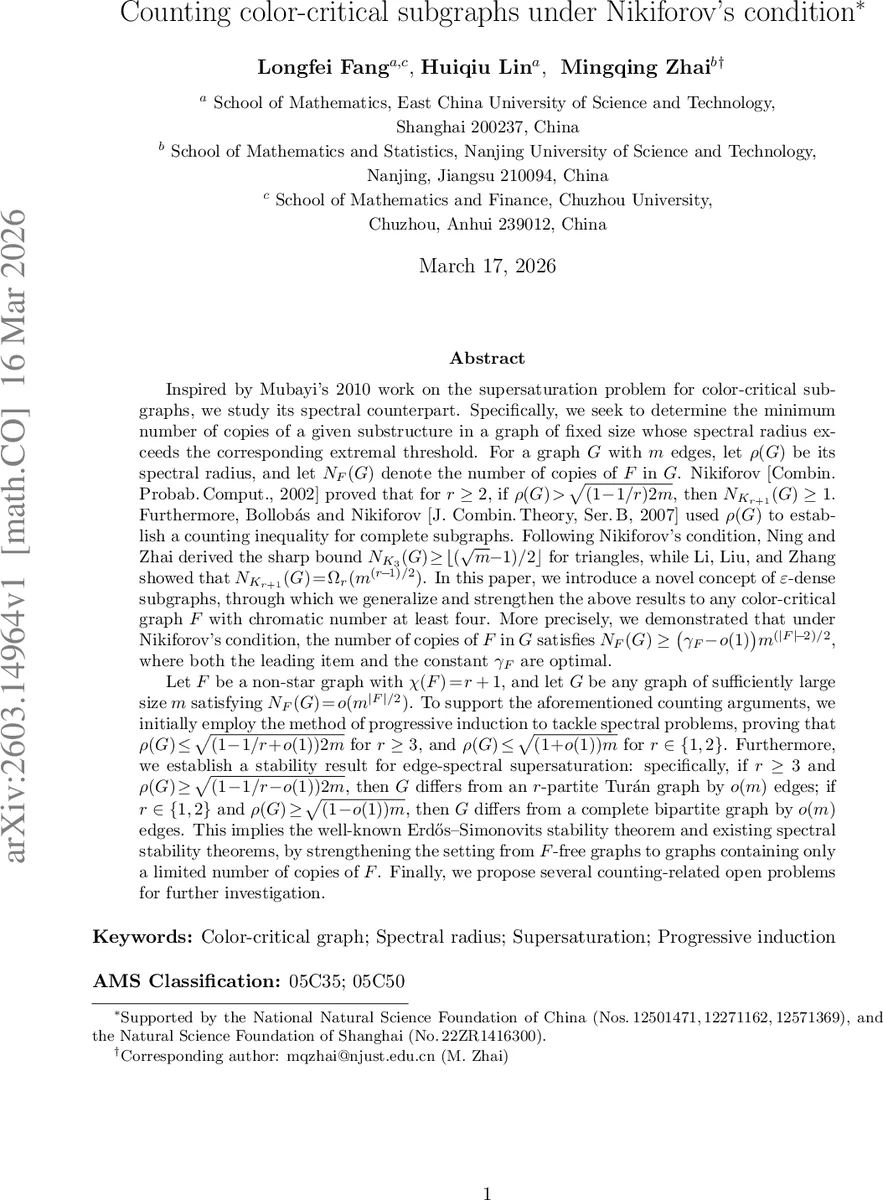
For a graph $G$ with $m$ edges, let $ρ(G)$ be its spectral radius, and let $N_F(G)$ denote the number of copies of $F$ in $G$. Nikiforov [Combin. Probab.,Comput., 2002] proved that for $r\geq 2$, if $ρ(G)>\sqrt{(1-1/r)2m}$, then $N_{K_{r+1}}(G)\geq 1$. Furthermore, Bollobás and Nikiforov [J. Combin. Theory, Ser. B, 2007] used $ρ(G)$ to establish a counting inequality for complete subgraphs. In this paper, we generalize and strengthen the above results to any color-critical graph $F$ with chromatic number at least four. More precisely, we demonstrated that under Nikiforov’s condition, the number of copies of $F$ in $G$ satisfies $N_F(G)\geq\big(γ_F-o(1)\big)m^{(|F|-2)/2},$ where both the leading item and the constant $γ_F$ are optimal. Let $F$ be a non-star graph with $χ(F)=r+1$, and let $G$ be any graph of sufficiently large size $m$ satisfying $N_F(G)=o(m^{|F|/2})$. To support the aforementioned counting arguments, we initially employ the method of progressive induction to tackle spectral problems, proving that $ρ(G)\leq\sqrt{(1-1/r+o(1))2m}$ for $r\geq 3$, and $ρ(G)\leq\sqrt{(1+o(1))m}$ for $r\in {1,2}$. Furthermore, we establish a stability result for edge-spectral supersaturation: specifically, if $r\geq 3$ and $ρ(G)\geq\sqrt{(1-1/r-o(1))2m}$, then $G$ differs from an $r$-partite Turán graph by $o(m)$ edges; if $r\in {1,2}$ and $ρ(G)\geq\sqrt{(1-o(1))m}$, then $G$ differs from a complete bipartite graph by $o(m)$ edges. This implies the well-known Erdos-Simonovits stability theorem and existing spectral stability theorems, by strengthening the setting from $F$-free graphs to graphs containing only a limited number of copies of $F$. Finally, we propose several counting-related open problems for further investigation.
💡 Research Summary
The paper studies the supersaturation problem for color‑critical graphs under a spectral condition originally due to Nikiforov. For a graph G with m edges let ρ(G) be its spectral radius and N_F(G) the number of copies of a fixed subgraph F. Nikiforov (2002) proved that if ρ(G) > √{(1‑1/r)·2m} then G contains at least one (r+1)-clique. Bollobás and Nikiforov later turned this into a counting inequality for complete subgraphs. This work extends those results to any color‑critical graph F with chromatic number at least four.
The authors first develop a “progressive induction” method to handle graphs that contain only o(m^{|F|/2}) copies of F. They prove sharp spectral upper bounds: for r≥3, ρ(G) ≤ √{(1‑1/r+o(1))·2m}, and for r∈{1,2}, ρ(G) ≤ √{(1+o(1))·m}. These bounds are shown to be optimal by constructing near‑extremal graphs that are either regular complete r‑partite (for r≥2) or stars (for r=1).
Next they introduce the notion of ε‑dense subgraphs and obtain a quantitative supersaturation theorem. Under Nikiforov’s condition, any sufficiently large graph G satisfies
N_F(G) ≥ (γ_F – o(1))·m^{(|F|‑2)/2},
where γ_F is an explicit constant depending only on F. The constant γ_F is derived from the leading term α_F in the function c(n,F), the minimum number of copies of F obtained by adding a single edge to the Turán graph T_{n,r}. In particular, for a color‑critical F with χ(F)=r+1≥4 they prove
N_F(G) ≥ ( 2r/(r‑1)·α_F – o(1) )·m^{|F|/2‑1},
unless G is a regular complete r‑partite graph. This result is asymptotically tight; the leading term and the coefficient cannot be improved.
The paper then establishes an edge‑spectral supersaturation stability theorem. If ρ(G) is within o(1) of the Nikiforov threshold, then G differs from an r‑partite Turán graph (or a complete bipartite graph when r=2) by o(m) edges. This yields a new proof of the classical Erdős–Simonovits stability theorem and of existing spectral stability results, but now the hypothesis is weakened from “F‑free” to “contains only o(n^{|F|}) copies of F”. A vertex‑spectral version is also derived, extending Nikiforov’s earlier vertex‑spectral stability theorem.
The authors carefully analyze the exact value of c(n,F) using “good” edges and proper r‑colorings of F−e, leading to Lemma 2.1 which gives c(n,F)=α_F n^{|F|‑2}+O(n^{|F|‑3}). This combinatorial insight feeds directly into the spectral bounds and supersaturation estimates.
Finally, the paper lists several open problems: determining the exact constant γ_F for specific families of color‑critical graphs, extending the theory to sparse regimes (e.g., m=O(n)), and exploring analogous results for other graph matrices such as the Laplacian or normalized adjacency matrix.
In summary, the work unifies supersaturation and spectral extremal graph theory for a broad class of color‑critical graphs, provides optimal quantitative bounds, and strengthens stability theorems by allowing a small number of forbidden subgraphs rather than none. This represents a significant advance in understanding how spectral radius controls subgraph counts and graph structure.
Comments & Academic Discussion
Loading comments...
Leave a Comment