Domination and packing in graphs
The dominating number $γ(G)$ of a graph $G$ is the minimum size of a vertex set whose closed neighborhoods cover all vertices of $G$, while the packing number $ρ(G)$ is the maximum size of a vertex set whose closed neighborhoods are pairwise disjoint…
Authors: Ákos Dúcz, Anna Gujgiczer
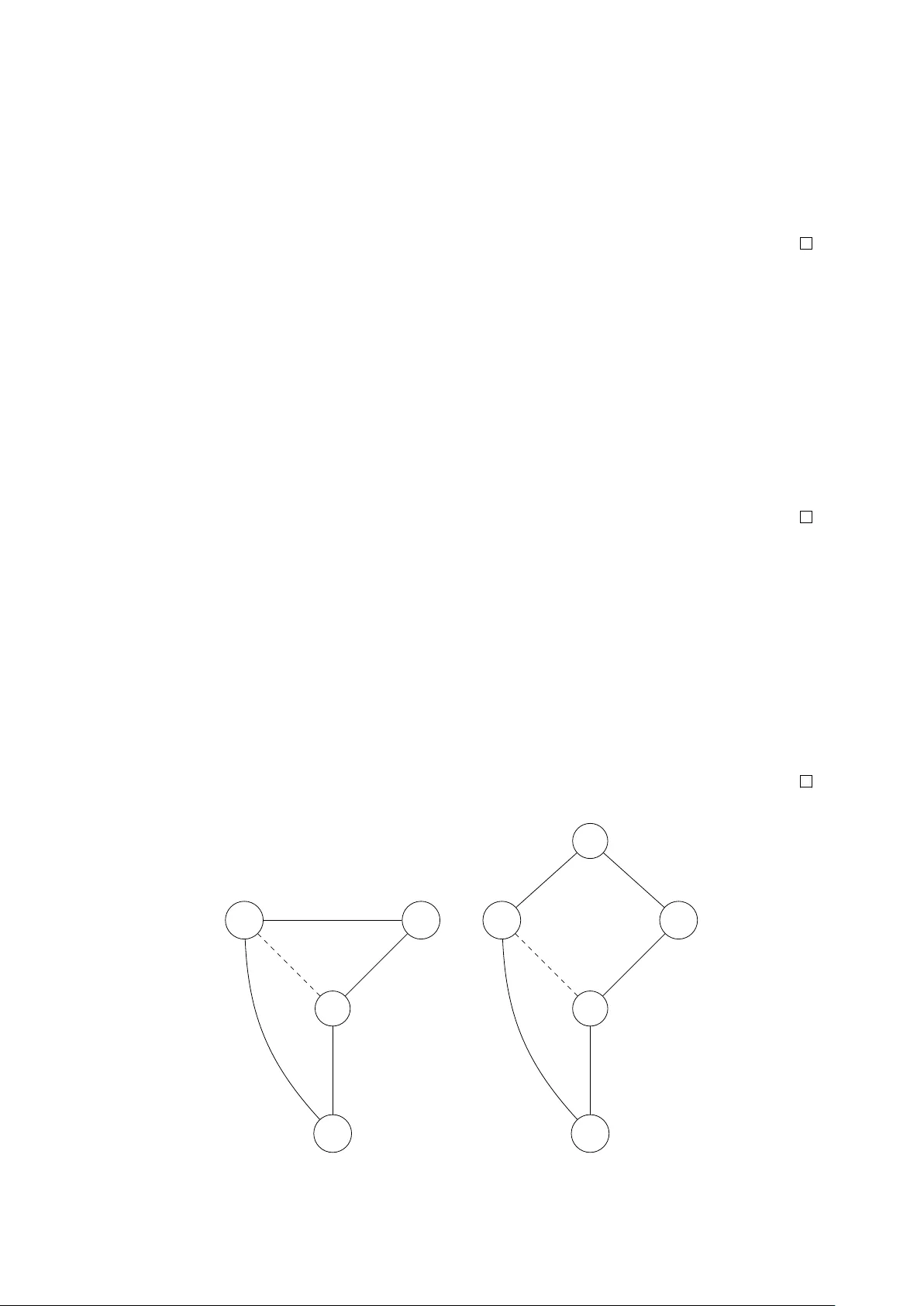
Domination and pac king in graphs ´ Ak os D ´ ucz 1 and Anna Gujgiczer 1,2,3 1 Dep artment of Computer Scienc e and Information The ory, Budap est University of T e chnolo gy and Ec onomics, Budap est, Hungary 2 HUN-REN Alfr ´ ed R´ enyi Institute of Mathematics, Budap est, Hungary 3 MT A–HUN-REN RI L end¨ ulet ”Momentum” Arithmetic Combinatorics R ese ar ch Gr oup, Budap est, Hungary F ebruary 2026 Abstract The dominating n umber γ ( G ) of a graph G is the minimum size of a vertex set whose closed neigh b orho o ds co ver all vertices of G , while the packing n umber ρ ( G ) is the maximum size of a vertex set whose closed neigh b orho o ds are pairwise disjoin t. In this pap er we in vestigate graph classes G for whic h the ratio γ ( G ) /ρ ( G ) is b ounded b y a constant c G for ev ery G ∈ G . Our main result is an improv ed upp er b ound on this ratio for planar graphs. W e also extend the list of graph classes admitting a b ounded ratio by sho wing this for ch ordal bipartite graphs and for homogeneously orderable graphs. In addition, we provide a simple, direct pro of for trees. 1 In tro duction Man y graph parameters come in pairs ( p ℓ , p u ) where one parameter - say p ℓ - pro vides a trivial lo w er bound on the other. A natural question in suc h situations is whether the gap b et ween the t wo can grow arbitrarily large, and if so, whether p u can still b e b ounded ab o ve by some function of p ℓ . If this is impossible in general, one ma y ask whether such a b ound exists within sp ecific graph classes. A classical example is the relationship b etw een the clique n umber ω ( G ) and the c hro- matic n umber χ ( G ): the searc h for χ -b ounded graph classes G , in whic h χ ( G ) can b e upp er b ounded b y a function of ω ( G ) for ev ery G ∈ G , fits exactly into this framew ork. In this pap er w e study another suc h pair of parameters: the pac king num b er ρ ( G ) and the domination n umber γ ( G ). Definition 1 (P acking n umber) . F or a gr aph G , its packing num b er ρ ( G ) is the maximum size of a vertex set P ⊆ V ( G ) whose close d neighb orho o ds ar e p airwise disjoint. Definition 2 (Domination num b er) . F or a gr aph G , its domination num b er γ ( G ) is the minimum size of a vertex set D ⊆ V ( G ) such that every vertex of G lies in the close d neighb orho o d of some vertex of D . 1 Observ e that the inequalit y ρ ( G ) ≤ γ ( G ) holds trivially for every graph G , since no t w o v ertices in a packing can b e dominated by the same v ertex in a dominating set. Similarly to the situation with the clique num b er and the c hromatic num b er, the problems of computing γ ( G ) and ρ ( G ) admit formulations as in teger programs, and the linear programming relaxations of these formulations are dual to eac h other. Domination num b er γ ( G ) : P acking num b er ρ ( G ) : minimize X v ∈ V ( G ) x v maximize X v ∈ V ( G ) y v s.t. X u ∈ N [ v ] x u ≥ 1 , ∀ v ∈ V ( G ) s.t. X u ∈ N [ v ] y u ≤ 1 , ∀ v ∈ V ( G ) , x v ∈ { 0 , 1 } , ∀ v ∈ V ( G ) y v ∈ { 0 , 1 } , ∀ v ∈ V ( G ) The fractional v ersions of the domination and pac king num b ers are denoted b y γ f ( G ) and ρ f ( G ), resp ectively . Based on the ab o v e observ ations, these four parameters satisfy the following relations: ρ ( G ) ≤ ρ f ( G ) = γ f ( G ) ≤ γ ( G ) The gap betw een the fractional and integral v arian ts of these parameters has also b een studied. A w ell-known result in this direction, due to Lo v´ asz [Lov75], is the following: Theorem (Lov´ asz [Lo v75]) . F or every gr aph G , we have γ ( G ) γ f ( G ) ≤ l og (∆( G )) , wher e ∆( G ) denotes the maximum de gr e e of G . It is also a natural question whether b etter b ounds on the ratio for the fractional and in tegral v ersions of these parameters can b e obtained for sp ecial graph classes. In this paper we fo cus on the gap b etw een γ ( G ) and ρ ( G ) and in particular w e restrict our atten tion to graph classes for whic h there exists a constan t c such that γ ( G ) ≤ c ρ ( G ) holds for every graph in the class. Note, that this b ound immediately gives us an in tegrality b ound as w ell. Also observ e, that a simple general upp er b ound on the domination– pac king ratio can b e giv en by the the maxim um degree. Indeed, for any graph G , the union of the op en neighborho o ds of the vertices in a maxim um pac king forms a dominating set, whic h implies γ ( G ) ≤ ∆( G ) ρ ( G ). Our in terest is therefore in smaller, degree-indep enden t b ounds for sp ecific graph classes. Throughout the paper w e use the notions of neigh b orho o ds and second neigh b orho o ds, so we collect the corresp onding notation here for con v enience. Unless stated otherwise, all graphs considered in this pap er are simple. dist G ( u, v ) : The distanc e betw een t wo vertices v , u ∈ V ( G ), denoted by dist G ( u, v ) - or if it is clear from the con text just dist ( u, v ) - is the length of the shortest path b et w een u and v in G . N G ( v ) : The op en neighb orho o d N G ( v ) of a v ertex v ∈ V ( G ) con tains all the vertices u ∈ V ( G ) for which dist G ( u, v ) = 1. N 2 G ( v ) : The se c ond op en neighb orho o d N 2 G ( v ) of a vertex v ∈ V ( G ) contains all the vertices u ∈ V ( G ) for which dist G ( u, v ) = 1 or 2. N G [ v ]: The close d neighb orho o d N G [ v ] of a v ertex v ∈ V ( G ) contains all the v ertices u ∈ V ( G ) for which dist G ( u, v ) ≤ 1, so N G [ v ] = N G ( v ) ∪ { v } . 2 N 2 G [ v ]: The se c ond close d neighb orho o d N 2 G [ v ] of a vertex v ∈ V ( G ) con tains all the v ertices u ∈ V ( G ) for which dist G ( u, v ) ≤ 2, so N 2 G [ v ] = N 2 G ( v ) ∪ { v } . N G [ X ]: The close d neighb orho o d N G [ X ] of a v ertex set X ⊆ V ( G ) is the union of all the closed neighborho o ds of v ∈ X , i.e. N G [ X ] = S v ∈ X N G [ v ]. As in the notation of the distance, we may omit G from the low er index if it is clear from the context. In the next subsections we first summarize the previous work in this area, and then w e presen t our results. 1.1 Related w ork Some of the earliest results concern classes where the tw o parameters coincide. In par- ticular, it is known that γ ( G ) = ρ ( G ) holds for trees [MM75], for strongly c hordal graphs [F ar84], and for dually c hordal graphs [BCD98]. More generally , sev eral graph classes are kno wn to admit a constant b ound on the ra- tio γ ( G ) /ρ ( G ). Cactus graphs were sho wn to satisfy γ ( G ) ≤ 2 ρ ( G ) in [LRR13], and con- nected biconv ex graphs w ere recently shown to admit the same b ounded ratio in [GG25]. Constan t upp er b ounds on γ ( G ) /ρ ( G ) for outerplanar graphs and for bipartite cubic graphs w ere obtained in [GG25], namely γ ( G ) ≤ 3 ρ ( G ) in the outerplanar case and γ ( G ) ≤ 120 49 ρ ( G ) for bipartite cubic graphs. F urther examples of graph classes admitting b ounded domination-packing ratios include asteroidal triple-free graphs, con vex graphs and unit disk graphs [BCGY25], whose b est known b ounds are 3 , 3 and 32 respectively . B¨ ohme and Mohar [BM03] studied co vering and pac king b y balls (a generalization of domination and pac king, corresp onding to balls of larger fixed radius) in graphs excluding a complete bipartite graph as a minor; in particular, their results yield constant bounds on γ ( G ) /ρ ( G ) for sev eral minor-free classes, including graphs of bounded genus and hence planar graphs. A more systematic sufficient condition was later given by Dvo ˇ r´ ak [Dvo13] in terms of we ak c oloring numb ers ( w col 1 and w col 2 ). Since we will not w ork directly with this notion, we do not recall its definition here; it suffices to note that b ounded weak coloring n umbers pro vide one con v enient wa y to formalize sparsity , and that [Dvo13] implies that a b ound on w col 2 ( G ) yields a constant b ound on γ ( G ) /ρ ( G ). F or further details, we refer the reader to [Dv o13, HLMR25]. These results suggested that bounded domination–packing ratios migh t b e closely tied to sparsity . How ever, it w as sho wn in [BCGY25] that γ ( G ) /ρ ( G ) is b ounded b y a constan t for 2-degenerate graphs, which do not fall under these sparsit y assumptions. V ery recently , in [BDMM26] the authors gav e an exact characterization of monotone graph classes G of b ounded av erage degree for which the domination num b er of every G ∈ G is b ounded by a linear function of its pac king n umber. On the negativ e side, Burger et al. [BHvV09] observ ed that the Cartesian pro duct of t wo complete graphs has domination num b er linear in the num b er of v ertices while its pac king n um b er is 1, implying that the ratio γ ( G ) /ρ ( G ) can b e unbounded, even for bipartite graphs. More recen tly , Dv o ˇ r´ ak [Dvo19] show ed that the ratio is un b ounded for the class of graphs with arb oricity 3. F urther examples where the domination–pac king ratio is un b ounded are split graphs, and consequently also c hordal graphs [BCGY25]. Moreo ver, unboundedness holds already for 3-degenerate graphs [Dv o13]. Tw o natural graph classes remained unresolv ed for the b oundedness of γ ( G ) /ρ ( G ), namely c hordal bipartite graphs and homogeneously orderable graphs (see the summary 3 figure in [BCGY25]). More broadly , even for man y graph classes where b oundedness is established, the optimal constant is typically unknown: existing arguments often provide explicit b ounds, but their sharpness is op en in most cases. 1.2 Our results In this pap er we obtain the following results. • W e improv e the b est previously kno wn constan t for planar graphs b y sho wing that γ ( G ) ≤ 7 ρ ( G ) for every planar graph G , strengthening the earlier b ound of 10. • W e settle t wo previously op en cases b y proving that γ ( G ) ≤ 2 ρ ( G ) holds for ev ery c hordal bipartite graph and for ev ery homogeneously orderable graph. • W e giv e a simple direct pro of for trees. While the statement is classical, to our kno wledge existing pro ofs in the literature are stated in the more general setting of distance domination and packing and are relativ ely inv olved. The organization of the pap er is as follows. W e first prov e the impro ved b ound for planar graphs, whic h constitutes our main result. Next, w e treat the tw o new graph classes, homogeneously orderable graphs and c hordal bipartite graphs. Finally , w e give the short pro of for trees, and we conclude with a discussion of remaining op en questions. 4 2 Planar graphs The main difficult y of using induction to pro ve domination/pac king b ounds is that re- mo ved vertices may still affect distances in the resulting smaller graph. A wa y to cir- cum ven t this is b y using a stronger induction h yp othesis. An example of this is given in [BCGY25], where the authors define ( X , Y )-dominating sets and ( X , Y )-pac kings for certain subsets X , Y ⊆ V ( G ). Inspired by these methods, w e in tro duce the following definitions: Definition 3 (X-domination) . L et G b e a gr aph and X ⊆ V ( G ) . A set D ⊆ V ( G ) is an X -dominating set of G if N [ D ] ∪ X = V ( G ) . The minimal size of such a D for fixe d X is denote d γ X ( G ) . W e can similarly generalize packing as follo ws: Definition 4 (X-packing) . L et G b e a gr aph and X ⊆ V ( G ) . A set P ⊆ V ( G ) is an X -p acking of G if X ∩ P = ∅ and N [ x ] ∩ N [ y ] = ∅ for any two (differ ent) x, y ∈ P . The maximal size of such a P for fixe d X is denote d ρ X ( G ) . These definitions can b e understo o d as a simplification of the concepts in tro duced in [BCGY25]. In order to pro v e that γ ( G ) ≤ 7 ρ ( G ) for all planar graphs, we will pro ve the follo wing stronger statement: γ X ( G ) ≤ 7 ρ X ( G ) (1) for all planar G and all X ⊆ V ( G ). Our theorem follo ws b y substituting X = ∅ . 2.1 Prop erties of a minimal counterexample Let G and X b e a minimal counterexample to (1), in the sense that | V ( G ) | + | E ( G ) | is minimal. W e can pro ve the follo wing lemmas ab out ( G, X ): Lemma 2.1. X is an indep endent set in G . Pr o of. Suppose there exist tw o v ertices x 1 , x 2 ∈ X with an edge e b etw een them. Consider G ′ = G − e . By the minimalit y of G , w e hav e γ X ( G ′ ) ≤ 7 ρ X ( G ′ ). Therefore w e can find an X -domination-packing pair ( D ′ , P ′ ) in G ′ with | D ′ | ≤ 7 | P ′ | . Since by definition X ∩ P ′ = ∅ and x 1 , x 2 ∈ X , one can easily c heck that P ′ is also an X -pac king in G , b ecause the edge e cannot b e part of a path of length 1 or 2 b etw een t wo vertices in P ′ . Similarly , since the vertices of X need not b e dominated by an X - dominating set b y definition, D ′ is also an X -dominating set in G , a con tradiction. Lemma 2.2. F or any vertex v ∈ V ( G ) with d ( v ) ≤ 7 we have v ∈ X . Pr o of. Let v b e a vertex s.t. v ∈ X and d ( v ) ≤ 7. Let X ′ = X ∪ N 2 ( v ), and ( D ′ , P ′ ) b e an X ′ -domination-pac king pair in G ′ = G − v with | D ′ | ≤ 7 | P ′ | (which exists b y minimality). Let D = D ′ ∪ N ( v ). D is clearly an X -dominating set of G with | D | ≤ | D ′ | + 7, since N ( v ) dominates all of N 2 [ v ] with at most 7 v ertices, and D ′ is an X -dominating set of the rest of G b y definition. No w let P = P ′ ∪ { v } , and observ e that P is an X -pac king of G since X ′ con tains N 2 ( v ), and b ecause v / ∈ X . Therefore ( D , P ) is an X -domination-pac king pair in G with | D | ≤ 7 | P | , a con tradiction. 5 Lemma 2.3. We have d ( x ) ≥ 2 for every vertex x ∈ X . Pr o of. T rivially , there are no isolated vertices in G . F or a vertex x ∈ X of degree one, consider G ′ = G − x , and ( D ′ , P ′ ) an X -domination-packing pair in G ′ with | D ′ | ≤ 7 | P ′ | . Since the addition of a degree one v ertex cannot change distances b etw een any other v ertices, P ′ is also an X -pac king in G . But since x ∈ X , D ′ is also an X -dominating set in G , again a con tradiction. Definition 5. L et x ∈ X b e a vertex of G . We wil l c al l a p air { a, b } ⊆ N ( x ) , ( a = b ) ”b ad”, if either ( a, b ) ∈ E ( G ) or { a, b } ⊆ N ( w ) for some w ∈ X with w = x , and ”go o d” otherwise. Lemma 2.4. If x ∈ X is a de gr e e two vertex in G with neighb ors a, b ∈ V ( G ) , then { a, b } is a go o d p air. Pr o of. Suppose that x, a, b ∈ V ( G ) con tradict Lemma 2.4. Consider G ′ = G − x and X ′ = X \ x . Let ( D ′ , P ′ ) b e an X ′ -domination-pac king pair in G ′ with | D ′ | ≤ 7 | P ′ | by minimalit y . Clearly D ′ is still an X -dominating set in G b ecause x ∈ X . Since adding x to G ′ do es not c hange the distances betw een an y t wo vertices in V ( G ′ ) (b ecause ( a, b ) is a bad pair), we hav e that P ′ is an X -pac king in G , whic h is a con tradiction. Lemma 2.5. If x ∈ X is a de gr e e thr e e vertex in G , then ther e ar e at le ast two go o d p airs in N ( x ) . Pr o of. Suppose this fails. Since d ( x ) = 3, x has at least 2 bad neigh b or pairs, and these pairs ha ve some common v ertex. W e will denote the t w o bad pairs { n 1 , n 2 } ⊂ N ( x ) and { n 1 , n 3 } ⊂ N ( x ) with the common vertex b eing n 1 WLOG. Consider G ′ = G − ( x, n 1 ), and ( D ′ , P ′ ) an X -domination-packing pair in G ′ with | D ′ | ≤ 7 | P ′ | by minimalit y . D ′ is an X -dominating set of G b ecause adding back the edge ( x, n 1 ) cannot ruin X -domination. But since { n 1 , n 2 } and { n 1 , n 3 } are bad pairs, at most one of n 1 , n 2 , n 3 can b e in P ′ . W e also ha ve x ∈ P ′ b ecause x ∈ X , and therefore the addition of ( x, n 1 ) to G ′ do es not ruin the X -packing prop ert y of P ′ . Since ( D ′ , P ′ ) is an X -domination-packing pair in G with | D ′ | ≤ 7 | P ′ | , we hav e a con tradiction. x n 1 n 2 n 3 x n 1 n 2 n 3 w Figure 1: Possible configurations of N ( v ) in the pro of of Lemma 2.5 (not exhaustiv e). 6 2.2 Disc harging metho d Lemma 2.6. If H is a simple c onne cte d planar gr aph and I is and indep endent set in H , then we c an add new e dges to H such that: • I is stil l indep endent in the new gr aph H ′ . • H ′ is planar (but not ne c essarily simple). • Every fac e of H ′ is a triangle. Pr o of. Let F be a non-triangular face of H . It is easy to see that F can b e sub divided b y adding a new edge in such a w ay that b oth new faces ha ve at least 3 b ounding edges, and such that I remains indep endent. Rep eating this pro cess until all faces are triangles giv es our lemma. R emark. T o illustrate that H ′ is not necessarily simple, consider triangulating C 4 with I b eing tw o opp osite v ertices: the triangulation of the inner and outer face will yield the addition of edges b etw een the same t wo vertices, V ( C 4 ) \ I . Lemma 2.7. L et H b e a simple planar gr aph with minimum de gr e e 4 . Then H has an e dge ( x, y ) with d ( x ) ≤ 7 and d ( y ) ≤ 7 . Pr o of. W e ma y assume that H is connected (otherwise we just tak e some comp onent of H ). Let I denote the set of vertices in H with d ( v ) ≤ 7. If I is not indep endent, the statemen t follows. Supp ose that I is indep enden t. By Lemma 2.6, w e can add new edges to H to obtain H ′ , every face of which is a triangle and in whic h I is still indep endent. Let us assign a c harge of d ( v ) − 6 to ev ery v ertex v of H ′ . By Euler’s form ula, we ha ve that the total sum of these c harges is negative. Now let eac h vertex v with d ( v ) ≥ 8 giv e a charge of 1 / 2 to eac h of it’s neighbors in I (if there are multiple edges b et ween v and w , then we coun t w as a ’neigh b or’ multiple times). Since H ′ is triangulated and I is indep enden t in H ′ , such a vertex v giv es c harge to at most half of it’s neighbors. Thus ev ery v ertex with d ( v ) ≥ 8 has nonnegative c harge after redistribution. If d ( v ) ≤ 7 then all of its neighbors ha ve degree at least 8, therefore v m ust receive 1 / 2 charge from each neighbor. The initial c harge of v is smallest in case d ( v ) = 4, whic h giv es a charge of d ( v ) − 6 + 4 · (1 / 2) = 0 after discharging. Therefore ev ery v ertex has nonnegativ e c harge at the end of the pro cedure, whic h is a con tradiction. 2.3 Finishing the pro of Let X ≤ 3 = { x | x ∈ X , d ( x ) ≤ 3 } . By Lemma 2.3, this set only con tains vertices of degrees 2 and 3. By Lemma 2.2, w e also hav e that ev ery v ∈ V ( G ) with d ( v ) ≤ 3 is in X ≤ 3 . After fixing a planar embedding of G , w e apply the follo wing op eration: for eac h v ertex x ∈ X ≤ 3 , w e select a maximal set of go o d pairs P x in N ( x ). Note that | P x | ≥ d ( x ) − 1 b y Lemmas 2.4 and 2.5 ab o ve. W e now remov e ev ery v ertex x ∈ X ≤ 3 from G and sim ultaneously add ev ery edge in P x to E ( G ). W e denote the resulting graph by H , and pro ve the follo wing statemen ts: (1) The remaining vertices of X are indep enden t in H . (2) d H ( v ) ≥ d G ( v ) for all v ∈ V ( H ). 7 (3) H is simple and planar. T o prov e (1), we need to chec k that no new edges w ere added b etw een tw o vertices in X . Indeed, since the new edges in H are all go o d pairs in some N ( x ) with x ∈ X , and b ecause X is indep endent in G , we cannot hav e added an edge b etw een tw o v ertices in X . The second statemen t follo ws from Lemmas 2.4 and 2.5. When remo ving a vertex x ∈ X ≤ 3 during our op eration, we decrease the degrees of its neighbors by one. Ho wev er, w e also add at least d ( x ) − 1 new edges to N ( x ), and it is easy to chec k that this increases the degrees of each neighbor b y at least one, since d ( x ) ≤ 3. In (3), simplicity follows from the definition of a go o d pair, and planarit y is easy to c heck since d ( x ) ≤ 3 for each remov ed v ertex. F rom (1) and (2) it follows that the set of vertices in H with d ( v ) ≤ 7 is indep endent. But H is also simple and planar by (3), which con tradicts Lemma 2.7, as H has minimum degree 4. Th us our minimal coun terexample ( G, X ) cannot exist, and the theorem is pro ved. 3 Homogeneously orderable graphs In order to talk ab out homogeneously orderable graphs, we first need to define the follow- ing notions. Let G b e an undirected graph. W e call a set A ⊆ V ( G ) , A = ∅ homogeneous, iff every vertex of A has the same neigh b orho o d in V ( G ) \ A . A vertex v of G is h-extremal, if there exists a set D ⊆ N 2 [ v ] such that D is homoge- neous in G , and D dominates N 2 [ v ]. In this case, D is a homogeneous dominating set of N 2 [ v ]. W e need the following lemma from [BDN97] ab out homogeneous dominating sets. W e also include the pro of here for completeness. Lemma 3.1. [BDN97] L et v b e a h-extr emal vertex of G . Then ther e exists a homo gene ous dominating set D ′ of N 2 [ v ] , such that D ′ ⊆ N [ v ] . Pr o of. Let D b e any homogeneous dominating set of N 2 [ v ]. If v / ∈ D , then some v ertex x ∈ N ( v ) ∩ D m ust dominate v , but then D ⊆ N ( v ) since D is homogeneous, so D ′ = D suffices. If v ∈ D , then let H = ( N 2 [ v ] \ N [ v ]). If H = ∅ , we are done since D ′ = D suffices. Because D is homogeneous, no x ∈ D can ha ve a neighbor in H \ D (since v has no neigh b or in H ). But H must b e dominated b y D , therefore H ⊆ D . By homogeneity , this implies that every vertex in H is connected to every vertex of N ( v ) \ D , since v ∈ D . W e also ha ve that ev ery v ertex of N ( v ) ∩ D is connected to every vertex of N ( v ) \ D by homogeneit y . But then D ′ = N ( v ) \ D is a homogeneous dominating set of N 2 [ v ]. A graph G is homogeneously orderable, if there exists an ordering of its v ertices suc h that ev ery vertex v is h-extremal in the subgraph induced by v and all subsequent vertices in this order. W e call this vertex order the homogeneous ordering of G . Theorem 3.2. γ ( G ) ≤ 2 · ρ ( G ) for any homo gene ously or der able gr aph G . Pr o of. Choose a homogeneous ordering of G , and index V ( G ) = { v 1 , v 2 , ..., v n } using this ordering. Let i ( v ) denote the index of a v ertex v , so i ( v k ) = k . 8 Let P b e a maximal pac king in G with P v ∈ P i ( v ) as small as p ossible. F or each v k ∈ V ( G ), w e hav e that v k is h-extremal in the subgraph induced by V ( G ) ≥ k = { v | v ∈ V ( G ) , i ( v ) ≥ k } . Then by Lemma 3.1, N [ v ] con tains a homogeneous dominating set of N 2 [ v ] in this graph. Let f ( v k ) b e any arbitrary v ertex in this dominating set. Note, that { v k , f ( v k ) } dominates N 2 [ v k ] in G ≥ k b y the definition of homogeneous dominating set. No w set D = { f ( v ) | v ∈ P } ∪ P , and supp ose there is a vertex w in G that is not dominated b y D . Clearly w ∈ N [ P ]. Then there must be some z ∈ P with dist ( w , z ) = 2, otherwise P w ould not b e maximal. W e cannot hav e i ( z ) < i ( w ), since then D w ould dominate w b y definition. Therefore i ( w ) < i ( z ). Observ e that there cannot exists an y other z ′ = z with dist ( w, z ′ ) = 2 , i ( w ) < i ( z ′ ) and z ′ ∈ P , since then f ( w ) would b e adjacen t to both of them, contradicting z , z ′ ∈ P . Since z is unique with this prop erty , P ′ = ( P \ { z } ) ∪ { w } is also a packing in G , which contradicts the minimalit y of P in the index sum. The constant 2 is b est possible, as evidenced b y C 4 . 4 Chordal bipartite graphs A bipartite graph G = ( A, B , E ) is called c hordal bipartite, if ev ery cycle of G with length at least 6 has a chord. A graph G is strongly c hordal if it is chordal, and every cycle C of G with even length at least 6 has an o dd chord (a chord connecting t wo v ertices of o dd distance apart in C ). Lemma 4.1. [BLS99] L et G = ( A, B , E ) b e a bip artite gr aph, and let spl it A ( G ) b e the gr aph obtaine d fr om G by making A a clique. Then spl it A ( G ) is str ongly chor dal iff G is chor dal bip artite. F or proving a b ounded domination-packing ratio for chordal bipartite graphs we will only need the direction of this ab ov e mentioned lemma, that if G is chordal bipartite then spl it A ( G ) is strongly chordal. W e include the pro of of this for completeness. Pr o of. If G is chordal bipartite, then G ′ = spl it A ( G ) is clearly c hordal, since an y cycle of G ′ with length at least 4 must ha ve at least tw o nonconsecutive v ertices in A . Let C b e a cycle of G ′ with an even length of at least 6. If C con tains no newly added edges (those in E ( G ′ ) \ E ( G )), then it must ha v e an o dd chord since G is chordal bipartite and E ( C ) ⊆ E ( G ). If C do es con tain some new edges, then by parit y it must con tain an ev en n umber of them. If there are at least four of these, then we can c ho ose tw o such that they hav e no common v ertex, and if there are exactly t wo then we will choose those. WLOG let the c hosen edges b e ( x, y ) , ( z , w ) ∈ E ( C ) with x, y , z , w ∈ A , and such that y = z is the common vertex if there is one. If y = z , then one of ( x, z ) , ( x, w ) , ( y , z ) , ( y , w ) must b e an o dd chord, since C has length at least 6. Otherwise ( x, y ) and ( y , w ) are the only new edges in C , therefore ( y , v ) is an o dd c hord of C for any other v ∈ V ( C ) ∩ A \ { x, w } . Using this lemma, and the fact that γ ( G ) /ρ ( G ) equals 1 for strongly c hordal graphs [F ar84], w e pro ve the follo wing theorem: 9 Theorem 4.2. γ ( G ) ≤ 2 · ρ ( G ) for every chor dal bip artite gr aph G . Pr o of. Let G = ( A, B , E ) and let G A = split A ( G ) and G B = split B ( G ) b e defined as in Lemma 4.1. Since G A and G B are strongly c hordal, we ha v e γ ( G A ) = ρ ( G A ) and similarly for G B . Let D A , D B b e minimal dominating sets and P A , P B b e maximum packings in G A and G B , resp ectiv ely . Since P A and P B are also packings in G , w e hav e ρ ( G ) ≥ max ( | P A | , | P B | ). No w observ e that D A ∪ D B is a dominating set in G : let v b e an arbitrary vertex of G , WLOG sa y v ∈ A . Then the vertex d B ∈ D B dominating v in G B will dominate it in G as well. Therefore γ ( G ) ≤ 2 · max ( | D A | , | D B | ). Since | D A | = | P A | and | D B | = | P B | , our theorem follows. The constant 2 is b est possible, as evidenced again by C 4 . 5 T rees T o our knowledge, the only pro ofs concerning trees in literature pro vide b ounds for general distance domination and packing, and are relativ ely inv olved. Here, we give a simple, direct pro of of the follo wing theorem: Theorem 5.1. γ ( T ) = ρ ( T ) for every tr e e T . Pr o of. W e only need to pro v e γ ( T ) ≤ ρ ( T ). Cho ose some vertex v ∈ V ( T ) as the ”ro ot”, and suppose that P is a maximal pac king of T with P p ∈ P dist ( v , p ) as large as p ossible. F or eac h w ∈ V ( T ), w e can define par ent ( w ) as the first vertex on the path from w to the ro ot. In case w = v , w e define par ent ( v ) = v . Consider D = { par ent ( p ) | p ∈ P } . Supp ose that there is some v ertex w not dominated b y D . Since w / ∈ P , there is some p w ∈ P at distance at most 2 from w (otherwise P w ould not b e maximal). Notice that p w m ust either b e par ent ( w ) or par ent ( par ent ( w )), since otherwise w would b e dominated by D . Since b oth of these can’t be in P , we ha ve that p w is the only v ertex in P with dist ( p w , w ) ≤ 2. But since dist ( v , p w ) < dist ( v , w ), ( P \ { p w } ) ∪ { w } (which is also a pac king) contradicts the maximalit y of P in the distance sum. 6 Summary In this w ork we studied graph classes G for which the domination–pac king ratio γ ( G ) /ρ ( G ) is b ounded b y a constant for all G ∈ G . W e settle tw o previously op en cases by proving a constan t b ound of 2 for c hordal bipartite graphs and for homogeneously orderable graphs. W e also improv e the best explicit constant known for planar graphs: w e sho w that ev ery planar graph satisfies γ ( G ) ≤ 7 ρ ( G ), improving the previously b est b ound 10. This constitutes our main technical contribut ion. F or c hordal bipartite graphs and for homogeneously orderable graphs, our b ound of 2 is sharp. In contrast, we do not exp ect the planar constant to b e optimal. A natural remaining question is therefore whether the planar b ound can be impro v ed further. The b est p ossible upp er b ound for planar graphs is 3, which can b e seen by taking the graph in Figure 2. This graph w as given in [GH02] as an example for G ha ving domination n umber 3 and radius 2 (therefore packing n um b er 1). 10 Figure 2: A planar graph with domination n um b er 3 and packing num b er 1. W e conjecture that the constan t b ound for planar graphs is 3, i.e. that every planar graph G satisfies γ ( G ) ≤ 3 ρ ( G ). The problem of b ounding γ ( G ) /ρ ( G ) remains op en for many geometric graph classes as w ell, such as in tersection graphs of axis-parallel rectangles in the plane and of axis-parallel b o xes in three dimensions. 7 Ac kno wledgmen ts Anna Gujgiczer was supp orted by the Lend¨ ulet ”Momen tum” program of the Hungarian Academ y of Sciences (MT A). References [BCD98] Andreas Brandst¨ adt, Victor D. Chep oi, and F eo dor F. Dragan. The algo- rithmic use of h yp ertree structure and maximum neighbourho o d orderings. Discr ete Applie d Mathematics , 82(1):43–77, 1998. [BCGY25] Marthe Bonamy , M´ onik a Csik´ os, Anna Gujgiczer, and Y elena Y uditsky . On graph classes with constan t domination-packing ratio. arXiv pr eprint , 2025. [BDMM26] Marthe Bonam y , Zdenˇ ek Dv o ˇ r´ ak, Luk as Mic hel, and David Mik ˇ san ´ ık. Char- acterization of sparse monotone graph classes with b ounded domination-to- 2-indep endence ratio. arXiv pr eprint , 2026. [BDN97] Andreas Brandst¨ adt, F eo dor F Dragan, and F alk Nicolai. Homogeneously orderable graphs. The or etic al Computer Scienc e , 172(1-2):209–232, 1997. [BHvV09] Alewyn P . Burger, Mic hael A. Henning, and Jan H. v an V uuren. On the ratios b et ween packing and domination parameters of a graph. Discr ete Mathemat- ics , 309(8):2473–2478, 2009. [BLS99] Andreas Brandst¨ adt, V an Bang Le, and Jeremy P Spinrad. Gr aph classes: a survey, Cor ol lary 8.3.2, p. 129 . SIAM, 1999. [BM03] Thomas B¨ ohme and Bo jan Mohar. Domination, packing and excluded mi- nors. Ele ctr onic Journal of Combinatorics , 10, 2003. 11 [Dv o13] Zden ˇ ek Dvo ˇ r´ ak. Constan t-factor appro ximation of the domination num b er in sparse graphs. Eur op e an Journal of Combinatorics , 34(5):833–840, 2013. [Dv o19] Zden ˇ ek Dv o ˇ r´ ak. On distance r -dominating and 2 r -indep endent sets in sparse graphs. Journal of Gr aph The ory , 91(2):162–173, 2019. [F ar84] Martin F arb er. Domination, indep endent domination, and dualit y in strongly c hordal graphs. Discr ete Applie d Mathematics , 7(2):115–130, 1984. [GG25] Renzo G´ omez and Juan Guti´ errez. Domination and pac king in graphs. Dis- cr ete Mathematics , 348(1):114393, 2025. [GH02] W ayne Go ddard and Mic hael A Henning. Domination in planar graphs with small diameter. Journal of Gr aph The ory , 40(1):1–25, 2002. [HLMR25] J¸ cdrzej Ho dor, Hoang La, Piotr Micek, and Cl´ ement Ram baud. W eak coloring n umbers of minor-closed graph classes. In Pr o c e e dings of the 2025 A nnual A CM-SIAM Symp osium on Discr ete Algorithms (SOD A) , pages 3325–3334. SIAM, 2025. [Lo v75] L´ aszl´ o Lo v´ asz. On the ratio of optimal in tegral and fractional co vers. Discr ete Mathematics , 13(4):383–390, 1975. [LRR13] Christian L¨ ow enstein, Dieter Rautenbac h, and F riedrich Regen. Chirapto- phobic co c kroaches ev ading a torch light. A rs Combinatoria , 111:181–192, 2013. [MM75] Amram Meir and John W. Mo on. Relations b et w een pac king and co vering n umbers of a tree. Pacific Journal of Mathematics , 61:225–233, 1975. 12
Original Paper
Loading high-quality paper...
Comments & Academic Discussion
Loading comments...
Leave a Comment