Cryogenic Magnomechanics for Thermometry Applications
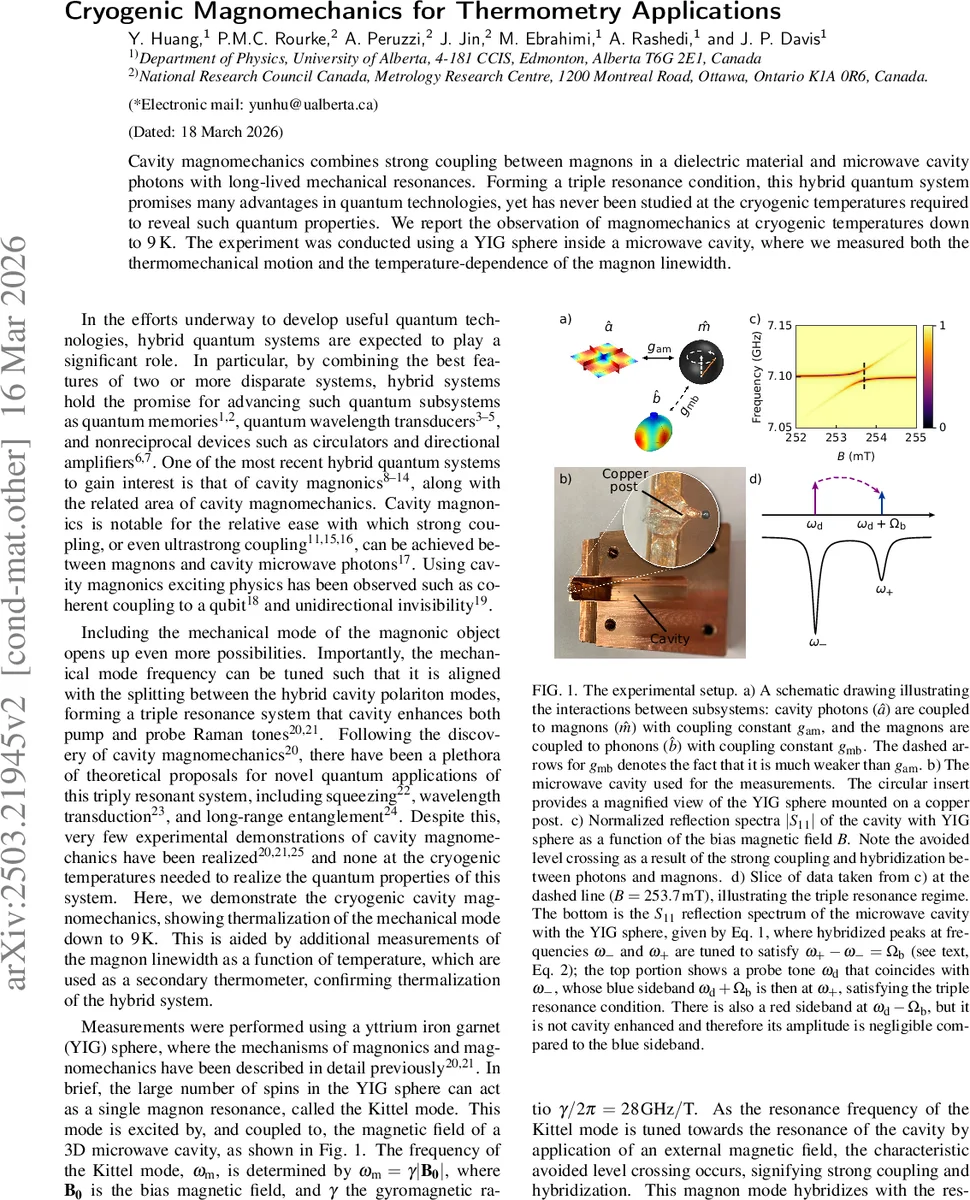
Cavity magnomechanics combines strong coupling between magnons in a dielectric material and microwave cavity photons with long-lived mechanical resonances. Forming a triple resonance condition, this hybrid quantum system promises many advantages in quantum technologies, yet has never been studied at the cryogenic temperatures required to reveal such quantum properties. We report the observation of magnomechanics at cryogenic temperatures down to \qty9K. The experiment was conducted using a YIG sphere inside a microwave cavity, where we measured both the thermomechanical motion and the temperature-dependence of the magnon linewidth.
💡 Research Summary
The authors present the first experimental demonstration of cavity magnomechanics at cryogenic temperatures, achieving thermalization of a yttrium‑iron‑garnet (YIG) sphere down to 9 K. The system consists of a 250 µm YIG sphere placed inside a three‑dimensional copper microwave cavity (TE₁₀₁ mode at 7.074 GHz). A static magnetic bias field tunes the Kittel magnon mode (ωₘ = γ|B₀|) into resonance with the cavity photon mode, producing two hybrid polariton modes (ω₊, ω₋) with a coupling strength g_am in the tens of megahertz. By adjusting the bias field, the frequency separation between the polaritons is matched to the mechanical resonance of the sphere (Ω_b ≈ 12.6 MHz), establishing a triple‑resonance condition in which a probe tone at ω_d resonant with one polariton generates a sideband at ω_d + Ω_b that is simultaneously resonant with the other polariton. This configuration dramatically enhances the otherwise weak thermomechanical sideband, enabling its detection.
Thermal anchoring of the sphere proved critical. The authors abandoned a glass‑capillary mount (which left the sphere poorly thermalized at low temperature) and instead glued the sphere to the tip of a sharpened copper needle, which is rigidly attached to the cavity wall. This improves thermal contact but introduces clamping loss, raising the mechanical linewidth from ~100 Hz (capillary) to ~1 kHz. The cavity is critically coupled (external coupling κ_ext ≈ 8 MHz) to maximize extraction of the weak signal, and a low‑noise HEMT amplifier at 4 K boosts the output.
Two measurement schemes are employed. First, a vector network analyzer (VNA) is used to record magnomechanically induced transparency/absorption (MMIT/MMIA) spectra. By sweeping a weak probe tone across the hybrid polariton resonance while a strong pump populates the mechanical mode, the authors locate the mechanical frequency and verify the triple‑resonance condition. Second, a homodyne detection scheme captures the undriven thermomechanical motion. A single microwave tone at ω_d is injected; thermal phonons scatter photons to sidebands at ω_d ± Ω_b. An IQ mixer down‑converts the signal using a local oscillator at ω_d, and the Q‑quadrature (after careful phase balancing) contains only the mechanical sideband. A lock‑in amplifier demodulates this component at the mechanical frequency, and a long‑time FFT yields the power spectral density of the thermomechanical noise. Because the signal is extremely weak, the authors average ~50 000 traces over a week to achieve a signal‑to‑noise ratio of ~10 at drive powers of –14 dBm and –9 dBm.
A novel aspect of the work is the use of the magnon linewidth γ_m as an internal thermometer. YIG exhibits a pronounced linewidth peak near 40 K due to rare‑earth ion relaxation; below this temperature γ_m decreases sharply and becomes sensitive to the sphere’s own temperature. By fitting the reflection coefficient S₁₁ to the theoretical expression (including impedance mismatch, internal and external cavity losses, and magnon loss), the authors extract γ_m and the magnon‑photon detuning Δ for each measurement. They calibrate γ_m(T, Δ) against a certified NRC Cernox thermometer across 4–25 K, fitting a fifth‑order polynomial to obtain a mapping from γ_m to temperature. Validation shows agreement within ±0.5 K, confirming that γ_m can serve as a secondary thermometer to verify that the YIG sphere is truly thermalized with its environment.
Thermomechanical spectra are recorded at nominal bath temperatures of 4.5 K, 7 K, and 10 K. At the lowest temperature the magnon linewidth becomes smaller than the mechanical frequency, moving the system from the sideband‑unresolved to the sideband‑resolved regime, which has important implications for quantum‑limited measurements, ground‑state cooling, and generation of non‑classical mechanical states. The measured mechanical quality factors, while limited by clamping loss, are sufficient to resolve the thermal motion.
In summary, this work demonstrates that cavity magnomechanics can operate at cryogenic temperatures, that the triple‑resonance condition can be harnessed to amplify thermomechanical signals, and that the magnon linewidth provides a practical, on‑chip thermometer for hybrid systems. These results open pathways toward quantum information processing applications such as quantum memories, microwave‑optical transducers, and non‑reciprocal devices that rely on precise thermal control and low‑noise operation. Future improvements could focus on reducing mechanical loss (e.g., phononic bandgap supports), extending operation to sub‑kelvin temperatures, and integrating quantum‑limited microwave amplifiers to approach the standard quantum limit for displacement detection.
Comments & Academic Discussion
Loading comments...
Leave a Comment