Optimal Estimation of Temperature in Finite-sized System
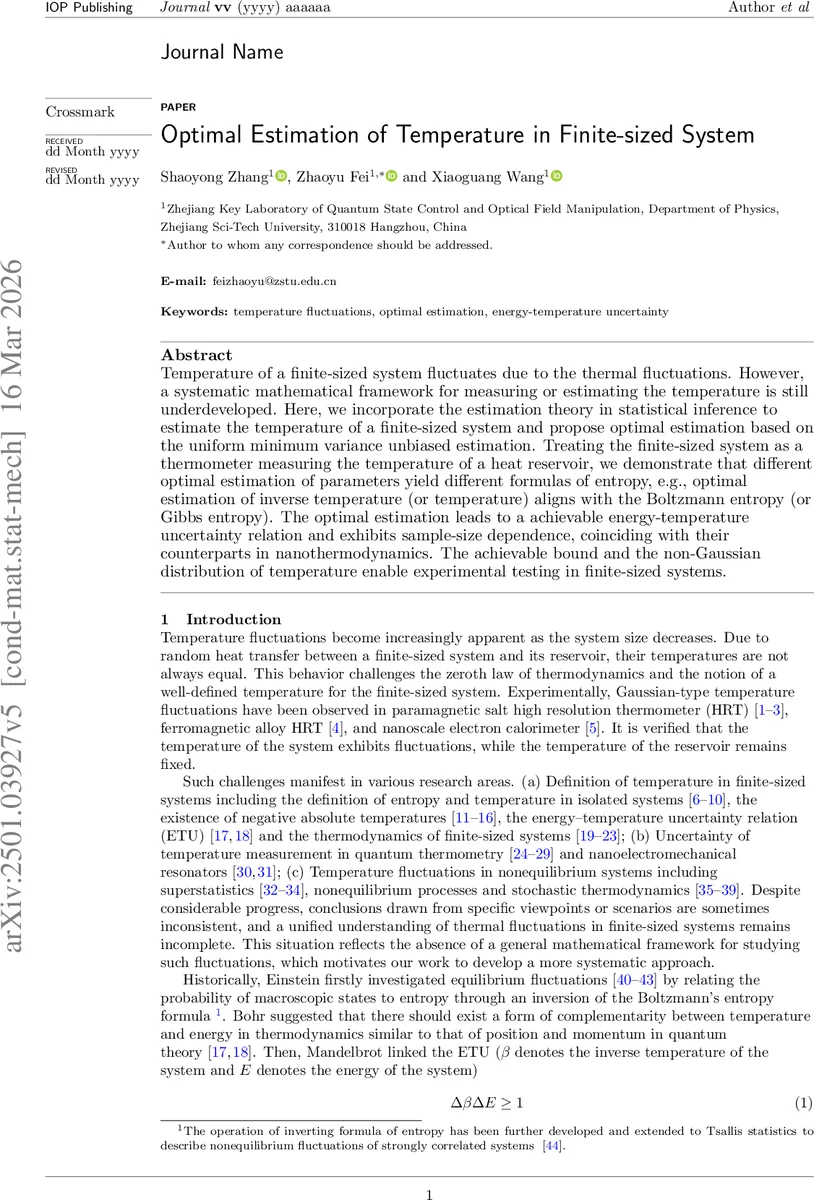
Temperature of a finite-sized system fluctuates due to the thermal fluctuations. However, a systematic mathematical framework for measuring or estimating the temperature is still underdeveloped. Here, we incorporate the estimation theory in statistical inference to estimate the temperature of a finite-sized system and propose optimal estimation based on the uniform minimum variance unbiased estimation. Treating the finite-sized system as a thermometer measuring the temperature of a heat reservoir, we demonstrate that different optimal estimation of parameters yield different formulas of entropy, e.g., optimal estimation of inverse temperature (or temperature) aligns with the Boltzmann entropy (or Gibbs entropy). The optimal estimation leads to a achievable energy-temperature uncertainty relation and exhibits sample-size dependence, coinciding with their counterparts in nanothermodynamics. The achievable bound and the non-Gaussian distribution of temperature enable experimental testing in finite-sized systems.
💡 Research Summary
The paper addresses the long‑standing problem of defining and measuring temperature in finite‑sized systems, where thermal fluctuations make the temperature of a small system a stochastic quantity rather than a deterministic thermodynamic variable. By treating a finite system as a thermometer that samples the canonical distribution of a large heat reservoir, the authors import the full machinery of statistical estimation theory. They focus on two fundamental criteria for an estimator: unbiasedness (the estimator’s expectation equals the true parameter) and efficiency (minimum variance among all unbiased estimators). The optimal estimator satisfying both criteria is the Uniform Minimum‑Variance Unbiased Estimator (UMVUE).
The authors first show that the canonical Boltzmann–Gibbs distribution belongs to the exponential family, whose sufficient statistic is the total energy (E). Using the Rao‑Blackwell‑Lehmann‑Scheffé theorem, any estimator that is a function of (E) and is unbiased is automatically the UMVUE, provided the statistic is complete. They construct explicit unbiased estimators for powers of the inverse temperature (\beta) (and consequently for temperature (T=1/\beta)) in equations (6)–(9). These estimators depend on the density of states (\sigma(E)) and its integral (\Omega(E)). For systems without an upper energy bound, the estimator (\hat\beta_{B}) (derived from the derivative of the Boltzmann entropy (S_{B}=\ln
Comments & Academic Discussion
Loading comments...
Leave a Comment