Deconfounded Time Series Forecasting: A Causal Inference Approach
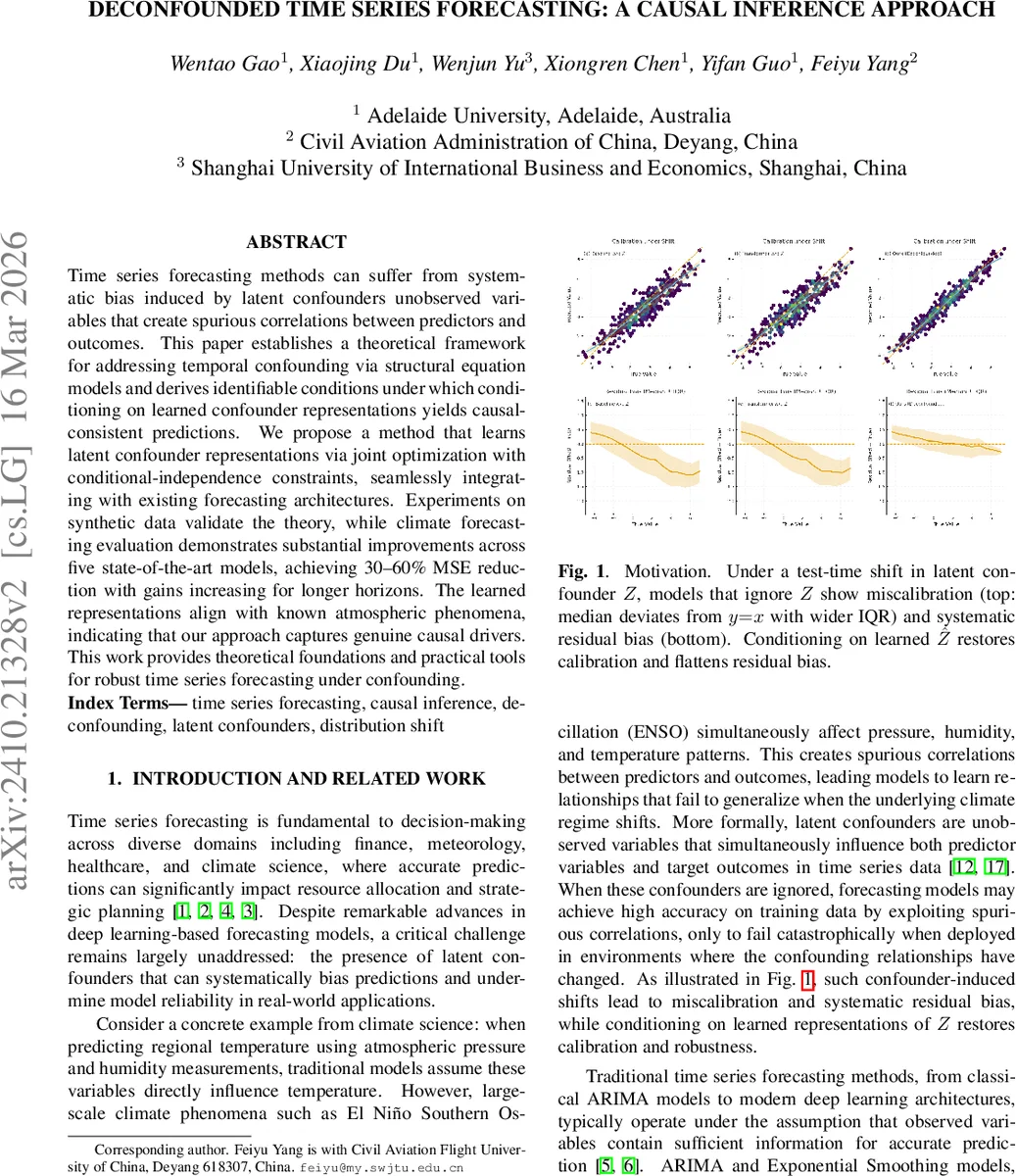
Time series forecasting is a critical task in various domains, where accurate predictions can drive informed decision-making. Traditional forecasting methods often rely on current observations of variables to predict future outcomes, typically overlooking the influence of latent confounders, unobserved variables that simultaneously affect both the predictors and the target outcomes. This oversight can introduce bias and degrade the performance of predictive models. In this study, we address this challenge by proposing an enhanced forecasting approach that incorporates representations of latent confounders derived from historical data. By integrating these confounders into the predictive process, our method aims to improve the accuracy and robustness of time series forecasts. The proposed approach is demonstrated through its application to climate science data, showing significant improvements over traditional methods that do not account for confounders.
💡 Research Summary
The paper tackles a fundamental yet often overlooked source of bias in time‑series forecasting: latent confounders—unobserved variables that simultaneously influence both the predictors and the target outcome. Traditional forecasting methods, ranging from classical ARIMA and exponential smoothing to modern deep learning architectures such as LSTMs and Transformers, assume that the observed variables contain all necessary information and that the training and test distributions are identical. In real‑world settings, especially in domains like climate science, large‑scale latent drivers (e.g., El Niño‑Southern Oscillation, Indian Ocean Dipole) affect multiple observed series, creating spurious correlations that degrade model performance when the underlying confounding relationships shift.
The authors formalize the problem within a causal inference framework. They define a temporal causal graph with latent confounder (Z_t), observed covariates (X_t), treatments (or primary predictors) (A_t), and the future outcome (Y_{t+h}). Structural equations describe the dynamics of each node, and “temporal confounding bias” is defined as the discrepancy between (E
Comments & Academic Discussion
Loading comments...
Leave a Comment