Beyond Distance: Quantifying Point Cloud Dynamics with Persistent Homology and Dynamic Optimal Transport
We introduce a framework for analyzing topological tipping in time-evolutionary point clouds by extending the recently proposed Topological Optimal Transport (TpOT) distance. While TpOT unifies geometric, homological, and higher-order relations into …
Authors: Yixin Wang, Ting Gao, Jinqiao Duan
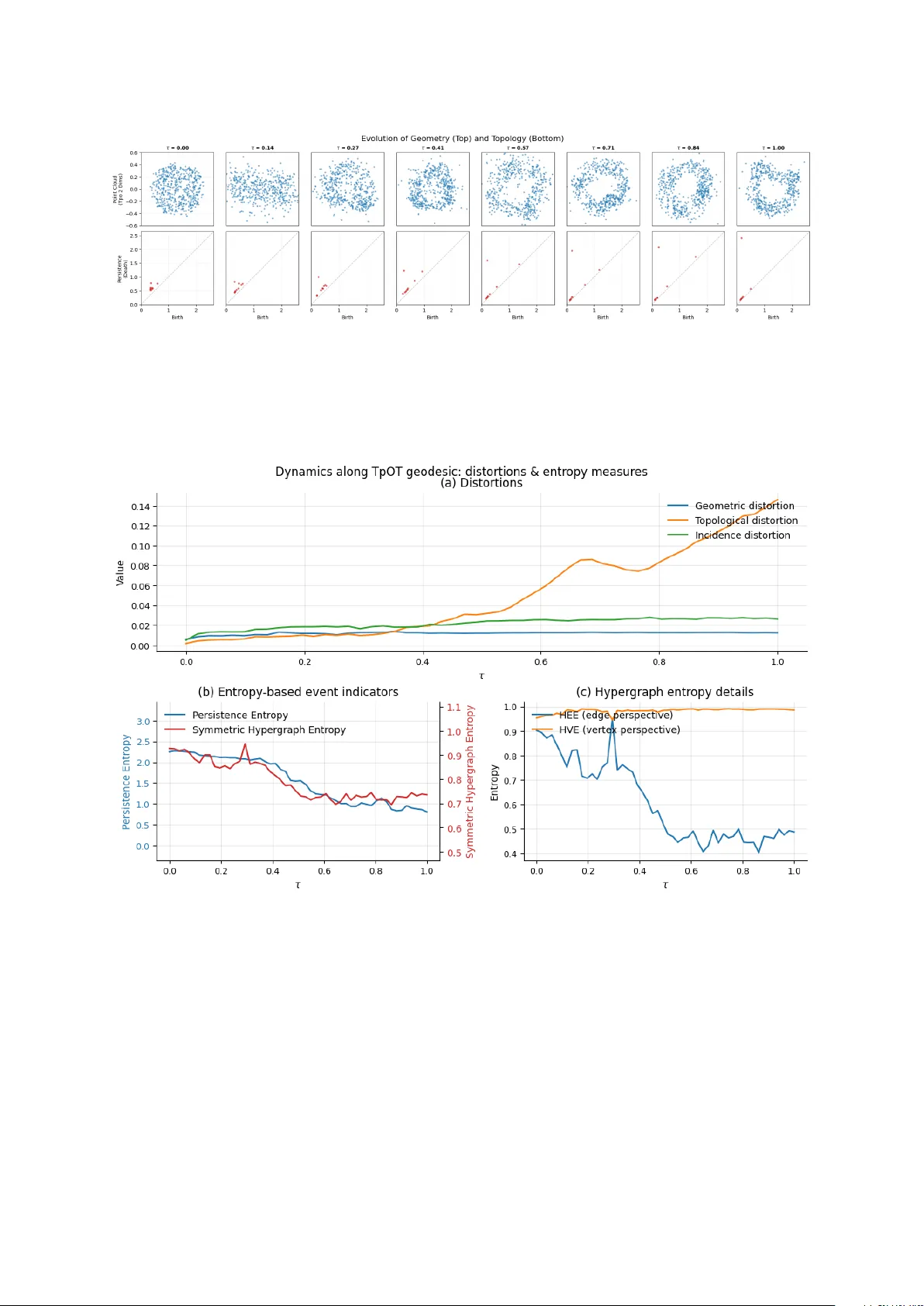
Bey ond Distance: Quan tifying P oin t Cloud Dynamics with P ersisten t Homology and Dynamic Optimal T ransp ort Yixin W ang 1 , 2 , † , Ting Gao 1 , 2 , 3 ∗ , Jinqiao Duan 4 , 5 , ‡ 1 Sc ho ol of Mathematics and Statistics, Huazhong Universit y of Science and T ec hnology , W uhan, China 2 Cen ter for Mathematical Science, Huazhong Universit y of Science and T ec hnology , W uhan, China 3 Steklo v-W uhan Institute for Mathematical Exploration, Huazhong Universit y of Science and T ec hnology , China 4 Departmen t of Mathematics and Departmen t of Ph ysics, Great Bay Universit y , Dongguan, China 5 Guangdong Provincial Key Laboratory of Mathematical and Neural Dynamical Systems, Dongguan, China. Abstract W e introduce a framework for analyzing top ological tipping in time evolution- ary point clouds b y extending the recen tly proposed T op ological Optimal T ransp ort (T pOT) distance. While T pOT unies geometric, homological and higher‐order re- lations into one metric, its global scalar distance can obscure transient, lo calized structural reorganizations during dynamic phase transitions. T o ov ercome this lim- itation, w e presen t a hierarchical dynamic ev aluation framework driv en by a nov el top ological and h yp ergraph reconstruction strategy . Instead of directly interpo- lating abstract netw ork parameters, our method interpolates the underlying spa- tial geometry and rigorously re-computes the v alid topological structures, ensuring ph ysical delity . Along this geo desic, w e introduce a set of multi-scale indicators: macroscopic metrics (T op ological Distortion and Persistence Entrop y) to capture global shifts, and a no vel mesoscopic dual-p ersp ectiv e Hyp ergraph Entrop y (no de- p ersp ective and edge-p ersp ectiv e) to detect highly sensitive, asynchronous local rewirings. W e further propagate the cycle-level en tropy c hange on to individual v ertices to form a point-lev el topological eld. Extensiv e ev aluations on ph ysical dynamical systems (Rayleigh-V an der P ol limit cycles, Double-W ell cluster fusion), high-dimensional biological aggregation (D’Orsogna mo del), and longitudinal stroke fMRI data demonstrate the utility of combining transp ort‐based alignment with m ulti‐scale en tropy diagnostics for dynamic top ological analysis. Keyw ords: Dynamic T op ological Optimal T ransp ort, Multiscale Tipping, Per- sistence entrop y , Hyp ergraph entrop y , Medical imaging 1 In tro duction Complex systems (e.g., climate systems, biological netw orks, nancial markets) often exhibit nonlinear phase transitions and critical phenomena [1]. Detecting their tipping 1 p oin ts and structural changes is crucial for predicting systemic collapse and designing early-w arning mec hanisms [2]. T raditional statistical metrics, such as v ariance and au- to correlation co ecients, are employ ed to monitor critical transitions and their driving net works [3]; ho w ever, they o verlook potential top ological structural c hanges in dynam- ical systems. In con trast, dynamical mo dels like bifurcation theory require predened dieren tial equations and p erform p o orly on real-world non-stationary systems with un- kno wn couplings [4]. In [5], the authors in tro duce a no vel Schrödinger bridge approac h for early warning signals (EWS) in probabilit y measures that align with the entrop y pro- duction rate. Nev ertheless, aligning disparate distributions in a manner that is b oth mathematically rigorous and computationally tractable remains a fundamental challenge in in terdisciplinary science. Originating from Monge’s 1781 optimal transport problem, optimal transp ort (OT) theory seeks to nd couplings b etw een probabilit y distributions as eciently as p ossible with resp ect to a giv en cost function [6]. A w ell-known distance measure, the W asserstein distance, ev aluates the geometric separation b et w een supp orts, where the cost function is induced by the distance function in a metric space. Recen tly , extensions of the opti- mal transp ort problem, such as the Gromo v–W asserstein (GW) distance and its v ariant, the F used Gromo v–W asserstein (F GW) distance, hav e garnered increasing attention due to their applicability in settings where probabilit y distributions are dened on dierent metric spaces [7–9]. Motiv ated b y the goal of representing relations in complex systems through higher-order net works, recen t work has applied a Gromo v–W asserstein v ariant kno wn as co-optimal transp ort [10] to hypergraph mo deling, demonstrating its eective- ness in b oth theoretical framew orks and practical applications [11]. T op ological Data Analysis (TDA) is a mathematical framew ork rooted in algebraic top ology that extracts multiscale top ological features from high-dimensional complex data [12]. Giusti and Lee dev elop ed a computable feature map for paths of p ersistence diagrams [13]. Li et al. introduced a exible and probabilistic framework for trac king top ological features in time-v arying scalar elds by emplo ying merge trees and partial optimal trans- p ort [14]. Numerous researchers hav e developed inno v ativ e methodologies for topological feature trac king and even t detection b y leveraging diverse to ols from TD A, including p ersistence diagrams, merge trees, Reeb graphs, and Morse–Smale complexes. F or exam- ple, T an weer et al. in tro duced a TD A-based approach that uses sup erlev el p ersistence to mathematically quan tify P-t yp e bifurcations in sto c hastic systems through a ”homo- logical bifurcation plot,” which illustrates the c hanging ranks of 0th and 1st homology groups via Betti v ectors [15]. Shamir et al. prop osed a progressiv e isosurface algorithm that predicts the con tour at time step t + 1 based on the contour at time step t [16]. Doraisw amy et al. describ ed a framework for the exploration of cloud systems at multi- ple spatial and temp oral scales using infrared(IR) brightness temp erature images, which automatically extracts cloud clusters as contours for a given temp erature threshold[17]. A comprehensive review of metho dologies for top ological feature trac king and structural c hange detection is presented in [18]. In recent y ears, there has b een growing in terest in extending classical graph entrop y[19– 22] to hypergraphs, as h yp ergraphs are capable of capturing higher-order in teractions that con ven tional pairwise netw orks cannot. The concept of h yp ergraph en tropy was rst in- tro duced b y Simon yi (1996) [23] within an information-theoretic framew ork. Subsequen t studies ha ve prop osed alternative formulations, including en trop y v ectors deriv ed from 2 partial hypergraphs [24] and tensor-based en tropy for uniform hypergraphs [25]. A ddi- tionally, en tropy-maximization mo dels ha ve b een emplo yed to generate random h yp er- graphs, serving as useful n ull mo dels for real-w orld systems [26]. These developmen ts underscore the versatilit y of h yp ergraph en tropy as a to ol for quantifying uncertaint y and complexity in higher-order netw orks, motiv ating its application to the analysis of h yp ergraph structures deriv ed from p ersisten t homology . In this work, w e propose a set of dynamic distortion and entrop y indicators that in tegrate optimal transp ort, top ological data analysis, and information theory for h yp er- graphs. Our approac h builds up on the recen tly introduced T op ological Optimal T rans- p ort (T pOT) framew ork [27], whic h aligns point clouds while join tly optimizing geometric corresp ondence and topological delit y through a principled coupling of their p ersistent homology classes. By incorporating this trade-o betw een geometric and top ological preserv ation, our metrics enable robust detection of m ultiscale structural shifts. T o sys- tematically capture these m ultiscale dynamics, our methodology proceeds in four fun- damen tal stages (Figure 1): computing the initial T pOT spatial coupling, p erforming geometric in terp olation along the underlying geo desic, rigorously reconstructing v alid top ological and hypergraph structures to ensure ph ysical delity , and extracting m ulti- scale early warning indicators. Driv en by this pip eline, our main contributions are listed as follo ws. First, w e prop ose a dynamic h yp ergraph reconstruction strategy that in tegrate in terp olation of underlying geometric information. Second, w e prop ose dynamic distor- tion and entrop y as early warning indicators for m ulti-scale tipping detection, notably a nov el mesoscopic dual-p ersp ective h yp ergraph en trop y (HE V and HE E ) that uniquely captures async hronous structural decoupling. W e further propagate the cyle-lev el en tropy c hange on to individual v ertices to form a p oin t-lev el top ological eld that iden ties key lo cal transformations. Third, w e pro vide rigorous theoretical guaran tees for these metrics, whic h are precisely v alidated across physical dynamical systems, biological aggregations, and clinical strok e fMRI data. The structure of this pap er is organized as follows: Section 2 describ es our prop osed top ological & hypergraph reconstruction and dynamic distortions & entropies framework for m ultiscale tipping detection. Esp ecially , Sections 2.3 to 2.5 detail the dynamic re- construction strategy , the dual-p ersp ective entrop y form ulations with their theoretical pro ofs, and the point-lev el lo calized mapping, resp ectively . Section 3 presen ts compre- hensiv e exp erimental v alidations, nally w e summarize conclusions and future w ork in Section 4. 2 Metho dology In man y applications—from neuroscience and materials science to mac hine learning— p ersisten t homology (PH) has prov en eective for dimension reduction, feature generation, and hypothesis testing. How ev er, standard diagram-based comparisons often disregard the underlying geometry of represen tativ e cycles. Recent extensions address this limita- tion b y extracting explicit cycles and organizing them in to higher-order structures such as PH-h yp ergraphs, where vertices corresp ond to data p oints and hyperedges enco de cy- cle memberships [28]. It has also b een sho wn that the T opological Optimal T ransp ort (T pOT) framew ork not only provides a p ow erful distance for comparing complex data but also endo ws the resulting space with ric h geometric structure, enabling in terp ola- 3 tion, extrap olation, and barycenter computations among measure–top ological netw orks [27]. Detailed mathematical denitions and properties are pro vided in the Supplemen tary Material A.1. Before in tro ducing our extensions, we critically assess the prop erties of the T op olog- ical Optimal T ransp ort (T pOT) framework. This analysis motiv ates the design c hoices presen ted in this section. T pOT sim ultaneously aligns p oint–point anities via a Gromov–W asserstein term, p ersistence diagram co ordinates via a W asserstein term, and p oin t–cycle incidences via a co-optimal transp ort term, thereb y integrating geometric, homological, and higher- order relational information within a single optimization. The space of measure top o- logical net works P / ∼ w , d TpOT ,p admits geodesics that are realized by conv ex com- binations of kernels, birth–death em b eddings, and incidence functions. These geo desics enjo y non‐negativ e Alexandro v curv ature. As a pseudo-metric, d TpOT ,p satises symmetry and the triangle inequality . The non-negativ e curv ature prop erty of the geo desic further guaran tees con vexit y of squared‐distance functionals, which enables robust interpolation, barycen ter computations, and clustering in the netw ork space. How ever, the T pOT faces t wo limitations: • Static distortion loss masks ev olution details. The T pOT framew ork returns only a scalar distance that quan ties the cost of transp orting P to P ′ along the optimal geodesic. How ev er, this endp oint‐only v alue omits the information ab out the intermediate distortions L t geom , L t topo , and L t hyper for t ∈ (0 , 1) . As a result, any transien t or evolving geometric or top ological phenomena o ccurring b et w een P and P ′ are en tirely mask ed, prev enting the lo calization of when—and to what exten t —signican t structural changes o ccur along the in terp olation path. • Dicult y of detecting abrupt top ological c hanges. Constant-speed in terp ola- tion yields smo othly v arying loss curves. Consequently , abrupt top ological changes, suc h as the sudden birth or death of long-lived cycles, app ear only as mild inec- tions, making them dicult to detect within the aggregated T pOT ob jectiv e. • Sensitivit y of hyperparameters. The c hoice of the entropic regularization weigh t ε critically inuences the trade-o b etw een delity and smo othness. Inappropriate settings ma y result in ov erly diuse couplings that obscure salient structure, or in unstable transp ort plans that are highly sensitiv e to noise. T o address these inheren t limitations, we introduce tw o key extensions in this work: • Dynamic distortion curv es. Rather than report only the nal scalar distance d TpOT ,p , we extract, at eac h interpolation time t ∈ [0 , 1] , the three dynamic dis- tortion loss functions L t geom , L t topo , and L t hyper . These curves precisely lo calize the timing and magnitude of geometric, top ological, and incidence deformations along the geo desic. • En tropy‐based ev ent detectors. W e in tro duce p ersistenc e entr opy (PE) and hyp er gr aph entr opy (HE) as complementary diagnostics. PE quanties the Shannon en tropy of the distribution of barcode lengths, capturing sensitivit y to the abrupt app earance or disapp earance of signicant cycles. HE measures the uniformity 4 of vertex–h yp eredge incidence, highligh ting sudden reorganizations in higher-order connectivit y . By integrating these en tropy-based indicators, w e are able to contin uously monitor and detect anomalous top ological ev ents in temp orally ev olving p oin t clouds. In this section, w e pro vide a detailed description of the prop osed pip eline for quantifying m ulti-scale tipping phenomena with geometric/top ological/hypergraph distortions in time-evolving p oin t clouds, whic h is illustrated in Figure 1. The structure of this section is as follow: First, w e present the background kno wledge of Measure T op ology Net work and T pOT for optimal coupling in Section 2.1 and Section 2.2. Then, our main contributions on Hyp ergraph Reconstruction and early warning in- dicators with dynamic distortions are presen ted in Section 2.3, which explained tipping detection in four-steps aligned with Figure 1. F urthermore, we study v arious denitions of entrop y as early warning indicators in Section 2.4. Our con tribution also lies in nov el denitions of V ertex-P ersp ective entrop y , Hyp eredge-Perspective entrop y and Symmetric Hyp ergraph entrop y , with theoretical pro ofs on sensitivity of abrupt topological transi- tions and top ological upp er bound. In addition, w e also present p oint-lev el hypergraph en tropy in Section 2.5, as an important ev aluation metric in some real data exp erimen t. 2.1 Measure T op ological Net w ork Giv en a p oint cloud i.e., a nite set of p oin ts X = { x i } N i =1 ⊂ R d , w e build its asso ciated me asur e top olo gic al network [27] P = ( X , k , µ ) , ( Y , ι, ν ) , ω , as dened in Section A.3. Concretely: • Geometry: c ho ose a symmetric kernel k ( x, x ′ ) (e.g. Gaussian anity or Euclidean distance) and uniform measure µ ( x i ) = 1/ N . • T op ology: w e use a pow erful top ological to ol Ripser er.jl to compute persistent homology in the desired dimension (e.g. 0D or 1D) to obtain a set of cycle repre- sen tatives Y . Record each cycle’s birth–death co ordinates via ι : Y → Λ and assign equal mass ν ( y ) = 1/ | Y | . • Incidence: for each pair ( x i , y ) , set ω ( x i , y ) = 1 if x i lies on the chosen represen- tativ e cycle y , and 0 otherwise. Analogously , for a second p oint cloud X ′ , w e construct the corresp onding measure top o- logical net work P ′ = (( X ′ , k ′ , µ ′ ) , ( Y ′ , ι ′ , ν ′ ) , ω ′ ) follo wing the same pro cedure. 2.2 T pOT Distance and Optimal Coupling W e then compute the T pOT distance of order p = 2 b et w een P and P ′ (23) in which all geo desics in P / ∼ w are con vex. F or clarit y and ecien t implemen tation, we now express eac h distortion in purely tensor‐ or matrix‐based summation form. W e denote the cardinalities of the p oin t clouds 5 Figure 1: Sc hematic ov erview of the h yp ergraph reconstruction and dynamic distortion framework. Row 1 (Initial T pOT): The optimal spatial coupling π v ⋆ is computed b etw een the source X 0 and target X 1 p oin t clouds via solving optimal T pOT problem. Ro w 2 (Geometric Interpolation): Metric interpolation and Multidimen- sional Scaling (MDS) generate intermediate spatial congurations X t along the geo desic t ∈ [0 , 1] . Row 3 (T op ological Structure Reconstruction): P ersistent homology is computed based on the interpolated geometric p oint cloud to extract authentic in terme- diate features. Ro w 4 (Hyp ergraph Reconstruction: Measure top ological netw orks P t are assem bled, where no des represen t regions and colored h ulls represent top ological h yp eredges. Ro w 5 (Dynamic Distortion as Early W arning Indicators) The dy- namic distortions ( L t ) are rigorously computed b y solving the T pOT distances b etw een the global reference source P 0 and eac h intermediate state P t . 6 b y N = | X | and N ′ = | X ′ | , and the n umber of p ersisten t homology generators (cycles) b y M = | Y | and M ′ = | Y ′ | . With these notations, let: L geom ii ′ j j ′ := k ( x i , x j ) − k ′ ( x ′ i ′ , x ′ j ′ ) p , 1 ≤ i, j ≤ N , 1 ≤ i ′ , j ′ ≤ N ′ , L topo uv := ∥ ι ( y u ) − ι ′ ( y ′ v ) ∥ p , 1 ≤ u ≤ M , 1 ≤ v ≤ M ′ , ∥ ι ( y u ) − ι ′ ( ∂ Y ′ ) ∥ p , 1 ≤ u ≤ M , v = M ′ + 1 , ∥ ι ( ∂ Y ) − ι ′ ( y ′ v ) ∥ p , u = M + 1 , 1 ≤ v ≤ M ′ , 0 , u = M + 1 , v = M ′ + 1 L hyper ii ′ uu ′ := 1 2 ω i,u − ω ′ i ′ ,u ′ p , 1 ≤ u ≤ M , 1 ≤ u ′ ≤ M ′ , 1 2 ω ′ i ′ ,u ′ p , u = M + 1 , 1 ≤ u ′ ≤ M ′ , 1 2 ω i,u p , 1 ≤ u ≤ M , u ′ = M ′ + 1 , 0 , u = M + 1 , u ′ = M ′ + 1 . Let Π v ∈ R N × N ′ and Π e ∈ R ( M +1) × ( M ′ +1) b e the optimal coupling matrices. Then L geom (Π v ) = N ,N ′ X i,i ′ =1 N ,N ′ X j,j ′ =1 L geom ii ′ j j ′ Π v ii ′ Π v j j ′ , (1) L topo (Π e ) = M +1 X u =1 M ′ +1 X v =1 L topo uv Π e uv , (2) L hyper (Π v , Π e ) = N X i =1 N ′ X i ′ =1 M +1 X u =1 M ′ +1 X v =1 L hyper ii ′ uu ′ Π v ii ′ Π e uu ′ . (3) Giv en a 4-wa y tensor L and a matrix ( C ij ) ij , w e dene tensor-matrix m ultiplication[29] L ⊗ C := X kl L ij k l C kl ! ij . So the T pOT distance b etw een tw o measure top ological net works P and P ′ with tunable w eights can b e written as L TpOT ,p (Π v , Π e , α, β ) = α L geom (Π v ) + (1 − α ) L topo (Π e ) + β L hyper (Π v , Π e ) (4) = α ⟨ L geom ⊗ Π v , Π v ⟩ + (1 − α ) ⟨ L topo , Π e ⟩ + β ⟨ L hyper ⊗ Π v , Π e ⟩ (5) In practice w e solve the T pOT problem (23) in its entropic‐regularised form min π v ∈ Π( µ,µ ′ ) π e ∈ Π adm ( ν,ν ′ ) L TpOT ,p ( π v , π e , α, β ) + ε v KL π v | µ ⊗ µ ′ + ε e KL π e | ν ⊗ ν ′ . F ollo wing section3.4 of [27], we solv e the entropically regularised T pOT problem by alter- nately up dating the t w o couplings while k eeping the other xed. These tw o Sinkhorn-st yle up dates are utilized un til con vergence to ( π v ⋆ , π e ⋆ ) . 7 2.3 Hyp ergraph Reconstruction and Dynamic Distortion Theoretically , the space of measure topological netw orks admits geo desics dened b y con vex com binations of their comp onen ts [27]. Given an optimal coupling ( π v ⋆ , π e ⋆ ) , a the- oretical constan t‐sp eed geo desic P t for t ∈ [0 , 1] would b e dened b y linear in terp olation: P t = ( X × X ′ , k t , π v ⋆ ) , (( Y × Y ′ ) ∪ ( Y × ∂ Y ′ ) ∪ ( ∂ Y × Y ′ ) , ι t , π e ⋆ ) , ω t , where linear in terp olation yields k t = (1 − t ) k + t k ′ , ι t = (1 − t ) ι + t ι ′ , ω t = (1 − t ) ω + t ω ′ . Remark: A direct linear interpolation of the incidence matrix ω raises t w o funda- men tal issues: First, it could inevitably in tro duce fractional mem b ership v alues (e.g., ω t ( x, y ) ∈ (0 , 1) ), whic h are ill-dened in the context of binary h yp ergraphs. Second, and more critically , the top ological structures generated by such abstract algebraic in terp ola- tion may b ecome detac hed from the geometric realit y of the data manifold; specically , the in terp olated cycles my fail to corresp ond to actual lo ops formed b y the interpolated p oin ts. T o o vercome these limitations and preserv e ph ysical v alidit y , we prop ose a h yp er- graph reconstruction strategy . Instead of in terp olating the parameters of measure top ological netw orks directly , w e st in terp olate the underlying geometry , next re-compute the top ological structure and then reconstruct the measure top ological net w ork (Hyp er- graph). Specically , with the optimal geometric coupling π v ⋆ , we construct the contin uous tra jectory as follo ws: • Step 1: Geometric In terp olation: F ollowing the geodesic construction in tro- duced b y Han et al. [27, 30], w e rst obtain an optimal matc hing from the en tropic regularized spatial coupling π v ⋆ . F or the matc hed p oint pairs, w e linearly interpo- late their squared Euclidean distance matrices as k t = (1 − t ) k + tk ′ . The spatial co ordinates of the intermediate p oint cloud X t are then recov ered b y applying the Multidimensional Scaling (MDS) algorithm to k t , follo wed b y a rigid transformation step for spatial alignmen t. • Step 2: T op ological Structure Reconstruction: Rather than articially blend- ing abstract features, we re-compute the p ersistent homology directly on the newly generated p oin t cloud X t to extract the authentic top ological features (e.g., p ersis- tence barco des) that ph ysically exist at time t . • Step 3: Measure T op ological Netw ork (Hyp ergraph) Reconstruction: Us- ing the spatial co ordinates X t and the authentically extracted top ological features, w e construct the intermediate measure top ological net w ork P t = ( X t , k t , µ t ) , ( Y t , ι t , ν t ) , ω t follo wing the pip eline outlined in Section 2.1. 8 • Step 4: Early W arning Indicator with Dynamic Distortion: Finally , the dynamic structural distortions L t are ev aluated b y solving the T pOT problem be- t ween the initial reference source P 0 and the reconstructed intermediate net work P t at each time step t ∈ [0 , 1] . That is, at each in terp olation step t , w e measure the optimal discrepancy b etw een the initial reference netw ork P 0 and the reconstructed h yp ergraph P t . The three dynamic distortion curves are dened as the minimized costs as follo ws. Let L geom ,t , L topo ,t , and L hyper ,t denote the cost tensors dened b etw een the static source P 0 and the dynamic reconstruction P t . Unlike the theoretical linear interpolation where the coupling remains xed, here we solv e the optimal transport problem at eac h step t . Let ( π v t , π e t ) b e the optimal couplings achieving the T pOT distance d TpOT ( P 0 , P t ) . L t geom = Z Z ( X × X t ) 2 k ( x, y ) − k t ( x ′ , y ′ ) p d π v t ( x, x ′ ) d π v t ( y , y ′ ) (6) L t topo = Z ¯ Y × ¯ Y t ∥ ι ( y ) − ι t ( y ′ ) ∥ p d π e t ( y , y ′ ) (7) L t hyper = Z X × X t × Y × Y t ω ( x, y ) − ω t ( x ′ , y ′ ) p d π v t ( x, x ′ ) d π e t ( y , y ′ ) . (8) These curv es L t quan titatively track the ev olution of structural deviations. Specif- ically , π v t and π e t adaptiv ely up date the matc hing betw een the source and the ev olving manifold, ensuring that the distortion reects the true top ological dierence rather than artifacts of linear in terp olation. Similarly , let the time-dep enden t cost tensors L geom ,t ii ′ j j ′ , L topo ,t uv , L hyper ,t ii ′ uv b e computed b e- t ween the reference netw ork P 0 and the reconstructed netw ork P t (using the re-computed maps k t , ι t , and ω t ). Since the top ological structure of P t is re-generated at eac h step, the optimal corresp ondence may ev olve. Let Π v t and Π e t denote the time-sp e cic optimal couplings obtained b y solving the T pOT problem b etw een P 0 and P t . The three dynamic distortion curv es are then calculated as the minimized transp ort costs: L t geom = X i,i ′ ,j,j ′ L geom ,t ii ′ j j ′ Π v t, ii ′ Π v t, j j ′ = L geom ,t ⊗ Π v t , Π v t , (9) L t topo = X u,v L topo ,t uv Π e t, uv = L topo ,t , Π e t , (10) L t hyper = X i,i ′ ,u,v L hyper ,t ii ′ uv Π v t, ii ′ Π e t, uv = L hyper ,t ⊗ Π e t , Π v t . (11) Figure 1 illustrates this reconstruction-based T pOT inetrpolation and dynamic ev aluation framew ork. These three dynamic distortion curves L t capture the deformation of geometry , top ol- ogy , and cycle incidence as t increases. 2.4 En trop y as Early W arning Indicator T o detect abrupt top ological ev ents along the geo desic, we compute t wo en tropy metrics at eac h t : persistence entrop y and hypergraph entrop y . 9 First we apply the p ersistence en tropy whic h is in tro duced in [31]. Extract the barcode B t = { [ b t i , d t i ] } in ι t ( Y , Y ′ ) . Let l t i = d t i − b t i and L t = P i l t i . Dene the P ersistence En tropy on geo desic as PE ( B t ) = − X i l t i L t log l t i L t . (12) In tuitively , en trop y measures how dierent bars of the barco des are in length. A barco de with uniform lengths has small entrop y . Large c hanges in PE ( B t ) highligh t the birth or death of signican t homological features. In order to detect abrupt top ological transitions along the T pOT geo desic, one may consider Shannon‐t yp e entropies dened on the hypergraph. Let H = ( V , E ) denote the h yp ergraph asso ciated with a measure top ological netw ork, where V is the set of vertices (corresp onding to the data p oin ts in X ) and E is the set of hyperedges (corresp onding to the p ersistent cycles in Y ). A classical prop osal (e.g.[24]) pro ceeds by forming the matrix L ( H ) = I ( H ) I ( H ) T where I ( H ) is the incidence matrix and then computing the eigen v alues 0 ≤ λ 1 ( L ( H )) ≤ λ 2 ( L ( H )) ≤ . . . ≤ λ m ( L ( H )) . Then classicaly the Shannon en tropy of h yp ergraph H is dened as S ( H ) = − m X i =1 µ i log 2 ( µ i ) , (13) where µ i is dened as µ i = λ i ( L ( H )) P m i =1 λ i ( L ( H )) = λ i ( L ( H )) Tr ( L ( H )) . While this Shannon entr opy captures global connectivity patterns, it has tw o dra w- bac ks: • It requires eigen‐decomp osition of an m × m matrix (where m = | V | ), which can b e exp ensiv e for large h yp ergraphs. • It smo oths o ver lo cal v ertex–edge redistributions, and th us ma y fail to react sharply to small but top ologically signican t c hanges (e.g. the in tersection of sev eral cycles). T o address these issues and formulate a mathematically rigorous measure of struc- tural information, we adopt the information-theoretic framew ork for netw orks prop osed b y Dehmer (2008) [21, 22]. Dehmer’s paradigm assigns a probability v alue to each graph elemen t based on a lo cal structural functional f ( · ) , follo wed by the computation of Shan- non en tropy . Let H = ( V , E ) b e the hypergraph formed by the extracted p ersistent cycles, with incidence matrix ω ∈ { 0 , 1 } | V |×| E | . Let L ( v ) = P e ∈ E ω ( v , e ) be the degree of vertex v , and S ( e ) = P v ∈ V ω ( v , e ) b e the size of hyperedge e . T o rigorously a void singularities suc h as 0 · ln (0) or division b y zero, w e restrict our analysis to the active vertex set V ∗ = { v ∈ V | L ( v ) > 0 } and the active hyp er e dge set E ∗ = { e ∈ E | S ( e ) > 0 } . The total incidence of the h yp ergraph is I total = P v ∈ V ∗ L ( v ) = P e ∈ E ∗ S ( e ) . 10 Denition 1 ( V ertex-Perspective Entrop y ) . F ol lowing the Dehmer fr amework, we dene the structur al functional for a vertex as its de gr e e, f ( v ) = L ( v ) . Normalizing this functional over the active set yields a valid pr ob ability distribution p ( v ) = L ( v ) I total , which r epr esents the pr ob ability that a r andomly chosen incidenc e c onne ction b elongs to vertex v . The V ertex-Persp e ctive Entr opy is dene d as: HE V ( H ) = − X v ∈ V ∗ p ( v ) ln p ( v ) . (14) Denition 2 ( Hyperedge-Perspective Entrop y ) . Dual ly, dening the structur al func- tional for a hyp er e dge as its size f ( e ) = S ( e ) yields the pr ob ability distribution q ( e ) = S ( e ) I total . The Hyp er e dge-Persp e ctive Entr opy is dene d as: HE E ( H ) = − X e ∈ E ∗ q ( e ) ln q ( e ) . (15) By formulating the entropies as standard Shannon entropies o ver the discrete proba- bilit y spaces V ∗ and E ∗ , w e obtain the following rigorous structural prop erties: Prop ert y 1 ( Bounds and Maximal Assumption ) . The entr opies ar e b ounde d by 0 ≤ HE V ( H ) ≤ ln | V ∗ | and 0 ≤ HE E ( H ) ≤ ln | E ∗ | . The maximum HE V ( H ) = ln | V ∗ | is achieve d if and only if H is a regular h yp ergraph (i.e., L ( v ) is c onstant for al l v ∈ V ∗ ). Dual ly, HE E ( H ) = ln | E ∗ | is achieve d if and only if H is a uniform hypergraph (i.e., S ( e ) is c onstant for al l e ∈ E ∗ ). Pro ofs of this prop erty and subsequent theorems are provided in the App endix B. With this prop erty , w e could normalize ] HE V ( H ) = HE V ( H ) ln | V ∗ | , g HE E ( H ) = HE E ( H ) ln | E ∗ | ∈ [0 , 1] . Denition 3 ( Symmetric Hyp ergraph Entrop y ) . T o c aptur e b oth p ersp e ctives simul- tane ously, we intr o duc e HE sym ( G ) = α ] HE V + (1 − α ) g HE E , α ∈ [0 , 1] . (16) By adjusting α , one c an emphasize vertex‐level ( α ≈ 1 ) or hyp er e dge‐level ( α ≈ 0 ) changes, or tr e at b oth e qual ly ( α = 0 . 5 ). Theorem 1 ( Sensitivit y to Abrupt T op ological T ransitions ) . L et { H t } t ∈T b e a se quenc e of dynamic hyp er gr aphs p ar ameterize d by t . Supp ose at a critic al p ar ameter t c , an abrupt top olo gic al tr ansition o c curs via the emer genc e of a new active hyp er e dge e new of size k > 0 . Then the vertex-p ersp e ctive hyp er gr aph entr opy strictly changes at t c (i.e., lim t → t − c HE V ( H t ) = HE V ( H + ) ), exc ept p ossibly for a highly r estrictive set of hyp er gr aphs whose de gr e e se quenc es satisfy a sp e cic, rigid Diophantine e quation. Theorem 2 ( Dual Sensitivit y to T op ological T ransitions ) . The same c onclusion holds for hyp er e dge-p ersp e ctive entr opy HE E , exc ept for a highly r estrictive zer o-me asur e algebr aic c ondition governe d by the F undemental The or em of A rithmetic. 11 Theorem 3 ( Isomorphism In v ariance of T op ological En trop y ) . L et H 1 = ( V 1 , E 1 ) and H 2 = ( V 2 , E 2 ) b e two hyp er gr aphs derive d fr om two me asur e top olo gic al networks. If H 1 and H 2 ar e isomorphic (i.e., ther e exist bije ctions φ : V 1 → V 2 and ψ : E 1 → E 2 pr eserving the incidenc e r elations ω 1 ( v , e ) = ω 2 ( φ ( v ) , ψ ( e )) ), then HE V ( H 1 ) = HE V ( H 2 ) and HE E ( H 1 ) = HE E ( H 2 ) . Theorem 4 ( Algebraic T op ological Upp er Bound ) . L et D k denote the k -th p ersis- tenc e diagr am obtaine d fr om the V ietoris–Rips ltr ation of the network, and let | D k | b e the numb er of p ersistent gener ators (i.e., top olo gic al fe atur es with non-zer o p ersistenc e). A nd supp ose the hyp er gr aph H is c onstructe d using al l p ersistent gener ators acr oss al l dimensions. Then the hyp er e dge-p ersp e ctive entr opy is strictly b ounde d by the top olo gic al c omplexity of the manifold: HE E ( H ) ≤ ln X k | D k | ! . In man y practical data analysis scenarios, the measure topological netw ork is con- structed explicitly fo cusing on a sp ecic homological dimension k (e.g., k = 1 to analyze lo ops, or k = 2 for v oids). Corollary 1 ( Dimension-Sp ecic T op ological Bound ) . If the hyp er gr aph H is c on- structe d exclusively using the k -dimensional p ersistent gener ators, the hyp er e dge-p ersp e ctive entr opy is strictly b ounde d by the numb er of k-dimensional top olo gic al fe atur es : HE E ( H ) ≤ ln ( | D k | ) . (17) Remark: This corollary has signican t practical implications. F or instance, when trac king the structural dynamics of a 1-dimensional functional net work, the maxim um p ossible hyperedge en trop y is fundamentally b ottleneck ed by the total n umber of k- dimensional p ersistent features ln ( | D 1 | ) . This implies that our entrop y metric is not only a statistical measure of incidence, but a direct pro xy for the 1-dimensional algebraic top ological capacit y of the system. Our newly prop osed h yp ergraph entropies hav e follo wing adv antages • Computational eciency: eac h requires only O ( | V | · | E | ) operations, a v oiding costly eigen‐decomp ositions. • The or etic al Sensitivity: As prov en in Theorem 1, the abrupt app earance or disap- p earance of a top ological feature instantaneously forces a non-zero displacement in the probability simplex. This guarantees a mathematically rigorous en tropy spik e or inection, making it highly sensitiv e to critical top ological ev ents. • Structur al Interpr etability: The metrics provide a clear macroscopic interpretation of top ological uniformit y . F urthermore, their theoretical upp er bounds are deeply ro oted in algebraic top ology: the h yp eredge en tropy is fundamentally b ottleneck ed b y the top ological capacity of the system (i.e., b ounded b y the p ersistent features, HE E ≤ ln β k , as established in Theorem 3 and Corollary 1), serving as a direct quan titative proxy for the homological complexity of the data manifold. 12 W e computeHE sym ( t ) on the interpolated h yp ergraph G t along the T pOT geo desic, and use sudden deviations in these curv es to ag discrete top ological even ts. Sudden deviations in HE sym mark structural reorganizations of the cycle hypergraph. In practice, w e ev aluate the symmetric h yp ergraph en tropy HE sym ( H t ) = α HE V ( H t ) ln | V ∗ | + (1 − α ) HE E ( H t ) ln | E ∗ | on the dynamically reconstructed h yp ergraph H t at eac h in terp olation step. W e then use the sharp discontin uities and sudden deviations in these curv es to detect discrete top ological phase transitions and structural reorganizations within the ev olving p oin t cloud. F or clarit y , we provide pseudo co de b elow for our metho d (Algorithm 1). 2.5 P oin t-Level Hyp ergraph En trop y Change Complex hypergraph netw orks often contain multiple in terdep enden t cycles that en- co de structural relationships at dieren t spatial and top ological scales. When such net works evolv e—for instance, under temp oral deformation, diusion, or connectivity reorganization—the glob al hypergraph entrop y tends to av erage out the lo cal transforma- tions, thereb y obscuring where the most signicant structural c hanges o ccur. T o resolv e this limitation, we in tro duce a cycle-level entr opy de c omp osition that projects en tropy do wn to the vertex level. This formulation enables identication of lo cal top ological v ari- ations within complex h yp ergraph systems. Incidence transp ort via optimal coupling. W e dene this decomp osition generally b et w een a r efer enc e h yp ergraph (with incidence matrix ω ∈ R n × m ≥ 0 ) and a tar get hyper- graph (with incidence matrix ω ′ ∈ R n ′ × m ′ ≥ 0 ). Here, ω [ i, j ] indicates the participation weigh t of vertex i in the j -th reference cycle. Because the ordering of top ological features gener- ally diers b et w een states, the target matrix ω ′ is column-aligned to the reference ω using a p erm utation (or assignmen t) matrix A ∈ { 0 , 1 } m ′ × m : b ω = ω ′ A. This matrix multiplication explicitly permutes the columns of the target incidence matrix, yielding a column-aligned matrix b ω ∈ R n ′ × m ≥ 0 where the j -th column directly corresp onds to the j -th reference cycle. Column normalization. T o compute the en tropy , the columns of the incidence ma- trices are normalized to form probability distributions o ver the v ertices. F or the reference matrix ω and the aligned target matrix b ω , we explicitly dene their normalized counter- parts P and b P as: P [ i, j ] = ω [ i, j ] P n i ′ =1 ω [ i ′ , j ] + ε , b P [ i, j ] = b ω [ i, j ] P n ′ i ′ =1 b ω [ i ′ , j ] + ε , where ε is a sucien tly small constant to ensure numerical stability . Cycle-lev el en tropy . Let p j = P [: , j ] denote the normalized vertex distribution of the j -th reference cycle, and b p j = b P [: , j ] denote the corresp onding distribution from the 13 aligned target matrix. W e dene the cycle-lev el en tropy for the reference and target states, resp ectiv ely , as: H j = − 1 log n n X i =1 p ij log p ij , b H j = − 1 log n ′ n ′ X i =1 b p ij log b p ij , (18) whic h measures ho w spatially diuse (large entrop y) or concentrated (small en tropy) the participation is within that sp ecic top ological cycle. En tropy dierence and propagation. F or eac h reference cycle j , the change in struc- tural en tropy b et w een the tw o states is dened as: ∆ H j = b H j − H j . (19) T o lo calize this structural v ariation on to the target v ertex set, the absolute en tropy c hange | ∆ H j | is propagated back to the target vertices according to their membership weigh ts in the aligned cycles: s i = m X j =1 b P [ i, j ] | ∆ H j | . (20) By dening the column v ector s = [ s 1 , . . . , s n ′ ] ⊤ and the en tropy dierence vector ∆ H = [∆ H 1 , . . . , ∆ H m ] ⊤ , this bac k-pro jection can b e compactly written in matrix form as s = b P | ∆ H | . The v ector s forms a vertex-level hyp er gr aph-entr opy eld , whic h highlights lo calized regions undergoing the strongest structural transformations. In terpretation. Equations (18)–(20) transform the complex structural comparison of high-dimensional h yp ergraphs into an interpretable scalar eld o v er the vertex domain. Visualizing the eld s on the spatial p oint cloud rev eals lo calized topological deformations that global en tropy measures inherently av erage out. This completes the detailed description of our metho d. In Section 3 w e v alidate its eectiv eness on synthetic and real‐world datasets. 3 Exp erimen ts W e ev aluate our metho d on four distinct settings: tw o syn thetic phenomenological bi- furcation mo dels, a high-dimensional biological aggregation model (D’Orsogna), and a real-w orld longitudinal fMRI dataset. In each case, we report: (1) the three dynamic distortion curv es ( L geom , L topo , L hyper ), whic h trac k the hierarc hical structural ev olution, and (2) the entrop y indicators, namely Persistence En tropy (PE), Symmetric Hyp er- graph En tropy (HE sym ), V ertex-P ersp ective Entrop y(HE V ) and Hyp eredge-P ersp ectiv e En tropy(HE E ). These en tropy measures pro vide complemen tary , parallel c haracteriza- tions of top ological evolution: PE captures v ariations in the p ersistence-diagram domain, while HE sym , HE V , HE E quan tify changes in the higher-order hypergraph incidence struc- ture. In addition, the point-lev el h yp ergraph-entrop y eld is used to capture local v ertices that con tribute most to the observed structural reorganization in the real fMRI data. 14 Algorithm 1 Early warning detection via dynamic distortions and Entrop y Require: Time-series p oint clouds { X ( i ) } T i =1 , distance k ernel k . Require: T pOT trade-o w eights ( α , β ) , regularization weigh ts ( ε v , ε e ) , and symmetric en tropy weigh t γ . Require: Lo cal geodesic resolution L , forming a uniform partition of the in terv al [0 , 1] denoted b y { τ ℓ } L ℓ =1 . Ensure: A contin uous global tra jectory of structural ev aluations: distortion curves L geom ( τ ∗ ) , L topo ( τ ∗ ) , L hyper ( τ ∗ ) and entrop y curves PE ( τ ∗ ) , HE sym ( τ ∗ ) parameterized b y the global contin uous timeline τ ∗ ∈ [0 , 1] . 1: Initialization: 2: Construct the global reference netw ork P (1) = ( X (1) , k (1) , µ (1) ) , ( Y (1) , ι (1) , ν 1 ) , ω (1) . 3: for i = 1 to T − 1 do 4: Construct net works P ( i ) and P ( i +1) via p ersisten t homology . 5: Compute T pOT b etw een P ( i ) and P ( i +1) using w eigh ts ( α, β ) and regularization w eights ( ε v , ε e ) to obtain the optimal spatial coupling π v ⋆ . 6: for = 1 to L do 7: τ ← τ ℓ // L o c al ge o desic p ar ameter τ ∈ [0 , 1] 8: τ ∗ ← ( i + τ − 1)/( T − 1) // Mapping to glob al c ontinuous timeline τ ∗ ∈ [0 , 1] 9: // Step 1: Ge ometric Displac ement Interp olation 10: Compute in terp olated spatial p ositions based on matched pairs ( x, x ′ ) ∼ π v ⋆ : 11: X τ ∗ ← Embed k τ ∗ = (1 − τ ) k ( i ) + τ k ( i +1) π v ⋆ > 0 12: // Step 2: T op olo gic al R e c onstruction 13: Re-compute p ersistent homology strictly on X τ ∗ to construct the intermediate net work P τ ∗ . 14: // Step 3: Dynamic Curve Evaluation (R elative to Glob al R efer enc e P (1) ) 15: Solv e T pOT b etw een P (1) and P τ ∗ using weigh ts ( α, β , ε v , ε e ) to obtain ev alu- ation couplings (Π v τ ∗ , Π e τ ∗ ) . 16: Obtain dynamic distortion curv es by computing the tensor inner pro ducts: 17: L geom ( τ ∗ ) = L τ ∗ geom , Π v τ ∗ ⊗ Π v τ ∗ 18: L topo ( τ ∗ ) = L τ ∗ topo , Π e τ ∗ 19: L hyper ( τ ∗ ) = L τ ∗ hyper , Π v τ ∗ ⊗ Π e τ ∗ 20: Obtain structural en tropy curves from the active top ology of P τ ∗ : 21: PE ( τ ∗ ) = − P l j L log l j L // fr om b ar c o de lengths of Y τ ∗ 22: HE sym ( τ ∗ ) ← HE sym ( P τ ∗ ; γ ) // Evaluate d with entr opy weight γ 23: Compute HE V ( τ ∗ ) and HE E ( τ ∗ ) iden tically following denition equations. 24: end for 25: end for 15 A cross all experiments, the en tropic T pOT problem is consistently optimized using the Sinkhorn algorithm. W e congure the optimization with trade-o parameters α = 0 . 5 and β = 1 . 0 , along with en tropic regularization weigh ts ε s = 0 . 003 for the spatial coupling and ε f = 0 . 01 for the feature coupling. The symmetric en tropy weigh t is set to γ = 0 . 5 . 3.1 Exp eriment 1: T op ological Phase T ransition in Sto c hastic Oscillators Data Generation. T o ev aluate the proposed dynamic T pOT and structural entrop y framew ork on systems exhibiting complex top ological phase transitions, w e generate a syn thetic dataset based on the stochastic Rayleigh-V an der Pol (R VP) oscillator [15]. F orced b y additiv e white Gaussian noise, the stationary joint probabilit y density function (PDF) of the R VP oscillator’s state space ( x 1 , x 2 ) is prop ortional to the exp onential of its p oten tial energy: p ( x 1 , x 2 ) ∝ exp − V ( x 1 , x 2 ) T , where V ( x 1 , x 2 ) = 1 2 ( x 2 1 + x 2 2 ) 2 + h ( x 2 1 + x 2 2 ) , (21) where h is the critical bifurcation parameter and T controls the eectiv e noise intensit y of the system. As theoretically established in stochastic dynamical systems [15], this oscillator un- dergo es a phenomenological bifurcation (P-bifurcation) exactly at h = 0 . F or h < 0 , the system exhibits limit-cycle oscillations (LCO), and its PDF forms a crater-like geome- try . T op ologically , this corresp onds to a prominent 1-dimensional p ersistent lo op (i.e., a Betti-1 feature). As h increases past 0 , the system shifts to a monostable state, and the geometry structurally collapses in to a single dense 0-dimensional connected comp onen t. T o replicate a real-w orld discrete data acquisition scenario, w e generated a time- v arying sequence of p oint clouds b y sampling from this analytical PDF. Since direct sampling from this unnormalized distribution is non-trivial, we employ ed the Metrop olis- Hastings Marko v Chain Mon te Carlo (MCMC) algorithm. W e sim ulated the dynamical ev olution by discretizing the bifurcation parameter h ∈ [ − 1 , 1] in to 51 uniformly spaced snapshots. F or each snapshot, w e set the eectiv e noise T = 0 . 001 and extracted N = 200 samples. This rigorous pro cedure yields a dynamic p oint cloud sequence { X ( i ) } 51 i =1 that accu- rately captures b oth the con tin uous geometric deformation and the abrupt topological phase transition from a ring to a single cluster, serving as the ground truth for our dy- namic ev aluation framew ork. A visualization of the sampled point clouds is sho wed in the top ro w of gure 2. 16 Figure 2: Ground truth ev olution of the stochastic R VP oscillator. (T op) Scatter plots of the state space showing the transition from a limit cycle to a monostable p oin t. F our sparse snapshots are c hosen as our training densit y samples for top ological optimal transp ort task (illustrated in red b o xes ). (Bottom) The corresp onding p ersistence dia- grams trac king the birth and death of the 1-dimensional homological feature. Figure 3: Baseline(ground truth) sequen tial ev aluation directly computed betw een the ref- erence state ( h = − 1 ) and subsequent empirical snapshots. (a) The top ological distortion p eaks and attens exactly as the limit cycle collapses. (b) Both p ersistence en tropy and the prop osed symmetric h yp ergraph en trop y exhibit a discontin uous jump at the critical p oin t h = 0 . (c) The jump in symmetric en tropy is primarily driv en by the h yp eredge- p ersp ective comp onen t (HE E ).T o facilitate a direct visual comparison, b oth p ersp ective en tropies are normalized by their resp ectiv e theoretical upp er b ounds. Baseline Sequential Ev aluation Before ev aluating our prop osed geo desic interpola- tion metho d, w e rst apply our framework directly to the fully sampled empirical sequence o ver the parameter range h ∈ [ − 1 , 1] to establish a ground truth baseline as presen ted in gure 3. As the bifurcation parameter h increases, the system strictly follows the theo- retical dynamics of the R VP oscillator: the crater-lik e limit cycle collapses in to a dense, 17 monostable cluster at the critical point h = 0 . T o quan tify this P-bifurcation, we compute the structural distortions relativ e to the global reference state h = − 1 . The distortion dynamics show a m ulti-scale temp oral decoupling, corresp onding to a ’macro-meso-micro’ structural relaxation sequence. A t the macro-scale , the top ological distortion ( L topo ) p eaks drastically just b efore h = 0 as the global limit cycle contracts, incurring a substan tial W asserstein p enalty . Once the macroscopic lo op v anishes, L topo attens in to a constan t plateau, as the reference loop can only b e matc hed to diagonal features. Subsequen tly , at the meso-scale , the incidence distortion ( L hyper ) p eaks and reorganizes. The mem b ership incidence matrix m ust dissolv e and reorganize to accommo- date the collapsed top ology . Finally , at the micro-scale , the geometric distortion ( L geom ) settles last, reecting the ph ysical diusion time required for individual stochastic par- ticles to cluster at the new local density peak. A ccompan ying this multi-scale cascade, the structural en tropies (Persistence Entrop y and the prop osed HE sym ) exhibit a surge near the topological tipping p oint (h=0). This behavior suggests their p otential utilit y as indicators of the phase transition without relying on predened thresholds. Dynamic Reconstruction of T op ological Phase T ransitions. T o demonstrate the predictive pow er of our metho dology on temp orally sparse observ ations, we arti- cially subsampled the dataset in to merely four equidistan t k eyframes across the param- eter space (simulating a lo w-resolution data acquisition scenario). W e then applied our reconstruction-based T pOT interpolation framew ork (Algorithm 1) to generate the con- tin uous tra jectory parameterized b y τ ∈ [0 , 1] . The results are illustrated in gure 4. The dynamic ev aluation along the reconstructed geodesic tra jectory approximates the unobserv ed P-bifurcation, closely aligning with the unobserved ground truth dynamics. As visualized in the interpolation results, the generated intermediate states P τ capture b oth the geometric collapse and the progressiv e deterioration of the Betti-1 barco de. More imp ortantly , the reconstructed distortion and en tropy curves along the in terp ola- tion parameter τ closely aligning with the unobserv ed ground truth dynamics previously observ ed along the true parameter h . Our metho d successfully repro duces the abrupt en tropic jumps at the critical transition phase, strictly v erifying the theoretical guarantees of Theorem 1(2) on in terp olated data. F urthermore, the generated trajectory explicitly preserves the macro-meso-micro temp oral decoupling: the in terp olated L topo curv e p eaks and attens well b efore the stabilization of the geometric component L geom . This conrms that our in terp olation strategy do es not merely blend co ordinates linearly , but rigorously reconstructs the authentic, multi-scale pro cess of the underlying sto chastic dynamical system from highly sparse observ ations. 18 (a) Reconstructed spatial geometry and corresp onding p ersistence diagrams (b) Reconstructed structural dynamics Figure 4: Exp erimental v alidation via T pOT geo desic in terp olation. W e sub- sampled the empirical dataset into merely four equidistant keyframes and reconstructed the con tinuous top ological ev olution parameterized b y τ ∈ [0 , 1] . (a) The MDS-based isometric em b edding interpolates the intermediate spatial geometries b etw een the sparse k eyframes, approximating the collapse of the limit cycle. (b) The dynamic ev aluation along the reconstructed geodesic repro duces the hierarc hical macro-meso-micro distortion sequence and the abrupt en tropic jumps at the critical transition p oint, closely aligning with the unobserv ed ground truth dynamics. 19 3.2 Exp eriment 2: Dimension-Sp ecicit y and Negativ e Con trol in a Double-W ell P oten tial Figure 5: Phenomenological bifurcation in the double-w ell p otential mo del. (T op) Scatter plots of the state space sho wing the transition from a bistable regime(t wo distinct clusters) to a monostable regime(a single fused cluster). F our sparse snapshots are c hosen as our training density samples for topological optimal transp ort task (illustrated in red b o xes ). (Bottom) The corresp onding p ersistence diagrams trac king the birth and death of the 1-dimensional homological feature. Data Generation and Ph ysical Mo del. T o further rigorously ev aluate our frame- w ork, particularly its dimension-specicity and the decoupling of its distortion comp o- nen ts, w e construct a second synthetic dataset inspired b y the phenomenological bifurca- tions discussed in App endix A of T an weer et al. [15]. W e simulate a sto chastic system go verned by a parameterized double-well p oten tial: V ( x 1 , x 2 ; h ) = ( x 2 1 − h ) 2 + x 2 2 , (22) where the state space is sampled using a Metrop olis-Hastings MCMC sampler with a generalized noise temp erature T = 0 . 04 . The parameter h decreases from 1 . 00 to − 1 . 00 o ver 51 uniform snapshots. As visualized in the scatter plots of Figure 5, when h > 0 , the system is in a bistable r e gime , forming tw o distinct connected components ( β 0 = 2 ). As h ≤ 0 , the tw o wells merge into a single global minimum, and the p oin t cloud top ologically fuses into a single monostable cluster ( β 0 = 1 ). Unlik e the R VP oscillator in Exp erimen t 1, this fusion pro cess strictly in volv es a 0-dimensional top ological transition, completely devoid of any macroscopic 1-dimensional homological features (i.e., no authentic lo ops or β 1 generators are created or destro yed). Baseline Ev aluation: Sp ecicit y and Dimension-Selectivit y . T o demonstrate the targeted selectivit y of our prop osed metrics, we explicitly constrained the p ersistent ho- mology feature extraction exclusively to 1-dimensional homology ( H 1 ) while ev aluating this β 0 -driv en dataset. The fully separated state at h = 1 . 00 serves as the global reference P (1) . The baseline dynamics (computed directly on the full sequence) support the specicity of our framew ork, as shown in the ground truth curves of Figure 6. Because the t wo distinct probabilit y masses physically migrate and conv erge to w ard the center ov er time, 20 Figure 6: Ground truth baseline dynamics o ver parameter h . Because the system only undergo es a 0-dimensional transition, the 1-dimensional structural metrics ( L topo , L hyper , and Entropies) remain completely suppressed, while the geometric distortion L geom rises to capture the spatial con vergence. the pure geometric distortion ( L geom ) exhibits a contin uous, monotonic rise, successfully capturing the macroscopic spatial fusion. Ho wev er, since our top ological h yp ergraph w as strictly congured to monitor H 1 fea- tures, it acts as a precise theoretical lter. Because no macroscopic lo ops exist during the cluster merging, the H 1 -based top ological distortion ( L topo ) and incidence distortion ( L hyper ) remain completely suppressed at near-zero levels throughout the en tire bifurcation in terv al. Consequen tly , the structural entropies (P ersistence Entrop y and the prop osed HE sym ) do not exhibit the stark step-function discon tinuities seen in Experiment 1; in- stead, they merely uctuate stably around baseline noise levels. This serv es as a p ow erful ne gative c ontr ol , proving that our entrop y indicators are not spuriously triggered by mere spatial displacemen t, but are strictly sensitiv e only to the designated algebraic top ological dimensions. Exp erimen tal V alidation of Dimension-Selectiv e T rac king. W e then subsampled this tra jectory into four highly sparse keyframes and applied our reconstruction-based T pOT in terp olation (Algorithm 1) o ver τ ∈ [0 , 1] . The interpolated tra jectory captures b oth the spatial dynamics and the dimensional decoupling. As demonstrated in Figure 7(a), the dynamic curves computed along the geo desic τ closely aligning with the ground truth: the interpolated geometric curve L geom rises to capture the spatial fusion, while the H 1 -sp ecic top ological comp onents and en- trop y indicators remain correctly inv ariant. This conrms that our in terp olation frame- w ork reliably reconstructs b oth the presence and the absenc e of top ological phenomena, preserving the strict decoupling b etw een micro-scale geometric diusion and macro-scale homological p ersistence across arbitrarily sparse temp oral observ ations. 21 (a) Reconstructed structural dynamics (b) Reconstructed spatial geometry and corresp onding p ersistence diagrams Figure 7: Dimension-sp ecicity and negativ e control ev aluation. (a)Dynamic reconstruction via geo desic in terp olation from only four keyframes successfully reproduces this exact dimension-sp ecic decoupling. (b)The MDS-based isometric embedding and corresp onding 1-D p ersistence diagram. 3.3 Exp eriment 3: Self-Organization and Dimensionalit y in Bi- ological Aggregations Data Generation and Physical Mo del. T o demonstrate the capabilit y of our frame- w ork in analyzing higher-dimensional, real-world biological phenomena, w e turn to the w ell-known D’Orsogna mo del of biological aggregations (e.g., bird o cks and sh sc ho ols)[32– 35]. W e utilized the publicly av ailable sim ulation dataset from T opaz’s study , whic h tracks the complex top ological self-organization of N = 500 self-prop elled in teracting particles. Unlik e the previous purely spatial mo dels, the state of this system must b e describ ed in a 4-dimensional phase space ( x, y , v x , v y ) , as the particles’ orien tations and v elo cities in trinsically dictate the collectiv e top ological state (e.g., distinguishing a single mill from a double mill). The agen ts ob ey Newtonian dynamics driven by self-propulsion, friction, and a pairwise attractive-repulsiv e in teraction potential. Over time, the system sp on taneously self-organizes from a relatively disorganized, disk-like sw arm into a highly structured “mill” or v ortex state, c haracterized b y particles rotating around a hollo w core. In the 22 4-dimensional phase space, the emergence of this hollow core and the rotational o w corresp onds to the birth of prominen t 1-dimensional homological features ( H 1 top ological circles). W e extracted a uniformly spaced sequence of 61 snapshots from T = 1 . 00 to T = 60 . 00 to serve as our empirical sequence. Figure 8: Ground truth ev olution of the D’Orsogna biological aggregation mo del. (T op) The 2-dimensional spatial pro jection ( x, y ) of the 4-dimensional phase space shows parti- cles self-organizing from a disorganized state into a mill with a hollow core. F our sparse snapshots are chosen as our training density samples for top ological optimal transport task (illustrated in red boxes ). (Bottom) The corresponding 1-dimensional p ersistence diagrams track the emergence of a robust Betti-1 feature represen ting the rotational v or- tex. Baseline Ev aluation: Self-Organization and En tropy Drop. W e rst ev aluate the baseline dynamics computed directly on the full 61-frame sequence, using the initial unstructured state at T = 1 . 00 as the global reference P (1) . As visualized in Figure 8, the system gradually dev elops a prominent p ersisten t lo op in H 1 . Quan titatively , the distortion curves in Figure 9(a) eectively capture the multi-scale hierarc hical relaxation of this self-organization. At the macro-scale, the topological dis- tortion ( L topo ) rises substantially as the initial trivial top ology develops a robust Betti-1 v ortex. A t the meso- and micro-scales, the incidence ( L hyper ) and geometric ( L geom ) dis- tortions track the con tin uous physical rearrangement of particles en tering the annular o w. The structural entropies correlate with the system’s dynamical shifts, suggesting their utilit y as e arly-warning indic ators for self-organization. As sho wn in Figure 9(b) and (c), unlik e the top ological distortion ( L topo ) which exhibits a con tinuous, gradual rise as the physical optimal transp ort costs accumulate, the Symmetric Hyp ergraph Entrop y exp erience a sharp, discon tinuous drop from a highly en tropic state ( ≈ 1 . 0 ) to a low- en tropy state ( ≈ 0 . 7 ). This discrete step-function b ehavior clearly demonstrates a rapid state-to-state phase transition. F urthermore, a close examination of the temp oral timeline rev eals a distinct an tic- ipatory sensitivity: the prop osed Symmetric Hyp ergraph En tropy (HE sym ) triggers the abrupt en tropy drop visibly earlier than b oth the topological distortion and the Persis- tence En tropy (PE). This temp oral precedence is theoretically w ell-founded within our macro-meso-micro framew ork. While L topo and PE require the global macroscopic lo op ( H 1 ) to fully mature and ac hieve a measurable barco de lifespan, HE sym con tinuously ev al- uates the instantaneous mesosc opic incidence distribution. Consequen tly , it successfully detects the initial lo calized structural reorganizing—as agents just b egin to align into the 23 ann ular ow—w ell b efore the global vortex fully forms. This mathematical b eha vior reects the ph ysical transition from a c haotic swarm to a deterministic mill state. Figure 9: Baseline dynamic ev aluation of the 4D D’Orsogna mo del. (a) The top ological distortion L topo rises signicantly to capture the formation of the homological lo op. (b, c) Unlike previous bifurcation exp eriments, the structural entropies undergo a signican t drop, rigorously quantifying the thermo dynamic transition from a disorganized chaotic sw arm into a highly self-organized, low-en tropy vortex state. Dynamic Reconstruction of T op ological Phase T ransitions. T o test our frame- w ork’s capacity to handle high-dimensional phase spaces with extreme temp oral sparsity , w e aggressively subsampled the 61-frame sequence in to merely four k eyframes. W e then applied Algorithm 1 to reconstruct the 4-dimensional topological geo desic parameterized b y τ ∈ [0 , 1] . 24 Figure 10: Reconstructed spatial geometry and p ersistence diagrams from only four k eyframes. While the 2D visual pro jection exhibits minor alignment artifacts due to the rigid 4-dimensional optimal transp ort coupling, the 1-dimensional p ersisten t homol- ogy accurately reconstructs the birth of the v ortex core. Figure 11: Exp erimental v alidation of the reconstructed structural dynamics. The T pOT geo desic interpolation tracks the ground truth dynamics from Figure 9, recov ering b oth the the increase in topological distortion and the subsequen t en trop y drop associated with biological self-organization. As shown in Figure 10, our MDS-based geometric reconstruction interpolates the 4- dimensional phase space. It is worth noting that while the 2-dimensional ( x, y ) spatial pro jections of the interpolated states may exhibit slight visual alignment artifacts, these are purely cosmetic. This visual discrepancy is a natural consequence of projecting and rigidly aligning the full 4-dimensional ( x, y , v x , v y ) optimal transport coupling in to a 2D viewing plane. Th us, these alignment artifacts ha ve no impact on the quan titative re- sults of our framew ork. Because our dynamic ev aluation—including b oth the persistent 25 homology reconstruction and the T pOT cost computation—relies strictly on the in trinsic pairwise distance function k τ , the mathematical outcomes are in v arian t to rigid rotational alignmen ts used for visualization. The underlying topological structure and structural en- tropies are highly preserv ed. This is denitiv ely pro ven by the dynamic curv es computed along the in terp olated geo desic τ (Figure 11). The reconstructed tra jectories mirror the ground truth sequence: the framework exactly recov ers the contin uous rise in top ological distortion L topo and the precise tra jectory of the en tropy drop. This v alidates that our algorithm robustly captures complex, high-dimensional biological self-organization from highly sparse observ ations, main taining strict mathematical accuracy ev en when lo w-dimensional visual pro jections b ecome c hallenging. 3.4 Real‐W orld Data: Stroke fMRI 3.4.1 Data description and prepro cessing Let the fMRI data at tw o time p oints b e denoted as X ( M ) ∈ R n x × n y × n z × T M , X ( Y ) ∈ R n x × n y × n z × T Y , where ( i, j, k ) indexes v o xel co ordinates in the spatial domain Ω , and t indexes time. T o obtain a stable v oxel representation, we compute the mean of the BOLD signal: ¯ X ( M ) ( i, j, k ) = 1 T M T M X t =1 X ( M ) ( i, j, k , t ) , ¯ X ( Y ) ( i, j, k ) = 1 T Y T Y X t =1 X ( Y ) ( i, j, k , t ) . Eac h scan is a 4D volume of size 64 × 64 × 34 × 60 . F or eac h time p oint, we compute the v oxel-wise temp oral a v erage, pro ducing tw o 3D volumes of size 64 × 64 × 34 . The human cerebral cortex exhibits highly heterogeneous patterns of functional con- nectivit y . T o eliminate v oxel-lev el noise and enhance in terpretability , we utilize the widely adopted Y eo7 atlas [36] to partition the spatial domain Ω into seven functionally coher- en t regions. After aligning the atlas to the sub ject’s native space, w e obtain a discrete partition Ω = S 7 v =1 Ω v , where v ∈ { 1 , . . . , 7 } indexes the large-scale functional net works (e.g., Visual, Somatomotor, Default Mo de). Eac h vo xel is represented by a 4-dimensional feature vector incorp orating spatial co- ordinates and the BOLD signal: x ( M ) i,j,k = ( i, j, k , ¯ X ( M ) ( i, j, k ) ) ⊤ , x ( Y ) i,j,k = ( i, j, k , ¯ X ( Y ) ( i, j, k ) ) ⊤ . The region-sp ecic p oint clouds for each functional netw ork v are thus dened as: P ( M ) v = { x ( M ) i,j,k | ( i, j, k ) ∈ Ω ( M ) v } , P ( Y ) v = { x ( Y ) i,j,k | ( i, j, k ) ∈ Ω ( Y ) v } . Finally , w e form the full vo xel-wise datasets: X M = 7 [ v =1 P ( M ) v ∈ R N M × 4 , X Y = 7 [ v =1 P ( Y ) v ∈ R N Y × 4 , with corresp onding lab el vectors M ∈ { 1 , ..., 7 } N M , Y ∈ { 1 , ..., 7 } N Y . 26 (a) Raw fMRI v olume (3-month) (b) UMAP pro jections of parcellated net w orks Figure 12: Visualization of the strok e patien t’s fMRI data and dimensionality reduction. (a) An exemplary 3D spatial slice of the patien t’s ra w fMRI volume. (b) 2D UMAP em- b eddings of the vo xel feature v ectors at 3-mon th (left) and 1-y ear (righ t) p ost-strok e time p oin ts. Poin ts are colored b y their corresp onding Y eo7 functional netw ork assignments. 3.4.2 Em b edding and netw ork construction T o visualize and analyse the strok e fMRI volumes at 3 mon ths and 12 months, w e applied the follo wing dimensionality-reduction pip eline: Standar dization and UMAP emb e dding. The v o xel-wise datasets X M and X Y are standardized to ha ve zero mean and unit v ariance. Uniform Manifold Approximation and Pro jection (UMAP) is then applied to map the standardized data from R 4 to R 2 , yielding the resp ectiv e low-dimensional em b eddings Z M , Z Y ⊂ R 2 . The result is sho wn in Figure 12(b). Within the em b eddings, eac h Y eo7 netw ork corresp onds to a regional subset: Z M ,v = { z i ∈ Z M | M [ i ] = v } , Z Y ,v = { z i ∈ Z Y | Y [ i ] = v } . These subsets are essen tial for visualizing inter-net w ork geometry and for constructing h yp ergraphs o ver the embedded regions in subsequent en tropy-based analyses. These 2D embeddings are b oth resampled to 600 points and then serve as the input p oin t clouds for our T pOT analysis. W e then construct 1D p ersistent homology (retaining the top 20 p ersistence pairs to represen t the dominant top ological features), binary incidence matrices, and measure top ological net w orks. 3.4.3 Multi-Scale T op ological Analysis and Findings The en tropic T pOT problem is solved as b efore, and distortions are computed on an in terp olation grid of 51 p oints spanning the geo desic b etw een the 3-month and 12-mon th p ost-strok e states. T o characterize the dynamic reconguration of functional brain organization, we ev al- uated the em b edded vo xel sets through a hierarchical set of indicators: the macroscopic metrics (T op ological Distortion L topo and Persistence Entrop y PE), our prop osed meso- scopic dual-persp ective framew ork (HE V , HE E , and the aggregated HE sym ), and the base- line Geometric Distortion ( L geom ). 27 Figure 13 displa ys the heatmaps of these six indicators across the seven Y eo brain areas (v ertical axis) and the interpolated temp oral parameter τ ∈ [0 , 1] (horizon tal axis). A comparativ e analysis across these heatmaps illustrates the m ulti-scale structural dynamics of our framew ork. Macroscopic and Mesoscopic Dynamics. The macroscopic indicators, PE and L topo (Figures 13d, e), follow contin uous tra jectories and sho w similar global trends. Both metrics capture the distinct top ological ev olution (sharply rise at τ ≈ 0 . 4 ) in Netw ork 2 (Somatomotor), c haracterizing structural shifts at a macroscopic scale. A t the mesoscopic scale, the three hypergraph en tropies (Figures 13a-c) are more sensitiv e to lo cal and transient top ological reorganizations. These metrics rev eal region- sp ecic reorganization patterns that are t ypically obscured b y macroscopic measures. Unlik e syn thetic datasets where transitions are often uniform, the real-world fMRI data sho ws a clear de c oupling b etw een HE V and HE E : • In certain brain net works, suc h as Netw ork 2 (Somatomotor) and Net w ork 3 (Dorsal A ttention), HE V and HE E displa y opp osite temp oral trends. • In Netw ork 4 (V entral A ttention), HE V remains stable while HE E decreases around τ ≈ 0 . 9 . • Conv ersely , in others suc h as Net w ork 7 (Default Mo de), HE V and HE E follo w sync hronized tra jectories. This asynchronous b eha vior suggests that brain functional reorganization is complex, with no de participation (HE V ) and functional loop uniformit y (HE E ) evolving indep en- den tly during strok e recov ery . Symmetric Hyp ergraph En tropy (HE sym ) integrates these v ariations. As shown in Figure 13a, HE sym com bines features from b oth vertex- and edge-p ersp ective entropies to represent mesoscopic structural transitions. Microscopic Geometric Distortion. It is worth noting that the Geometric Distortion ( L geom , Figure 13f) displa ys an almost uniform linear gro wth across all brain regions. This indicates that while pure geometric optimal transp ort distances reliably trac k the o verall spatial displacement of the p oint clouds, they are naturally less sensitive to the complex top ological phase transitions o ccurring within the functional net works during the recov ery pro cess. V ertex-Level Lo calization. T o estimate the spatial distribution of these structural transitions, Figure 14a illustrates the v ertex-level hypergraph entrop y eld on the Dor- sal Atten tion Net work. W e mapped the absolute cycle-lev el entrop y v ariation | ∆ HE | = | HE τ − HE 0 | back to the v ertex domain (as dened in Eq. 20). Eac h p oin t represen ts a v ertex in the resampled UMAP embedding, and its color encodes the propagated en- trop y change. Regions highlighted in red corresp ond to vertices that participate in cycles exhibiting the strongest en trop y v ariations, indicating lo calized structural reorganization within the hypergraph. This spatial map, complemented by the exact embeddings at 3 mon ths and 1 year (Figures 14b and 14c) , demonstrates how our cycle-to-p oin t entrop y propagation eectively identies key lo cal transformations. A dditionally , the sp ecic dis- tortion curv es on the Dorsal Atten tion Netw ork is presen ted in Figure 15 28 (a) Symmetric En trop y (HE sym ) (b) V ertex-p ersp ectiv e En- trop y (HE V ) (c) Edge-p ersp ective En tropy (HE E ) (d) Persistence En tropy (PE) (e) T op ological Distortion ( L topo ) (f ) Geometric Distortion ( L geom ) Figure 13: Dynamic en trop y and distortion heatmaps across sev en functional brain netw orks (Y eo7) along the T pOT geo desic. The mesoscopic h yp ergraph en tropies (a-c) capture async hronous lo cal rewirings and region-sp ecic v ariations. In con trast, the macroscopic Persistence Entrop y (d) and T op ological Distortion (e) charac- terize global structural shifts (e.g., in Net work 2). The Geometric Distortion (f ) exhibits uniform linear gro wth, tracking o verall spatial displacemen t rather than topological phase transitions. (a) Visualization of v ertex-lev el h yp ergraph en trop y change in Dorsal Atten tion Netw ork de- ned as (20) (b) Embeddings of the Dorsal A ttention net work at 3 month (c) Em b eddings of the Dorsal A ttention net work at 1 year Figure 14: V ertex-lev el h yp ergraph en tropy analysis of the Dorsal Atten tion netw ork. 29 Figure 15: Distortion and en tropy tra jectories along the T pOT geo desic of the Dorsal A ttention netw ork. Computational details. All exp eriments were implemen ted in Python and using Ripserer.jl for p ersistent homology . Syn thetic runs required approximately 20 seconds p er frame on an M3 Pro CPU; the real‐w orld exp erimen t to ok appro ximately 300 seconds. Conclusion. Exp erimen ts on sto c hastic mo dels and biological systems sho w that the T pOT framew ork recov ers top ological phase transitions from sparse temp oral observ a- tions. The dynamic distortion comp onents ( L geom , L hyper , L topo ) distinguish contin uous ph ysical deformations from discrete structural jumps, identifying a hierarc hical critical transition across macro-, meso-, and micro-scales. Our structural entrop y indicators serve as threshold-free markers for v arious top olog- ical even ts. While Persistence En trop y tracks the lifespan of global homological features, Symmetric Hyp ergraph En tropy (HE sym ) acts as an early-w arning indicator for b oth bi- furcations (indicated by en tropy jumps) and biological self-organization (indicated by en- trop y drops). F urthermore, negativ e con trol ev aluations conrm the dimension-selectivit y and sp ecicit y of these metrics. Finally , application to strok e fMRI data illustrates the utility of the dual-p ersp ective framew ork. The decoupling b etw een v ertex- and edge-p ersp ective en tropies rev eals asym- metric cortical reorganization. Com bined with the p oin t-level h yp ergraph-en tropy eld to localize the structural origins of these transitions, our metho d pro vides a m ulti-scale approac h for analyzing dynamic top ological phenomena in complex systems. 4 Summary and F uture W ork In this pap er, w e in tro duced a rigorous mathematical framew ork for tracking dynamic structural transitions in time-v arying p oint clouds. By utilizing a top ological and hy- p ergraph reconstruction strategy instead of direct abstract netw ork in terp olation, our 30 metho d yields contin uous top ological trajectories from sparse temp oral snapshots. Along these trajectories, we prop osed a hierarchical ev aluation framew ork. W e demonstrated that macroscopic metrics (such as PE and T op ological Distortion) are w ell-tted for cap- turing global ev olutions, whereas our prop osed mesoscopic dual-p ersp ective Hyp ergraph En tropy (HE V and HE E ) provides a highly sensitive lens for detecting transien t, asyn- c hronous lo cal rewirings. Our v alidation across ph ysical, biological, and neuroimaging datasets conrms the sp ecicit y and complemen tarity of these multi-scale indicators. The real-world stroke fMRI exp erimen t in this study serv ed primarily as a metho dolog- ical pro of-of-concept to demonstrate the computational sensitivity of our mathematical framew ork. Lo oking ahead, our future w ork will focus on extending this framework to large-scale longitudinal clinical cohorts, statistically correlating our dynamic h yp ergraph en tropy curves with cognitive and motor reco very scores to establish robust top ological biomark ers for p ost-stroke rehabilitation. Our future w ork will explore the underlying bio- logical mechanisms and information geometry driving the entrop y decoupling observed in these functional brain netw orks. W e aim to mathematically explain how geometric defor- mations of probability supp ort sets drive this async hronous structural evolution. Finally , dev eloping scalable appro ximations for T pOT and top ological extraction on massiv e, un- parcellated graphs remains a crucial computational direction. A c kno wledgemen ts W e would lik e to thank Professor Xiaosong Y ang for the helpful discussions. This work w as supp orted b y the National Natural Science F oundation of China (12401233), NSFC In ternational Creative Researc h T eam (W2541005), National Key Research and Develop- men t Program of China (2021ZD0201300), Guangdong-Dongguan Join t Researc h F und (2023A1515140016), Guangdong Provincial Key Laboratory of Mathematical and Neu- ral Dynamical Systems (2024B1212010004), Guangdong Ma jor Pro ject of Basic Researc h (2025B0303000003), and Hub ei Key Laboratory of Engineering Mo deling and Scien tic Computing. A Supplemen tary material A.1 P ersisten t Homology Giv en a nite point cloud X ⊂ R d , P ersistent Homology(PH) constructs a nested sequence of simplicial complexes (e.g., the Vietoris–Rips or Čec h complexes) parameterized b y a scale parameter ε [37]. As ε increases, simplices are added whenever all pairwise distances among their v ertices fall b elo w ε , yielding a ltration K ε ( X ) : K ε 0 → K ε 1 → · · · → K ε M , where K ε i ⊆ K ε i +1 . By trac king the appearance (“birth”) and disappearance (“death”) of homology classes (connected comp onen ts, lo ops, etc.) throughout this ltration, one obtains a p ersistence diagram—a m ultiset of p oints { ( b i , d i ) } in the plane, eac h recording the in terv al ( b i , d i ) o ver which a top ological feature exists. 31 The multiset of lifespans { d i − b i } serv es as a succinct “signature” of the data’s top ol- ogy: longer interv als corresp ond to more prominent features, while short-liv ed inter- v als often reect top ological noise. P ersistence diagrams are stable under p erturbations of the input, and admit w ell-studied metrics suc h as the b ottleneck and W asserstein distances[38, 39]. A.2 Gromo v-W asserstein and Co-Optimal T ransp ort Distances In this subsection we review three fundamen tal optimal-transp ort-based metrics that form the building blo c ks of the T op ological Optimal T ransp ort framework. Let ( X , d ) b e a Polish metric space and µ, µ ′ t wo Borel probabilit y measures supp orted on X. F or p ∈ 1 , ∞ ) , the p-W asserstein distance is dened by d W,p ( µ, µ ′ ) = inf π ∈ Π( µ,µ ′ ) Z X × X d ( x, x ′ ) p d π ( x, x ′ ) 1/ p , where Π( µ, µ ′ ) denotes the set of couplings (joint measures) with marginals µ and µ ′ , and an optimal coupling π realises this inmum. When comparing p ersistence diagrams D and D ′ , one augmen ts the plane with a “diagonal” p oin t ∂ Λ to allo w unmatc hed features, and replaces Π( µ, µ ′ ) by the set of admissible partial matc hings Π( D , D ′ ) . The resulting diagram-W asserstein distance is d PD W,p ( D , D ′ ) p = min π ∈ Π( D ,D ′ ) X ( a,b ) ∈ π ∥ a − b ∥ p p + X s ∈ U π ∥ s − Proj ∂ Λ( s ) ∥ p p , where U π are unmatc hed p oin ts and Proj ∂ Λ pro jects on to the diagonal[39]. When the t w o measures liv e on dieren t metric spaces ( X, d, µ ) and ( X ′ , d ′ , µ ′ ) , the Gromo v–W asserstein (GW) distance aligns their relational structures b y minimizing dif- ferences of pairwise distances. F or a coupling π ∈ Π( µ, µ ′ ) , the p-distortion dis GW ,p ( π ) = Z Z ( X × X ′ ) 2 d ( x, y ) − d ′ ( x ′ , y ′ ) p d π ( x, x ′ ) d π ( y , y ′ ) 1/ p . The GW distance is then d GW ,p ( X , d, µ ) , ( X ′ , d ′ , µ ′ ) = inf π ∈ Π( µ,µ ’ ) dis GW ,p ( π ) , whic h denes a pseudo-metric on the metric-measure spaces[8]. T o compare t wo measure hypernetw orks H = ( X , µ, Y , ν, ω ) and H ′ = ( X ′ , µ ′ , Y ′ , ν ′ , ω ′ ) , where ω enco des v ertex–h yp eredge incidences, one seeks couplings π v ∈ Π( µ, µ ′ ) (v ertices) and π e ∈ Π( ν, ν ′ ) (hyperedges) that minimise dis COOT ,p ( π v , π e ) = Z X × X ′ × Y × Y ′ ω ( x, y ) − ω ′ ( x ′ , y ′ ) p d π v ( x, x ′ ) d π e ( y , y ′ ) 1/ p . The co-optimal transp ort distance is then d COOT ,p ( H , H ′ ) = inf π v ∈ Π( µ,µ ′ ) π e ∈ Π( ν,ν ′ ) dis COOT ,p ( π v , π e ) , inducing a pseudo-metric on the space of measure h yp ernet works[11]. 32 A.3 Measure T op ological Net w ork A me asur e top olo gic al network is dened as the triple P = ( X , k , µ ) , ( Y , ι, ν ) , ω , whic h in tegrates geometric, top ological, and incidence information in to a unied mea- sure‐theoretic framew ork[27]. Belo w we describ e each comp onent in detail. Geometric Component ( X , k , µ ) . • X = { x 1 , . . . , x N } ⊂ R d is a nite p oin t cloud represen ting the raw data samples. • k : X × X → R is a symmetric kernel or similarity function; for example, one may tak e k ( x, x ′ ) = exp −∥ x − x ′ ∥ 2 / σ 2 or k ( x, x ′ ) = ∥ x − x ′ ∥ , lo cal geometric anities or pairwise distances. • µ is a probabilit y measure supp orted on X , often c hosen to b e the uniform distribu- tion µ ( { x i } ) = 1/ N . This measure allows us to sp eak of “mass” at eac h data p oin t and to transp ort mass in later constructions. T op ological Comp onen t ( Y , ι, ν ) . • Y is a lo cally compact Polish space whose points corresp ond to homology generators (e.g. cycles) extracted via p ersisten t homology . • ι : Y → Λ is a con tinuous map in to the persistence‐diagram domain Λ = { ( b, d ) ∈ R 2 | d > b ≥ 0 } . Under ι , eac h generator y ∈ Y is sen t to its birth–death pair ι ( y ) = ( b y , d y ) . • ν is a Radon measure on Y such that the push‐forw ard ι # ν coincides with the usual p ersistence‐diagram measure on Λ . In practice one may tak e ν to assign equal mass to eac h cycle representativ e in a given homological dimension. Incidence F unction ω : X × Y → R . The function ω records the binary mem b ership of p oin ts in cycles: ω ( x, y ) = ( 1 , x is a v ertex of the cycle represented by y , 0 , otherwise . By treating ω as a measurable k ernel, w e couple the geometric and top ological parts: mass transp orted b et w een tw o p oin t clouds in X can b e coheren tly matched with transp ort of their asso ciated cycles in Y . The measure top ological net w ork P simultaneously captures: • Metric structur e through ( X , k , µ ) , enabling geometry‐a ware transp ort; • T op olo gic al fe atur es via ( Y , ι, ν ) , preserving the birth–death statistics of homology classes; • Higher‐or der r elation through ω , enforcing consistency b etw een p oin ts and the cycles they generate. 33 A.4 T op ological Optimal T ransp ort (T pOT) Giv en tw o measure top ological netw orks P = ( X , k , µ ) , ( Y , ι, ν ) , ω and P ′ = ( X ′ , k ′ , µ ′ ) , ( Y ′ , ι ′ , ν ′ ) , ω ′ , The T op olo gic al Optimal T r ansp ort (T pOT) distance of order p then is dened by d TpOT ,p ( P , P ′ ) = inf π v ∈ Π( µ,µ ′ ) π e ∈ Π adm ( ν,ν ′ ) h L geom ( π v ) + L topo ( π e ) + L hyper ( π v , π e ) i 1/ p , (23) where the inmum is taken ov er all v ertex–v ertex couplings π v and admissible top ology couplings π e [27]. In tuitively , π v matc hes data p oints in X with those in X ′ , while π e matc hes homology generators in Y with those in Y ′ . The three distortion terms quan tify mismatc hes of geometry , top ology , and incidence structure, resp ectiv ely . Geometric distortion L geom . This term generalises the Gromov–W asserstein dis- crepancy to our k ernelized setting: L geom ( π v ) = Z Z ( X × X ′ ) 2 k ( x 1 , x 2 ) − k ′ ( x ′ 1 , x ′ 2 ) p d π v ( x 1 , x ′ 1 ) d π v ( x 2 , x ′ 2 ) . (24) By comparing pairwise anities k versus k ′ , this term ensures that the global metric relationships among p oin ts are preserv ed under the optimal coupling. T op ological distortion L topo . The T pOT measures distance betw een p ersistence diagrams via a classical W asserstein cost: L topo ( π e ) = Z ¯ Y × ¯ Y ′ ι ( y ) − ι ′ ( y ′ ) p p d π e ( y , y ′ ) , (25) where ¯ Y = Y ∪ { ∂ Y } and lik ewise for ¯ Y ′ , with ∂ Y the diagonal “n ull” feature. This term aligns birth–death pairs, p enalizing large shifts in feature lifetimes. Hyp ergraph incidence distortion L hyper . Finally , to couple points and cycles consisten tly , we hav e L hyper ( π v , π e ) = Z X × X ′ × Y × Y ′ ω ( x, y ) − ω ′ ( x ′ , y ′ ) p d π v ( x, x ′ ) d π e ( y , y ′ ) . (26) Since ω and ω ′ are binary incidence functions, this term enforces that matc hed points participate in matc hed cycles, thereby preserving higher‐order top ological connectivit y . In summary , T pOT simultaneously optimizes ov er corresp ondences of p oin ts and cy- cles, striking a balance b etw een geometric delit y , top ological consistency , and cycle mem b ership preserv ation. The resulting distance d TpOT ,p denes a pseudo-metric on the space of measure topological net w orks, suitable for comparing complex data with b oth geometry and top ology . 34 A.5 Geo desic In terp olation in T pOT Space An imp ortant prop ert y of the T pOT framework is that the space of measure top ological net works endo wed with the distance d TpOT ,p is a (non‐negatively curved) geo desic space. In particular, giv en t w o netw orks P and P ′ and an optimal coupling, one can explicitly construct a constant‐speed geo desic b et w een them via conv ex combinations of their data. The follo wing result summarises this construction. Let P = ( X , k , µ ) , ( Y , ι, ν ) , ω , P ′ = ( X ′ , k ′ , µ ′ ) , ( Y ′ , ι ′ , ν ′ ) , ω ′ , and let π v ∈ Π( µ, µ ′ ) , π e ∈ Π adm ( ν, ν ′ ) be optimal couplings achieving the inm um in (23). Then for each t ∈ [0 , 1] , the in terp olated netw ork is dened as P t = ( e X , k t , π v ) , ( e Y , ι t , π e ) , ω t , (27) where: • e X = X × X ′ is the pro duct of the tw o point clouds, endo wed with the coupling measure π v . • e Y = ( Y × Y ′ ) ∪ ( Y × { ∂ Y ′ } ) ∪ ( { ∂ Y } × Y ′ ) augmen ts the cycle space with diagonal placeholders to accommo date unmatc hed generators, carrying the coupling π e . • Geometric k ernel in terp olation: k t ( x 1 , x ′ 1 ) , ( x 2 , x ′ 2 ) = (1 − t ) k ( x 1 , x 2 ) + t k ′ ( x ′ 1 , x ′ 2 ) . A t t = 0 , this recov ers the original kernel k , and at t = 1 it recov ers k ′ , while for in termediate t it provides a linear blend of anities. • T op ological coordinate in terp olation: ι t ( y , y ′ ) = (1 − t ) ι ( y ) + t ι ′ ( y ′ ) . Here ι ( y ) and ι ′ ( y ′ ) lie in the p ersistence diagram plane, and their con vex combina- tion traces a straigh t line segment b et w een birth–death pairs. • Hyp eredge incidence in terp olation: ω t ( x, x ′ ) , ( y , y ′ ) = (1 − t ) ω ( x, y ) + t ω ′ ( x ′ , y ′ ) . This in terp olation main tains fractional mem b ership v alues, ensuring that the binary incidence structure of cycles deforms con tinuously along the geo desic. Besides, w e hav e the following prop erties: • Metric geo desicity . The space P / ∼ w , d TpOT ,p is a geo desic metric space. • Conv exit y of geo desics for p = 2 . When p = 2 , ev ery geodesic in this space is c onvex . • Non‐negative curv ature. The metric space P / ∼ w , d TpOT ,p has curv ature bounded b elo w b y zero. This guaran tees con v exit y of the cost functional and stabilit y of in terp olation. 35 B Pro ofs for Section 2.4 Pr o of of Pr op erty 1. W e prov e the prop erty for the v ertex-p ersp ectiv e entrop y HE V ( H ) ; the pro of for HE E ( H ) follo ws symmetrically . By Denition 1, p ( v ) = L ( v ) I total constitutes a discrete probability distribution o ver the nite active vertex set V ∗ , satisfying p ( v ) > 0 for all v ∈ V ∗ and P v ∈ V ∗ p ( v ) = 1 . By Gibbs’ inequality , giv en tw o discrete probability distributions P = { p ( v ) } v ∈ V ∗ and Q = { q ( v ) } v ∈ V ∗ , then − X v ∈ V ∗ p ( v ) ln p ( v ) ≤ − X v ∈ V ∗ p ( v ) ln q ( v ) with equalit y if and only if p ( v ) = q ( v ) , for v ∈ V ∗ . Substitute q ( v ) = 1 | V ∗ | in to the inequalit y , we obtain that the vertex-persp ectiv e entrop y is p ositively strictly b ounded: 0 < − X v ∈ V ∗ p ( v ) ln p ( v ) ≤ ln | V ∗ | The upp er b ound ln | V ∗ | is achiev ed if and only if the probabilit y distribution is uniform, i.e., p ( v ) = 1 | V ∗ | for all v ∈ V ∗ . Substituting the denition of p ( v ) , this equalit y holds if and only if L ( v ) I total = 1 | V ∗ | = ⇒ L ( v ) = I total | V ∗ | ∀ v ∈ V ∗ This implies that the degree L ( v ) is a constan t for all active v ertices. By denition in graph theory , a h yp ergraph where all v ertices hav e the iden tical degree is a r e gular hyp er gr aph . Dually , HE E ( H ) = ln | E ∗ | if and only if S ( e ) is constant for all e ∈ E ∗ , which denes a uniform hyp er gr aph . Pr o of of The or em 1. F ollo wing the algebraic framew ork of Homan and Singleton[40] for constraining graph top ologies via Diophan tine equations, our pro of analyzes the entrop y transition using a n um b er-theoretic approac h rather than contin uous-limit appro xima- tions. Let H − = ( V , E − ) denote the h yp ergraph strictly b efore t c , with total incidence I . Let H + = ( V , E + ) denote the h yp ergraph at t c with the new edge e new connecting a v ertex subset V new ( | V new | = k ). The new total incidence is I + k . F or notational simplicity , let Σ = P v ∈ V ∗ L ( v ) ln L ( v ) . Using Denition 1, the v ertex- p ersp ective entrop y b efore the transition is: HE V ( H − ) = − X v ∈ V ∗ L ( v ) I ln L ( v ) I = ln I − Σ I . After the transition, the degrees up date to L ( v ) + 1 for v ∈ V new , and remain L ( v ) for v / ∈ V new . The lo cal v ariation term is dened as ∆Σ = P v ∈ V new ( L ( v ) + 1) ln ( L ( v ) + 1) − L ( v ) ln L ( v ) . The new entrop y is: HE V ( H + ) = ln ( I + k ) − Σ + ∆Σ I + k . W e pro ceed b y analyzing the exact condition under whic h the en tropy remains un- c hanged. Assume HE V ( H − ) = HE V ( H + ) . Equating the tw o expressions and rearranging yields: ln ( I + k ) − ln I = Σ + ∆Σ I + k − Σ I = I · ∆Σ − k Σ I ( I + k ) . 36 Multiplying both sides by I ( I + k ) to isolate the terms with integer co ecients, w e obtain: I ( I + k ) ln ( I + k ) − I ( I + k ) ln I = I · ∆Σ − k Σ . W e expand Σ and ∆Σ into their explicit v ertex summations b y partitioning V ∗ in to aected v ertices ( v ∈ V new ) and unaected v ertices ( v / ∈ V new ): I · ∆Σ − k Σ = I X v ∈ V new ( L ( v ) + 1) ln ( L ( v ) + 1) − L ( v ) ln L ( v ) − k X v ∈ V new L ( v ) ln L ( v ) + X v / ∈ V new L ( v ) ln L ( v ) ! . Grouping the terms for v ∈ V new and v / ∈ V new separately , and utilizing the logarithmic iden tity x ln y = ln ( y x ) , the righ t-hand side b ecomes: X v ∈ V new ln ( L ( v ) + 1) I ( L ( v )+1) L ( v ) ( I + k ) L ( v ) − X v / ∈ V new ln L ( v ) kL ( v ) . Applying the same logarithmic iden tities to the left-hand side and equating both sides as single logarithms of pro ducts , w e obtain: ln ( I + k ) I ( I + k ) I I ( I + k ) = ln Q v ∈ V new ( L ( v ) + 1) I ( L ( v )+1) Q v ∈ V new L ( v ) ( I + k ) L ( v ) · Q v / ∈ V new L ( v ) kL ( v ) ! . Since the logarithmic function is strictly monotonic, w e can remov e the logarithms, whic h yields a strict integer multiplicativ e identit y: ( I + k ) I ( I + k ) Y v / ∈ V new L ( v ) kL ( v ) Y v ∈ V new L ( v ) ( I + k ) L ( v ) = I I ( I + k ) Y v ∈ V new ( L ( v ) + 1) I ( L ( v )+1) . (28) Equation (28) represen ts a highly constrained non-linear Diophan tine equation[41, 42]. By the F undamen tal Theorem of Arithmetic, b oth sides must yield the exact same prime factorization. Notice that the addition of e new acts as a lo cal top ological p erturbation, y et it in tro- duces a massiv e global m ultiplier shift via the terms ( I + k ) I ( I + k ) and I I ( I + k ) . Because I and I + k generally possess distinct prime factors (e.g., they are coprime if k = 1 ), satisfying this equality demands that the exact missing prime factors b e supplied by the degree sequences L ( v ) of the vertices. In the com binatorial space of h yp ergraphs, the degree sequence cannot arbitrarily absorb suc h macroscopic algebraic shifts without fundamentally restructuring the en tire graph. A solution requires an exact matc hing of prime factors b etw een the global size I and local degrees L ( v ) . Consequen tly , equality holds only for a trivially small, mathemat- ically contriv ed class of degree sequences. F or generic structural transitions, the prime factorizations strictly div erge, guaranteeing HE V ( H − ) = HE V ( H + ) . Pr o of of The or em 2. Let H − = ( V , E − ) denote the h yp ergraph strictly b efore t c , with total incidence I . Let H + = ( V , E + ) denote the h yp ergraph at t c , where E + = E − ∪ { e new } and the size of the new h yp eredge is S ( e new ) = k . The new total incidence is I + k . 37 Note that unlik e vertex degrees which up date lo cally , the sizes of the existing hyper- edges remain strictly unchanged: S ( e ) is constant for all e ∈ E − . Let Σ E = P e ∈ E − S ( e ) ln S ( e ) . Using Denition 2, the h yp eredge-p ersp ective entrop y b efore the transition is: HE E ( H − ) = − X e ∈ E − S ( e ) I ln S ( e ) I = ln I − Σ E I . After the top ological transition, the summation expands to include the new hyperedge e new , while the global denominator up dates to I + k : HE E ( H + ) = − X e ∈ E − S ( e ) I + k ln S ( e ) I + k − k I + k ln k I + k = ln ( I + k ) − Σ E + k ln k I + k . W e analyze the condition for entrop y stagnation b y assuming HE E ( H − ) = HE E ( H + ) . Equating the t wo forms and rearranging yields: ln ( I + k ) − ln I = I ( k ln k ) − k Σ E I ( I + k ) . Similar to the pro of of Theorem 1, w e deriv e a Diophantine equation ( I + k ) I ( I + k ) Y e ∈ E − S ( e ) kS ( e ) = I I ( I + k ) k I k . (29) This iden tity reveals a mathematically rigid algebraic dep endency . The righ t-hand side of Equation (29) is completely determined by the macroscopic v ariables: the initial total incidence I and the p erturbation size k . Con versely , the left-hand side relies heavily on the microscopic top ological distribution of all prior existing h yp eredge sizes S ( e ) . By the F undamen tal Theorem of Arithmetic, this equalit y holds if and only if both sides share the exact same prime factorization. This condition requires the term Q S ( e ) kS ( e ) to exactly oset the dierence in prime factors. Suc h a prime factor alignment b e- t ween the prior top ological state and the global p erturbation is com binatorially improb- able. Therefore, for any generic top ological transition, the equality fails, conrming that HE E ( H − ) = HE E ( H + ) . Pr o of of The or em 3. Since the isomorphism preserv es incidence, the degree mapping is preserv ed: L 1 ( v ) = L 2 ( φ ( v )) for all v ∈ V 1 . S 1 ( e ) = S 2 ( ψ ( e )) for all e ∈ E 1 . Consequen tly , the total incidence I total is iden tical for b oth h yp ergraphs, yielding iden tical probabilit y distributions up to a p ermutation of indices. Since the Shannon en tropy is p erm utation-in v ariant (symmetric with resp ect to its argumen ts), the summations yield iden tical scalar v alues. Pr o of of The or em 4. By construction, the activ e hyperedge set E ∗ corresp onds exactly to the set of homological generators that hav e non-zero birth–death p ersistence in the c hosen parameter range. The cardinalit y of this set is precisely the sum of the n um b er 38 of p ersistent generators, i.e., | E ∗ | = P k | D k | . Substituting this in to Prop ert y 1 directly yields HE E ( H ) ≤ ln ( | E ∗ | ) = ln X k | D k | ! . 39 References [1] Lingyu F eng, Ting Gao, W ang Xiao, and Jinqiao Duan. Early warning indicators via laten t sto c hastic dynamical systems. Chaos , 34 3, 2023. [2] Peng Zhang, Ting Gao, Jinqiu Guo, Jinqiao Duan, and Sergey Nikolenk o. Early w arning prediction with automatic lab elling in epilepsy patien ts. The ANZIAM Journal , 2023. [3] R Liu, K Aihara, and L Chen. Dynamical net work biomark ers for identifying critical transitions and their driving netw orks of biologic pro cesses. quan t biol 1: 105–114, 2013. [4] Christian Kuehn. A mathematical framework for critical transitions: Bifurcations, fast–slo w systems and sto chastic dynamics. Physic a D: Nonline ar Phenomena , 240(12):1020–1035, 2011. [5] Peng Zhang, Ting Gao, Jinqiu Guo, and Jinqiao Duan. Action functional as an early w arning indicator in the space of probability measures via sc hrö dinger bridge. Quant. Biol. , 13, 2024. [6] Cédric Villani et al. Optimal tr ansp ort: old and new , v olume 338. Springer, 2008. [7] Titouan V ay er, Laetitia Chap el, Rémi Flamary , Romain T a venard, and Nicolas Court y . F used gromov-w asserstein distance for structured ob jects. A lgorithms , 13(9):212, 2020. [8] F acundo Memoli. On the use of Gromov-Hausdor Distances for Shap e Compar- ison. In M. Botsch, R. P a jarola, B. Chen, and M. Zwic k er, editors, Eur o gr aphics Symp osium on Point-Base d Gr aphics . The Eurographics Asso ciation, 2007. [9] F acundo Mémoli. Gromo v–wasserstein distances and the metric approac h to ob ject matc hing. F oundations of c omputational mathematics , 11(4):417–487, 2011. [10] V a y er Titouan, Ievgen Redk o, Rémi Flamary , and Nicolas Courty . Co-optimal trans- p ort. A dvanc es in neur al information pr o c essing systems , 33:17559–17570, 2020. [11] Samir Chowdh ury , T om Needham, Ethan Semrad, Bei W ang, and Y oujia Zhou. Hy- p ergraph co-optimal transp ort: Metric and categorical properties. Journal of A pplie d and Computational T op olo gy , 8(5):1171–1230, 2024. [12] Larry W asserman. T opological data analysis. A nnual r eview of statistics and its applic ation , 5(2018):501–532, 2018. [13] Chad Giusti and Darric k Lee. Signatures, lipsc hitz-free spaces, and paths of p er- sistence diagrams. SIAM Journal on A pplie d Algebr a and Ge ometry , 7(4):828–866, 2023. [14] Mingzhe Li, Xin yuan Y an, Lin Y an, T om Needham, and Bei W ang. Flexible and probabilistic top ology trac king with partial optimal transp ort. IEEE T r ansactions on V isualization and Computer Gr aphics , 2025. 40 [15] Sunia T anw eer, Firas A. Khasawneh, Elizab eth Munc h, and Joshua R. T emp elman. A top ological framew ork for iden tifying phenomenological bifurcations in sto chastic dynamical systems. Nonline ar Dynamics , 112(6):4687–4703, 2024. [16] Chandra jit Ba ja j, Ariel Shamir, and Bong-So o Sohn. Pr o gr essive tr acking of iso- surfac es in time-varying sc alar elds . Computer Science Department, Univ ersity of T exas at A ustin, 2002. [17] Harish Doraisw amy , Vija y Natarajan, and Ra vi S Nanjundiah. An exploration frame- w ork to iden tify and track mov emen t of cloud systems. IEEE T r ansactions on Visu- alization and Computer Gr aphics , 19(12):2896–2905, 2013. [18] Lin Y an, T alha Bin Maso o d, Ragha vendra Sridharamurth y , F arhan Rasheed, Vijay Natara jan, Ingrid Hotz, and Bei W ang. Scalar eld comparison with topological descriptors: Prop erties and applications for scien tic visualization. In Computer Gr aphics F orum , volume 40, pages 599–633. Wiley Online Library , 2021. [19] Ernesto T rucco. A note on the information conten t of graphs. Bul letin of Mathemat- ic al Biolo gy , 18:129–135, 1956. [20] Nicolas P . Rashevsky . Life, information theory , and top ology . Bul letin of Mathe- matic al Biolo gy , 17:229–235, 1955. [21] Matthias Dehmer. A nov el metho d for measuring the structural information conten t of netw orks. Cyb ernetics and Systems: A n International Journal , 39(8):825–842, 2008. [22] Matthias Dehmer. Information pro cessing in complex netw orks: Graph entrop y and information functionals. A ppl. Math. Comput. , 201:82–94, 2008. [23] Gab or Simon yi. Entrop y splitting hypergraphs. journal of c ombinatorial the ory, Series B , 66(2):310–323, 1996. [24] Isab elle Blo c h and Alain Bretto. A new entrop y for h yp ergraphs. In International Confer enc e on Discr ete Ge ometry for Computer Imagery , pages 143–154. Springer, 2019. [25] Can Chen and Indika Ra japakse. T ensor en trop y for uniform h yp ergraphs. IEEE T r ansactions on Network Scienc e and Engine ering , 7(4):2889–2900, 2020. [26] F abio Saracco, Giov anni Petri, Renaud Lam biotte, and Tiziano Squartini. Entrop y- based mo dels to randomise real-world hypergraphs. Communic ations Physics , 8(1):284, 2025. [27] Stephen Y Zhang, Michael PH Stumpf, T om Needham, and Agnese Barb ensi. T op o- logical optimal transp ort for geometric cycle matc hing. Journal of A pplie d and Com- putational T op olo gy , 9(2):11, 2025. [28] Agnese Barb ensi, Iris HR Y o on, Christian Degn b ol Madsen, Deborah O Ajayi, Mic hael PH Stumpf, and Heather A Harrington. Hyp ergraphs for multiscale cycles in structured data. arXiv pr eprint arXiv:2210.07545 , 2022. 41 [29] Samir Chowdh ury and T om Needham. Gromo v-wasserstein a veraging in a riemannian framew ork. In Pr o c e e dings of the IEEE/CVF Confer enc e on Computer V ision and Pattern R e c o gnition W orkshops , pages 842–843, 2020. [30] Y anjun Han, Philippe Rigollet, and George Stepanian ts. Co v ariance alignmen t: from maxim um lik eliho o d estimation to gromo v–wasserstein. SIAM Journal on Mathemat- ics of Data Scienc e , 7(3):1491–1513, 2025. [31] Harish Chin takunta, Thanos Gentimis, Ro cio Gonzalez-Diaz, Maria-Jose Jimenez, and Hamid Krim. An entrop y-based p ersistence barco de. Pattern R e c o gnition , 48(2):391–401, 2015. [32] Y ao-li Ch uang, Maria R D’orsogna, Daniel Marthaler, Andrea L Bertozzi, and Lin- coln S Chay es. State transitions and the con tin uum limit for a 2d in teracting, self- prop elled particle system. Physic a D: Nonline ar Phenomena , 232(1):33–47, 2007. [33] Maria R D’Orsogna, Y ao-Li Chuang, Andrea L Bertozzi, and Lincoln S Cha yes. Self-prop elled particles with soft-core in teractions: patterns, stability , and collapse. Physic al r eview letters , 96(10):104302, 2006. [34] Herb ert Levine, W outer-Jan Rapp el, and Inon Cohen. Self-organization in systems of self-prop elled particles. Physic al R eview E , 63(1):017101, 2000. [35] Chad M T opaz, Lori Ziegelmeier, and T om Halverson. T op ological data analysis of biological aggregation mo dels. PloS one , 10(5):e0126383, 2015. [36] BT Thomas Y eo, F enna M Krienen, Jorge Sepulcre, Mert R Sabuncu, Danial Lashkari, Marisa Hollinshead, Joshua L Roman, Jordan W Smoller, Lilla Zöllei, Jonathan R P olimeni, et al. The organization of the human cerebral cortex esti- mated b y intrinsic functional connectivity . Journal of neur ophysiolo gy , 2011. [37] Afra Zomorodian and Gunnar Carlsson. Computing persistent homology . In Pr o c e e d- ings of the twentieth annual symp osium on Computational ge ometry , pages 347–356, 2004. [38] David Cohen-Steiner, Herbert Edelsbrunner, and John Harer. Stability of persistence diagrams. In Pr o c e e dings of the twenty-rst annual symp osium on Computational ge ometry , pages 263–271, 2005. [39] Théo Lacombe, Marco Cuturi, and Steve Oudot. Large scale computation of means and clusters for p ersistence diagrams using optimal transp ort. A dvanc es in Neur al Information Pr o c essing Systems , 31, 2018. [40] Alan J Homan and Rob ert R Singleton. On mo ore graphs with diameters 2 and 3. IBM Journal of R ese ar ch and Development , 4(5):497–504, 1960. [41] T arlok N Shorey and Rob ert Tijdeman. Exp onential diophantine e quations , vol- ume 87. Cambridge Universit y Press, 1986. [42] Nobuhiro T erai and T Hibino. On the exp onen tial diophan tine equation. Interna- tional Journal of Algebr a , 6(23):1135–1146, 2012. 42
Original Paper
Loading high-quality paper...
Comments & Academic Discussion
Loading comments...
Leave a Comment