Concentrated solutions to fractional Schrödinger-Poisson system with non-homogeneous potentials
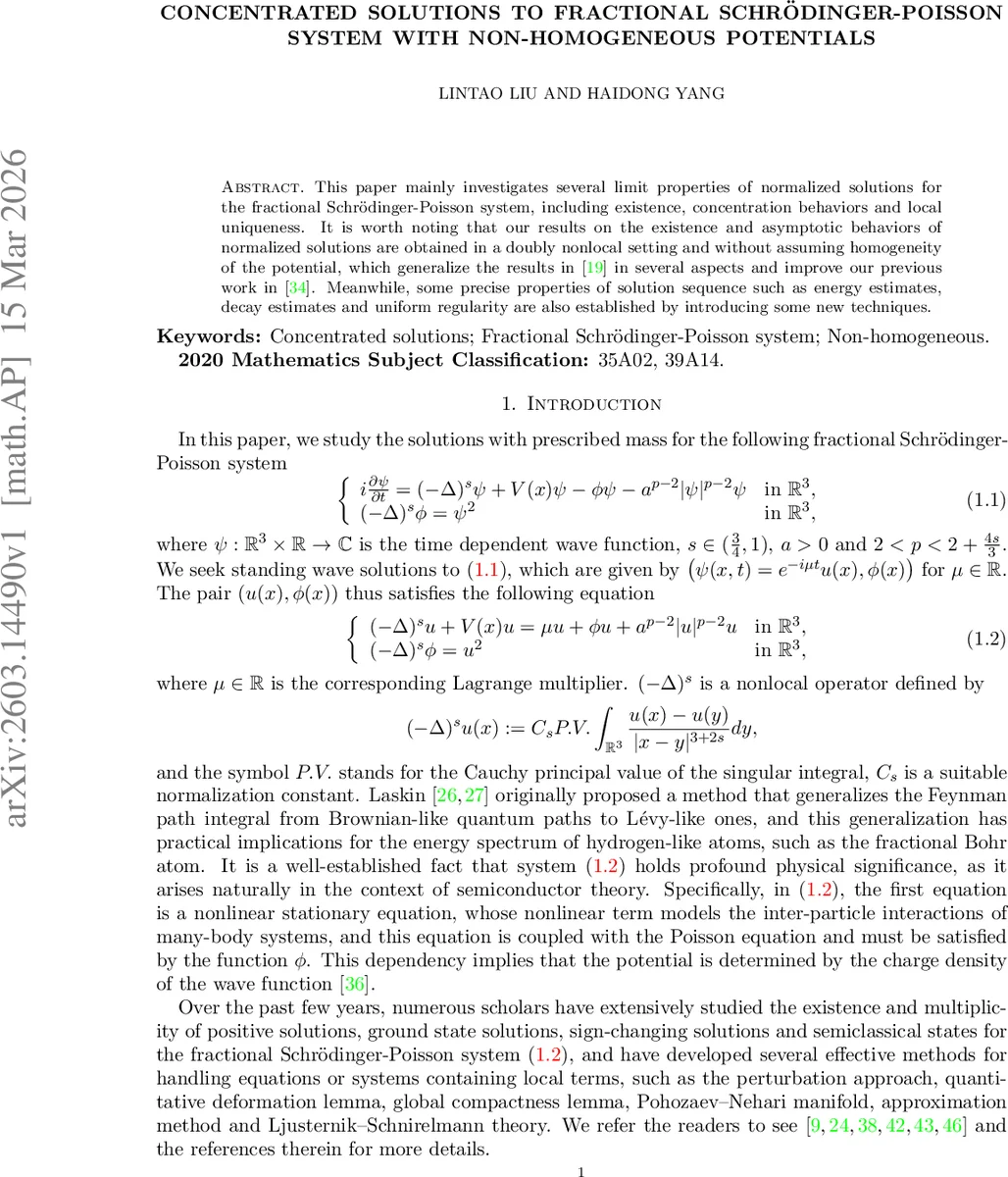
This paper mainly investigates several limit properties of normalized solutions for the fractional Schrödinger-Poisson system, including existence, concentration behaviors and local uniqueness. It is worth noting that our results on the existence and asymptotic behaviors of normalized solutions are obtained in a doubly nonlocal setting and without assuming homogeneity of the potential, which generalize the results in \cite{GDCDS} in several aspects and improve our previous work in \cite{LIUYANG}. Meanwhile, some precise properties of solution sequence such as energy estimates, decay estimates and uniform regularity are also established by introducing some new techniques.
💡 Research Summary
This paper studies a three‑dimensional fractional Schrödinger–Poisson system with a bounded, non‑homogeneous external potential V(x) and fractional Laplacian exponent s∈(3/4,1). Starting from the time‑dependent equation (1.1) and looking for standing waves ψ(x,t)=e^{-iμt}u(x), the authors reduce the coupled system (1.2) to a single non‑local equation (1.6) by expressing the Poisson component ϕ_u explicitly as a Riesz potential of u². The main object is the constrained minimization problem
e_m(a)=inf_{u∈S_m}E_a(u), S_m={u∈H^s(ℝ³):‖u‖_2²=m},
where the energy functional E_a(u) contains the kinetic term, the potential term, the non‑local interaction term (∫∫|u(x)|²|u(y)|²|x−y|^{−(3−2s)}dxdy) and a power‑type nonlinearity a|u|^{p−2}u with 2<p<2+4s/3.
Existence (Theorem 1.1). Under the mild assumptions V∈L^∞(ℝ³)∩C^α(ℝ³) and V_∞=sup V, the authors prove that e_m(a) admits at least one minimizer for any prescribed mass m>0. The proof relies on the optimal fractional Gagliardo–Nirenberg inequality (1.9) with the sharp constant C_opt and the unique positive solution Q of the limit equation (−Δ)^sQ+Q−Q^{p−1}=0. By comparing the energy of a trial function built from Q with the lower bound supplied by (1.9), they obtain compactness of minimizing sequences without invoking coercivity of V.
Concentration as a→∞ (Theorem 1.3). The paper then investigates the asymptotic profile of minimizers when the coefficient a of the power nonlinearity tends to infinity. The potential is assumed to satisfy (V2): near each global minimum point x_i of V (where V(x_i)=0) the function V behaves like a homogeneous function V_i of degree r_i>0, i.e. V(x_i+x)≈V_i(x) as |x|→0. Defining
ε_k = (a_k√a^)^{-2/(p−4)}, a^ = ‖Q‖_2²,
the authors show that any sequence of non‑negative minimizers u_k for a_k→∞ possesses a subsequence such that
ε_k^{3/2} u_k(ε_k x + x_k) → √a^* Q(x) in H^s(ℝ³)∩L^∞(ℝ³),
where x_k is the unique global maximum point of u_k and satisfies x_k→x_0 with V(x_0)=0. Moreover, the rescaled shift (x_k−x_0)/ε_k converges to a point y_0 belonging to the set K_0 of minimizers of the auxiliary functional
H(y)=∫_{ℝ³} V_0(x+y) Q²(x)dx,
with V_0 being the homogeneous approximation at the dominant minimum point(s). The proof introduces an auxiliary minimization problem (3.3) to obtain a sharp lower bound for e_1(a) and uses refined energy estimates to control the non‑local term, which cannot be handled directly by the classical fractional Gagliardo–Nirenberg inequality because of the L²‑subcritical exponent.
Local uniqueness (Theorem 1.4). Finally, under an additional non‑degeneracy condition (V3) – namely that the set Z_0 of dominant minimum points contains a single element and that y_0 is a non‑degenerate critical point of H – the authors prove that for a sufficiently large the minimizer of e_1(a) is unique. The argument proceeds by considering the difference of two putative minimizers, scaling it, and deriving a linearized non‑local equation for the scaled difference η_k. Because standard tools (Nash–Moser, Bessel kernel estimates) are ineffective for this equation, the authors develop a new comparison principle (Lemma 4.2, Lemma A.2). They also employ the Caffarelli–Silvestre extension to convert the fractional Laplacian into a local operator in one higher dimension, which enables the derivation of a Pohozaev‑type identity (Lemmas 4.3, A.3, A.4). Combining the comparison principle with the Pohozaev identity yields η_k→0, establishing uniqueness.
Structure. Section 2 proves existence of minimizers. Section 3 is devoted to the concentration analysis as a→∞, including the construction of the scaling ε_k and the identification of the limiting profile Q. Section 4 treats the local uniqueness, presenting the comparison principle, the extension method, and the Pohozaev identity. Appendix A contains technical lemmas used in Section 4.
Significance. The work extends the theory of normalized solutions for Schrödinger–Poisson type equations to a doubly non‑local setting with bounded, non‑homogeneous potentials, removing the need for coercivity or homogeneity that were essential in earlier studies. The introduction of a new auxiliary minimization problem, refined energy bounds, a novel comparison principle for fractional equations, and the use of the Caffarelli–Silvestre extension constitute methodological advances that are likely to be useful for a broad class of non‑local nonlinear PDEs arising in quantum mechanics, semiconductor theory, and fractional quantum models.
Comments & Academic Discussion
Loading comments...
Leave a Comment