Directed Polymer Transfer Matrices as a Unified Generator of Distinct One-Point Fluctuation Laws
We revisit the transfer-matrix approach to directed polymers in random media and show that a single ensemble of random transfer-matrix products provides a unified realization of the canonical one-point fluctuation laws in $(1+1)$ dimensions. For a fi…
Authors: Sen Mu, Abbas Ali Saberi, Roderich Moessner
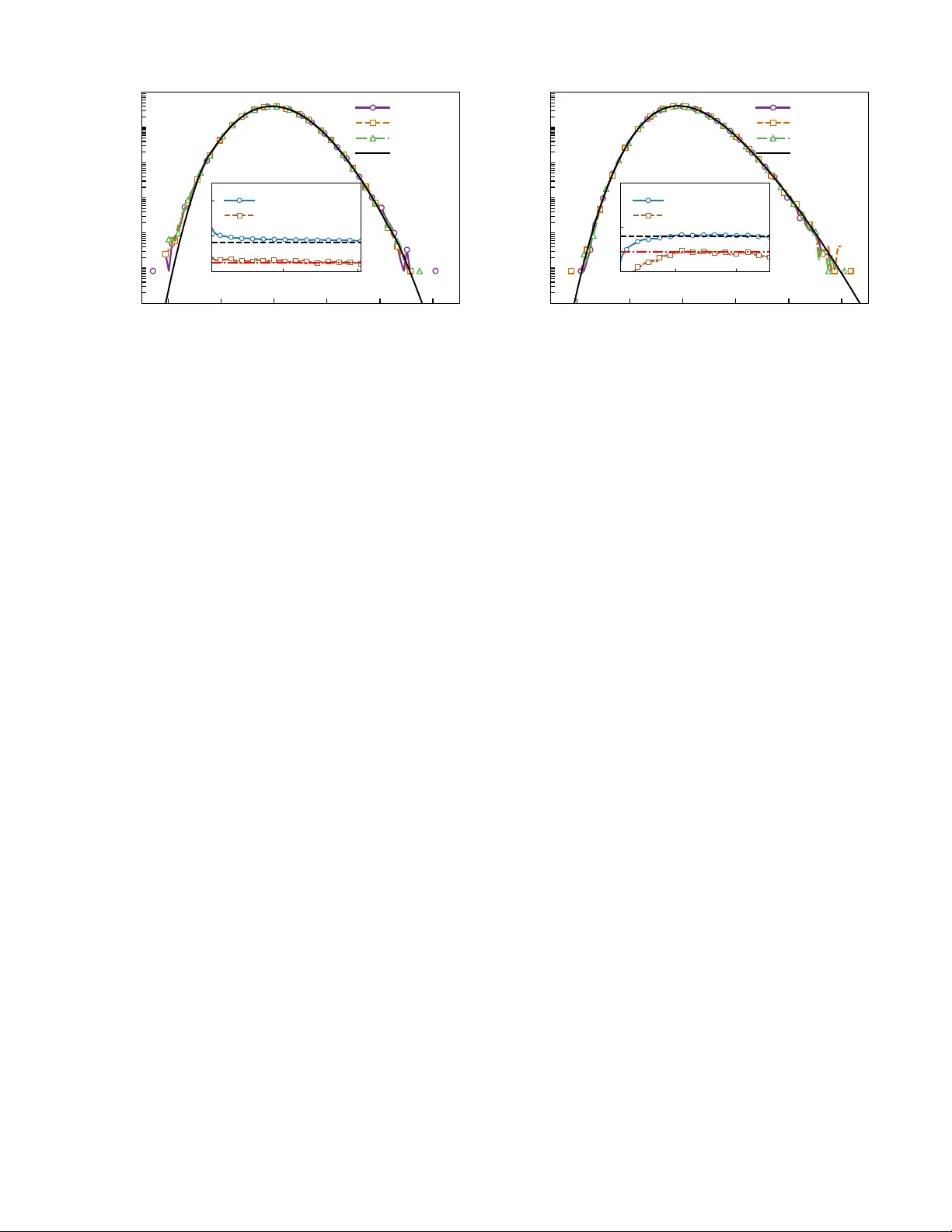
Directed P olymer T ransfer Matrices as a Unified Generator of Distinct One-P oin t Fluctuation La ws Sen Mu, 1 Abbas Ali Sab eri, 2, 1 , ∗ Ro deric h Moessner, 1 and Mehran Kardar 3 1 Max Planck Institute for the Physics of Complex Systems, 01187 Dr esden, Germany 2 Scho ol of Scienc e, Constructor University, Campus R ing 1, 28759 Br emen, Germany 3 Dep artment of Physics, Massachusetts Institute of T e chnolo gy, Cambridge, USA (Dated: March 17, 2026) W e revisit the transfer-matrix approac h to directed p olymers in random media and show that a single ensemble of random transfer-matrix pro ducts provides a unified realization of the canonical one-p oin t fluctuation laws in (1 + 1) dimensions. F or a fixed disorder realization, the p olymer parti- tion function is obtained as a contraction of the same pro duct matrix W ( t ), and different con tractions repro duce the standard KPZ sub classes: T racy–Widom GUE (p oint-to-point), GOE (p oin t-to-line), GSE (half-space p oint-to-point), and Baik–Rains (stationary line-to-point). In eac h case, w e observ e t 1 / 3 free-energy fluctuation gro wth and conv ergence of standardized distributions with low-order cu- m ulants close to the corresp onding universal b enchmarks. Viewing geometry-dep endent sub classes as pro jections of a single matrix-pro duct ensemble naturally suggests additional observ ables intrin- sic to W ( t ). As an example, we examine the leading eigenv alue λ 1 ( t ) whose logarithm exhibits t 1 / 3 scaling, while its standardized statistics remain distinct from the canonical T racy–Widom laws within the accessible range. This transfer-matrix p ersp ective thus organizes kno wn KPZ one-p oint sub classes within a finite-dimensional matrix framework and highlights matrix-lev el fluctuation ob- serv ables b eyond geometry-selected universalit y classes. I. INTR ODUCTION The Kardar-Parisi-Zhang (KPZ) universalit y class gov- erns a broad range of non-equilibrium fluctuation phe- nomena in one spatial dimension, including sto c hastic in terface growth, interacting particle systems, and di- rected p olymers in random media (DPRM) [ 1 – 5 ]. Be- y ond mo del-sp ecific details, KPZ systems share a char- acteristic scaling structure: F or growing interfaces, typ- ical heigh t fluctuations initially grow in time as t β with β = 1 / 3, spatial correlations spread as t 1 /z with dynamic exp onen t z = 3 / 2, ultimately saturating at finite size with roughness exp onent α = β z [ 1 – 3 , 5 ]. An equiv- alen t form ulation of the same universalit y class is pro- vided by directed p olymers in random media (DPRM), in whic h one studies a directed path propagating through a quenched random energy landscap e; the logarithm of its partition function defines a free energy whose fluctu- ations obey the same t 1 / 3 scaling, while the transverse w andering of the p olymer endp oint scales as t 2 / 3 . A cen tral insight of the modern theory is that KPZ univ ersality in 1 + 1 dimensions con tains distinct one- p oin t fluctuation sub classes, selected by geometry and b oundary conditions (or, for full-line gro wth, by initial data) [ 4 – 7 ]. F or curved (droplet) geometry , the prop- erly centered and scaled height/free-energy fluctuations con verge to the T racy-Widom GUE distribution [ 8 – 11 ]. F or flat geometry , the limiting law is T racy-Widom GOE [ 6 , 12 ]. F or stationary geometry , obtained by imp osing a t wo-sided Brownian initial profile, the limiting one-p oint la w is the Baik-Rains distribution [ 6 , 7 ]. In half-space set- ∗ asaberi@constructor.university tings, the presence of a b oundary introduces additional sub classes; in particular, at the appropriate boundary condition, one obtains T racy-Widom GSE fluctuations [ 12 – 14 ]. Differen t KPZ sub classes can comp ete and lead to crossov ers when distinct gro wth sectors are coupled, as shown for growth on crossing substrates with v arious sub class pairings [ 15 ]. These results provide one of the clearest examples of universal fluctuation laws con trolled b y geometry rather than microscopic dynamics. T raditionally , these sub classes are realized through dis- tinct dynamical settings: differen t initial data, b oundary geometries, or half-space constructions are imposed at the level of the growth pro cess itself. In this sense, the canonical one-p oint laws app ear as outcomes of separate ev olutions, each tailored to a particular geometry . The directed p olymer form ulation is historically one of the foundational routes into KPZ ph ysics. In the lat- tice DPRM, the partition function is obtained by sum- ming Boltzmann w eights ov er all directed paths through a quenc hed random energy landscap e, and its logarithm enco des the polymer free energy [ 2 – 4 , 16 ]. The o verall sum can b e computed recursively in p olynomial time with a transfer-matrix algorithm, in which the sum vector at time t is up dated from time t − 1 b y multiplication with a random near-diagonal matrix. This form ulation play ed a central role in early analytical treatments and numer- ical studies of DPRM/KPZ systems, because it mak es the growth recursion explicit and giv es direct access to finite-time fluctuation statistics [ 2 , 16 , 17 ]. At the same time, it naturally presents a matrix-product viewp oint that suggests connecting p olymer observ ables to matrix elemen ts and sp ectral statistics. The connection betw een KPZ ph ysics and random ma- trix theory (RMT) is no w a cornerstone of the field. The app earance of T racy-Widom laws in KPZ fluctu- 2 ations w as first understoo d through exact solutions of in tegrable growth models and exclusion processes, and through their mapping to determinantal/Pfaffian struc- tures [ 6 – 8 ]. In this corresp ondence, the edge fluctuations of random matrices provide the universal limiting distri- butions (GUE, GOE, GSE), while KPZ mo dels pro vide the dynamical ph ysical realization [ 4 , 5 , 9 , 12 ]. Subse- quen t exact solutions of the con tin uum KPZ equation and con tinuum directed p olymer further cemented this link, showing explicitly how the one-p oin t free-energy dis- tribution crosses o v er to the T racy-Widom la ws in the long-time limit [ 10 , 11 ]. In the present work, we revisit the transfer-matrix for- m ulation of lattice DPRM and adopt a complementary viewp oin t. Rather than treating each KPZ sub class as arising from a separate dynamical construction, we re- gard the time-ordered pro duct of random transfer matri- ces W ( t ) = T ( t ) T ( t − 1) · · · T (1) as the fundamen tal ob ject. F or a fixed disorder real- ization, the p olymer partition function is a matrix ele- men t of this pro duct. W e show numerically that differ- en t b oundary contractions of the same random matrix pro duct W ( t ) repro duce the canonical one-p oin t KPZ sub classes: p oint-to-point (droplet) yields T racy–Widom GUE, p oint-to-line (flat) yields T racy–Widom GOE, a stationary line-to-p oint construction yields Baik–Rains, and a half-space implementation with an absorbing b oundary yields T racy–Widom GSE. In all cases, we re- co ver the expected t 1 / 3 fluctuation growth and observe agreemen t of standardized distributions and lo w-order cum ulants with the corresp onding univ ersal benchmarks. This matrix-pro duct p ersp ectiv e organizes geometry- dep enden t KPZ sub classes as distinct pro jections of a single finite-dimensional random-matrix ensemble. In this sense, the well-kno wn T racy–Widom and Baik–Rains fluctuation laws arise from different con tractions of the same ob ject, rather than from fundamen tally distinct sto c hastic evolutions. A t the same time, the transfer-matrix ensemble natu- rally contains observ ables that are not tied to canonical endp oin t geometries. Beyond matrix elements, one may examine intrinsic sp ectral prop erties of W ( t ), such as its leading eigenv alue. Motiv ated by the cen tral role pla yed b y the edge eigen v alue in classical random matrix the- ory , w e consider the growth of ln λ 1 ( t ), where λ 1 ( t ) is the largest eigenv alue of W ( t ). While ln λ 1 ( t ) exhibits KPZ-lik e t 1 / 3 fluctuation gro wth ov er an in termediate time windo w, its standardized one-p oint distribution and lo w-order cumulan ts remain distinct from the canonical T racy–Widom benchmarks within the numerically acces- sible regime. This suggests that the transfer-matrix en- sem ble may enco de additional fluctuation structures b e- y ond the geometry-selected KPZ sub classes. The remainder of the pap er is organized as fol- lo ws. In Sec. I I we introduce the lattice directed- p olymer transfer-matrix formulation and define the ran- FIG. 1. Illustration of the random energies on the green bonds in the 6-v ertex model represen tation considered for the di- rected p olymer in random media. dom matrix-pro duct e nsem ble studied here. In Sec. I I I w e show how different contraction s of the same pro duct matrix realize the canonical one-point KPZ sub classes and present numerical evidence for T racy–Widom GUE, GOE, and GSE statistics, as well as Baik–Rains fluctua- tions in the stationary construction. In Sec. IV w e turn to matrix-lev el observ ables beyond endp oint free ener- gies, fo cusing in particular on the largest eigenv alue of the transfer-matrix pro duct. Finally , in Sec. V we sum- marize the results and discuss future directions from the sp ectral p ersp ective op ened by this framework. I I. DIRECTED POL YMER IN RANDOM MEDIA AND TRANSFER-MA TRIX F ORMULA TION W e consider directed p olymers in random media (DPRM), where the central ob ject is the partition func- tion obtained by summing ov er all directed paths con- necting sp ecified initial and final p oints. F or a p oly- mer starting at ( x 0 , 0) and ending at ( x, t ), with x 0 , x ∈ [1 , . . . , N ] and t > 0, the partition function is defined as Z ( x, x 0 , t ) = X directed paths exp " − t X α =1 E α x,x 0 # . (1) Here, P t α =1 E α x,x 0 denotes the total random energy ac- cum ulated along each path, and the Boltzmann w eight assigns larger statistical w eight to low er-energy paths. The asso ciated free energy is F ( x, x 0 , t ) = − ln Z ( x, x 0 , t ) . (2) A conv enient wa y to ev aluate the partition function is through a transfer-matrix formulation, which takes ad- v antage of the directed nature of the paths. Denoting b y T ( t ) the transfer matrix at time slice t , the partition function satisfies the recursion relation Z ( x, x 0 , t ) = X x ′ ⟨ x | T ( t ) | x ′ ⟩ Z ( x ′ , x 0 , t − 1) . (3) It is therefore useful to introduce the ordered pro duct of 3 transfer matrices W ( t ) = t Y t ′ =1 T ( t ′ ) , (4) so that the partition function can b e written compactly as the matrix element Z ( x, x 0 , t ) = ⟨ x | W ( t ) | x 0 ⟩ . (5) Equation ( 5 ) makes clear that all polymer observ ables considered in this work are matrix elements—or contrac- tions—of the same random matrix pro duct W ( t ). F or a fixed realization of disorder, the entire geometry dep en- dence of the p olymer free energy is enco ded in how this pro duct matrix is contracted with b oundary vectors. In this work, we adapt a sp ecific realization of DPRM motiv ated by a 6-vertex mo del in a random en vironment. As depicted in Fig. 1 , random energies are assigned to di- agonal b onds of the mo del in a manner that leads to a particularly simple lo cal transfer matrix. W e adopt this c hoice b ecause it pro vides an efficien t and transparen t transfer-matrix represen tation, while preserving the es- sen tial ingredien ts of the problem. The corresponding tridiagonal transfer matrix at each time slice now tak es the form T ( t ′ ) = M t ′ 11 1 0 0 · · · 1 M t ′ 22 1 0 · · · 0 1 M t ′ 33 1 · · · 0 0 1 M t ′ 44 · · · . . . . . . . . . . . . . . . , (6) with time-dep endent diagonal entries M t ′ ii = e − 2 E t ′ i − 1 + e 2 E t ′ i . (7) The random v ariables E t ′ i are the (diagonal) b ond ener- gies of the c orresponding vertex mo del (Fig. 1 ) taken to b e indep endent and identically distributed random v ari- ables drawn from a uniform distribution with mean µ and standard deviation σ , E t ′ i ∈ [ µ − √ 3 σ, µ + √ 3 σ ] . (8) A t the boundaries, the diagonal en tries of the transfer matrix are mo dified according to the v ertex-mo del ge- ometry . In particular, we imp ose M t ′ 11 = e − 2 E t ′ 0 + e 2 E t ′ 1 , M t ′ N N = e − 2 E t ′ N − 1 . (9) These b oundary terms complete the definition of the DPRM transfer-matrix ensemble considered in this w ork. Throughout this w ork, we focus on system sizes N and ev olution times t chosen so as to probe the pre-saturation regime of KPZ scaling. F or 1 ≪ t ≪ N 3 / 2 , finite-size ef- fects are sub dominant and free-energy fluctuations are exp ected to exhibit the characteristic t 1 / 3 gro wth asso ci- ated with KPZ univ ersality . The numerical results pre- sen ted b elow are obtained within this scaling window. 10 0 10 1 10 2 10 3 t 4 6 10 20 40 σ [ F ( t )] Bro wnian-weigh ted line-pt half-space pt-pt pt-pt pt-line ∼ t 1 / 3 FIG. 2. Standard deviation of the free energy , σ [ F ( t )], as a function of time t for the Brownian-w eigh ted line-to-point, half-space p oint-to-point, p oint-to-point, and point-to-line b oundary conditions, plotted on log-log scales. The blac k solid line indicates the p ow er law t 1 / 3 . The data are consis- ten t with KPZ scaling of the free-energy fluctuations in all four cases. Model parameters are N = 128, µ = 0, and σ = 3, with evolution up to t = 1024 ov er 10 6 disorder realizations. I I I. KPZ SUBUNIVERSALITY FR OM PR ODUCT MA TRIX ELEMENTS It is well established that, for DPRM in 1 + 1 dimen- sions, different c hoices of endp oint geometry , and b ound- ary data select distinct one-p oin t KPZ fluctuation sub- classes. In the con ven tional formulation, these subclasses are realized b y mo difying the geometry or initial c ondi- tion of the growth pro cess itself. In the transfer-matrix framework developed here, the situation can b e viewed differently . F or a fixed disorder realization, the entire ev olution is encoded in the sin- gle product matrix W ( t ). Geometry then enters only through ho w this matrix is contracted with boundary v ectors. Different one-p oin t KPZ sub classes, therefore, corresp ond to different contractions of the same random matrix pro duct. In particular, fixing b oth the starting p oint and the endp oin t realizes the droplet geometry , for which the cen- tered and scaled free energy is exp ected to approach the T racy–Widom GUE distribution. Summing uniformly o ver one endpoint while keeping the other fixed corre- sp onds to the flat geometry and leads to the T racy– Widom GOE distribution. F or the stationary sub class, the corresp onding one-point law is the Baik–Rains dis- tribution, which is asso ciated with a stationary free- energy profile and is canonically realized by a tw o-sided Bro wnian profile in the con tin uum setting. In half- space settings, the presence of a b oundary introduces an additional subclass structure; in the absorbing-wall re- alization considered below, the resulting p oin t-to-p oint free-energy fluctuations are naturally compared with the 4 − 4 − 2 0 2 4 6 ˜ F pt − pt 10 − 6 10 − 5 10 − 4 10 − 3 10 − 2 10 − 1 10 0 PDF 500 1000 t 0 . 0 0 . 2 0 . 4 Skewness Excess kurtosis t = 512 t = 768 t = 1024 TW-GUE FIG. 3. Statistics of the standardized free energy for the p oin t-to-p oint b oundary condition. Main: Distribution of the standardized free energy ˜ F pt-pt at differen t times ( t = 512 , 768 , 1024), together with the standardized TW-GUE dis- tribution. Inset: Time evolution of the skewness and excess kurtosis of the standardized free energy . The black dashed and red dot-dashed lines denote the corresp onding TW-GUE v alues, 0.22 and 0.09, respectively . Model parameters are N = 128, µ = 0, σ = 3, and x 0 = 64 with evolution up to t = 1024 ov er 10 6 disorder realizations. T racy–Widom GSE distribution. In all of these sub classes, we characterize the fluctua- tions of the free energy through its standard deviation σ [ F ( t )] = p ⟨ F ( t ) 2 ⟩ − ⟨ F ( t ) ⟩ 2 , (10) where ⟨· · · ⟩ denotes the disorder a verage. As shown in Fig. 2 , we find that σ [ F ( t )] exhibits a clear p ow er-la w gro wth in time in all four cases shown, consisten t with the KPZ scaling form σ [ F ( t )] ∼ t 1 / 3 . In the following, we present the full distributions of the standardized free energy , ˜ F ( t ) = − F ( t ) − ⟨ F ( t ) ⟩ /σ [ F ( t )] , (11) for each of these sub classes and compare them with the corresp onding universal b enc hmark distributions. A. T racy-Widom GUE and GOE distributions W e first consider tw o basic con tractions of the pro d- uct matrix W ( t ) corresponding to fixed and partially summed endp oints: ( F pt-pt ( t ) = − ln ⟨ x 0 | W ( t ) | x 0 ⟩ , for p oint-to-point, F pt-line ( t ) = − ln P x ⟨ x | W ( t ) | x 0 ⟩ , for p oint-to-line, (12) with fixed x 0 . In the first case, b oth endp oints are fixed, while in the second case, the final endpoint is summed uniformly ov er all transverse p ositions. These t wo con- tractions are exp ected to prob e the droplet (TW-GUE) and flat (TW-GOE) sub classes, resp ectively . − 4 − 2 0 2 4 6 ˜ F pt − line 10 − 6 10 − 5 10 − 4 10 − 3 10 − 2 10 − 1 10 0 PDF 500 1000 t 0 . 1 0 . 3 0 . 5 Skewness Excess kurtosis t = 512 t = 768 t = 1024 TW-GOE FIG. 4. Statistics of the standardized free energy for the p oin t-to-line boundary condition. Main: Distribution of the standardized free energy ˜ F pt-line at different times ( t = 512 , 768 , 1024), together with the standardized TW-GOE dis- tribution. Inset: Time evolution of the skewness and excess kurtosis of the standardized free energy . The black dashed and red dot-dashed lines denote the corresp onding TW-GOE v alues, 0.29 and 0.17, respectively . Model parameters are N = 128, µ = 0, σ = 3 and x 0 = 64 with evolution up to t = 1024 ov er 10 6 disorder realizations. W e present the free-energy statistics for the p oint-to- p oin t b oundary condition in Fig. 3 . The standardized distribution at late time is well describ ed by the T racy– Widom GUE b enchmark. This iden tification is further supp orted b y the time ev olution of the sk ewness and excess kurtosis, which approac h the corresp onding TW- GUE v alues within the accessible time range. W e next presen t the free-energy statistics for the p oint- to-line b oundary condition in Fig. 4 . In this case the standardized distribution is well described by the T racy– Widom GOE b enchmark, as exp ected for the flat sub- class. This identification is again supp orted by the cor- resp onding skewness and excess kurtosis, whic h evolv e to ward the TW-GOE v alues at late times. B. T racy-Widom GSE distribution W e next mo dify the con traction b y in tro ducing a b oundary constraint that effectively restricts the p olymer to a half-space. Within the transfer-matrix framework, this corresp onds to altering the structure of W ( t ) near the b oundary while k eeping the bulk disorder ensem ble unc hanged. The half space is realized by placing an absorbing wall at the b oundary , taken to b e the last site x = N in our mo del, and by choosing the p olymer to start and end at the adjacent site x 0 = N − 1. An absorbing wall means that any p olymer tra jectory that reaches x = N is ter- minated and contributes no further weigh t. Equiv alen tly , the w all site cannot serve as the starting point of any fur- 5 − 4 − 2 0 2 4 6 ˜ F hs pt − pt 10 − 6 10 − 5 10 − 4 10 − 3 10 − 2 10 − 1 10 0 PDF 500 1000 t 0 . 0 0 . 2 0 . 4 Skewness Excess kurtosis t = 512 t = 768 t = 1024 TW-GSE FIG. 5. Statistics of the standardized free energy for the p oin t-to-p oint b oundary condition in half space. Main: Dis- tribution of the standardized free energy ˜ F hs pt-pt at differ- en t times ( t = 512 , 768 , 1024), together with the standardized TW-GSE distribution. Inset: Time ev olution of the sk ew- ness and excess kurtosis of the standardized free energy . The blac k dashed and red dot-dashed lines denote the correspond- ing TW-GSE v alues, 0.16 and 0.04, resp ectively . Mo del pa- rameters are N = 128, µ = 0, σ = 3 and x 0 = 127 with ev olution up to t = 1024 ov er 10 6 disorder realizations. ther con tinuation of the p olymer. In our transfer-matrix form ulation, this condition can b e imp osed at each step b y ∀ x ′ , t ′ : ⟨ x ′ | T ( t ′ ) | N ⟩ = 0 , (13) so that no propagation proceeds out w ard from the ab- sorbing site. With this b oundary condition, the half- space p oint-to-point free energy is defined by F hs pt-pt ( t ) = − ln ⟨ x 0 | W ( t ) | x 0 ⟩ , (14) with x 0 = N − 1 and the absorbing-wall condition in Eq. ( 13 ). A conv enien t implementation keeps the wall site as an auxiliary absorbing state. The p olymer is then allow ed to enter x = N from x = N − 1, but it cannot return. A t the level of each one-step transfer matrix T ( t ′ ), this corresp onds to choosing the blo ck acting on the last tw o sites {| N − 1 ⟩ , | N ⟩} to b e triangular, T { N − 1 ,N } ( t ′ ) = M t ′ N − 1 0 1 M t ′ N , (15) whic h p ermits transitions N − 1 → N while forbidding transitions N → N − 1. F or the point-to-point matrix elemen t ⟨ x 0 | W ( t ) | x 0 ⟩ , this construction remov es contri- butions from tra jectories that ev er reac h the absorbing site and is therefore equiv alen t for the observ able consid- ered here. The resulting free-energy statistics are shown in Fig. 5 . W e find that the standardized free-energy distribution − 4 − 2 0 2 4 6 ˜ F Bw line − pt 10 − 6 10 − 5 10 − 4 10 − 3 10 − 2 10 − 1 10 0 PDF 200 400 t 0 . 2 0 . 4 Skewness Excess kurtosis t = 128 t = 256 t = 512 Baik-Rains FIG. 6. Statistics of the standardized free energy for the Bro wnian w eighted line-to-p oint b oundary condition. Main: Distribution of the standardized free energy ˜ F Bw line-pt at dif- feren t times ( t = 128 , 256 , 512), together with the standard- ized Baik-Rains distribution. Inset: Time ev olution of the sk ewness and excess kurtosis of the standardized free energy . The blac k dashed and red dot-dashed lines denote the cor- resp onding Baik-Rains v alues, 0.36 and 0.29, resp ectively . Mo del parameters are N = 128, µ = 0, σ = 3, x 0 = 64 and σ B = 6 . 2 with evolution up to t = 512 ov er 10 6 disorder realizations. is well describ ed by the T racy–Widom GSE b enchmark. This identification is further supp orted by the time evo- lution of the skewness and excess kurtosis, whic h mo ve to ward the corresp onding TW-GSE v alues at late times. C. Baik-Rains distribution W e now turn to a construction aimed at probing the stationary KPZ subclass within the same transfer-matrix framew ork. In the contin uum formulation, the station- ary sub class is obtained by initializing the interface with a tw o-sided Brownian profile. Under time ev olution, suc h a profile preserves stationarit y of height incremen ts, and the resulting one-p oint fluctuations conv e rge to the Baik–Rains distribution. T o approximate this setting in the present discrete transfer-matrix formulation, w e introduce a Brownian- w eighted initial vector | u ⟩ with comp onents u ( x ) = e B ( x ) , (16) where B ( x ) is a discrete tw o-sided random w alk ref- erenced to a central site and fixed b y the con v ention B ( x mid ) = 0. This remo ves an arbitrary additive con- stan t and defines a random initial free-energy profile. The corresp onding free energy is obtained from the con- 6 traction F Bw line-pt ( t ) = − ln X x e B ( x ) ⟨ x 0 | W ( t ) | x ⟩ = − ln ⟨ x 0 | W ( t ) | u ⟩ , (17) whic h represents a Brownian-w eigh ted line-to-p oint ob- serv able from the same pro duct matrix W ( t ). In other w ords, the stationary-t yp e b oundary condition is imple- men ted by summing ov er all starting p ositions with ran- dom initial weigh ts e B ( x ) , while keeping the bulk disorder ensem ble unchanged. After centering and rescaling, the resulting one-p oin t free-energy distribution is then com- pared with the Baik–Rains b enchmark. In the discrete transfer-matrix realization considered here, the exact stationary measure of the m icroscopic dynamics is not known analytically and may dep end on the disorder distribution as w ell as on the update rule. W e therefore treat the standard deviation parameter σ B of the Brownian increments as an effective tuning pa- rameter. Specifically , we determine σ B empirically by requiring that the late-time skewness and excess kurto- sis of the standardized free-energy fluctuations approach the Baik–Rains b enchmark v alues as closely as p ossible within the accessible time window. It is important to emphasize that this Brownian- w eighted initialization should b e view ed as an effectiv e appro ximation to the stationary sub class rather than an exact in v ariant measure of the discrete dynamics. Finite- size and finite-time corrections can affect one-p oint and t wo-point observ ables differently , and the optimal v alue of σ B for matching one-p oint cumulan ts need not coin- cide with that inferred from spatial roughness diagnos- tics. Within the present system sizes and evolution times, w e therefore fo cus on one-p oint fluctuation statistics as the primary diagnostic of the stationary sub class. The numerical results are shown in Fig. 6 . After cen- tering and rescaling, the one-p oint free-energy distribu- tion exhibits go o d agreemen t with the Baik–Rains bench- mark ov er the accessible time range, and the lo w-order cum ulants approach the exp ected universal v alues. This indicates that, within the unified transfer-matrix ensem- ble, the stationary KPZ sub class can be effectively re- alized through a Bro wnian-weigh ted contraction of the same pro duct matrix W ( t ). IV. MA TRIX–LEVEL OBSER V ABLES BEYOND ENDPOINT GEOMETRIES The contractions considered in Sec. I I I prob e DPRM free energies asso ciated with specific endp oint geome- tries. How ever, the transfer-matrix pro duct W ( t ) con- tains more information than its matrix elements alone. It is therefore natural to ask whether in trinsic matrix- lev el observ ables, indep endent of canonical b oundary ge- ometries, also exhibit KPZ-like fluctuation behavior. In this section, we fo cus on one such observ able: the largest eigen v alue of the pro duct matrix W ( t ). 10 0 10 1 10 2 10 3 t 10 0 10 1 σ [ln λ 1 ( t )] ∼ t 1 / 3 ∼ t 1 / 2 FIG. 7. Standard deviation of the logarithmic leading eigen- v alue, σ [ln λ 1 ( t )], as a function of time t on log-log scales. The solid guide lines indicate the p ow er laws t 1 / 3 (blac k) and t 1 / 2 (red). The data display an in termediate regime com- patible with KPZ-like t 1 / 3 gro wth, follow ed at later times by a crosso ver tow ard a steep er scaling. Model parameters are N = 128, µ = 0 and σ = 3 with evolution up to t = 512 ov er 10 6 disorder realizations. A. Largest Eigenv alue Let { λ i ( t ) } N i =1 denote the eigenv alues of the product matrix W ( t ), ordered by decreasing mo dulus, | λ 1 ( t ) | ≥ | λ 2 ( t ) | ≥ · · · ≥ | λ N ( t ) | . (18) Since eac h transfer matrix has strictly positive entries, the pro duct W ( t ) is also strictly positive. By the Perron– F robenius theorem, the leading eigenv alue λ 1 ( t ) is there- fore real and p ositive. This mak es F 1 ( t ) = ln λ 1 ( t ) (19) a natural sp ectral growth observ able to study . Unlik e the canonical p oint-to-point or p oin t-to-line free energies, ln λ 1 ( t ) is not asso ciated with a specific end- p oin t geometry . It therefore pro vides an example of a matrix-lev el observ able intrinsic to the ensemble defined b y W ( t ). T o assess whether ln λ 1 ( t ) displays KPZ-like b e- ha vior, we examine the gro wth of its fluctuations. Ov er an intermediate time window, we observe that the stan- dard deviation grows approximately as σ [ln λ 1 ( t )] ∼ t 1 / 3 . (20) consisten t with KPZ scaling, as shown in Fig. 7 . This scaling regime is restricted in time and limited by finite- N effects; beyond a crossov er scale, deviations become visible. W e also examine the full distribution of the standard- ized ln λ 1 ( t ) at different times and compute its skewness and excess kurtosis, presen ted in Fig. 8 . Within the ac- cessible time range, these cum ulants remain systemati- cally distinct from the canonical T racy–Widom GUE and 7 − 5 0 5 ˜ F 1 10 − 5 10 − 3 10 − 1 PDF t = 16 (a) TW-GSE TW-GOE TW-GUE Baik-Rains − 5 0 5 ˜ F 1 10 − 5 10 − 3 10 − 1 t = 128 (b) TW-GSE TW-GOE TW-GUE Baik-Rains − 5 0 5 ˜ F 1 10 − 5 10 − 3 10 − 1 PDF t = 512 (c) TW-GSE TW-GOE TW-GUE Baik-Rains 128 256 384 512 t 0 . 0 0 . 5 1 . 0 (d) Skewness Excess kurtosis BR skewness BR excess kurtosis FIG. 8. Statistics of the standardized logarithmic leading eigen v alue ˜ F 1 ( t ). Panels (a)–(c) sho w the distribution of ˜ F 1 ( t ) at times t = 16 , 128 , 512, compared with the standardized TW-GSE, TW-GOE, TW-GUE, and Baik–Rains b enc hmark distributions. Panel (d) sho ws the time ev olution of the sk ew- ness and excess kurtosis of ˜ F 1 ( t ). The horizontal dashed and dot-dashed lines indicate the Baik–Rains sk ewness and excess kurtosis, resp ectively , shown only as reference v alues for com- parison. Among these canonical laws, Baik–Rains provides the closest ov erall reference to the numerical data o ver the accessible range and is therefore included as a guide to the ey e, rather than as an identified limiting law. Model param- eters are N = 128, µ = 0, and σ = 3, with evolution up to t = 512 ov er 10 6 disorder realizations. GOE b enchmark v alues. In particular, no clear conv er- gence tow ard kno wn TW cumulan ts is observed ov er the sim ulated regime. T ak en together, these results indicate that ln λ 1 ( t ) ex- hibits KPZ-like t 1 / 3 fluctuation growth ov er an interme- diate window, while its one-point statistics do not co- incide with geometry–selected T racy–Widom or Baik– Rains sub classes discussed in Sec. I I I . B. Sp ectral Perspective The leading eigenv alue pro vides only the simplest ex- ample of an intrinsic matrix-level observ able. More gen- erally , the full sp ectrum of W ( t ) encodes information ab out the structure of the random matrix product as- so ciated with DPRM evolution. In contrast to the end- p oin t free energies, which are selected by sp ecific b ound- ary contractions, sp ectral observ ables are determined by the internal structure of W ( t ) itself. The transfer-matrix viewp oin t, therefore, suggests a broader class of fluctua- tion observ ables deriv ed from the same disorder ensem- ble. While the present work fo cuses on the largest eigen- v alue as a represen tative, a systematic study of the sp ec- tral statistics of W ( t ) is desirable, but lies b eyond the scop e of this pap er. V. DISCUSSION AND OUTLOOK W e hav e sho wn that a single lattice DPRM transfer- matrix ensemble pro vides a compact realization of the canonical (1 + 1)-dimensional KPZ one-p oint sub class structure. The cen tral ob ject is the random pro duct ma- trix W ( t ) = T ( t ) T ( t − 1) · · · T (1) , from which p olymer partition sums and free energies are obtained by b ound- ary con traction. Within this framework, geometry do es not require distinct sto chastic evolutions; instead, it is enco ded algebraically through different contractions of the same random matrix pro duct. P oint-to-point, p oint- to-line, stationary , and half-space settings are realized by v arying only the b oundary vectors or endp oint summa- tions while keeping the bulk disorder ensemble fixed. F or the canonical endpoint observ ables, our numer- ics repro duce the exp ected t 1 / 3 free-energy fluctua- tion scaling and yield one-p oint distributions that are in go o d agreemen t with the corresponding univ ersal b enc hmarks. The droplet and flat con tractions ap- proac h T racy–Widom GUE and GOE, resp ectively; the half-space construction yields behavior consisten t with T racy–Widom GSE; and a Brownian-w eigh ted con trac- tion provides an effectiv e realization of the Baik–Rains stationary sub class. T aken together, these results show that geometry-dep endent KPZ one-p oint sub classes can b e organized directly at the level of a finite-dimensional matrix–pro duct ensemble. Bey ond these canonical pro jections, the transfer- matrix product W ( t ) naturally giv es access to intrin- sic matrix-level observ ables. As a representativ e exam- ple, we examined the logarithm of the leading eigen- v alue ln λ 1 ( t ); within the n umerically accessible regime, this sp ectral observ able exhibits KPZ-like t 1 / 3 fluctuation gro wth ov er an intermediate time windo w. A t the same time, its standardized distribution and cumulan ts remain distinct from the known T racy–Widom and Baik–Rains sub classes ov er the sim ulated range. Thus, while the presen t results do not establish an asymptotic limiting la w for this observ able, they indicate that the unified transfer-matrix ensemble contains fluctuation structures not directly tied to the standard geometry-selected sub- classes. This persp ective suggests a broader interpretation of the KPZ one-p oint structure. The familiar T racy–Widom and Baik–Rains laws arise as sp ecific pro- jections of a larger random matrix pro duct. In this sense, geometry selects particular observ ables of W ( t ), rather than defining fundamen tally differen t stochastic pro cesses. The transfer-matrix form ulation, therefore, pro vides a compact framework in which canonical KPZ sub classes coexist with additional matrix-derived observ- ables whose statistical prop erties remain to b e explored. Sev eral directions follo w naturally from the presen t viewp oin t. On the numerical side, larger system sizes and longer times would clarify the intrinsic sp ectral observ- ables such as ln λ 1 ( t ). On the conceptual side, it would b e in teresting to understand more systematically how sp ec- 8 tral observ ables of W ( t ) relate to the other DPRM config- urations, and whether additional matrix-level quantities admit univ ersal descriptions. More broadly , the transfer- matrix approach opens a route to studying DPRM and KPZ fluctuations through structured random matrix pro ducts, complementing integrable and con tinuum for- m ulations. In summary , a single ensem ble of finite-dimensional DPRM transfer-matrix pro ducts provides a unified framew ork for the canonical geometry-dep endent KPZ one-p oin t fluctuation la ws, while simultaneously suggest- ing a wider class of matrix-level observ ables whose scaling prop erties extend b eyond the canonical T racy–Widom sub classes. A cknow le dgements. S.M. thanks Jonas Karcher for helpful discussions. This w ork was funded by the Deutsc he F orsc hungsgemeinsc haft (DFG, German Researc h F oundation) under Pro ject No. 557852701 (A.A.S.). The study was also supported by the Ad- v anced Study Group “Strongly Correlated Extreme Fluc- tuations” at the Max Planck Institute for the Physics of Complex Systems, Dresden (2024/25) [ 18 ], and the NSF through Grant No. DMR-2218849 (M.K.). [1] M. Kardar, G. Parisi, and Y.-C. Zhang, Dynamic scaling of growing interfaces, Physical Review Letters 56 , 889 (1986) . [2] T. Halpin-Healy and Y.-C. Zhang, Kinetic roughening phenomena, sto chastic growth, directed polymers and all that. asp ects of mul tidisciplinary statistical mec hanics, Ph ysics Rep orts 254 , 215 (1995) . [3] T. Kriecherbauer and J. Krug, A p edestrian’s view on in teracting particle systems, KPZ universalit y and ran- dom matrices, Journal of Physics A: Mathematical and Theoretical 43 , 403001 (2010) . [4] I. Corwin, The k ardar-parisi-zhang equation and univer- salit y class, Random Matrices: Theory and Applications 1 , 1130001 (2012) . [5] K. A. T ak euchi, An app etizer to mo dern developmen ts on the k ardar-parisi-zhang universalit y class, Physica A: Statistical Mec hanics and its Applications 504 , 77 (2018) . [6] M. Pr¨ ahofer and H. Sp ohn, Universal distributions for gro wth pro cesses in 1+1 dimensions and random matri- ces, Physical Review Letters 84 , 4882 (2000) . [7] J. Baik and E. M. Rains, Limiting distributions for a p olyn uclear growth mo del with external sources, Journal of Statistical Physics 100 , 523 (2000) . [8] K. Johansson, Shap e fluctuations and random matri- ces, Communications in Mathematical Physics 209 , 437 (2000) . [9] C. A. T racy and H. Widom, Level-spacing distributions and the airy kernel, Communications in Mathematical Ph ysics 159 , 151 (1994) . [10] T. Sasamoto and H. Spohn, One-dimensional k ardar- parisi-zhang equation: An exact solution and its univer- salit y , Physical Review Letters 104 , 230602 (2010) . [11] G. Amir, I. Corwin, and J. Quastel, Probability distribu- tion of the free energy of the contin uum directed random p olymer in 1+1 dimensions, Communications on Pure and Applied Mathematics 64 , 466 (2011) . [12] C. A. T racy and H. Widom, On orthogonal and symplec- tic matrix ensembles, Communications in Mathematical Ph ysics 177 , 727 (1996) . [13] T. Sasamoto and T. Imamura, Fluctuations of the one- dimensional polynuclear growth mo del in a half-space, Journal of Statistical Physics 115 , 749 (2004) . [14] T. Imamura and T. Sasamoto, Fluctuations of the one- dimensional polynuclear growth mo del with external sources, Nuclear Physics B 699 , 503 (2004) . [15] A. A. Sab eri, H. Dashti-Naserabadi, and J. Krug, Com- p eting univ ersalities in k ardar–parisi–zhang gro wth mod- els, Physical Review Letters 122 , 040605 (2019) . [16] M. Kardar, Replica bethe ansatz studies of tw o- dimensional in terfaces with quenched random impurities, Nuclear Physics B 290 , 582 (1987) . [17] J. M. Kim, A. J. Bray , and M. A. Mo ore, Zero- temp erature directed p olymers in a random p otential, Ph ysical Review A 44 , 2345 (1991) . [18] https://www.pks.mpg.de/asg2024 .
Original Paper
Loading high-quality paper...
Comments & Academic Discussion
Loading comments...
Leave a Comment