A Physically-Grounded Attack and Adaptive Defense Framework for Real-World Low-Light Image Enhancement
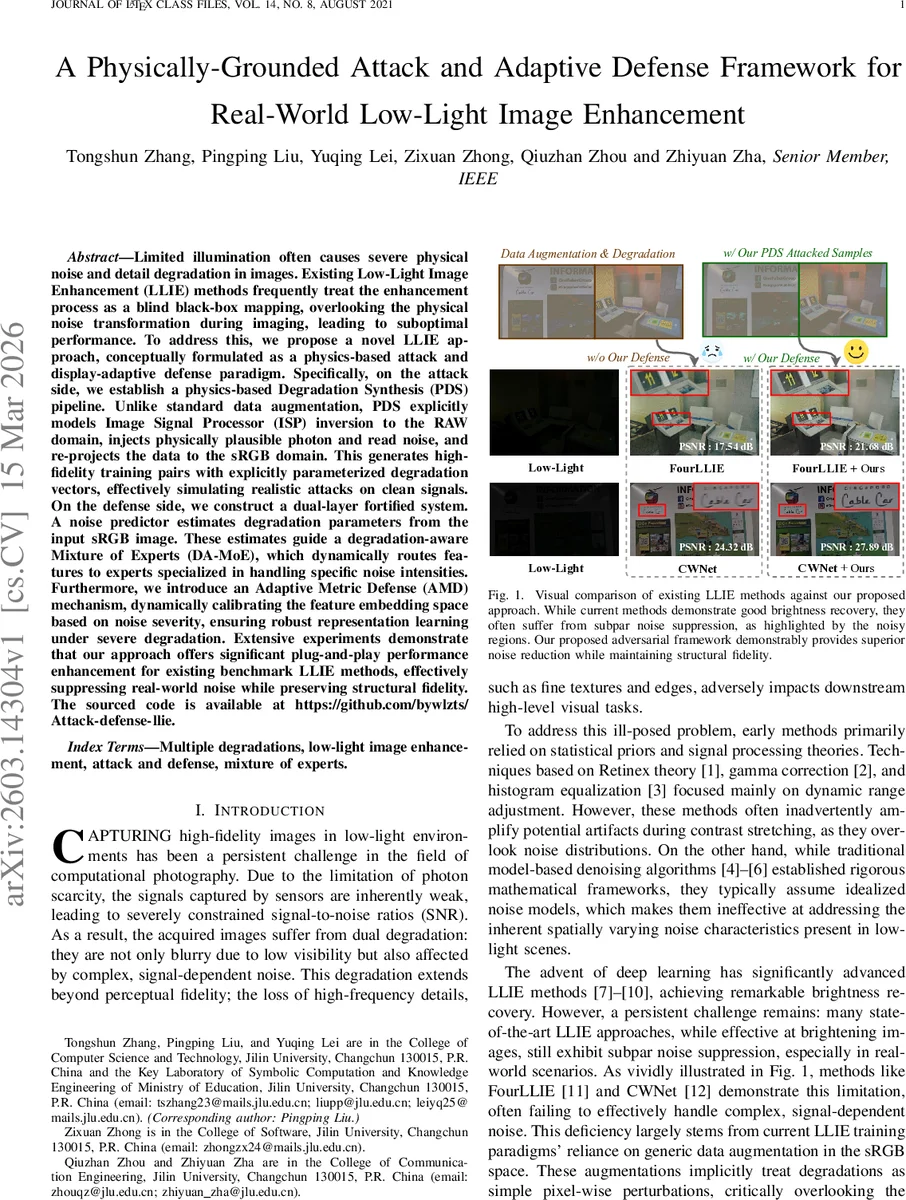
Limited illumination often causes severe physical noise and detail degradation in images. Existing Low-Light Image Enhancement (LLIE) methods frequently treat the enhancement process as a blind black-box mapping, overlooking the physical noise transformation during imaging, leading to suboptimal performance. To address this, we propose a novel LLIE approach, conceptually formulated as a physics-based attack and display-adaptive defense paradigm. Specifically, on the attack side, we establish a physics-based Degradation Synthesis (PDS) pipeline. Unlike standard data augmentation, PDS explicitly models Image Signal Processor (ISP) inversion to the RAW domain, injects physically plausible photon and read noise, and re-projects the data to the sRGB domain. This generates high-fidelity training pairs with explicitly parameterized degradation vectors, effectively simulating realistic attacks on clean signals. On the defense side, we construct a dual-layer fortified system. A noise predictor estimates degradation parameters from the input sRGB image. These estimates guide a degradation-aware Mixture of Experts (DA-MoE), which dynamically routes features to experts specialized in handling specific noise intensities. Furthermore, we introduce an Adaptive Metric Defense (AMD) mechanism, dynamically calibrating the feature embedding space based on noise severity, ensuring robust representation learning under severe degradation. Extensive experiments demonstrate that our approach offers significant plug-and-play performance enhancement for existing benchmark LLIE methods, effectively suppressing real-world noise while preserving structural fidelity. The sourced code is available at https://github.com/bywlzts/Attack-defense-llie.
💡 Research Summary
The paper tackles a fundamental limitation of current low‑light image enhancement (LLIE) methods: the entanglement of sensor noise with illumination recovery when operating solely in the sRGB domain. Existing approaches typically treat LLIE as a black‑box mapping, using generic data augmentations or handcrafted sRGB‑space degradations that ignore the complex, signal‑dependent noise introduced by the camera’s Image Signal Processor (ISP). As a result, while they can brighten dark scenes, they often fail to suppress realistic noise, especially in real‑world conditions.
To overcome this, the authors propose a physics‑driven adversarial framework consisting of a “physics‑based attack” and a “display‑adaptive defense.” The attack component, called Degradation Synthesis (PDS), first inverts a clean sRGB image back to linear RAW using an analytically modeled inverse ISP. In the RAW domain, it injects physically plausible photon (Poisson) noise and read (Gaussian) noise parameterized by a pair (k, σ) that reflect sensor characteristics. The corrupted RAW is then passed through a forward ISP to obtain a realistic low‑light sRGB image. This process generates high‑fidelity training pairs together with explicit degradation vectors, effectively creating worst‑case yet physically plausible noise scenarios.
On the defense side, three modules are introduced. 1) A Noise Predictor estimates the degradation parameters (k, σ) directly from the attacked sRGB input, providing explicit noise awareness. 2) A Degradation‑Aware Mixture of Experts (DA‑MoE) contains multiple expert subnetworks, each specialized for a particular noise regime (e.g., low‑intensity Gaussian, high‑intensity Poisson, mixed). The predictor’s output gates the experts dynamically; high‑resolution features receive Poisson‑oriented experts with Spatial Feature Transform (SFT) modulation, while low‑resolution features favor Gaussian‑oriented experts, leveraging the Central Limit Theorem. 3) An Adaptive Metric Defense (AMD) adjusts the margin in the loss function according to the estimated noise severity, enlarging the feature‑space separation for hard‑negative (strongly attacked) samples while preserving fine details for mild degradations.
Training is performed with a dual‑domain self‑supervised loss that simultaneously aligns the enhanced output with the clean normal‑light target in both RAW and sRGB spaces, using the degradation vectors supplied by PDS as supervision. The whole defense stack is plug‑and‑play: it can be attached to any existing LLIE backbone without redesigning the core architecture.
Extensive experiments on public low‑light benchmarks (e.g., LOL, SID) and real smartphone captures demonstrate that adding the proposed modules to state‑of‑the‑art LLIE models such as FourLLIE and CWNet yields consistent improvements: PSNR gains of roughly 3–4 dB, higher SSIM, and visibly cleaner textures. Qualitative results show that noise is substantially reduced while structural fidelity and color consistency are preserved, addressing the trade‑off that plagues many prior methods.
In summary, the paper reframes LLIE as an adversarial game between a physics‑grounded attacker that synthesizes realistic RAW‑domain noise and a noise‑aware defender that adapts its architecture and loss to the estimated degradation. By explicitly modeling sensor noise, providing interpretable degradation priors, and introducing adaptive expert routing and metric calibration, the work offers a principled and practical pathway to robust low‑light enhancement that bridges the gap between RAW‑domain physics and sRGB‑domain deployment. Future directions include extending the pipeline to diverse sensor models, accelerating the inverse ISP step for real‑time use, and integrating multimodal cues (depth, infrared) to further strengthen low‑light vision systems.
Comments & Academic Discussion
Loading comments...
Leave a Comment