CETOmega: The Causal-Informational Completion of Gravity
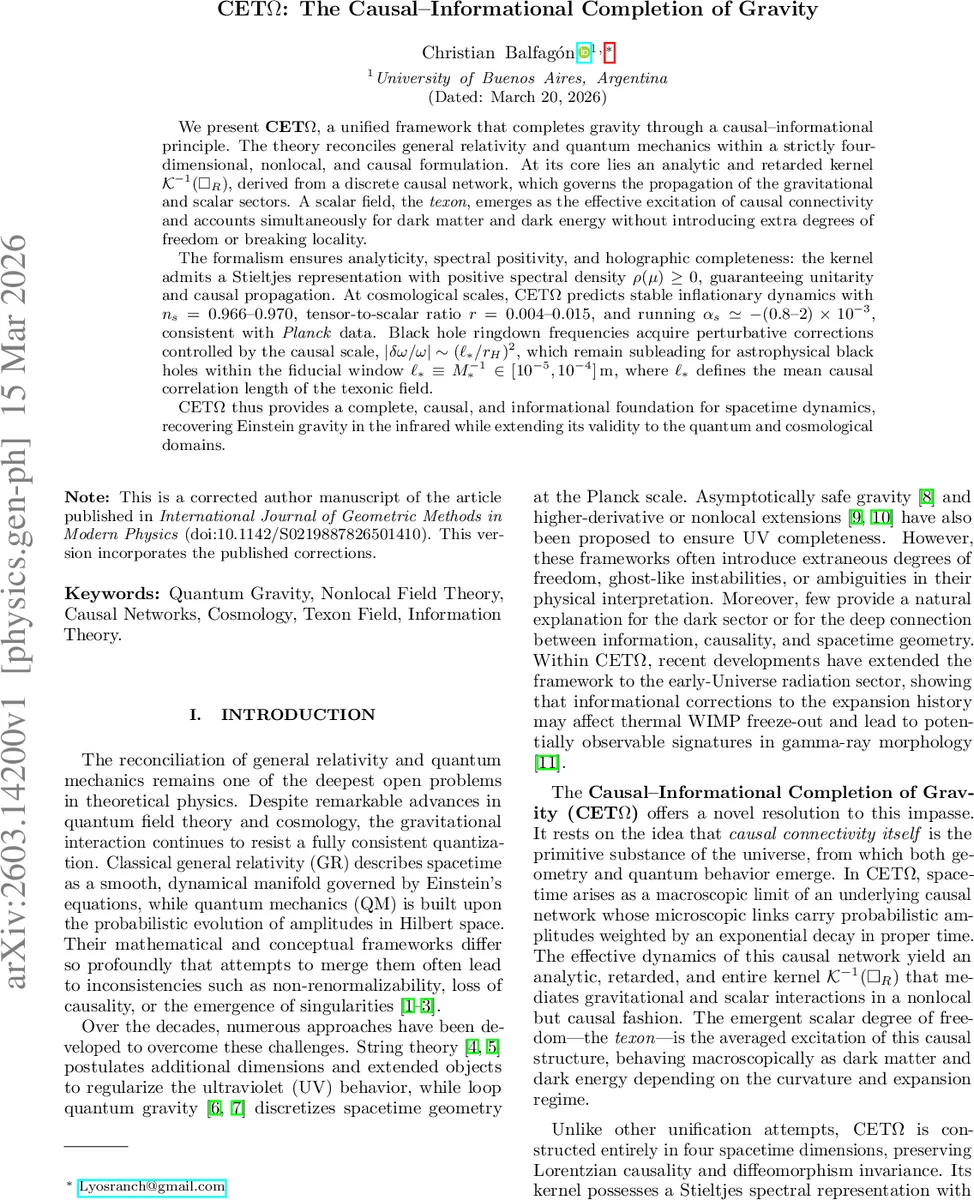
We present CETOmega, a unified framework that completes gravity through a causal-informational principle. The theory reconciles general relativity and quantum mechanics within a strictly four-dimensional, nonlocal, and causal formulation. At its core lies an analytic and retarded kernel K^-1(Box_R), derived from a discrete causal network, which governs the propagation of the gravitational and scalar sectors. A scalar field, the texon, emerges as the effective excitation of causal connectivity and accounts simultaneously for dark matter and dark energy without introducing extra degrees of freedom or breaking locality. The formalism ensures analyticity, spectral positivity, and holographic completeness. The kernel admits a Stieltjes representation with positive spectral density rho(mu) greater than or equal to zero, guaranteeing unitarity and causal propagation. At cosmological scales, CETOmega predicts stable inflationary dynamics consistent with Planck observations. Black hole ringdown frequencies acquire perturbative corrections controlled by the causal scale and remain subleading for astrophysical black holes within the fiducial window l* between 10^-5 and 10^-4 meters, where l* defines the mean causal correlation length of the texonic field. CETOmega thus provides a complete, causal, and informational foundation for spacetime dynamics, recovering Einstein gravity in the infrared while extending its validity to the quantum and cosmological domains.
💡 Research Summary
CETOmega proposes a four‑dimensional, non‑local yet causal completion of gravity built on a causal‑informational principle. The theory introduces a retarded, analytic kernel K⁻¹(□_R) defined by a Stieltjes integral with a positive spectral density ρ(μ)≥0, guaranteeing unitarity, absence of ghosts, and causal propagation. A scalar field called the texon, emerging as the averaged excitation of an underlying causal network, couples to curvature through the same kernel and carries no extra degrees of freedom. Its potential V(ϕ)=V₀
Comments & Academic Discussion
Loading comments...
Leave a Comment