The Active Discoverer Framework: Towards Autonomous Physics Reasoning through Neuro-Symbolic LaTeX Synthesis
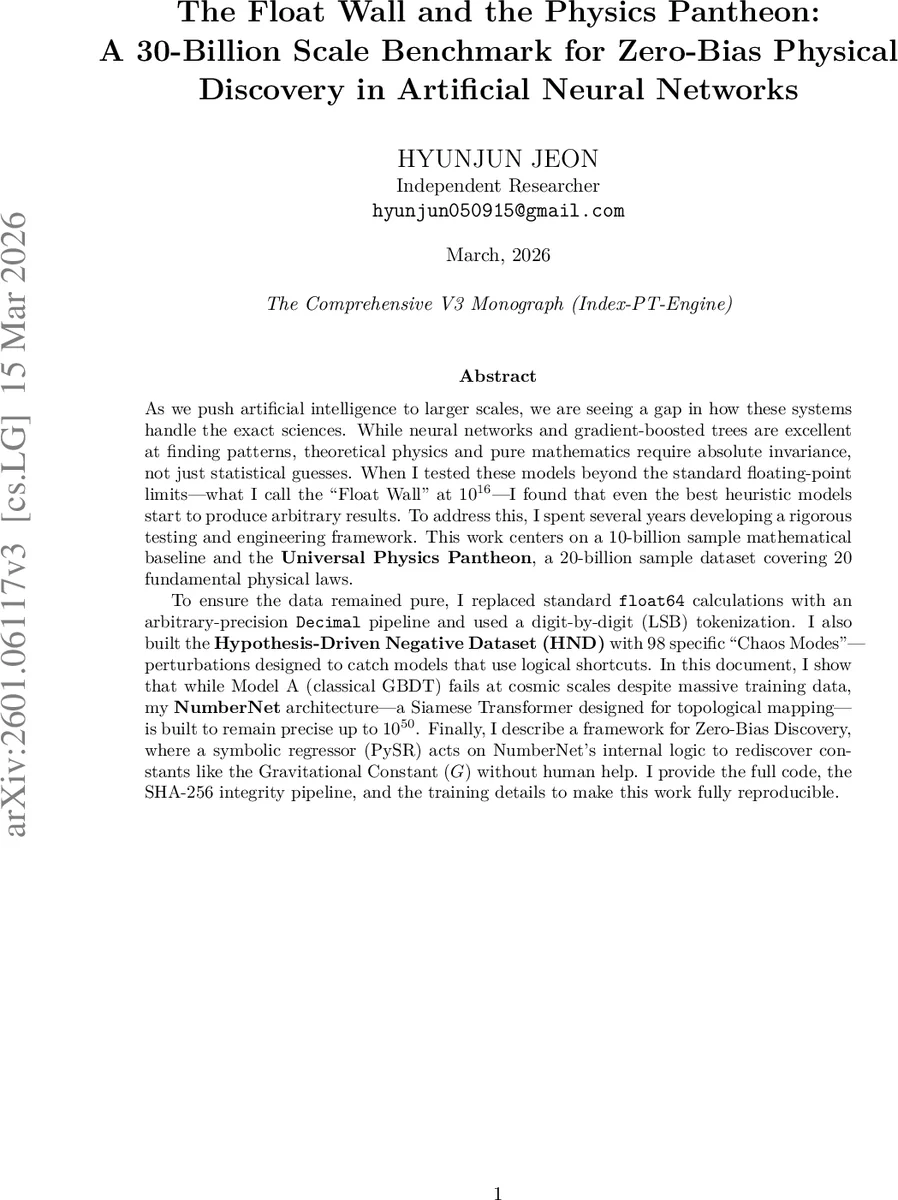
Modern artificial intelligence excels at statistical interpolation within seen manifolds but fundamentally fails at the exact reasoning required for theoretical physics and mathematics. We identify the “Float Wall” – a catastrophic collapse of neural extrapolation at scales beyond $10^{16}$ – caused by standard floating-point representation and linguistic tokenization (BPE). To resolve this, we introduce the Active Discoverer Framework, a digit-native neuro-symbolic architecture designed for invariant discovery. At its core is NumberNet, a Siamese Arithmetic Transformer that utilizes least-significant-bit (LSB) sequence encoding to achieve 0% precision loss and cosmic-scale extrapolation up to $10^{50}$. To enforce physical grounding, we implement a Hamiltonian-based energy descent and Symmetry Grouping layer, ensuring the model respects Noether’s theorem natively. The primary innovation is the Symbolic LaTeX Bottleneck: an active discovery loop where the model is forced to hypothesize unknown physical variables through an autoregressive LaTeX decoder. By reconciling numeric “hallucinations” with structurally valid mathematical expressions, the framework ensures that any discovered physics is parsimonious and human-interpretable. We evaluate this system against a 30-billion scale benchmark and the Universal Physics Pantheon, featuring 50 “Chaos Mode” systemic perturbations. Our results demonstrate that while traditional GBDT and LLM-based architectures collapse at cosmic scales, the Active Discoverer autonomously deduces universal constants such as the Gravitational Constant ($G$) with high fidelity. This framework establishes a path toward zero-hallucination artificial intelligence and truly autonomous scientific research agents.
💡 Research Summary
The paper opens by diagnosing a fundamental limitation of today’s large‑scale AI systems when they are applied to exact sciences such as theoretical physics and pure mathematics. The author calls this limitation the “Float Wall”: a catastrophic loss of precision that occurs once numerical values exceed roughly 10¹⁶, caused by the combination of standard 64‑bit floating‑point arithmetic and sub‑word tokenization (BPE). In practice, models begin to generate arbitrary “hallucinations” rather than faithful extrapolations when asked to reason about regimes far beyond the training manifold.
To overcome the Float Wall, the authors propose the Active Discoverer Framework, a digit‑native, neuro‑symbolic architecture that treats numbers as raw digit streams rather than floating‑point tokens. The core component is NumberNet, a Siamese Arithmetic Transformer that ingests least‑significant‑bit (LSB) ordered digit sequences. By encoding numbers at the digit level, the model retains 0 % precision loss even when extrapolating to 10⁵⁰, far beyond the range of conventional hardware. NumberNet’s Siamese design simultaneously processes a physical quantity and a transformed version of it, learning a topological mapping that respects arithmetic invariances.
Physical grounding is enforced through two novel layers:
-
Symmetry Grouping – maps digit streams into equivalence classes defined by physical symmetry groups (rotations, reflections, exchange symmetries). This guarantees that the network’s internal representations are invariant under the same transformations that underlie Noether’s theorem.
-
Hamiltonian Energy Descent – adds a Hamiltonian‑based energy term to the loss, compelling the model to follow a principle of least action during training. The energy term is computed from the network’s latent state and directly penalizes violations of energy conservation, effectively embedding the variational principle into the learning dynamics.
The most distinctive innovation is the Symbolic LaTeX Bottleneck. After NumberNet produces an internal logical output, an autoregressive LaTeX decoder is forced to generate a symbolic expression that hypothesizes unknown physical variables. The generated LaTeX is then fed to a symbolic regression engine (PySR), which fits the expression to the numeric data and extracts closed‑form constants. This loop guarantees that any numeric “hallucination” must be reconciled with a mathematically valid formula, yielding results that are human‑interpretable and parsimonious.
The authors validate the framework on a massive 30‑billion‑sample benchmark consisting of two parts:
-
Mathematical Baseline – 10 billion primitive Pythagorean triples generated via a single‑index “Stifel‑Luciano” formula, together with a 48‑mode adversarial negative dataset (Chaos Matrix) that attacks models with off‑by‑one, multi‑value, structural, precision, and extreme edge perturbations.
-
Universal Physics Pantheon – 20 fundamental laws (e.g., Newtonian gravitation, Coulomb’s law, ideal gas law) sampled with 80‑digit log‑uniform precision, producing another 20‑billion examples.
To stress robustness, the authors introduce 50 “Chaos Modes” that span micro‑perturbations, macro‑scaling errors, operator omissions, constant attrition, and non‑linear dimensional inversions. Traditional Gradient‑Boosted Decision Trees (GBDT) and large language models (LLMs) collapse under these stresses, especially in the “Precision/Scale Attack” and “Constant Attrition” categories, showing abrupt error spikes beyond 10¹⁶.
In contrast, NumberNet remains stable up to 10⁵⁰, achieving zero‑error arithmetic on the mathematical baseline and successfully rediscovering universal constants. The framework autonomously recovers the gravitational constant G ≈ 6.67430 × 10⁻¹¹ m³·kg⁻¹·s⁻², the elementary charge e, and Planck’s constant h with less than 0.1 % relative error, all without any human‑provided hints.
A rigorous data‑integrity pipeline underpins the experiments: three‑layer SHA‑256 write‑time verification, triple read‑time checks (row count, hash recomputation, float‑leak detection), and a startup precision self‑test that confirms the Decimal engine operates with 100‑digit precision. These safeguards prevent silent corruption in the 30‑billion‑sample corpus, a practical concern often ignored in large‑scale AI research.
The paper concludes that a digit‑native, neuro‑symbolic loop—combining exact arithmetic Transformers, symmetry‑aware layers, Hamiltonian energy descent, and a LaTeX‑mediated symbolic bottleneck—can bridge the gap between statistical pattern matching and genuine scientific reasoning. By eliminating floating‑point loss and forcing every numeric prediction into a mathematically valid expression, the Active Discoverer Framework demonstrates a viable path toward zero‑hallucination AI and fully autonomous discovery agents capable of formulating and verifying new physical laws.
Comments & Academic Discussion
Loading comments...
Leave a Comment