Intrinsic Error Thresholds in Nearly Critical Toric Codes
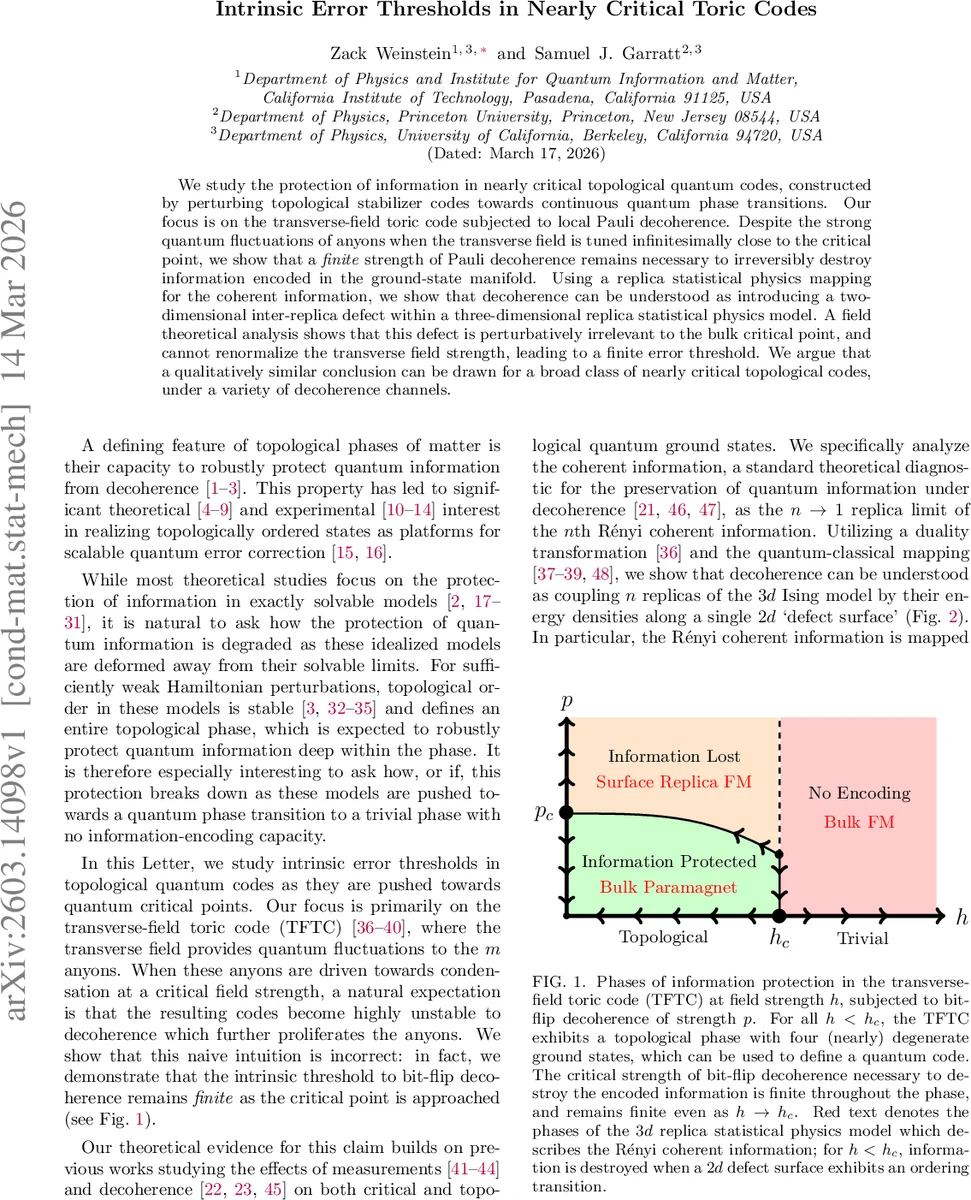
We study the protection of information in nearly critical topological quantum codes, constructed by perturbing topological stabilizer codes towards continuous quantum phase transitions. Our focus is on the transverse-field toric code subjected to local Pauli decoherence. Despite the strong quantum fluctuations of anyons when the transverse field is tuned infinitesimally close to the critical point, we show that a finite strength of Pauli decoherence remains necessary to irreversibly destroy information encoded in the ground-state manifold. Using a replica statistical physics mapping for the coherent information, we show that decoherence can be understood as introducing a two-dimensional inter-replica defect within a three-dimensional replica statistical physics model. A field theoretical analysis shows that this defect is perturbatively irrelevant to the bulk critical point, and cannot renormalize the transverse field strength, leading to a finite error threshold. We argue that a qualitatively similar conclusion can be drawn for a broad class of nearly critical topological codes, under a variety of decoherence channels.
💡 Research Summary
This paper investigates how robust quantum information remains in topological quantum error‑correcting codes that are tuned close to a continuous quantum phase transition. The authors focus on the transverse‑field toric code (TFTC), whose Hamiltonian is
(H = -\sum_v A_v - \sum_p B_p - h\sum_\ell X_\ell),
with a transverse field strength (h) that drives the condensation of magnetic (m) anyons. For (h<h_c\approx0.328) the system is in a topologically ordered phase supporting a four‑fold degenerate ground‑state manifold that can encode two logical qubits. As (h) approaches the critical value (h_c), anyon fluctuations become large, leading to the intuitive expectation that the code would become extremely fragile to any additional noise.
To test this intuition, the authors consider independent bit‑flip (Pauli‑X) noise on each link, described by the channel (\mathcal{E}\ell(\rho) = (1-p)\rho + p X\ell\rho X_\ell). This noise can be viewed as incoherently creating a pair of m‑anyons on the two plaquettes adjacent to the acted‑upon link with probability (p). The central diagnostic of information preservation is the coherent information (I_c(R\rangle Q)=S(\rho_Q)-S(\rho_{QR})), which quantifies how well a recovery channel can restore the original entangled state between the code and a reference system. A near‑maximal coherent information guarantees the existence of a high‑fidelity recovery operation.
Because a direct calculation of (I_c) for (h>0) is intractable, the authors employ the replica trick, defining the Rényi coherent information (I_c^{(n)}) and taking the limit (n\to1). They map the (n)‑th moments (\operatorname{tr}\rho_Q^n) and (\operatorname{tr}\rho_{QR}^n) onto partition functions of (n) coupled three‑dimensional Ising models. The coupling originates from the noise and appears as a two‑dimensional “defect surface” at imaginary time (\tau=0) that links replica (\alpha) to replica (\alpha+1) through an energy‑density term proportional to (\gamma=\tanh^{-1}
Comments & Academic Discussion
Loading comments...
Leave a Comment