Optimal pinning control of directed hypergraphs
Identifying the nodes that must be directly controlled to steer a network along a desired trajectory remains an open problem for digraphs, and even more so for hypergraphs. In this manuscript, we investigate network systems coupled via directed hyper…
Authors: Fabio Della Rossa, Davide Liuzza, Francesco Lo Iudice
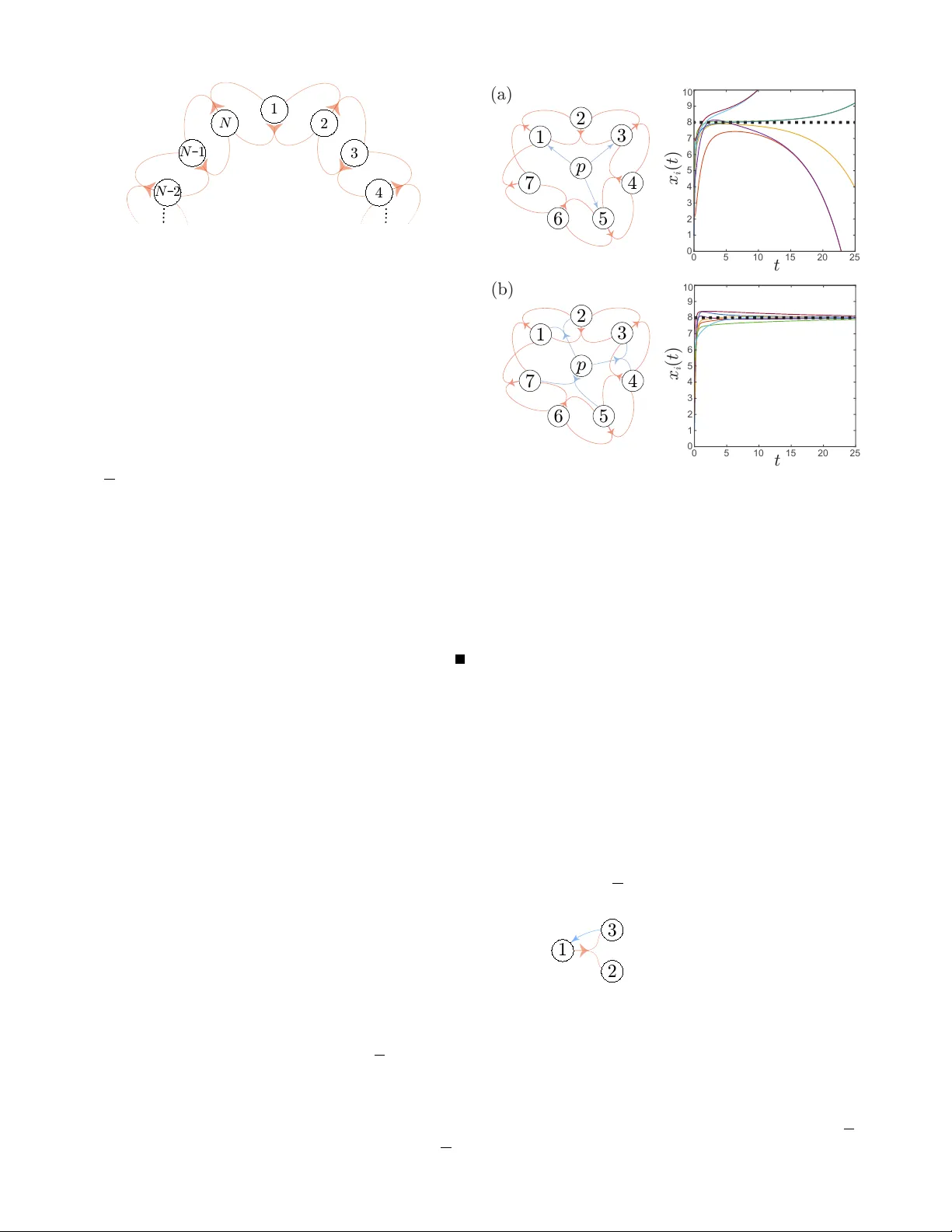
1 Optimal pinning control of directed hyper graphs Fabio Della Rossa, Davide Liuzza, Francesco Lo Iudice, and Pietro De Lellis, Senior Member , IEEE Abstract — Identifying the nodes that must be directly con- trolled to steer a network along a desired trajectory remains an open problem for digraphs, and even mor e so for hypergraphs. In this manuscript, we inv estigate network systems coupled via directed hypergraphs and consider a broad class of individual dynamics and coupling configurations, extending the definition of type II netw orks originally f ormulated for digraphs. For this class of networks with higher-order interactions, we establish necessary and sufficient conditions under which a pinning selection locally ensures successful control. Building on these analytical results, we propose a greedy heuristic for pinning control selection, which demonstrably outperforms existing methods. I . I N T RO D U C T I O N Steering the collectiv e behavior of networks of coupled dynamical systems (also called multiagent systems) has been an open challenge in the control literature in the last decades [1]. The interest of the research community has been triggered by the numerous applications spanning wide areas of science and engineering. For instance, coordinating the motion of interacting systems is at the foundation of se v- eral engineering problems, including formation control [2], rendez-vous problems [3], and po wer grid synchronization [4]. Additionally , control theory has provided insights into the mechanisms underlying opinion dynamics [5], and into strategies for controlling and mitigating epidemic outbreaks [6], [7]. When the control action can only be exerted on a (possibly small) fraction of the network nodes, the classical pinning control scheme has been proposed [8]. In pinning control, an external node, the pinner , sets a solution of the individual dynamics as the reference trajectory for the entire network. The pinner then sends a proportional control action to a This study was carried out within the 2022FHHHPC ≪ The Structure, Dynamics and Control of Network Systems With Higher-Order Interac- tions ≫ and the 2022K8EZBW ≪ Higher-order interactions in social dynam- ics with application to monetary networks ≫ projects – funded by European Union – Next Generation EU within the PRIN 2022 program (D.D. 104 - 02/02/2022 Ministero dell’Universit ` a e della Ricerca). This manuscript reflects only the authors’ views and opinions and the Ministry cannot be considered responsible for them. The work of Davide Liuzza was supported in part by the Uni versity of Sannio—“Finanziamento della Ricerca di Ateneo (FRA). P . De Lellis is with the Department of Electrical Engineering and Information T echnology , Uni versity of Naples Federico II, 80125, Naples, Italy (e-mail: pietro.delellis@unina.it). F . Della Rossa is with the Department of Electronics, Infor- mation, and Bioengineering, Politecnico of Milan, Italy (e-mail: fabio.dellarossa@polimi.it). F . Lo Iudice is with the Department of Electrical Engineering and Information T echnology , Uni versity of Naples Federico II, 80125, Naples, Italy (e-mail: francesco.loiudice2@unina.it). D. Liuzza is with the Department of Engineering, Univ ersity of Sannio, Benev ento, Italy . fraction of the network nodes, denoted pinned nodes , of which it is assumed to be able to measure the state. Each feedback signal is modeled as a directed edge from the pinner to a pinned node. The problem then became that of identifying ho w many and which nodes to pin in order to control the entire network. It was observed that at least one node in each root strongly connected component of the graph should be pinned [9]. Then, gi ven a number of node measurements that can be taken, researchers hav e tried to optimally select where to inject the control signals. For instance, in the context of consensus, the maximization of the smallest eigen value of the grounded Laplacian has been used as a selection criterion for the pinned nodes [10], [11]. Adaptive strategies have also been proposed to modulate the gains to foster pinning controllability [12]. Existing approaches focus on standard pinning control on digraphs. Howe ver , it has been recently pointed out that, in sev eral applications, this control problem should be formulated on directed hypergraphs instead of digraphs, for a twofold reason. First, modeling the connections between the controlled nodes by directed edges, implicitly assumes pairwise interactions. In sev eral real-world network systems, howe ver , nonlinear interactions take place between groups (larger than 2) of agents, which cannot be factored as sum of pairwise interactions. This is the case, for instance, of chemical reaction networks, where reaction terms depend on the joint concentration of multiple reactants [13], or in social contagion and opinion formation, where adoption or behavioral change may require reinforcement from multiple peers at once [14], [15]. The second reason for which directed multibody inter- actions naturally arise in pinning control is that assuming directed edges from the pinner to the controlled nodes would imply the ability of individually measuring the outputs of the pinned nodes. This is not the case, ho wev er , when the sensors can only measure an aggregated output of two or more nodes [16]. Such rele vant case cannot be modeled by directed edges from the pinner to the pinned nodes, but rather as directed hyperedges from the pinner to a set of pinned nodes. This control framework has been recently proposed in [16]–[18] and references therein, but no method exists for the minimal selection of the pinning hyperedges, that is, a strategy that minimizes the number of measurements required for control. The only existing heuristic, proposed in [17], can only be applied to the case of pinning edges, that is, when the pinner can individually measure the state of the pinned nodes. In this paper , we aim to fill this gap and tackle the problem of optimally selecting the nodes to constitute the pinning hy- peredges. In particular, we focus on network systems with a 2 type II Master Stability Function, a definition that we e xtend to the case of higher-order interactions. For this wide class of systems (which include e.g. diffusi vely coupled smooth QU AD dynamical systems), we study the limit behavior of the eigenv alues of an extended Laplacian that describes the pinning controlled hypergraph. Based on this result, we are able to formulate an optimal control problem so to use a minimal number of measurements to control the network to the desired trajectory . Somewhat surprisingly , we find that there are instances in which pinning hyperedges are preferred to pinning edges, albeit the former are associated to aggregated, lower-resolution measurements. Since the optimal control problem should be in principle solved by exhausti ve search, unfeasible for large networks, we also propose an analytically grounded, yet efficient greedy heuristic. Through extensi ve numerical analysis on testbed hypergraph topologies, we sho w that a) the proposed heuristic closely matches the performance of an exhaus- tiv e search, b) when applied to the selection of pinning hyperedges, it strongly outperforms the heuristic proposed in [17], as well as alternati ve, purely topological, strategies, and c) it also effecti vely works for the selection of pinning hyperedges, where it closely matches the optimal solution obtained from exhausti ve search. I I . M A T H E M AT I C A L P R E L I M I NA R I E S A. Matrix notation Giv en a positive integer n , I n denotes the identity matrix in R n × n , with e i being its i -th column, and 0 n and 1 n are a vector of all zeros and of all ones in R n , respecti vely . Gi ven a vector v = [ v 1 , . . . , v n ] T , diag( v ) ∈ R n × n is the diagonal matrix with elements v 1 , . . . v n on the diagonal. Giv en a matrix M ∈ R n × n , M T is its transpose, and σ ( M ) is the set containing its eigen v alues. Further , we denote λ i ( M ) the i -th eigen value of M . Giv en two matrices M 1 ∈ R a × b and M 2 ∈ R c × d , we denote ( M 1 ⊗ M 2 ) ∈ R ac × bd their Kronecker product [19], and, when they hav e the same number of columns ( b = d ), [ M 1 ; M 2 ] ∈ R ( a + c ) × b their vertical concatenation, whereas, when they have the same number of rows ( a = c ) , [ M 1 , M 2 ] ∈ R a × ( b + d ) their horizontal concatenation. B. Directed hypergr aphs A directed hypergraph H is a pair ( V , E ) , where V = { ν 1 , . . . , ν N } is the set of nodes, and E = { ε 1 , . . . , ε M } is the set of directed hyperedges; the i -th directed hyperedge ε i of H is an ordered pair ( T ( ε i ) , H ( ε i )) of (possibly empty) disjoint subsets of the hyper graph nodes [20]. Namely , the ordered subsets T ( ε i ) and H ( ε i ) of V , are the set of tails and heads of the hyperedge ε i , respecti vely , and such that T ( ε i ) ∩ H ( ε i ) = ∅ . The cardinality | ε i | of a hyperedge ε i is defined as the number |T ( ε i ) | + |H ( ε i ) | of nodes composing it. The functions t ( ε, i ) and h ( ε, j ) associate to the i -th tail and j -th head of a hyperedge ε ∈ E the corresponding labels in V , respectiv ely . Furthermore, given two node subsets V 1 , V 2 ⊆ V , we denote E V 1 , V 2 = { ε ∈ E : V 1 ⊆ T ( ε ) ∧ V 2 ⊆ H ( ε ) } ; with a slight abuse of notation, when a subset is a singleton, we will refer to it by its only element, e.g. if V 1 = { ν j } we write E j, V 2 in place of E { ν j } , V 2 . Finally , we denote E · ,j = { ε i ∈ E : ν j ∈ H ( ε i ) } as the subset of hyperedges having ν j as a head, and E j, · = { ε i ∈ E : ν j ∈ T ( ε i ) } as the subset of hyperedges having ν j as a tail; we define the in-degree d in j and out-degree d out j of a node ν j as the cardinality of the latter two sets, that is, d in j = |E j, · | and d out j = |E · ,j | . C. Signed graphs [21] A weighted signed graph S is defined by the triple {V , E , W } , where V is the set of nodes, E ⊆ V × V is the set of edges, and the function W : V × V → R associates 0 to each pair ( i, j ) ∈ V × V that is not in E , and a non-zero weight to each edge in E . Dif ferent from standard weighted digraphs, also negati ve weights can be associated to edges. The adjacency matrix A associated to S is such that its ij -th entry a ij is equal to the weight W ( i, j ) associated to edge ( i, j ) . The Laplacian matrix for signed graphs has been defined as L = D − A , where D = diag h d out 1 , . . . , d out |V | i T , with d out i = P |V | j =1 a ij being the out-degree of node i . By definition, L is zero row- sum, which implies that 0 ∈ sp ec( L ) , and that 1 N is its associated (right) eigen vector . I I I . P I N N I N G C O N T R O LL A B I L I T Y O F N E T W O R K S Y S T E M S O N H Y P E R G R A P H S A. Network model and contr ol question W e consider an ensemble of N nonlinear dynamical sys- tems coupled through a directed hypergraph H c = {V c , E c } , where the sets V c = { ν 1 , . . . , ν N } and E c = { ε 1 , . . . , ε N } are the set of nodes and hyperedges, respecti vely . Given a node ν i ∈ V c , its state will be a vector x i ∈ R n , whereas, denoting x t ( ε,i ) and x h ( ε,j ) the state of the i -th tail and of the j -th head of a hyperedge ε ∈ E c , we associate to ε a tail state matrix x τ ε = [ x t ( ε, 1) , . . . , x t ( ε, |T ( ε ) | ) ] and a head state matrix x h ε = [ x h ( ε, 1) , . . . , x h ( ε, |H ( ε ) | ) ] . In the absence of a control action, the network dynamics would read ˙ x i = f ( x i ) + X ε ∈E · ,i c σ ε g ( x τ ε α ε − x h ε β ε ) , (1) where σ ε is the coupling gain associated to the hyperedge ε ; f : R n × R ≥ 0 → R n is the vector field describing the indi vid- ual dynamics, and g : R n → R n is the (possibly nonlinear) coupling protocol; α ε = [( α ε ) t ( ε, 1) , . . . , ( α ε ) t ( ε, |T ( ε ) | ) ] T and β ε = [( β ε ) h ( ε, 1) , . . . , ( β ε ) h ( ε, |H ( ε ) | ) ] T are the (ordered) vec- tors stacking the non-negativ e weights associated to the tails and heads of ε , respectiv ely , defined such that α T ε 1 |T ( ε ) | = β T ε 1 |H ( ε ) | = 1 . This coupling protocol is known as hyperdif- fusiv e, as it reduces to the standard diffusi ve protocol when only pairwise interactions are present [16]. Definition 1: The hypergraph weights are homogeneous when α ε = 1 |T ( ε ) | / |T ( ε ) | and β ε = 1 |H ( ε ) | / |H ( ε ) | [17]. In the presence of a pinner , an additional node p is added to the network, with state x p ∈ R n , sharing the same individual dynamics as the rest of the netw ork, and setting the 3 reference trajectory as the solution of the following Cauchy problem ˙ x p = f ( x p , t ) , x p (0) = x p 0 . (2) The pinner node is unidirectionally coupled to a subset of the network nodes, P , through a set of directed hyperedges (the pinning hyperedg es E pin = { ε p 1 , . . . , ε p m } ), characterized by the fact that the pinner is the sole tail. The heads sets of the pinning hyperedges are obtained from a partition of the set P , this meaning that the same node cannot be pinned by two different hyperedges, and that |H ( ε p 1 ) | + . . . + |H ( ε p m ) | = |P | . When the pinner is present, the network dynamics (1) then become ˙ x i = f ( x i ) + X ε ∈E · ,i c σ ε g ( x τ ε α ε − x h ε β ε ) + X ε ∈E pin κg ( x p − x h ε β ε ) , (3) where κ > 0 is the control gain. Since the hyperdiffusi ve coupling protocol is synchroniza- tion nonin vasi ve, the synchronization manifold x i ( t ) = x p ( t ) for all i ∈ V is inv ariant. The control goal is to dri ve the pinning error e ( t ) = [ e 1 ; . . . ; e N ] , with e i = x i − x p , to zero. More formally , Definition 2: The controlled network (3) is locally asymp- totically controlled to the pinner’ s trajectory if 1) for each ς > 0 and t 0 ≥ 0 , there exists ∆ 1 ( ς , t 0 ) such that ∥ e ( t ) ∥ < ς , ∀ t ≥ t 0 , (4) for ∥ e ( t 0 ) ∥ ≤ ∆ 1 ( ς , t 0 ) ; and 2) for each t 0 ≥ 0 , there exists a ∆ 2 ( t 0 ) such that lim t → + ∞ e ( t ) = 0 . (5) for ∥ e ( t 0 ) ∥ ≤ ∆ 2 ( t 0 ) . Contr ol question: is network (3) pinning controllable, in the sense that there exists a control gain κ for which (3) is locally asymptotically controlled? B. Conver gence analysis Notice that the argument of the nonlinear function g in the first summation of (3) can be rewritten as X j ∈T ( ε ) ( ˜ α ε ) j ( x j − x i ) − X j ∈H ( ε ) ( ˜ β ε ) j ( x j − x i ) , (6) where ˜ β ε ( ˜ α ε ) belongs to R N and its j th element is 0 if node j is not a tail (head) of ε , whereas, if j is a tail (head) of ε , it is equal to the weight associated to that tail (head). Moreov er , we assume without loss of generality that the first |P | nodes receiv e a control input, sorted so that the nodes in ε p i precede those in ε p i +1 , for all i = 1 , . . . , m − 1 . It is then possible to define the following pinning matrix P = P ε 0 |P |× ( N −|P | ) 0 ( N −|P | ) ×|P | 0 ( N −|P | ) × ( N −|P | ) , (7) where P ε ∈ R |P |×|P | is the block diagonal matrix P ε = P ε p 1 . . . P ε p m , with P ε p i = β (1) ε p i · · · β ( | ε p i | ) ε p i . . . . . . β (1) ε p i · · · β ( | ε p i | ) ε p i . W e can no w focus on the dynamics of the i -th pinning error e i = x i − x p and linearize its dynamics around the reference trajectory x p , thus obtaining ˙ e i = JF( x p ) e i − N X j =1 ( L ij + κP ij )JG(0) e j , (8) where JF ∈ R n × n and JG ∈ R n × n are the Jacobian matrices associated to f and g , respectiv ely , and L ij is the entry ij of the Laplacian matrix of the signed graph S ( H c ) associated to H c , defined as L ij = X ε ∈E · , { i,j } ( ˜ β ε ) j σ ε − X ε ∈E j,i ( ˜ α ε ) j σ ε , (9) with E j,i being the set of hyperedges having j as a tail and i as a head, E · , { i,j } is set of hyperedges having both i and j as heads. W e can then rewrite (8) in matrix form as ˙ e = I N ⊗ JF( x p ) e − M ⊗ JG(0) e, (10) where M ( κ ) = L + κP . Next, we introduce the matrix V such that V − 1 M V is in Jordan form, and then introduce the transformation η = ( V ⊗ I n ) e . In general, matrix M has ν ≤ n Jordan blocks, and therefore η can be decomposed as [ η 1 , . . . , η ν ] , where η i = [ η i 1 , . . . , η ic i ] ∈ C nc i are the components of η associated to the i -th block, with η ij ∈ C n and c i being the size of the i -th block. The dynamics of η i are then giv en by ˙ η i 1 = (JF( x p ) − λ i JG(0)) η i 1 , ˙ η i 2 = (JF( x p ) − λ i JG(0)) η i 2 − JH(0) η i 1 , . . . (11) ˙ η ic i = (JF( x p ) − λ i JH(0)) η ic i − JG(0) η i ( c i − 1) , where λ i is the i -th eigenv alue of M . W e can now introduce the following master equation: ˙ ξ = JF( x p ) − µ JG(0) ξ , (12) where ξ ∈ R n and µ ∈ C n . Follo wing the notation used e.g. in [22] for networks on digraphs and in [16] for networks on directed hyper graphs, we call the maximum L yapunov exponent Λ( µ ) associated with (12) the master stability function for the pinned network (3). W e can now give the follo wing proposition: Pr oposition 1: if Λ max := max λ ∈ σ ( M ( κ )) Λ( λ ) < 0 , then the controlled network (3) is locally asymptotically controlled to the pinner’ s trajectory . Pr oof: As Λ max < 0 , all the Jordan blocks are asymptotically stable, and the thesis follows. T o answer the control question stated at the end of Section III-A using Proposition 1, one would need to check its 4 hypothesis for all possible values of κ . T o avoid such a daunting task, we can check the assumption in the limit of an infinitely large control gain. From the continuity of the eigen v alues of M ( κ ) , it would then follo w the existence of a finite κ guaranteeing network pinning controllability , as stated in the following: Cor ollary 1: if lim κ → + ∞ max λ ∈ σ ( M ( κ )) Λ( λ ) < 0 , then network (3) is pinning controllable. Corollary 1 could then be used to determine whether a giv en pinning configuration, described by the set E pin , can guarantee local asymptotic control to the desired trajectory . Howe ver , in order to use this result, we need to compute the spectrum of M as the control gain κ goes to infinity , which is the focus of the next subsection. C. Limit spectrum of M = L + κP Let us study the eigen values of M ( κ ) for κ → ∞ . From (7), and reminding that β T ϵ 1 |H ( ϵ ) | = 1 for all ϵ ∈ E , there exists a transformation T that diagonalizes P , such that we can read on its diagonal m unitary eigenv alues (each corresponding to a pinning hyperedge) follo wed by its N − m zero eigen v alues. W e can then apply this transformation to matrix M , and obtain M = T − 1 M T , which has the same spectrum as M . Matrix M can be written as M ( κ ) = L + κP , where P = diag([ 1 m ; 0 N − m ]) , and L = T − 1 LT can be written as L = L 11 L 12 L 21 L 22 . where L 11 is a square m -dimensional block and the dimen- sions of the remaining blocks follow . W e are now ready to state the following result Theor em 1: Denoting λ i ( M ( k )) , i = 1 , . . . , N , the eigen- values of M ( κ ) , we have that 1 lim κ → + ∞ λ i ( M ( κ )) = + ∞ , i = 1 , . . . , m, (13a) lim k → + ∞ { λ m +1 ( M ( κ )) , . . . , λ N ( M ( κ )) } = σ ( L 22 ) . (13b) Pr oof: The eigen v alues of M ( κ ) solve the equation det( M ( κ ) − λI N ) = 0 , where M ( κ ) = L 11 + κI m L 12 L 21 L 22 . Since we can always find a ¯ κ such that, for all κ > ¯ κ the block L 11 + κI m is inv ertible, for such values of κ we can define T ( κ ) = I m − ( L 11 + ( κ − λ ) I m ) − 1 L 12 0 I N − m . 1 In (13b), the limit of a set of functions is intended as the set of the limits of each element of the set. Then, we exploit the Schuur complement [23] by considering the following product ( M ( κ ) − λI N ) T ( κ ) = M 11 − λI m 0 L 21 L 22 − L 21 ( M 11 − λI m ) − 1 L 12 − λI N − m (14) Since det(( M ( κ ) − λI N ) T ( κ )) = det(( M ( κ ) − λI N )) det( T ( κ )) , and observing that det( T ( κ )) = 1 , we obtain that det ( M ( κ ) − λI N ) = Ξ 1 Ξ 2 , (15) where Ξ 1 = det ( L 11 + κI m − λI m ) , (16a) Ξ 2 = det L 22 − λI N − m − L 21 ( L 11 + κI m − λI m ) − 1 L 12 , (16b) and we used the triangular form of ( M ( κ ) − λI N ) T ( κ ) , implied trivially from (14). The eigen values of M ( k ) , and then of M ( k ) , are therefore given by the union of the zeros of Ξ 1 and Ξ 2 . Note that the zeros of Ξ 1 are κ + λ i ( L 11 ) , i = 1 , . . . , m, which implies (13a). Next, take λ = λ i ( L 22 ) , for any i = 1 , . . . , N − m . W e then hav e lim κ → + ∞ ( L 11 + κI m − λI m ) − 1 = 0 . From (16b), it follows that, in the limit for k → + ∞ , λ i ( L 22 ) is a zero of Ξ 2 , for any i = 1 , . . . , N − m . This implies (13b), and concludes the proof. Now that we hav e characterized the limit behavior of the spectrum of M ( κ ) , we can identify a class of networks whose network pinning controllability can be guaranteed. In particular , we extend the definition of type II master stability function, originally proposed in [24], to the case of network systems on directed hypergraphs Definition 3: W e say that the controlled network (3) is type II if there exists a real number ¯ µ such that Λ( µ ) < 0 , ∀ µ > ¯ µ (17) Using Theorem 1, we can now state the following corol- lary: Cor ollary 2: if network (3) is type II and Λ( λ i ( L 22 )) < 0 for all i = 1 , . . . , N − m , then network (3) is also pinning controllable. Pr oof: Since network (3) is type II, from Definition 3 it follows that lim µ → + ∞ Λ( µ ) < 0 and Λ( λ i ( L 22 )) < 0 . From Theorem 1, and since Λ( λ i ( L 22 )) < 0 for all i = 1 , . . . , N − m , Corollary 1 yields the thesis. Remark 1: Note that, e ven in the special instance of digraphs, the class of controlled network systems with a type II master stability function is wider than the class of systems that can be globally pinning controlled, see e.g. [25], [26], and references therein. For instance, the conditions in 5 1 2 3 4 N N - 1 N - 2 Fig. 1. Directed three-body nearest neighbor hypergraph. [26] only include QU AD dynamical systems, whereas type II master stability functions can also be exhibited by non- QU AD dynamical systems, such as the Lorenz system. The simplest scenario for a type II network is the classical consensus problem, generalized to the case of a directed many-body topology . Classical leader-follo wer consensus dynamics, similar to those in [27], can be recovered from (3) by setting f = 0 and g as the identity function. W e can then obtain the following result: Cor ollary 3: If n = 1 , f = 0 , g is the identity , and λ i ( L 22 ) > 0 for all i = 1 , . . . , N − m , then there exists κ such that network (3) globally achie ves consensus onto the pinner’ s initial condition. Pr oof: When n = 1 , f = 0 , the pinner dynamics is constant, that is, x p ( t ) = x p (0) for all t . Moreov er , as g is the identity , the network dynamics become ˙ e ( t ) = − M ( κ ) e ( t ) (18) From Theorem 1, and from the continuity of the eigen values of M ( κ ) with respect to κ , the thesis follows. D. Select observations The application of Corollary 2 yields some important facts about the pinning controllability of network (3), which can be effecti vely illustrated by means of the following examples. For ease of illustration, we refer to the leader - follower consensus dynamics considered in Theorem 3, so that we can focus our discussion on the spectrum of M ( κ ) . In addition, in all examples, we consider homogeneous coupling weights according to Definition 1. Observation 1: using dir ected hyperedges for pinning may outperform the use of dir ected edges. Example 1. Let us consider an uncontrolled network H c of N = 7 nodes coupled on a three-body nearest neighbor directed hypergraph (for a description of this topology , see Figure 1). Also, let us assume that we can only take three measurements of this network, that is, |E pin | = 3 . Interestingly , we note that if we limit our selection to directed edges as in standard pairwise pinning control (i.e. we indi vidually measure the state of three nodes), there is no selection of three nodes such that λ i ( L 22 ) > 0 for all i = 1 , . . . , 4 . Numerical explorations confirm that it is impossible to control the network with three standard edges, as illustrated for a representati ve selection of the pinning nodes in Figure 2(a). Nonetheless, taking three aggregated measurements we can make all the four eigen values of L 22 t (a) x i ( t ) t (b) x i ( t ) 0 5 10 15 20 25 0 1 2 3 4 5 6 7 8 9 10 0 5 10 15 20 25 0 1 2 3 4 5 6 7 8 9 10 2 3 4 5 6 7 1 p 2 3 4 5 6 7 1 p Fig. 2. Leader -follower consensus dynamics over a 7-node three-body nearest-neighbor hypergraph. In panel (a), nodes 1, 3, and 5 are controlled through standard, pairwise pinning; in panel (b), each pinning hyperedge corresponds to measuring the average state of two nodes, whereby H ( ε p 1 ) = { 1 , 2 } , H ( ε p 2 ) = { 3 , 4 } , H ( ε p 3 ) = { 5 , 7 } . The left panels depict the topology of the controlled network, whereas the right panels report the state dynamics when x i (0) = i, i = 1 , . . . , 7 , x p 0 = 8 , σ ε = 1 for all ε ∈ E c , and κ = 5 , with a thick dashed line identifying the pinner’ s trajectory . positiv e, thereby allowing the pinner to successfully driv e the followers to the reference consensus value, see Figure 2(b). Observation 2: in digraphs, leader-follower consensus is attained by pinning a number of nodes equal to the number of non-positive eigen values of the Laplacian. The same does not hold for directed hypergr aphs. Example 2. Let us consider the 3-node uncontrolled hy- pergraph H c in Figure 3. Since all the rows sum to zero, and the second and third ro ws are identical, the Laplacian matrix of the signed graph S ( H c ) associated to H c has two 0 eigen v alues, whereas the third will be positive and equal to 2. Nonetheless, it is possible to control it through only one measurement, that is, |E pin | = 1 . For instance, by only controlling node 3, L 22 has eigen values 1 and 0 . 5 . 1 2 3 L = 1 0 − 1 − 1 1 / 2 1 / 2 − 1 1 / 2 1 / 2 Fig. 3. Netw ork topology of the controlled network considered in Example 2. Example 3. Let us consider an uncontrolled network H c of N = 15 nodes coupled on a three-body nearest neighbor directed hyper graph. The Laplacian matrix of the signed graph S ( H c ) associated to H c has 7 non-positiv e eigen- values, but there does not exist any pinning configuration with 7 measurements that can make the eigenv alues of L 22 all positiv e, according to our exhausti ve numerical search. 6 I V . S E L E C T I O N O F T H E P I N N I N G H Y P E R E D G E S The addition of a new pinning hyperedge assumes the ability of performing an additional measurement, and specif- ically the measurement of an aggregated state of the heads of the hyperedge. This additional measurement comes at a cost (e.g. the cost of adding an additional sensor), therefore the problem arises of minimizing the number of measurements required to control the network, that is, minimizing the number of pinning hyperedges. In this vein, we can interpret the set E pin as the set of potential pinning hyper edges , that is, the set of possible measurements that can be taken on the hypergraph, and formulate the following optimization problem: min E sub pin s.t. E sub pin ⊆ E pin lim κ → + ∞ max λ ∈ σ ( M sub ) Λ( λ ) < 0 , (19) where M sub = L + κP sub , with P sub being the pinning matrix associated to E sub pin . The optimization problem (19) can in principle be solved by means of Corollary 2, howe v er it turns out to be combi- natorial, whereby all of its possible solutions correspond to 2 m , where we remind that m = |E pin | . In what follows, we propose a greedy heuristic grounded in Corollary 2 that allows for a computationally efficient selection of the pinning hyperedges. Heuristic for contr ol T o heuristically solve the problem, we propose an algo- rithm that iteratively adds to E sub pin one of the possible pinning hyperedges in E pin . Specifically , at ev ery iteration, we add the pinning hyperedge that maximizes a linear combination between the number of the eigen v alues λ of matrix M such that Λ( λ ) ≥ 0 and the related Λ( λ ) value. Before using the algorithm, one should preliminarily check the feasibility of the problem by means of Corollary 2. Specifically , one should verify that selecting E sub pin = E pin , Λ( λ i ( L 22 )) < 0 for all i = 1 , . . . , N − m . Once this preliminary check is introduced, one could apply the algorithm that we describe in the following: 0) Initialization. Set E sub pin = ∅ and step k = 0 . 1) For each ε i ∈ E rem pin = E pin \ E sub pin , compute J k i = X λ ∈U k i Λ( λ ) + |U k i | , where U k i = { λ ∈ sp ec( L k,i 22 ) : Λ( λ ) ≥ 0 } , with L k,i 22 is the ( N − k − 1) × ( N − k − 1) matrix obtained by removing the rows and columns of L corresponding to the hyperedges in E sub pin ∪ { ε i } , for i = 1 , . . . , |E rem pin | . 2) Compute i ⋆ = arg min i J k i and add ε i ⋆ to E sub pin . If J k i ⋆ = 0 , terminate the algorithm; otherwise, set k = k + 1 and go to point 1. t (b) (a) 0 1 2 3 4 5 0 1 2 3 4 5 6 7 8 9 10 1 2 3 4 5 6 x i ( t ) Fig. 4. Consensus dynamics in the uncontrolled network (1) (with f = 0 , g ( z ) = z , n = 1 ). Panel (a) depicts the network topology , which is a 6-node directed three-body nearest neighbor , whereas panel (b) reports the state dynamics when x i (0) = i, i = 1 , . . . , 6 and σ ε = 1 . V . N U M E R I C A L A P P L I C A T I O N S Here, we test the performance of the proposed heuristic for control. Specifically , in Section V -A we compare it against the pinning strategy proposed in [17], a random sequential selection of the pinning hyperedges in a leader-follo wer consensus problem, and a selection of the nodes with the largest difference between out- and in-degree. As benchmark hypergraph topology , we focus on directed three-body near- est neighbor hypergraphs, and on random hyper graphs. Then, in Section V -B, we apply the proposed heuristic to control a network of Lorenz chaotic systems. A. Leader-follower consensus Dir ected three-body near est-neighbor: as a testbed topol- ogy for the controlled network, we considered the directed three-body nearest neighbor hypergraph illustrated in Figure 1, which is particularly challenging for control. Indeed, even in the case of consensus, that is, when we set f = 0 , n = 1 and g the identity function in (1), instabilities in the uncontrolled network arise for network sizes larger than 4, as illustrated in the example with N = 6 in Figure 4. Specifically , we consider networks of different size, and vary N between 5 and 20 with step 1. W e start by considering the case in which the pinner can potentially measure the state of each node, that is, E pin = { ε p 1 , ε p 2 , . . . , ε p N } , with H ( ε p i ) = { i } for all i . For each N , we record the minimum number of measurements required to control the network through exhausti ve search and compare it with the number obtained by our greedy control heuristic, by the heuristic proposed in [17], and by randomly adding pinning hyperedges, as illus- trated in T able I. W e note that the proposed greedy heuristic strongly outperforms the alternativ e heuristics. Moreover , it closely matches the performance of an exhaustiv e search, whereby , for 11 v alues of N out of 16, the number of selected pinning hyperedges coincides. T o further delve into this finding, for N = 10 we compare the performance of our greedy heuristic against an exhausti ve search considering all possible selections of E pin . Namely , each selection corresponds to considering one of the partitions of the node set as the heads of the potential pinning hyperedges, for a total of 115975 partitions. Out of these partitions, we only consider the 10475 that fulfill Corollary 7 2 so that the network can be pinning controlled. Our control heuristic in 87% of the cases selects the minimum number of pinning hyperedges, and nev er adds more than one extra hyperedge. T ABLE I C O MPA R IN G A LT ER NAT IV E P I N N IN G S T R A T E G I ES WI T H R E S PE C T T O T HE C A RD I NA L I TY O F E sub pin O N D I RE C T ED N EA R E ST - N EI G H B OR T H R E E - B O DY H Y PE R G R AP H S . F R OM LE F T T O R IG H T , T H E FIR S T F O U R C OL U M NS R E PO RT T H E N U MB E R O F N O D ES N , T HE S M A L LE S T C A R DI NA L I T Y O F E sub pin O B T A IN E D T H RO U GH E XH AU S T IV E S E A RC H , T H E O N E O BTA IN E D T H RO UG H O U R P RO P O SE D H E U RI S T I C , AN D A C CO R D IN G T O [ 1 7 ], R E SP E C T IV E L Y . T H E LA S T T H R EE CO L U M NS RE P O RT T H E A V E R AG E C A RD I NA L I TY O F E sub pin W H EN NE W P I N N IN G H Y P ER E D G ES AR E A D D E D R A ND O M L Y , TH E P RO B AB I L I TY OF O BTA IN I N G T H E M IN I M A L C A RD I NA L I TY , A N D T H A T O F OB TA IN I N G T H E S EC O N D S MA L L E ST C A RD I NA L I TY , R E S PE C T I VE LY . N min heuristic [17] random 5 3 3 3 3 . 55 P (3) = 0 . 45 , P (4) = 0 . 55 6 3 3 5 4 . 29 P (3) = 0 . 13 , P (4) = 0 . 45 7 4 4 6 5 . 13 P (4) = 0 . 23 , P (5) = 0 . 41 8 5 5 5 5 . 94 P (5) = 0 . 26 , P (6) = 0 . 54 9 5 5 7 6 . 81 P (5) = 0 . 08 , P (6) = 0 . 29 10 5 6 7 7 . 79 P (5) < 0 . 01 , P (6) = 0 . 13 11 6 7 8 8 . 48 P (6) = 0 . 01 , P (7) = 0 . 18 12 7 7 8 9 . 39 P (7) = 0 . 05 , P (8) = 0 . 14 13 7 7 11 10 . 26 P (7) = 0 . 01 , P (8) = 0 . 06 14 7 7 11 11 . 13 P (7) < 0 . 01 , P (8) = 0 . 02 15 8 9 12 11 . 75 P (9) = 0 . 03 , P (10) = 0 . 17 16 9 9 12 12 . 89 P (9) = 0 . 02 , P (10) = 0 . 02 17 9 9 14 13 . 95 P (9) < 0 . 01 , P (10) = 0 . 02 18 9 9 13 14 . 38 P (9) < 0 . 01 , P (10) = 0 . 01 19 10 11 14 15 . 91 P (10) < 0 . 01 , P (11) < 0 . 01 20 11 11 14 16 . 32 P (11) < 0 . 01 , P (12) = 0 . 01 ER dir ected hyper graphs: Next, we consider the ER directed hyper graphs introduced in [16], and vary the pa- rameter p modulating its density between 0.01 and 0.02, and the maximum order o from 3 to 6 with step 1. For each combination of the pair ( p, o ) , we generate 100 topologies and focus on its giant strongly connected component 2 and record the av erage number of pinning edges (which coincide with the cardinality of E sub pin ) required to control it, and obtained by i) exhausti ve search, ii) our greedy heuristic, iii) the heuristic of [17], iv) a selection of the nodes with the largest dif ference between out- and in-degree (defined as in Section II-B), and v) a random selection. The first observ ation is that, ev en for 100 node networks, it becomes computationally demanding to determine the nodes to be pinned by exhaustiv e search (in the sense that for a single network it would scale with N 3+ |E sub pin | ). Therefore, in our exhausti ve search we stopped at exploring pinning selections such that |E sub pin | ≤ 4 . As a consequence, for p = 0 . 01 and o ≤ 5 , we only obtained a lo wer bound for the smallest percentage of nodes that need to be pinned, as highlighted in T able II. Nonetheless, our greedy heuristic closely matches the performance of an exhaustiv e search. Also, it clearly outperforms the alternativ e heuristic proposed 2 A strongly connected component (SCC) in a hypergraph is defined as a maximal sub-hypergraph such that there is a path from any node to any other node [20]. W e call the largest SCC the giant SCC. in [17], and a purely topological selection criterion based on the dif ference between out- and in-degree. Predictably , a random selection yields the worst performance. T ABLE II C O MPA R IN G A LT ER NAT IV E P I N N IN G S T R A T E G I ES WI T H R E S PE C T T O T HE C A RD I NA L I TY O F E sub pin O N R A ND O M D I RE C T E D E R H Y P E RG R A PH S . F RO M L E FT TO R I G H T , T H E FI R ST T H R E E C OL U M N S RE P O RT T H E PAR A M E TE R p OF T HE E R H Y P E RG R A P H , TH E M A X I MU M O R D ER o O F T H E H YP E R GR A P H , T H E A V E RA GE SI Z E ( OV E R 1 0 0 R E P ET I T I ON S ) O F T H E G IA N T S T RO N GLY C O NN E C TE D C O M P ON E N T , R E S P EC T I VE LY . T H E L A ST FI V E C O L UM N S R E PO RT T H E S M AL L E S T PE R C E NTAG E O F N O DE S I N E sub pin T O P IN N I NG C ON T RO L T H E N ET W O RK O BTA I NE D B Y E X H AUS T I V E S E AR C H ( O R A L OW E R B O UN D W H E N C OM P U T A T I O N I S UN F E A SI B L E ), W H EN NE W P I N N IN G H Y P ER E D G ES AR E A D D E D U SI N G T H E P RO PO S E D G R EE DY H E U R IS T I C , A CC O R D IN G T O [ 1 7] , M A X I MI Z I N G ∆ d = d out − d in , O R R A ND O M L Y , R E SP E C TI V E L Y . p o ⟨ N ⟩ min heuristic [17] ∆ d random 0.01 3 75.5 ≥ 5.5 (42) 7.3 12.6 46.2 74.6 0.02 3 97.5 1.2 (100) 1.2 1.7 6.0 10.7 0.01 4 93.1 ≥ 2.7 (90) 3.2 7.1 27.9 50.0 0.02 4 99.4 1.0 (100) 1.0 1.2 1.2 1.6 0.01 5 97.5 ≥ 1.6 (98) 1.7 4.0 13.4 26.7 0.02 5 100.0 1.0 (100) 1.0 1.4 1.0 1.3 0.01 6 99.3 1.1 (100) 1.1 2.1 3.1 9.7 0.02 6 100.0 1.0 (100) 1.0 1.3 1.0 1.3 B. Pinning synchr onization of Lor enz systems Here, we show how the proposed heuristic can be used to select the nodes to be pinned in a network of nonlinear dynamical systems. 1) Individual dynamics: the nodes are Lorenz systems [28], that is, in (3) we set the vector field f to f ( x i ) = " s ( x i 2 − x i 1 ) s x i 1 − x i 2 − x i 1 x i 3 x i 1 x i 2 − b ( x i 3 + p + s ) # , (20) where the parameters b = 8 / 3 , p = 28 , and s = 10 are selected so that, in the absence of coupling and control, the node dynamics admits a chaotic attractor . 2) Coupling pr otocol: we consider that the nodes are coupled through the interaction function g ( x ) = arctan( x ) . As illustrated in panels (a) and (b) in Figure 5, the controlled network (3) is type II according to Definition 3. 3) Hypergr aph topology and coupling gain: we consider a strongly connected directed ER hypergraph as introduced in [16], with N = 100 nodes, parameter p = 0 . 01 , and maximum order of interaction o = 4 . Selecting as coupling gain σ ε = 30 for all ε ∈ E c , we note that there are 10 eigen v alues λ ∈ σ ( L ) such that Λ( λ ) > 0 , see Figure 5(a), where each white cross corresponds to at least one eigen v alue, with some of the eigenv alues being repeated. 4) Selection of the pinning hyper edges: by applying our heuristic, we identify 14 nodes that need to be pinned to guarantee that Λ max < 0 for a sufficiently large control gain. Figure 5(b) illustrates how the eigen v alues of P are shifted so that Λ max = − 0 . 08 < 0 . Using this selection of pinned nodes, we then run a simulation in which we take initial 8 t t x i 1 e i 0 10 20 30 40 Re 0 10 20 30 40 Im 0 10 20 30 40 Re 0 10 20 30 40 Im <-0.5 -0.25 0 0.25 >0.5 0 1 2 3 4 5 -30 -20 -10 0 10 20 30 0 5 10 15 20 10 -10 10 -5 10 0 (a) (b) (c) (d) Fig. 5. Networks of N = 100 Lorenz systems coupled through a directed ER hypergraph with parameters p = 0 . 01 and o = 4 . Panels (a) and (b) superimpose the eigenv alues of L and M to the Master Stability Function obtained for g ( z ) = arctan z , respecti vely . Each eigenv alue is associated to a white cross, some of them are repeated, and some other (associated with negati ve values of Λ ) are not in the plot as they have real or imaginary part larger than 40 . Panels (c) and (d) depict the time evolution of the first state variable of each system and of the node error norm, respecti vely . conditions randomly extracted from a Gaussian with zero mean and variance 100, and set the control gain as κ = 60 .W e observe how all the state trajectories con verge to each other as the error norm approaches zero, as illustrated in Figure 5(c)-(d). V I . C O N C L U S I O N S In this paper , we focused on the pinning control problem for networks of systems coupled through higher-order inter- actions that can be modeled through directed hypergraphs. In particular , we hav e considered the optimal control problem of minimizing the number of measurements required to steer the network nodes to wards the desired trajectory set by the pinner . W e have modeled each measurement as a pinning hyperedge, and then translated the problem into the minimization of the number of pinning hyperedges required to control the network, a problem that had no solution in the literature. T o solve this problem, we hav e studied the limit behavior of the eigen values of an extended Laplacian-like matrix, which captures the topology of the controlled hypergraph together with the select pinning configuration. For the wide class of networks having a type II Master Stability Function, this allo wed us to find the minimal set of measurements (pinning hyperedges) required to control the entire network. W e have sho wn that the use of pinning hyperedges instead of standard edges can reduce the number of measurements required. Since the optimal solution is computationally daunting for large networks, we hav e proposed an efficient heuristic to find a mathematically grounded suboptimal solution. W e hav e shown how this solution closely matches the optimal one on testbed directed hypergraphs. Moreover , when used for the selection of standard pinning edges (instead of hyper- edges), it strongly outperforms the only pre-existing heuristic [17], as well as alternativ e, purely topological strategies. R E F E R E N C E S [1] R. M. D’Souza, M. di Bernardo, and Y .-Y . Liu, “Controlling complex networks with complex nodes, ” Nature Revie ws Physics , vol. 5, no. 4, pp. 250–262, 2023. [2] M. Cao, C. Y u, and B. D. Anderson, “F ormation control using range- only measurements, ” A utomatica , vol. 47, no. 4, pp. 776–781, 2011. [3] C. Canuto, F . Fagnani, and P . T illi, “ A Eulerian approach to the anal- ysis of rendez-v ous algorithms, ” IF AC Pr oceedings V olumes , vol. 41, no. 2, pp. 9039–9044, 2008. [4] T . Nishikawa and A. E. Motter, “Comparative analysis of existing models for power -grid synchronization, ” Ne w J ournal of Physics , vol. 17, no. 1, p. 015012, 2015. [5] S. E. Parsegov , A. V . Proskurnikov , R. T empo, and N. E. Friedkin, “Novel multidimensional models of opinion dynamics in social net- works, ” IEEE T ransactions on Automatic Control , vol. 62, no. 5, pp. 2270–2285, 2016. [6] F . Della Rossa, D. Salzano, A. Di Meglio, F . De Lellis, M. Coraggio, C. Calabrese, A. Guarino, R. Cardona-Riv era, P . De Lellis, D. Liuzza et al. , “ A network model of Italy shows that intermittent regional strategies can alleviate the COVID-19 epidemic, ” Nature Communi- cations , vol. 11, no. 1, p. 5106, 2020. [7] F . Parino, L. Zino, M. Porfiri, and A. Rizzo, “Modelling and predicting the effect of social distancing and travel restrictions on CO VID-19 spreading, ” Journal of the Royal Society Interface , vol. 18, no. 175, p. 20200875, 2021. [8] X. F . W ang and G. Chen, “Pinning control of scale-free dynamical networks, ” Physica A , vol. 310, no. 3-4, pp. 521–531, 2002. [9] W . Lu, X. Li, and Z. Rong, “Global stabilization of complex networks with digraph topologies via a local pinning algorithm, ” Automatica , vol. 46, no. 1, pp. 116–121, 2010. [10] M. Pirani and S. Sundaram, “On the smallest eigenv alue of grounded laplacian matrices, ” IEEE Tr ansactions on Automatic Control , vol. 61, no. 2, pp. 509–514, 2015. [11] X. Zhou, R. W ang, W . Li, and Z. Zhang, “Maximizing the smallest eigen value of grounded Laplacian matrix, ” Journal of Global Opti- mization , pp. 1–22, 2025. [12] A. Di Meglio, P . De Lellis, and M. di Bernardo, “Decentralized gain adaptation for optimal pinning controllability of complex networks, ” IEEE Contr ol Systems Letters , vol. 4, no. 1, pp. 253–258, 2019. [13] M. Feinberg, “Foundations of chemical reaction network theory , ” 2019. [14] I. Iacopini, G. Petri, A. Barrat, and V . Latora, “Simplicial models of social contagion, ” Nature Communications , vol. 10, no. 1, p. 2485, 2019. [15] L. Neuh ¨ auser , R. Lambiotte, and M. T . Schaub, “Consensus dynamics and opinion formation on hypergraphs, ” in Higher-Or der Systems . Springer , 2022, pp. 347–376. [16] F . Della Rossa, D. Liuzza, F . Lo Iudice, and P . De Lellis, “Emergence and control of synchronization in networks with directed many-body interactions, ” Physical Review Letters , vol. 131, no. 20, p. 207401, 2023. [17] P . De Lellis, F . Della Rossa, F . Lo Iudice, and D. Liuzza, “Pinning control of hyper graphs, ” IEEE Control Systems Letters , vol. 7, pp. 691–696, 2022. [18] D. Liuzza, F . Della Rossa, F . Lo Iudice, and P . De Lellis, “Syn- chronization and pinning control on circulating directed hypergraphs, ” IEEE T ransactions on Automatic Contr ol , 2025. [19] R. A. Horn and C. R. Johnson, Matrix analysis . Cambridge Uni versity Press, 2012. [20] G. Gallo, G. Longo, S. Pallottino, and S. Nguyen, “Directed hyper - graphs and applications, ” Discrete Applied Mathematics , vol. 42, no. 2-3, pp. 177–201, 1993. [21] S. Ahmadizadeh, I. Shames, S. Martin, and D. Ne ˇ si ´ c, “On eigenv alues of Laplacian matrix for a class of directed signed graphs, ” Linear Algebra and its Applications , vol. 523, pp. 281–306, 2017. 9 [22] L. M. Pecora and T . L. Carroll, “Master stability functions for synchronized coupled systems, ” Physical Review Letters , v ol. 80, no. 10, p. 2109, 1998. [23] J. Schur , “ ¨ Uber potenzreihen, die im innern des einheitskreises beschr ¨ ankt sind. ” 1917. [24] S. Boccaletti, V . Latora, Y . Moreno, M. Chavez, and D.-U. Hwang, “Complex networks: Structure and dynamics, ” Physics Reports , vol. 424, no. 4-5, pp. 175–308, 2006. [25] C. Ancona, F . Della Rossa, F . Lo Iudice, and P . De Lellis, “Percolation- induced explosi ve synchronization in pinning control, ” Chaos, Solitons & F ractals , v ol. 185, p. 115129, 2024. [26] P . DeLellis, F . Garofalo, and F . Lo Iudice, “The partial pinning control strategy for large complex networks, ” Automatica , vol. 89, pp. 111– 116, 2018. [27] R. Olfati-Saber and R. M. Murray , “Consensus problems in networks of agents with switching topology and time-delays, ” IEEE T ransac- tions on Automatic Contr ol , vol. 49, no. 9, pp. 1520–1533, 2004. [28] E. N. Lorenz, “Deterministic nonperiodic flow , ” J ournal of Atmo- spheric Sciences , vol. 20, no. 2, pp. 130–148, 1963.
Original Paper
Loading high-quality paper...
Comments & Academic Discussion
Loading comments...
Leave a Comment