ArrayTac: A tactile display for simultaneous rendering of shape, stiffness and friction
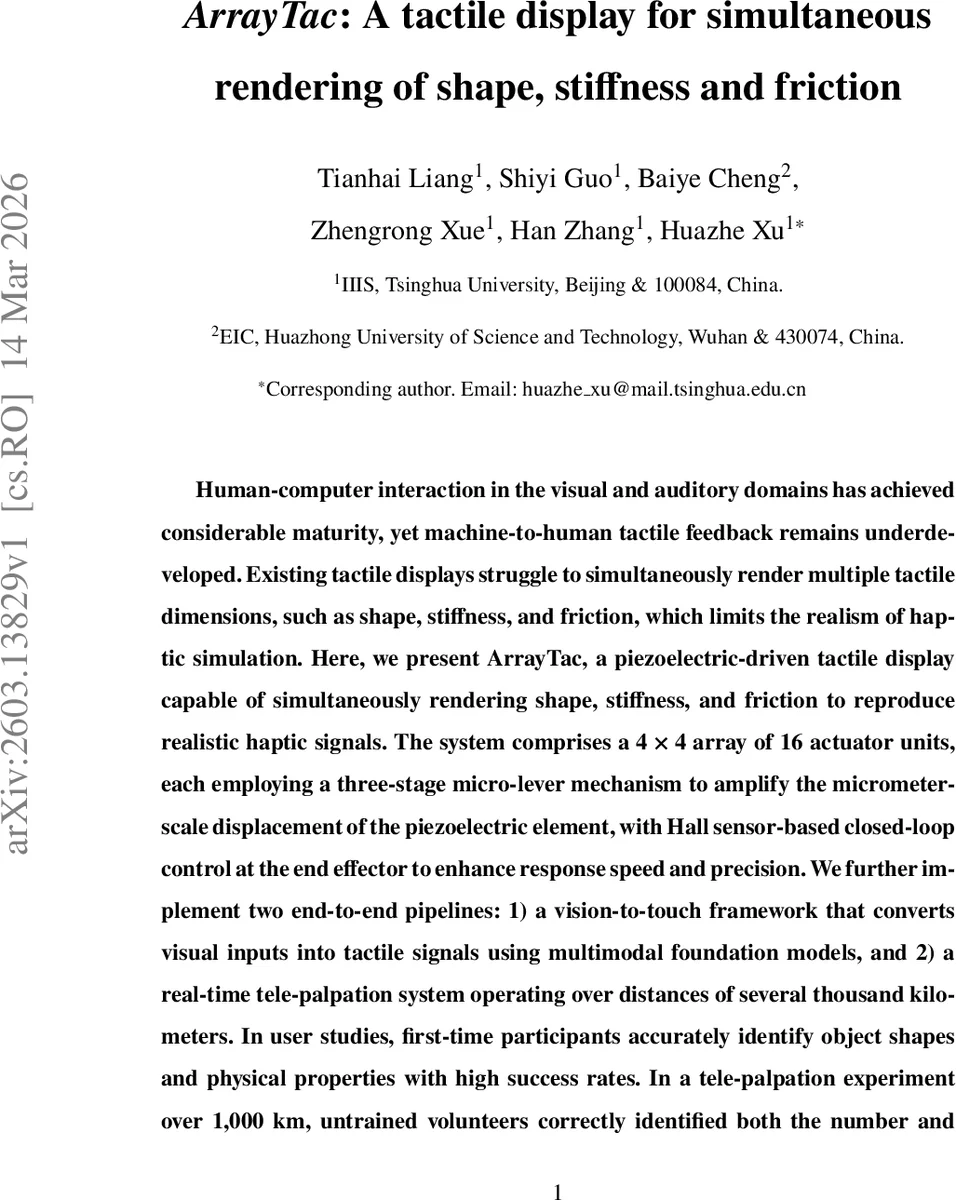
Human-computer interaction in the visual and auditory domains has achieved considerable maturity, yet machine-to-human tactile feedback remains underdeveloped. Existing tactile displays struggle to simultaneously render multiple tactile dimensions, such as shape, stiffness, and friction, which limits the realism of haptic simulation. Here, we present ArrayTac, a piezoelectric-driven tactile display capable of simultaneously rendering shape, stiffness, and friction to reproduce realistic haptic signals. The system comprises a 4x4 array of 16 actuator units, each employing a three-stage micro-lever mechanism to amplify the micrometer-scale displacement of the piezoelectric element, with Hall sensor-based closed-loop control at the end effector to enhance response speed and precision. We further implement two end-to-end pipelines: 1) a vision-to-touch framework that converts visual inputs into tactile signals using multimodal foundation models, and 2) a real-time tele-palpation system operating over distances of several thousand kilometers. In user studies, first-time participants accurately identify object shapes and physical properties with high success rates. In a tele-palpation experiment over 1,000km, untrained volunteers correctly identified both the number and type of tumors in a breast phantom with 100% accuracy and precisely localized their positions. The system pioneers a new pathway for high-fidelity haptic feedback by introducing the unprecedented capability to simultaneously render an object’s shape, stiffness, and friction, delivering a holistic tactile experience that was previously unattainable.
💡 Research Summary
**
The paper introduces ArrayTac, a novel tactile display that simultaneously renders three fundamental tactile dimensions—shape, stiffness, and friction—on a single platform. Existing tactile devices typically handle only one of these modalities, limiting realism and usability in immersive applications such as medical simulation, remote manipulation, and virtual reality. ArrayTac addresses these shortcomings through a combination of hardware innovation, closed‑loop control, and integrated software pipelines.
Hardware Architecture
ArrayTac consists of a 4 × 4 array of 16 independent actuator units. Each unit contains a piezoelectric ceramic that produces an initial 40 µm displacement, which is amplified by a three‑stage micro‑lever mechanism with a gain of 125, delivering up to 5 mm of vertical motion. This large displacement range enables the display to reproduce continuous height profiles of virtual objects, far exceeding the sub‑100 µm range of typical piezo‑based haptics.
To achieve precise, disturbance‑resistant operation, a Hall‑effect sensor is mounted at the tip of each actuator. The sensor‑to‑displacement relationship is modeled with a cubic polynomial, yielding an R² > 0.997 across all units, indicating robustness against assembly tolerances. A PID controller runs in a closed‑loop fashion, expanding the control bandwidth from ~15 Hz (open‑loop) to >123 Hz, and achieving step‑response settling times on the order of 10 ms. This fast, accurate feedback allows the system to maintain the intended shape profile even when the user’s finger pressure varies.
The actuator array is mounted on a gravity‑compensated XYZ sliding platform, providing a three‑dimensional workspace. High‑frequency (10 kHz) communication between the array and the host computer, together with a refresh rate exceeding 500 Hz, ensures low latency and smooth tactile updates.
Multidimensional Rendering
Shape rendering is accomplished by continuously adjusting the vertical displacement of each actuator according to a height map generated from a virtual object. In a psychophysical study with 22 naïve participants, six geometric models (hemisphere, cone, cube, bow‑shaped prism, semi‑ellipsoid, etc.) were identified with a median score of 5/5 on a descriptive accuracy scale, demonstrating that users can intuitively recognize complex 3D shapes without prior training.
Stiffness rendering is achieved by superimposing a virtual spring‑damper model on each actuator. By modulating the force‑displacement relationship in real time, the system can simulate materials ranging from soft tissue to rigid plastic.
Friction rendering uses high‑frequency micro‑vibrations at the contact surface to vary shear resistance, allowing users to feel differences between slippery and sticky textures.
Software Pipelines
Two end‑to‑end pipelines are built on top of the hardware.
-
Vision‑to‑Touch (Tac‑Anything): Multimodal foundation models (e.g., CLIP, Stable Diffusion) extract shape, stiffness, and friction cues from 2D images. The extracted semantics are transformed into height, compliance, and vibration parameters that drive the actuator array, enabling users to “feel” visual content directly.
-
Tele‑Touch: Real‑time sensor data (pressure, ultrasound) captured at a remote site are streamed over a network to the ArrayTac display. A clinical demonstration involved a breast‑phantom with hidden tumors. Ten untrained volunteers, located 1,000 km away, palpated the phantom via the system and identified both the number and type (malignant vs. benign) of tumors with 100 % accuracy, also localizing their positions precisely. This result surpasses prior remote palpation attempts, which suffered from low fidelity and high latency.
Implications and Future Work
ArrayTac’s combination of large‑stroke, high‑speed piezo actuation, per‑unit closed‑loop sensing, and simultaneous multidimensional rendering establishes a new benchmark for tactile interfaces. Potential applications include:
- Remote medical diagnosis and tele‑surgery, where clinicians can palpate patients or phantoms from afar.
- High‑fidelity virtual environments for training, entertainment, or accessibility for visually impaired users.
- Tele‑operation of robots in hazardous or space environments, providing operators with realistic force feedback.
Future research directions suggested by the authors include scaling the array to higher resolutions, refining stiffness and friction models for more nuanced material simulation, and developing adaptive user‑specific tactile profiles.
In summary, ArrayTac demonstrates that a compact, 16‑actuator piezo‑based array, equipped with Hall‑sensor closed‑loop control and integrated with modern AI‑driven pipelines, can faithfully reproduce shape, stiffness, and friction simultaneously, opening the door to truly immersive and functional haptic experiences across a wide range of domains.
Comments & Academic Discussion
Loading comments...
Leave a Comment