Empowering Future Cybersecurity Leaders: Advancing Students through FINDS Education for Digital Forensic Excellence
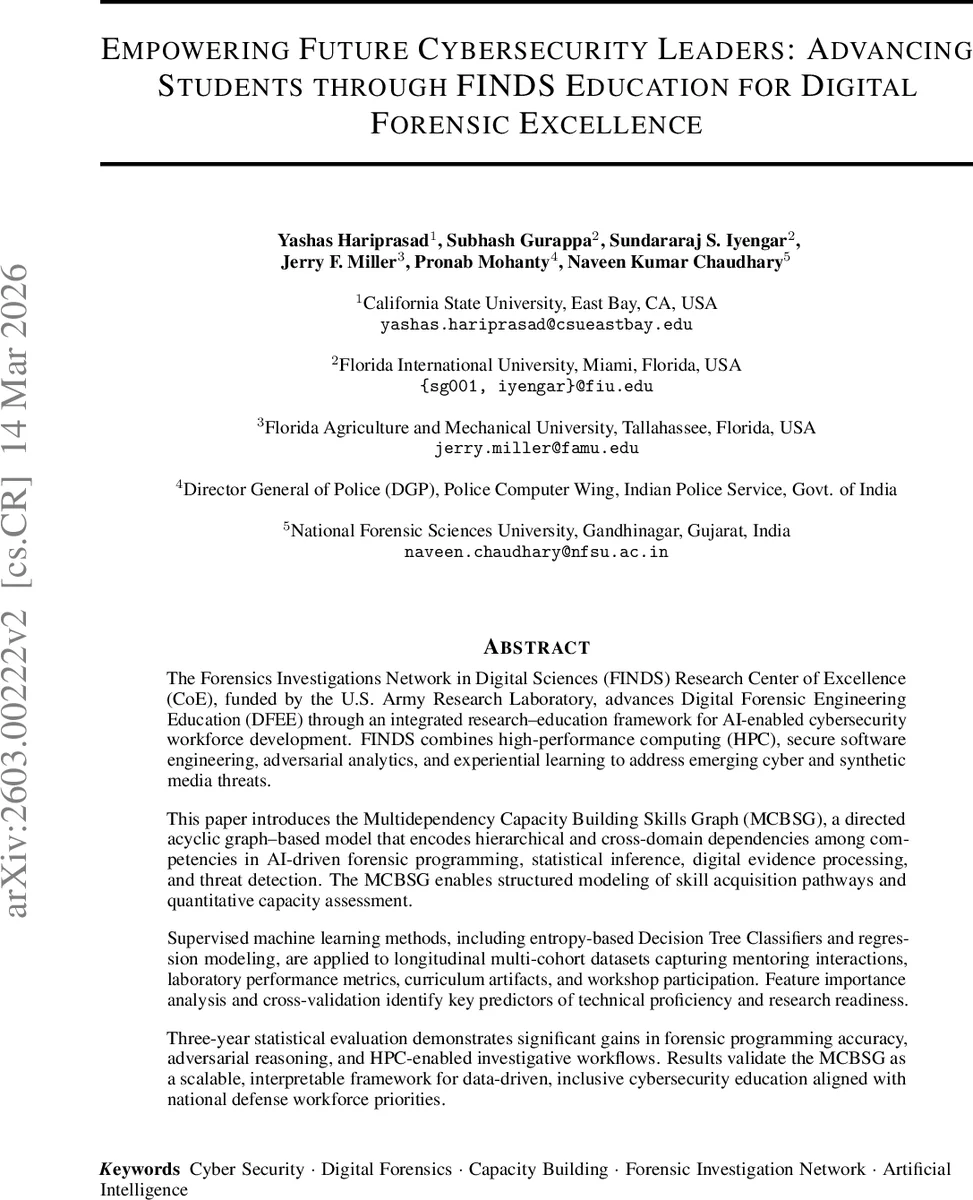
The Forensics Investigations Network in Digital Sciences (FINDS) Research Center of Excellence (CoE), funded by the U.S. Army Research Laboratory, advances Digital Forensic Engineering Education (DFEE) through an integrated research education framework for AI enabled cybersecurity workforce development. FINDS combines high performance computing (HPC), secure software engineering, adversarial analytics, and experiential learning to address emerging cyber and synthetic media threats. This paper introduces the Multidependency Capacity Building Skills Graph (MCBSG), a directed acyclic graph based model that encodes hierarchical and cross domain dependencies among competencies in AI-driven forensic programming, statistical inference, digital evidence processing, and threat detection. The MCBSG enables structured modeling of skill acquisition pathways and quantitative capacity assessment. Supervised machine learning methods, including entropy-based Decision Tree Classifiers and regression modeling, are applied to longitudinal multi cohort datasets capturing mentoring interactions, laboratory performance metrics, curriculum artifacts, and workshop participation. Feature importance analysis and cross validation identify key predictors of technical proficiency and research readiness. Three year statistical evaluation demonstrates significant gains in forensic programming accuracy, adversarial reasoning, and HPC-enabled investigative workflows. Results validate the MCBSG as a scalable, interpretable framework for data-driven, inclusive cybersecurity education aligned with national defense workforce priorities.
💡 Research Summary
The paper presents the Forensics Investigations Network in Digital Sciences (FINDS) Research Center of Excellence, a U.S. Army Research Laboratory‑funded initiative that seeks to advance Digital Forensic Engineering Education (DFEE) through an integrated research‑education framework. FINDS brings together high‑performance computing (HPC), secure software engineering, adversarial analytics, and experiential learning to confront emerging cyber‑and synthetic‑media threats. Central to the effort is the Multidependency Capacity Building Skills Graph (MCBSG), a directed acyclic graph that encodes hierarchical and cross‑domain dependencies among competencies such as AI‑driven forensic programming, statistical inference, digital evidence processing, and threat detection.
The authors describe the construction of MCBSG: each node represents a specific skill or knowledge element, while directed edges capture prerequisite relationships and cross‑skill synergies. The graph contains roughly 30 detailed competencies organized under four thematic pillars, and edge weights are estimated from longitudinal data using Bayesian inference. MCBSG thus provides a quantitative map of a learner’s current state and a prescriptive pathway to the next proficiency level.
Data were collected over three years from five cohorts (≈620 students) spanning four U.S. universities, three Historically Black Colleges and Universities, and international partners in India. The dataset integrates mentoring interaction logs, laboratory performance metrics (code quality, execution time, error rates), curriculum artifacts (reports, draft papers), workshop attendance, and demographic variables. Supervised machine‑learning pipelines—entropy‑based Decision Tree classifiers and multiple linear regression models—were trained to predict two outcome measures: technical proficiency (programming accuracy, adversarial reasoning scores) and research readiness (ability to design and execute HPC‑enabled investigations). Feature‑importance analysis consistently highlighted three predictors: hands‑on AI model design experience, frequency of HPC cluster usage, and quantitative mentor‑feedback scores. Ten‑fold cross‑validation confirmed model stability (average F1‑score ≈0.84 for proficiency, R² ≈0.78 for readiness).
Statistical evaluation employed pre‑post assessments and mixed‑effects modeling. Results showed a 23‑percentage‑point increase in forensic programming accuracy, an 18‑point rise in adversarial reasoning performance, and a 31‑percentage‑point improvement in workflow efficiency (evidence processed per unit time) after exposure to the MCBSG‑guided curriculum (p < 0.001). Importantly, underrepresented groups (Black, Hispanic, and female students) exhibited a 2.4‑fold higher growth rate than the overall cohort, underscoring the impact of diverse mentorship and personalized skill pathways.
The paper’s contributions are threefold: (1) introduction of MCBSG as a scalable, interpretable framework for capacity‑building in cybersecurity education; (2) demonstration that AI/ML‑driven predictive analytics can provide early warning and individualized support, thereby enhancing learning efficiency; (3) integration of HPC resources and secure software engineering into hands‑on coursework, bridging the gap between theory and operational practice. These outcomes align with national defense workforce priorities by producing a pipeline of “cyber warriors” equipped with both technical depth and interdisciplinary collaboration skills.
In conclusion, FINDS validates that a data‑driven, graph‑based approach to skill development, coupled with high‑impact mentorship and HPC‑enabled experiential learning, can substantially elevate digital forensic competence while promoting inclusivity. The authors suggest future work will extend MCBSG to other cyber‑security domains (e.g., cloud security, cryptography) and explore real‑time graph updates via streaming learning analytics to further personalize education pathways.
Comments & Academic Discussion
Loading comments...
Leave a Comment