Fractionally modulated discrete Carleson's Theorem and pointwise Ergodic Theorems along certain curves
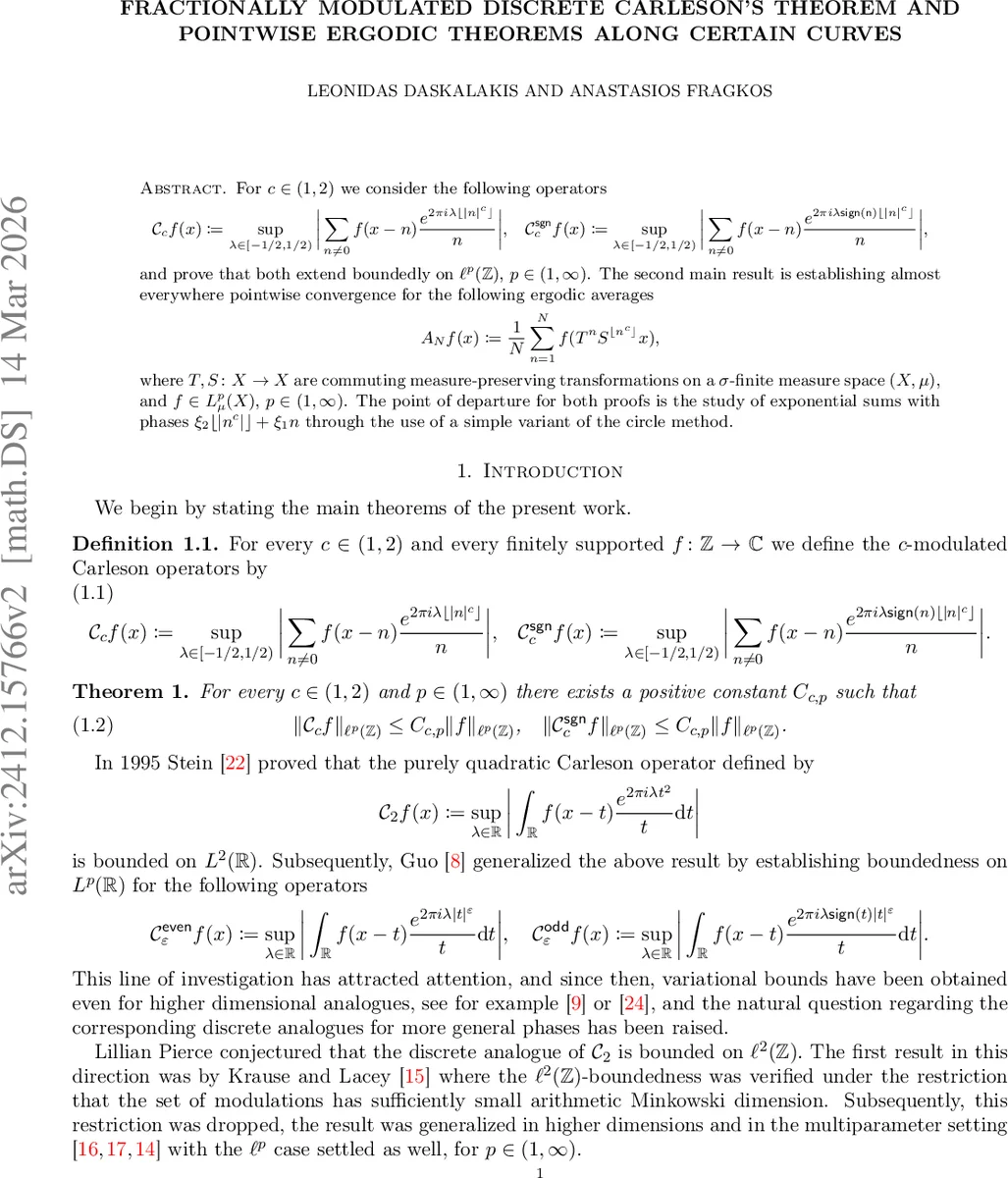
For $c\in(1,2)$ we consider the following operators [ \mathcal{C}{c}f(x) = \sup{λ\in [-1/2,1/2)}\bigg| \sum_{n \neq 0}f(x-n) \frac{e^{2πiλ\lfloor |n|^{c} \rfloor}}{n}\bigg|\text{,}\quad \mathcal{C}^{\mathsf{sgn}}{c}f(x) = \sup{λ\in [-1/2,1/2)}\bigg| \sum_{n \neq 0}f(x-n) \frac{e^{2πiλ\mathsf{sign(n)} \lfloor |n|^{c} \rfloor}}{n}\bigg| \text{,} ] and prove that both extend boundedly on $\ell^p(\mathbb{Z})$, $p\in(1,\infty)$. The second main result is establishing almost everywhere pointwise convergence for the following ergodic averages [ A_Nf(x)=\frac{1}{N}\sum_{n=1}^Nf(T^nS^{\lfloor n^c\rfloor}x)\text{,} ] where $T,S\colon X\to X$ are commuting measure-preserving transformations on a $σ$-finite measure space $(X,μ)$, and $f\in L_μ^p(X)$, $p\in(1,\infty)$. The point of departure for both proofs is the study of exponential sums with phases $ξ_2 \lfloor |n^c|\rfloor+ ξ_1n$ through the use of a simple variant of the circle method.
💡 Research Summary
The paper establishes two major results concerning discrete Carleson-type maximal operators with fractional modulation and pointwise ergodic theorems along a curved orbit.
1. Fractionally modulated discrete Carleson operators.
For a fixed exponent (c\in(1,2)) the authors define two maximal operators on sequences (f:\mathbb Z\to\mathbb C):
\
Comments & Academic Discussion
Loading comments...
Leave a Comment