Spin qubit gates via phonon buses in electron nanowires
Scalable architectures for quantum computing using semiconductor quantum dots require interactions between qubits beyond adjacent quantum dots. Here, we propose using nanowires of electrons to mediate the interaction between two quantum dots. Virtual phonons in the linear chain of electrons can mediate an interaction that gives rise to effective spin-spin coupling of the electrons in distant quantum dots. We find coupling strengths of more than 30 MHz for experimentally realisable parameters in GaAs quantum dots.
💡 Research Summary
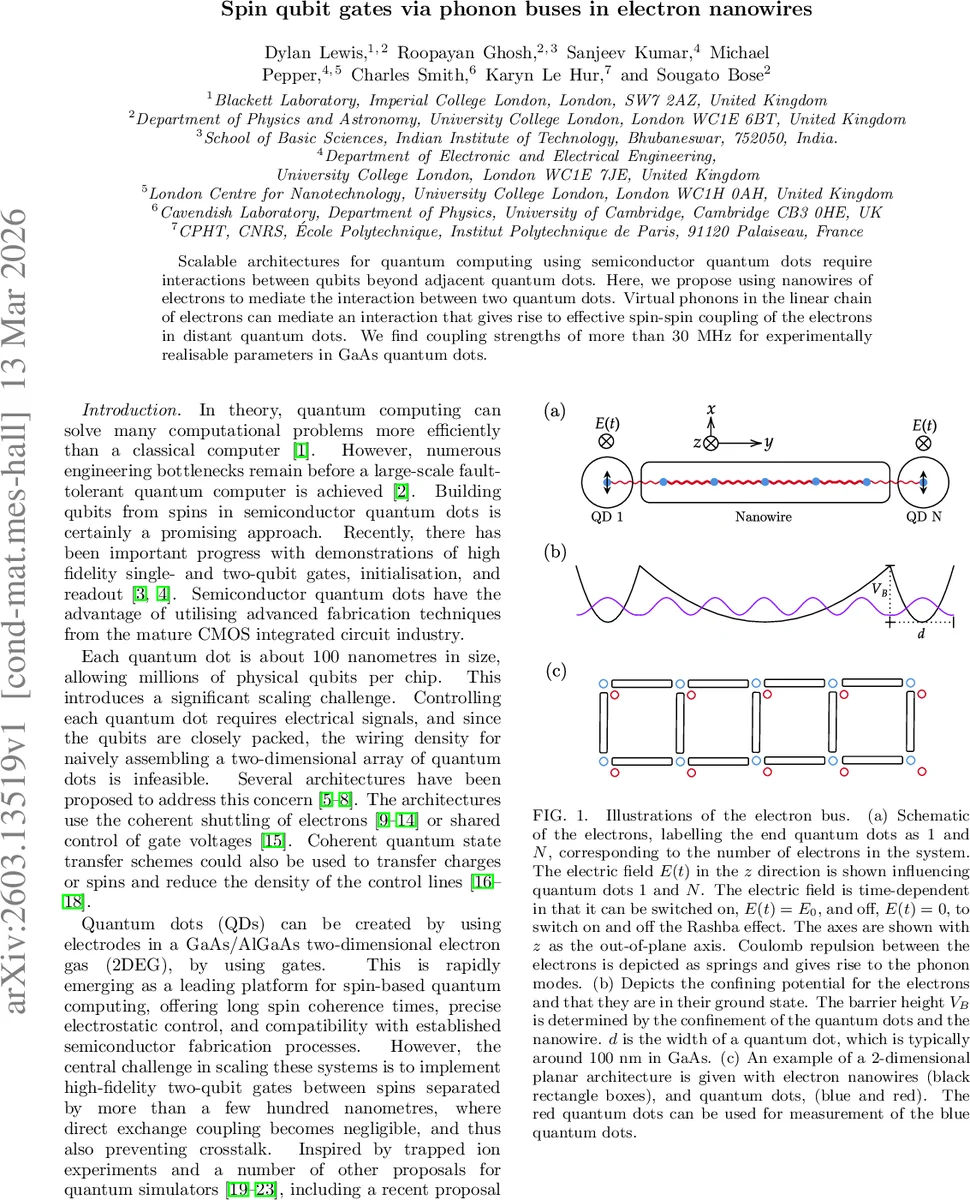
The paper proposes a novel architecture for semiconductor spin‑qubit quantum computers that enables high‑fidelity two‑qubit gates between quantum dots separated by distances far exceeding the range of direct exchange coupling. The key idea is to use a linear chain of electrons confined in a one‑dimensional “nanowire” within a two‑dimensional electron gas (2DEG) as a phonon bus. The electrons in the nanowire repel each other, forming a Wigner‑crystal‑like arrangement whose small collective vibrations are quantized as phonon‑like normal modes. These phonon modes can mediate an effective spin‑spin interaction between the spins localized in the end quantum dots (QDs).
The authors model the confinement potentials of the end QDs and the nanowire as harmonic traps with frequencies ωₐ, ω_w, and ω_b. By numerically minimizing the total electrostatic potential (including Coulomb repulsion) they obtain equilibrium positions for a typical GaAs device (effective mass m* = 0.067 m_e, dielectric constant ε_r = 12.9) with a dot size of ≈300 nm. Small displacements around equilibrium are expressed in terms of phonon creation/annihilation operators, yielding position and momentum operators for each electron. The phonon spectrum is obtained from the Hessian of the total potential; axial modes (along the wire) and transverse modes are both considered.
Spin–orbit coupling (SOC) provides the bridge between the electron’s charge motion and its spin. The Rashba term H_R = α(p_x σ_y − p_y σ_x) dominates over the Dresselhaus term for the chosen parameters; α can be tuned by an external static electric field E₀ (α ≈ 1 × 10⁻¹¹ eVm). By applying a time‑dependent electric field the Rashba interaction creates an effective magnetic field that oscillates in the plane perpendicular to the external Zeeman field (B ≈ 5.15 T, giving ω₀ ≈ 1.765 × 10¹¹ rad s⁻¹). This enables electric‑driven single‑qubit rotations (R_x, R_y) without the need for local micromagnets.
For two‑qubit gates the system is operated in the dispersive regime: the Zeeman splitting ω₀ is detuned from the selected axial phonon mode ω_{y,2} (≈ 1.70006 × 10¹¹ rad s⁻¹) by Δ ≈ 6.46 × 10¹⁰ rad s⁻¹. The Rashba‑phonon coupling for the first and last electrons is g_{y,12} = g_{y,82} ≈ 6.324 × 10⁸ rad s⁻¹. Using second‑order perturbation theory (Dyson series) the effective XY spin‑spin coupling is
J_{1N} ≈ (g_{y,12} g_{y,82} ω_{y,2}) / (ω₀² − ω_{y,2}²) ≈ 30.2 MHz,
and when all axial and transverse modes are summed the total coupling reaches ≈ 33.9 MHz. This strength is well above typical decoherence rates in GaAs quantum dots, suggesting that a high‑fidelity entangling gate can be performed in a few tens of nanoseconds.
The authors explore scaling by varying the number of electrons in the nanowire (N = 6–10). Optimizing the axial trap frequency ω_y and the distance between the end dots, they find that the coupling strength initially increases with wire length, reaching > 50 MHz for a ten‑electron chain. The increase is attributed to lower phonon frequencies for longer chains, which reduces the detuning denominator while keeping ω₀ fixed. However, beyond a certain length the linear chain becomes unstable (Coulomb repulsion can no longer be balanced by the confinement), and the coupling would start to decline.
Lattice phonon noise (deformation‑potential coupling) is examined and found to be comparable to that already present in single‑qubit gate experiments; the confined electrons are not rigidly attached to the crystal lattice, and their excitation frequencies are largely mismatched with bulk phonon spectra, limiting additional decoherence. Consequently, the phonon‑bus mediated two‑qubit gate does not introduce new dominant noise channels.
A conceptual 2‑D layout is presented: electron nanowires (black rectangles) interconnect arrays of quantum dots (blue for data qubits, red for readout qubits). The bus can be switched on/off by toggling the Rashba electric field, allowing selective coupling while keeping wiring density low—a crucial advantage for scaling to large qubit numbers.
In summary, the paper demonstrates that virtual phonons in an electrostatically defined electron nanowire can mediate strong, controllable spin‑spin interactions between distant quantum‑dot spin qubits. With realistic GaAs parameters, coupling rates of 30–50 MHz are achievable, single‑qubit control can be performed electrically via SOC, and the scheme is compatible with existing semiconductor fabrication techniques. This approach offers a promising pathway toward scalable, low‑crosstalk architectures for semiconductor spin‑based quantum computing.
Comments & Academic Discussion
Loading comments...
Leave a Comment