The Living Forecast: Evolving Day-Ahead Predictions into Intraday Reality
Accurate intraday forecasts are essential for power system operations, complementing day-ahead forecasts that gradually lose relevance as new information becomes available. This paper introduces a Bayesian updating mechanism that converts fully probabilistic day-ahead forecasts into intraday forecasts without retraining or re-inference. The approach conditions the Gaussian mixture output of a conditional variational autoencoder-based forecaster on observed measurements, yielding an updated distribution for the remaining horizon that preserves its probabilistic structure. This enables consistent point, quantile, and ensemble forecasts while remaining computationally efficient and suitable for real-time applications. Experiments on household electricity consumption and photovoltaic generation datasets demonstrate that the proposed method improves forecast accuracy up to 25% across likelihood-, sample-, quantile-, and point-based metrics. The largest gains occur in time steps with strong temporal correlation to observed data, and the use of pattern dictionary-based covariance structures further enhances performance. The results highlight a theoretically grounded framework for intraday forecasting in modern power systems.
💡 Research Summary
The paper addresses the gap between day‑ahead probabilistic forecasts and the need for accurate intraday predictions in modern power systems. While day‑ahead forecasts provide a joint probability distribution over an entire day, they quickly become outdated as real‑time measurements arrive. Existing intraday refinement methods either require training separate models, perform heuristic marginal adjustments, or rely on computationally intensive re‑inference, all of which can break the probabilistic consistency of the original forecast.
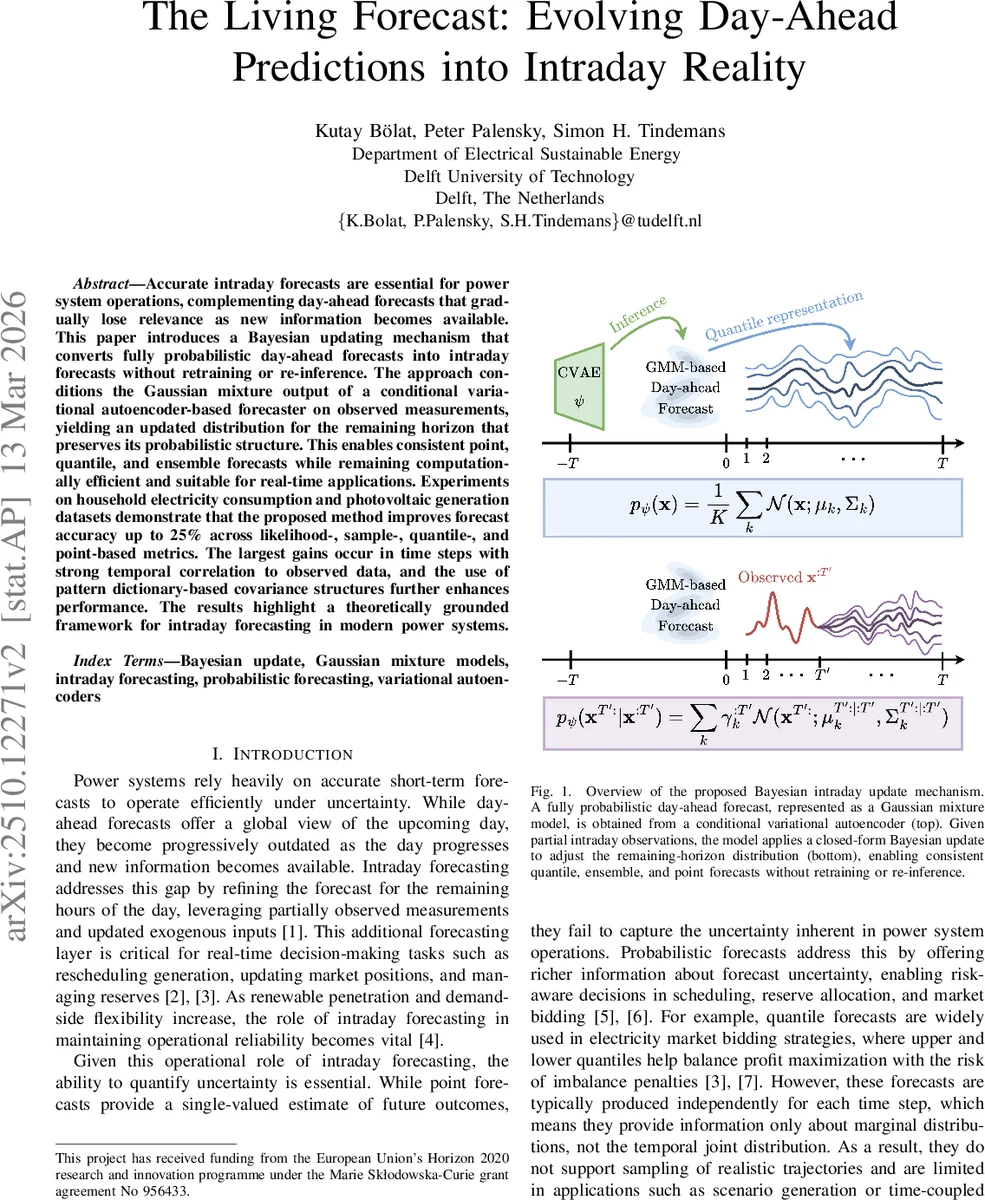
To solve this, the authors propose a Bayesian updating framework that directly re‑uses the day‑ahead forecast generated by a conditional variational autoencoder (CVAE). The CVAE outputs a Gaussian mixture model (GMM) with K components, each component being a multivariate normal distribution parameterized by a mean vector μₖ and a covariance matrix Σₖ. Covariances are modeled using a Pattern Dictionary‑based Covariance Composition (PDCC) Σₖ = U diag(σ̃ₖ²) Uᵀ + ξI, allowing rich temporal correlations beyond a diagonal assumption.
When intraday measurements up to time T′ (denoted x₁:ₜ′) become available, the framework applies Bayes’ rule to the GMM. For each component, the marginal likelihood of the observed part, p(x₁:ₜ′|zₖ,c), is computed, and the component weight is updated to γₖ ∝ πₖ · p(x₁:ₜ′|zₖ,c). The conditional distribution of the remaining horizon xₜ′: given the observations remains Gaussian, with updated mean μₖ|₁:ₜ′ = μₖₜ′ + Σₖₓₜ′ Σₖₓ₁:ₜ′⁻¹ (x₁:ₜ′ − μₖ₁:ₜ′) and updated covariance Σₖ|₁:ₜ′ = Σₖₓₜ′ − Σₖₓₜ′ Σₖₓ₁:ₜ′⁻¹ Σₖₓ₁:ₜ′ₓₜ′. This closed‑form update requires only linear‑algebraic operations; no additional forward passes through the neural network are needed.
The updated mixture can be sampled efficiently to produce ensembles, from which point forecasts (expected values), quantiles, and other statistics are derived. Sampling proceeds by selecting a component according to γ, retrieving its pre‑computed conditional μ and Σ, and drawing a multivariate normal sample. Caching these conditional parameters reduces computational overhead, especially when the number of samples S is large or the weight vector γ is sparse.
Complexity analysis shows that for each component the dominant cost is inverting the observed covariance Σ₁:ₜ′ (O(T′³)), while subsequent matrix multiplications scale as O((T − T′) T′²). Since T′ grows gradually during the day and typical horizons (e.g., 24 h with hourly resolution) keep T′ modest, the method remains tractable for real‑time deployment.
Empirical evaluation uses two real‑world datasets: (1) the Gipuzkoa SM smart‑meter dataset (≈6,800 residential/office customers, hourly consumption, T = 24) and (2) the Utrecht PV dataset (175 households, 15‑minute aggregated PV generation, T = 96). Exogenous inputs include day‑before profiles, calendar encodings, and weather forecasts. The authors assess four families of metrics: negative log‑likelihood (NLL), mean absolute error (MAE) from sampled ensembles, continuous ranked probability score approximated by pinball loss (CRPS), and point‑forecast MAE.
Results demonstrate consistent improvements over the un‑updated day‑ahead forecast. Depending on the observation horizon, NLL decreases by up to 0.8–1.2, MAE drops by 10–25 %, and CRPS improves by 5–7 %. Gains are most pronounced for time steps with strong temporal correlation to the observed data (e.g., afternoon peaks). Moreover, employing the PDCC covariance structure yields additional performance gains compared to a simple diagonal covariance, confirming the value of modeling inter‑temporal dependencies.
Key contributions of the work are: (i) a theoretically grounded Bayesian update that preserves the Gaussian mixture family, (ii) elimination of retraining or re‑inference during intraday operation, (iii) maintenance of full probabilistic consistency enabling unified extraction of point, quantile, and ensemble forecasts, and (iv) computational efficiency suitable for real‑time power system applications. Limitations include the cubic cost of covariance inversion for large T′ and the need to tune the number of mixture components K and dictionary dimension V. Future research directions suggested are sparse matrix techniques, low‑rank approximations, or variational Bayesian extensions to further reduce computational load and to capture non‑linear dependencies.
In summary, the paper presents a practical, mathematically sound approach to transform day‑ahead probabilistic forecasts into accurate intraday predictions by conditioning on real‑time observations through a closed‑form Bayesian update, achieving notable accuracy gains on both consumption and renewable generation datasets while preserving the full probabilistic structure required for modern power system decision‑making.
Comments & Academic Discussion
Loading comments...
Leave a Comment