Neural-Quantum-States Impurity Solver for Quantum Embedding Problems
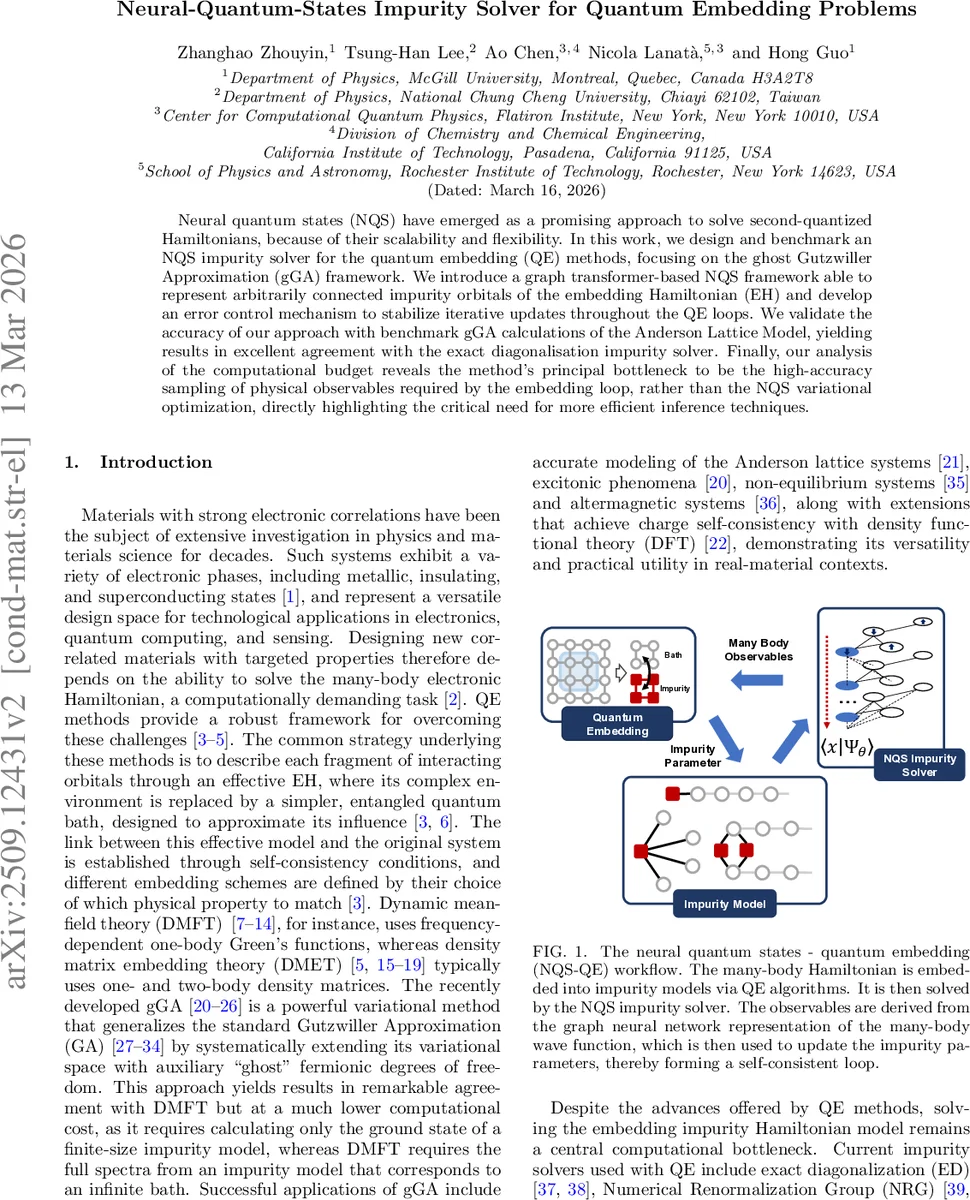
Neural quantum states (NQS) have emerged as a promising approach to solve second-quantized Hamiltonians, because of their scalability and flexibility. In this work, we design and benchmark an NQS impurity solver for the quantum embedding (QE) methods, focusing on the ghost Gutzwiller Approximation (gGA) framework. We introduce a graph transformer-based NQS framework able to represent arbitrarily connected impurity orbitals of the embedding Hamiltonian (EH) and develop an error control mechanism to stabilize iterative updates throughout the QE loops. We validate the accuracy of our approach with benchmark gGA calculations of the Anderson Lattice Model, yielding results in excellent agreement with the exact diagonalisation impurity solver. Finally, our analysis of the computational budget reveals the method’s principal bottleneck to be the high-accuracy sampling of physical observables required by the embedding loop, rather than the NQS variational optimization, directly highlighting the critical need for more efficient inference techniques.
💡 Research Summary
This paper introduces a graph‑transformer‑based Neural Quantum State (NQS) impurity solver and integrates it into the ghost‑Gutzwiller Approximation (gGA) quantum‑embedding (QE) framework. The authors begin by reviewing the challenges of strongly correlated electron systems, where conventional many‑body methods become intractable and quantum‑embedding schemes such as DMFT, DMET, and the more recent gGA are employed to reduce the problem to a finite impurity Hamiltonian coupled to an effective bath. While gGA dramatically lowers the computational cost compared with DMFT, it still requires an accurate impurity solver; traditional solvers (exact diagonalization, NRG, DMRG, etc.) scale poorly with orbital number and bath complexity.
To address this bottleneck, the authors adopt a variational Monte‑Carlo (VMC) approach where the many‑body wavefunction is represented by a neural network, i.e., an NQS. The key technical innovation is the use of a graph‑transformer architecture that can naturally encode arbitrarily connected impurity orbitals. Each orbital is a graph node whose initial feature is the binary occupation number; a separate occupation‑positional embedding maps the four possible local Fock states (|00⟩, |01⟩, |10⟩, |11⟩) to learned vectors, and positional embeddings distinguish different sites. The node embeddings are processed by a stack of GA‑T(v2) graph‑attention layers followed by feed‑forward networks (FFN) with residual connections, mimicking the transformer’s global attention while keeping the computational scaling close to O(N²) thanks to the sparsity of the impurity graph. The final linear layer outputs a real amplitude and a phase, thus providing the complex wavefunction value ⟨x|Ψθ⟩ for any occupation configuration x.
Optimization of the NQS parameters θ is performed with recent stochastic‑reconfiguration‑type algorithms: MinSR (minimum‑variance stochastic reconfiguration) and SPRING (scaled parameter‑wise updates). The authors monitor the energy variance Var
Comments & Academic Discussion
Loading comments...
Leave a Comment