Homotopy Cardinality and Entropy
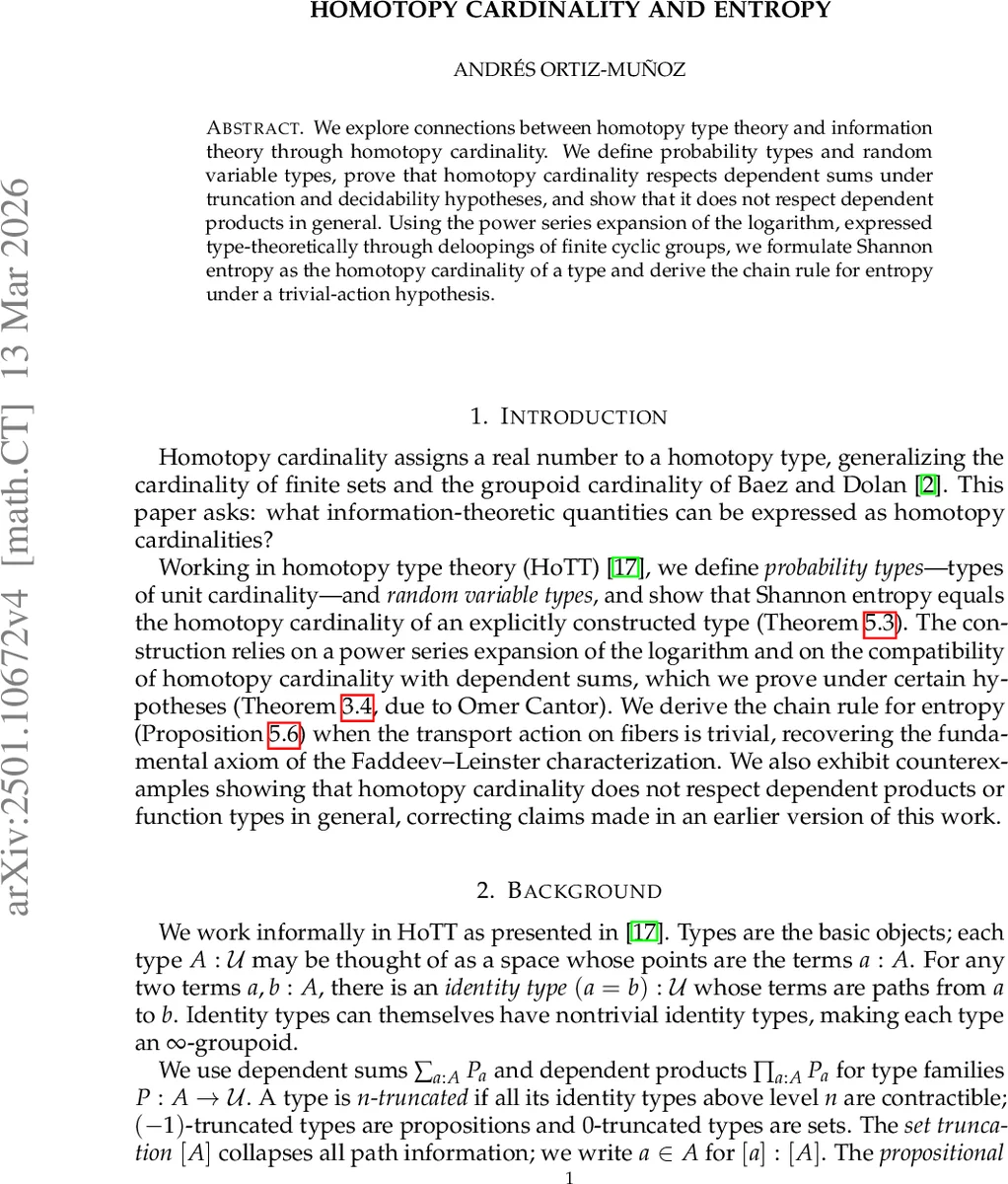
We explore connections between homotopy type theory and information theory through homotopy cardinality. We define probability types and random variable types, prove that homotopy cardinality respects dependent sums under truncation and decidability hypotheses, and show that it does not respect dependent products in general. Using the power series expansion of the logarithm, expressed type-theoretically through deloopings of finite cyclic groups, we formulate Shannon entropy as the homotopy cardinality of a type and derive the chain rule for entropy under a trivial-action hypothesis.
💡 Research Summary
The paper establishes a bridge between homotopy type theory (HoTT) and classical information theory by interpreting Shannon entropy as a homotopy cardinality. It begins by defining the homotopy cardinality of a type X as the sum over its set‑truncation of the cardinalities of its identity types, |X| = ∑_{x∈X} |x = x|. This generalizes both ordinary cardinality of finite sets and the Baez‑Dolan groupoid cardinality. Basic algebraic properties are proved: disjoint unions satisfy |X + Y| = |X| + |Y| and products satisfy |X × Y| = |X|·|Y|, using the fact that the identity type of a pair splits as a product of the identity types of its components.
The core technical result is Theorem 3.4 (attributed to Omer Cantor). Under the hypotheses that X is 1‑truncated, each fiber P x has bounded truncation level, and each P x admits decidable equality, the dependent sum Σ_{x:X} P x has homotopy cardinality equal to Σ_{x∈X}|P x|·|x = x|. The proof proceeds by orbit–stabilizer analysis on the action of the automorphism group Gₓ =
Comments & Academic Discussion
Loading comments...
Leave a Comment