Quantum simulation of Burgers turbulence: Nonlinear transformation and direct evaluation of statistical quantities
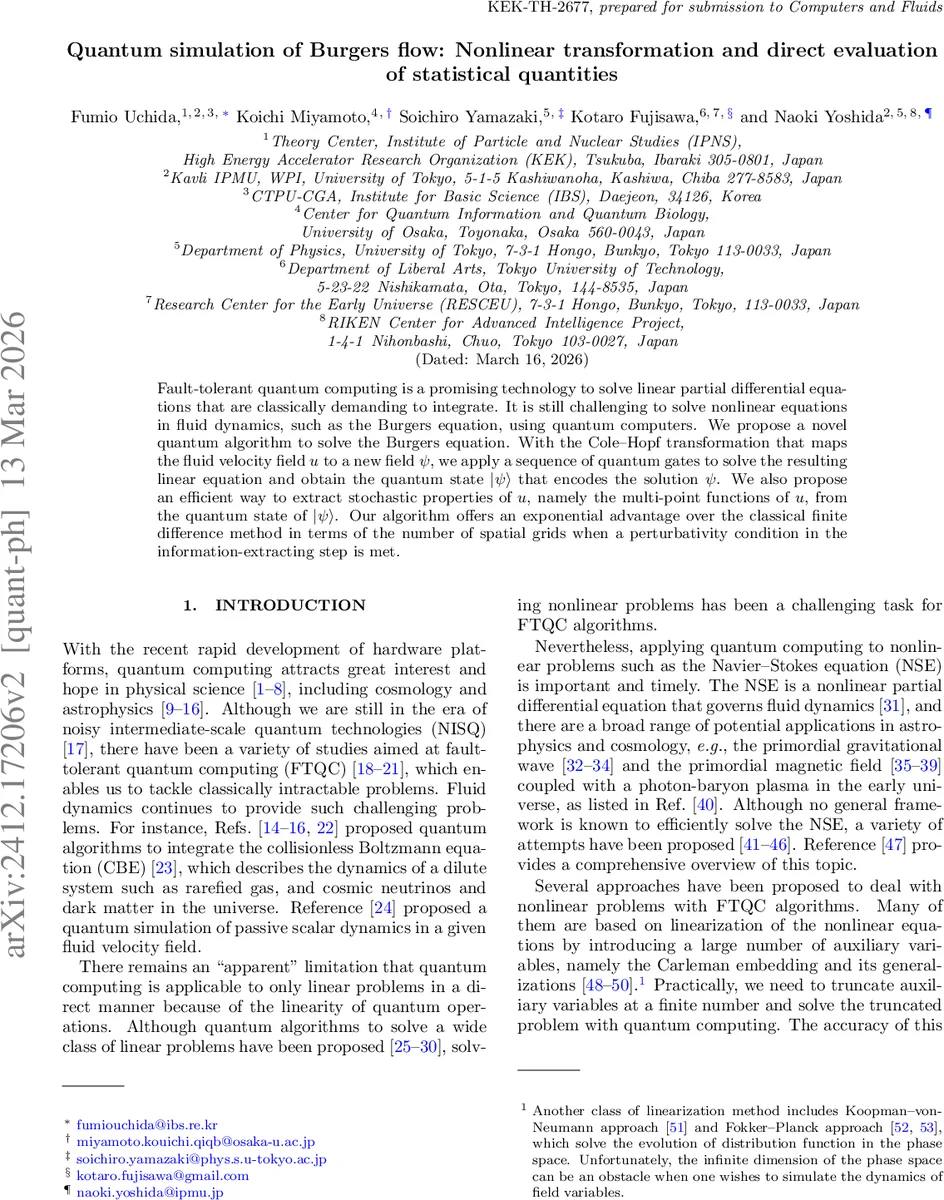
Fault-tolerant quantum computing is a promising technology to solve linear partial differential equations that are classically demanding to integrate. It is still challenging to solve non-linear equations in fluid dynamics, such as the Burgers equation, using quantum computers. We propose a novel quantum algorithm to solve the Burgers equation. With the Cole-Hopf transformation that maps the fluid velocity field $u$ to a new field $ψ$, we apply a sequence of quantum gates to solve the resulting linear equation and obtain the quantum state $\vertψ\rangle$ that encodes the solution $ψ$. We also propose an efficient way to extract stochastic properties of $u$, namely the multi-point functions of $u$, from the quantum state of $\vertψ\rangle$. Our algorithm offers an exponential advantage over the classical finite difference method in terms of the number of spatial grids when a perturbativity condition in the information-extracting step is met.
💡 Research Summary
The paper presents a novel quantum algorithm for simulating Burgers turbulence by exploiting the Cole‑Hopf transformation, which linearizes the one‑dimensional Burgers equation into a heat equation. The authors first discretize the spatial domain into Nₓ = 2ⁿˣ grid points with periodic boundary conditions and assume the existence of an oracle O_{ψ′0} that prepares the quantum state |∂ₓψ(0)⟩ encoding the initial derivative of the Cole‑Hopf field ψ.
The core of the algorithm consists of three stages. In the loading stage, known techniques such as the Grover‑Rudolph method or QRAM‑based state preparation are used to encode the initial condition into a quantum register. In the evolution stage, the heat equation ∂ₜψ = ν∂ₓ²ψ is discretized via a central‑difference scheme, yielding a sparse symmetric matrix A. The solution ψ(τ) = e^{Aτ}ψ(0) is implemented using block‑encoding of A and the linear‑combination‑of‑unitaries (LCU) technique. By expressing e^{Aτ} as a complex integral, approximated with Gaussian quadrature, the authors construct a weighted sum of unitary evolutions e^{ikAτ}. This yields an efficient quantum circuit whose query complexity scales as ˜O(polylog(1/ε)) and whose gate count scales as O(Nₓ·polylog(1/ε)).
The extraction stage addresses the non‑linear relation u = −2ν∂ₓψ/ψ. Since directly dividing by ψ is non‑linear, the authors introduce a perturbative approximation: they replace ψ in the denominator by a pre‑computed, spatially varying estimate ˜ψ, assumed to be close to the true ψ. This allows the definition of a diagonal operator Λ that maps |∂ₓψ⟩ to an approximate velocity state |u⟩ ≈ −Λ|∂ₓψ⟩. Multi‑point correlation functions of the velocity field, P^{(n)}(x₁,…,x_n), are expressed as expectation values ⟨u|C^{(n)}|u⟩, where C^{(n)} are constructed from cyclic shift operators P_{Nₓ} and their tensor products. Overlap estimation algorithms are employed to evaluate both the numerator and denominator of the normalized correlation functions, yielding the desired statistical quantities with only O(polylog) repetitions.
Complexity analysis shows that state preparation, Hamiltonian simulation, and operator construction each require O(Nₓ·polylog) elementary gates, while measurement costs are polylogarithmic. Consequently, the algorithm achieves an exponential speed‑up in the number of spatial grid points compared with classical finite‑difference methods, provided the perturbative condition (˜ψ ≈ ψ) holds. The authors note that for very high Reynolds numbers or extremely small viscosity ν, the required grid resolution grows as Nₓ ∝ ν^{-1/2}, and the perturbative approximation may break down, limiting the practical advantage.
Numerical demonstrations with Gaussian initial conditions and moderate viscosity confirm that the quantum‑derived two‑point correlation functions match classical solutions within 10⁻³ error, validating the approach under the assumed perturbative regime.
In conclusion, the work introduces a hybrid strategy that combines quantum linear‑system solvers with a controlled perturbative extraction of non‑linear observables, opening a pathway toward quantum simulations of more complex fluid dynamics problems such as the Navier‑Stokes equations. Future research directions include extending the method to higher dimensions, reducing reliance on the perturbative approximation, and comparing with alternative linearization schemes such as Carleman embedding.
Comments & Academic Discussion
Loading comments...
Leave a Comment