Representations of skew braces
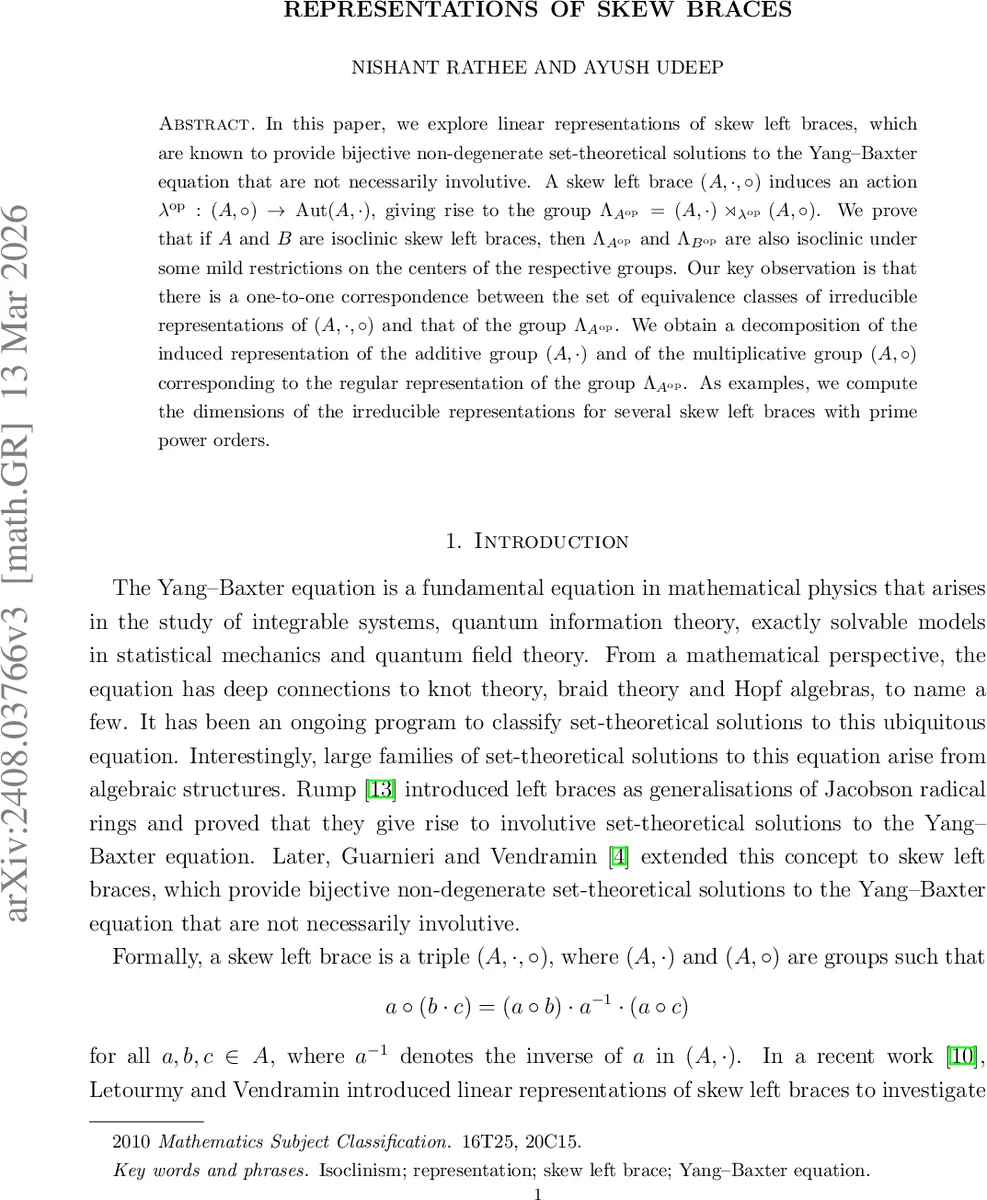
In this paper, we explore linear representations of skew left braces, which are known to provide bijective non-degenerate set-theoretical solutions to the Yang–Baxter equation that are not necessarily involutive. A skew left brace $(A, \cdot, \circ)$ induces an action $λ^{\op}: (A, \circ) \to \Aut (A, \cdot)$, which gives rise to the group $Λ_{A^{\op}} = (A, \cdot) \rtimes_{λ^{\op}} (A, \circ)$. We prove that if $A$ and $B$ are isoclinic skew left braces, then $Λ_{A^{\op}}$ and $Λ_{B^{\op}}$ are also isoclinic under some mild restrictions on the centers of the respective groups. Our key observation is that there is a one-to-one correspondence between the set of equivalence classes of irreducible representations of $(A, \cdot, \circ)$ and that of the group $Λ_{A^{\op}}$. We obtain a decomposition of the induced representation of the additive group $(A, \cdot)$ and of the multiplicative group $(A, \circ)$ corresponding to the regular representation of the group $Λ_{A^{\op}}$. As examples, we compute the dimensions of the irreducible representations for several skew left braces with prime power orders.
💡 Research Summary
The paper investigates linear representation theory for skew left braces, a class of algebraic structures that generate bijective non‑degenerate set‑theoretic solutions of the Yang–Baxter equation (YBE) without the involutivity restriction. A skew left brace (A=(A,\cdot,\circ)) carries two group structures, the additive group ((A,\cdot)) and the multiplicative group ((A,\circ)), linked by the compatibility condition
\
Comments & Academic Discussion
Loading comments...
Leave a Comment