Discovering an Unquenched Dynamics Mechanism for Charmonium Scattering
In this work, we propose an unquenched mechanism for charmonium scattering that utilizes the internal structure of charmonium. By capturing light flavor quarks and anti-quarks from the vacuum, charm and anti-charm quarks form virtual charmed mesons, which mediate an effective one-boson exchange process. This approach accurately reproduces the di-$J/ψ$ invariant mass spectrum observed by CMS and LHCb, demonstrating its validity. Our mechanism offers a comprehensive framework for understanding charmonium scattering and is applicable to the scattering problems involving all fully heavy hadrons, an area of increasing interest.
💡 Research Summary
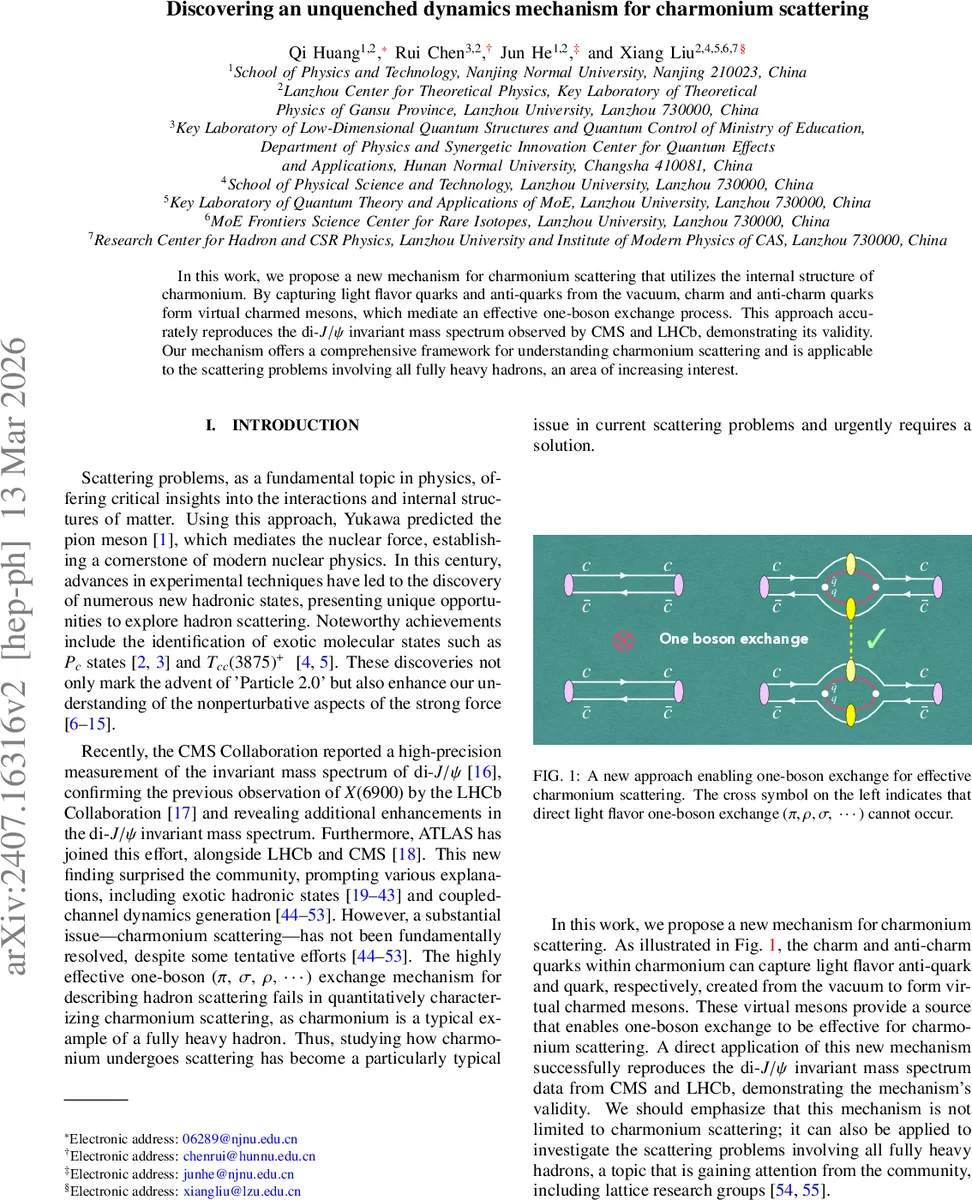
In this paper the authors address a long‑standing problem in hadron physics: how to describe scattering between fully heavy hadrons such as charmonium states, where conventional one‑boson‑exchange (OBE) models fail because light‑flavor quark exchange is forbidden. They propose an “unquenched dynamics” mechanism that exploits the internal quark structure of charmonium. The key idea is that the charm (c) and anti‑charm (c̄) quarks inside a charmonium can capture a light quark–antiquark pair (u ū or d d̄) created from the QCD vacuum. This pair combines with the heavy quarks to form virtual charmed mesons (D, D∗) and anti‑mesons. These virtual mesons then exchange a light scalar (σ) or pseudoscalar (η) boson, effectively realizing a long‑range OBE interaction between the original charmonia.
The mechanism is illustrated in Fig. 1 (showing that direct light‑flavor exchange is blocked) and Fig. 2 (displaying t‑ and u‑channel loop diagrams where one D meson is a spectator while the other participates in σ/η exchange). The authors argue that D‑meson loops provide a source for the light boson exchange, while direct heavy‑meson exchange would be extremely short‑ranged because of the large D‑meson mass.
To make the idea quantitative they construct an effective Lagrangian based on heavy‑quark effective theory (HQET) and chiral symmetry. The relevant interaction terms are given in Eqs. (1)–(5), with couplings g = 0.59, g_s = 0.76, f_π = 132 MeV taken from the literature. The loop integrals are regularized with a monopole form factor for the exchanged light boson, (F_q(q)=\Lambda_q^2/(\Lambda_q^2-q^2)), where (\Lambda_q=m_q+\alpha_q\Lambda_{\rm QCD}) and (\Lambda_{\rm QCD}=220) MeV. An additional Gaussian form factor, (F_{q_i}(q_i)=\exp
Comments & Academic Discussion
Loading comments...
Leave a Comment