Self-Reported Side Effects of Semaglutide and Tirzepatide in Online Communities
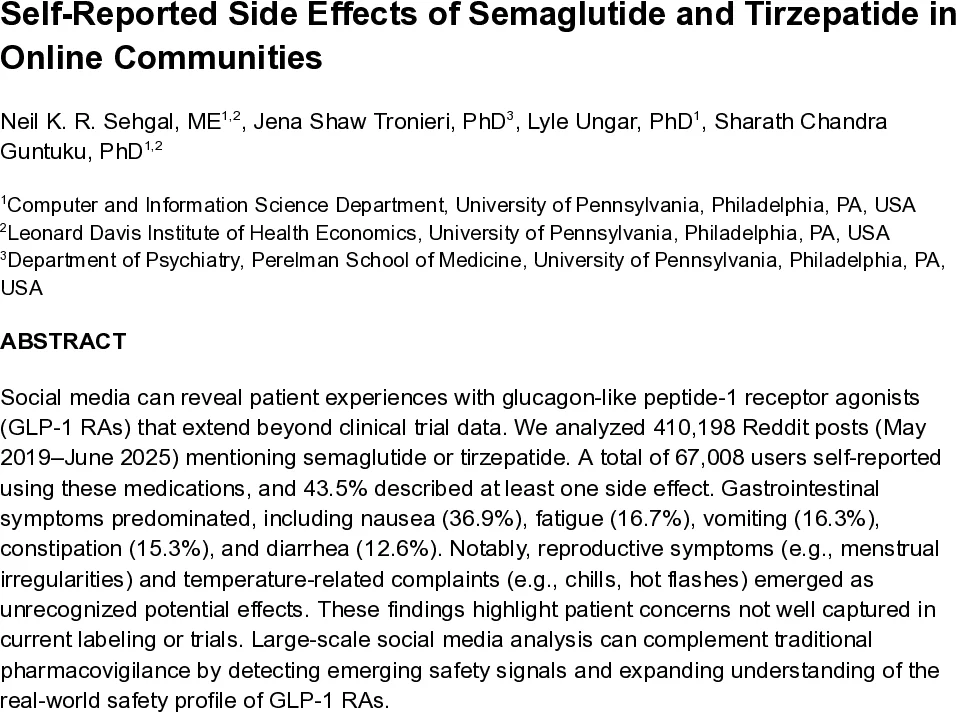
Social media can reveal patient experiences with glucagon-like peptide-1 receptor agonists (GLP-1 RAs) that extend beyond clinical trial data. We analyzed 410,198 Reddit posts (May 2019-June 2025) mentioning semaglutide or tirzepatide. A total of 67,008 users self-reported using these medications, and 43.5% described at least one side effect. Gastrointestinal symptoms predominated, including nausea (36.9%), fatigue (16.7%), vomiting (16.3%), constipation (15.3%), and diarrhea (12.6%). Notably, reproductive symptoms (e.g., menstrual irregularities) and temperature-related complaints (e.g., chills, hot flashes) emerged as unrecognized potential effects. These findings highlight patient concerns not well captured in current labeling or trials. Large-scale social media analysis can complement traditional pharmacovigilance by detecting emerging safety signals and expanding understanding of the real-world safety profile of GLP-1 RAs.
💡 Research Summary
This study leveraged a large‑scale Reddit data set to characterize real‑world adverse event reports for two novel glucagon‑like peptide‑1 receptor agonists (GLP‑1 RAs), semaglutide and tirzepatide. The authors harvested 410,198 posts from nine weight‑loss and diabetes‑focused subreddits spanning May 2019 to June 2025. Using a two‑stage GPT‑4‑mini pipeline, they first identified posts in which users disclosed personal use of either medication, then extracted self‑reported side‑effects and mapped them to MedDRA Preferred Terms (PTs). In total, 172,679 posts (42 % of the corpus) reflected personal use, representing 67,008 unique users. Of these, 43.5 % (29,172 users) reported at least one adverse event, with an average of 2.7 PTs per reporter (SD 2.4).
The distribution of reported events closely mirrors clinical trial findings for gastrointestinal (GI) toxicity: nausea (36.9 % of reporters), fatigue (16.7 %), vomiting (16.3 %), constipation (15.3 %), and diarrhea (12.6 %) were the most common. Additional GI symptoms such as decreased appetite, abdominal pain, reflux, and dizziness each appeared in ≥5 % of reporters, confirming that Reddit users discuss many of the same side‑effects captured in trial safety tables.
Beyond the GI domain, the analysis uncovered notable signals in other System Organ Classes (SOCs). General disorders and administration site conditions accounted for 28.8 % of reports, with fatigue, chills, injection‑site pain, and feeling cold each reported by 1–2 % of users. Nervous system disorders (19.6 %) featured headache, dizziness, somnolence, dysgeusia, and tremor. Metabolism and nutrition disorders (17.8 %) included decreased appetite, hypoglycemia, and dehydration. Psychiatric disorders (12.9 %) were represented by anxiety, insomnia, depression, and panic attacks. Skin/subcutaneous disorders (8.7 %) showed alopecia, hyperhidrosis, pruritus, and rash. Musculoskeletal complaints (6.3 %) comprised myalgia, arthralgia, and back pain.
Two emerging safety signals merit particular attention because they are not currently listed on FDA labeling for either drug. First, reproductive system and breast disorders were reported by roughly 4 % of those who disclosed side‑effects. Menstrual irregularities—intermenstrual bleeding (0.9 %), heavy bleeding (0.9 %), and irregular cycles (0.7 %)—appeared despite the fact that the study population was not limited to women, suggesting a potentially under‑recognized effect of GLP‑1 RAs on hypothalamic‑pituitary‑ovarian axis regulation. Second, temperature‑related symptoms (chills, feeling cold, hot flashes, pyrexia) were reported by 1–2 % of users, hinting at possible thermogenic effects mediated through glucagon pathways.
A sub‑analysis compared users who mentioned only semaglutide (n = 17,937) versus only tirzepatide (n = 7,125). Semaglutide reporters had higher rates of nausea (39.4 %) and vomiting (18.0 %) while tirzepatide reporters more frequently mentioned injection‑site reactions, myalgia, insomnia, and temperature‑related complaints. However, the authors caution that without demographic or clinical covariates, these differences cannot be causally attributed to the drug formulation.
The paper acknowledges several limitations. Reddit’s user base skews younger, male, and U.S.‑centric, limiting generalizability to the broader diabetic or obese populations. Self‑selection bias may inflate the proportion of users who post about adverse events, as those experiencing severe or bothersome symptoms are more likely to share. The unstructured nature of posts precludes accurate incidence estimates, severity grading, timing of onset, dose‑response relationships, or attribution to weight loss versus medication. Moreover, natural language processing, even with high‑performing LLMs, can misclassify nuanced expressions, and some reported phenomena may not map cleanly onto existing MedDRA concepts.
Despite these constraints, the study demonstrates that large‑scale, publicly available social‑media data can serve as an early‑warning system for drug safety, complementing traditional pharmacovigilance databases such as FAERS. The authors propose extending the pipeline to other platforms (patient forums, review sites) and integrating structured electronic health record data to validate and quantify the signals. They also recommend that future clinical trials and post‑marketing studies systematically assess fatigue, menstrual changes, and thermoregulatory symptoms using validated instruments, rather than relying solely on passive adverse event reporting.
In conclusion, the Reddit‑based analysis confirms known GI toxicities of semaglutide and tirzepatide, highlights psychiatric and metabolic side‑effects that are already recognized, and raises hypothesis‑generating signals for reproductive and temperature‑related adverse events. These findings can inform clinicians’ counseling, guide regulatory labeling updates, and shape the design of prospective safety studies for GLP‑1 RAs in real‑world settings.
Comments & Academic Discussion
Loading comments...
Leave a Comment