Evil Twins in Sums of Wildflowers
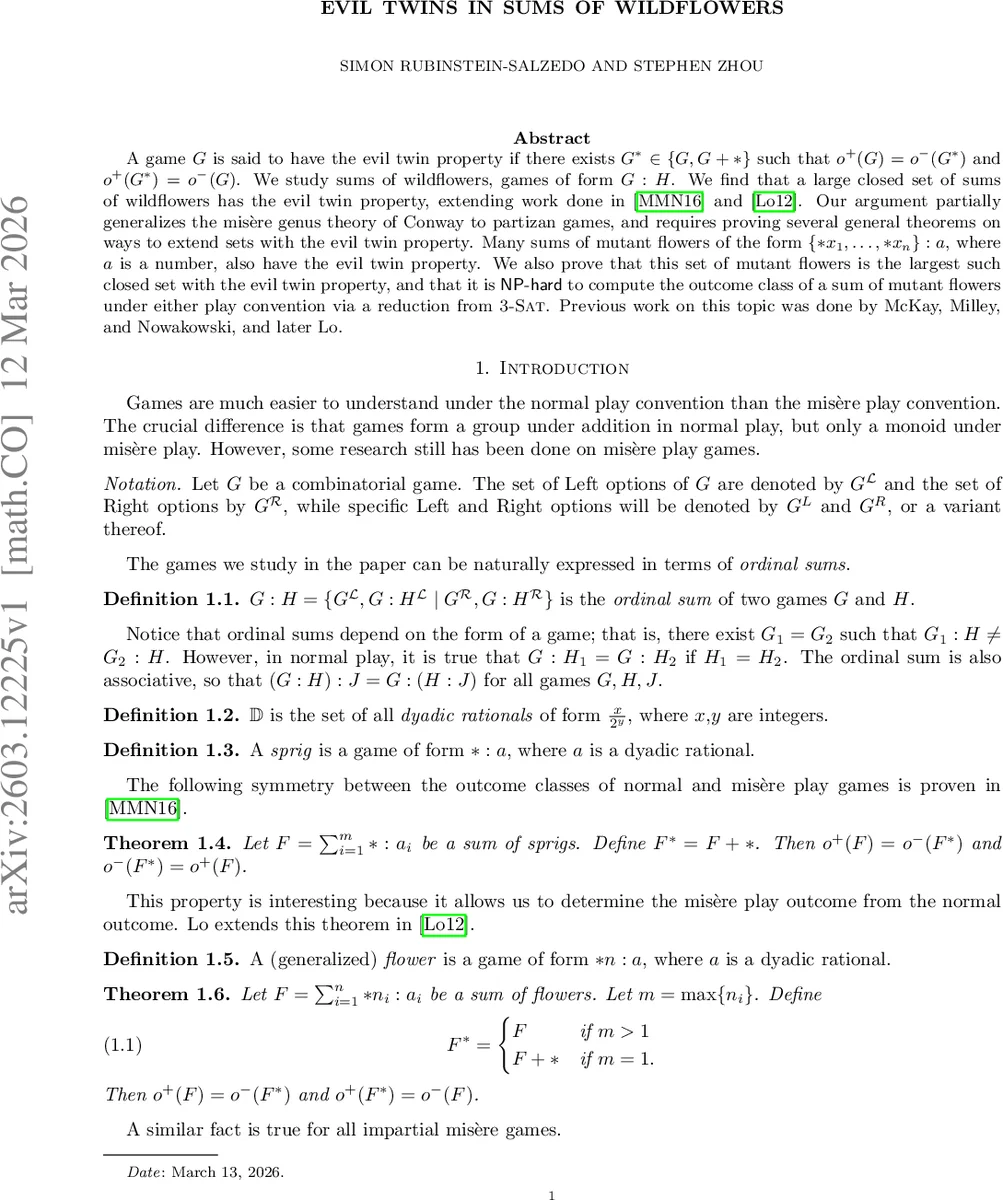
A game $G$ is said to have the evil twin property if there exists $G^* \in {G,G+}$ such that $o^+(G) = o^-(G^)$ and $o^+(G^*) = o^-(G)$. We study sums of wildflowers, games of form $G:H$. We find that a large closed set of sums of wildflowers has the evil twin property, extending work of McKay–Milley–Nowakowski and Lo. Our argument partially generalizes the misère genus theory of Conway to partizan games, and requires proving several general theorems on ways to extend sets with the evil twin property. Many sums of mutant flowers of the form ${*x_1,\dots,*x_n}:a$, where $a$ is a number, also have the evil twin property. We also prove that this set of mutant flowers is the largest such closed set with the evil twin property, and that it is $\mathsf{NP\text{-}hard}$ to compute the outcome class of a sum of mutant flowers under either play convention via a reduction from \textsc{3-Sat}. Previous work on this topic was done by McKay, Milley, and Nowakowski, and later Lo.
💡 Research Summary
The paper introduces the “evil twin” property for combinatorial games, a symmetry linking normal‑play and misère‑play outcomes. For a game G, if there exists a choice G* ∈ {G, G+} such that the normal‑play outcome o⁺(G) equals the misère outcome o⁻(G) and vice‑versa, then G is said to have an evil twin. This concept generalizes earlier results on sprigs (games of the form * : a) and generalized flowers (*ⁿ : a) proved by McKay–Milley–Nowakowski and later extended by Lo.
To formalize the property, the authors define an “evil kernel” K within a closed set A of games that contains . For any G ∈ A, they set G = G if G ∈ K and G* = G+* otherwise. The kernel guarantees that every game in A satisfies the evil twin condition. The paper then proves two powerful extension theorems. The first (Theorem 3.10) shows that if (A, K) is “evil‑normally” (i.e., the membership of a sum in K is exactly determined by the membership of its summands) and B is a set of dicotic games whose options intersect A\K in a star‑closed way, then the closure of A∪B retains an evil‑normal structure with the same kernel complement. The second (Theorem 3.11) allows adding elements to the non‑kernel side while preserving the property, provided that options of kernel and non‑kernel elements are star‑closed and certain technical “first‑move” conditions hold.
Applying this framework, the authors study ordinal sums called wildflowers (G : H) and a broader class called mutant flowers, which have the form {∗x₁,…,∗x_m} : a where each ∗x_i is a copy of * and a is a dyadic rational. They prove:
-
For the set S of “fickle” wildflowers and H of “firm” wildflowers, defining G* = G when G∉cl(L) and G* = G+* when G∈cl(L) yields the evil twin property (Theorem 1.8).
-
For any sum of mutant flowers, let m be the maximum height of a flower in the sum. If m > 1 set G* = G, otherwise set G* = G+*. Then the evil twin property holds (Theorem 1.9).
-
The collection of all mutant‑flower sums forms the largest closed set possessing the evil twin property; no larger closed set can have the property.
-
Determining the outcome class (L, R, N, P) of a sum of mutant flowers under either normal or misère play is NP‑hard. The reduction from 3‑SAT encodes variables and clauses as specific flower components; a satisfying assignment corresponds to a particular outcome, establishing the computational hardness.
The paper also connects the evil twin property to Conway’s misère genus theory, showing that the kernel plays a role analogous to the kernel of impartial misère quotients. Games in the kernel have identical normal and misère outcomes, while those outside the kernel have outcomes that are swapped by adding a single *.
Finally, the authors discuss open problems: extending evil‑kernel constructions to more general partizan games, designing algorithms that exploit the evil twin symmetry for faster outcome computation, and pinpointing exact complexity boundaries for various subclasses of wildflowers.
In summary, the work provides a unifying algebraic framework for relating normal‑play and misère‑play outcomes across a broad family of partizan games, establishes maximality and computational limits of this framework, and opens several avenues for further research in combinatorial game theory and computational complexity.
Comments & Academic Discussion
Loading comments...
Leave a Comment