On the $2$-adic valuation of $σ_k(n)$
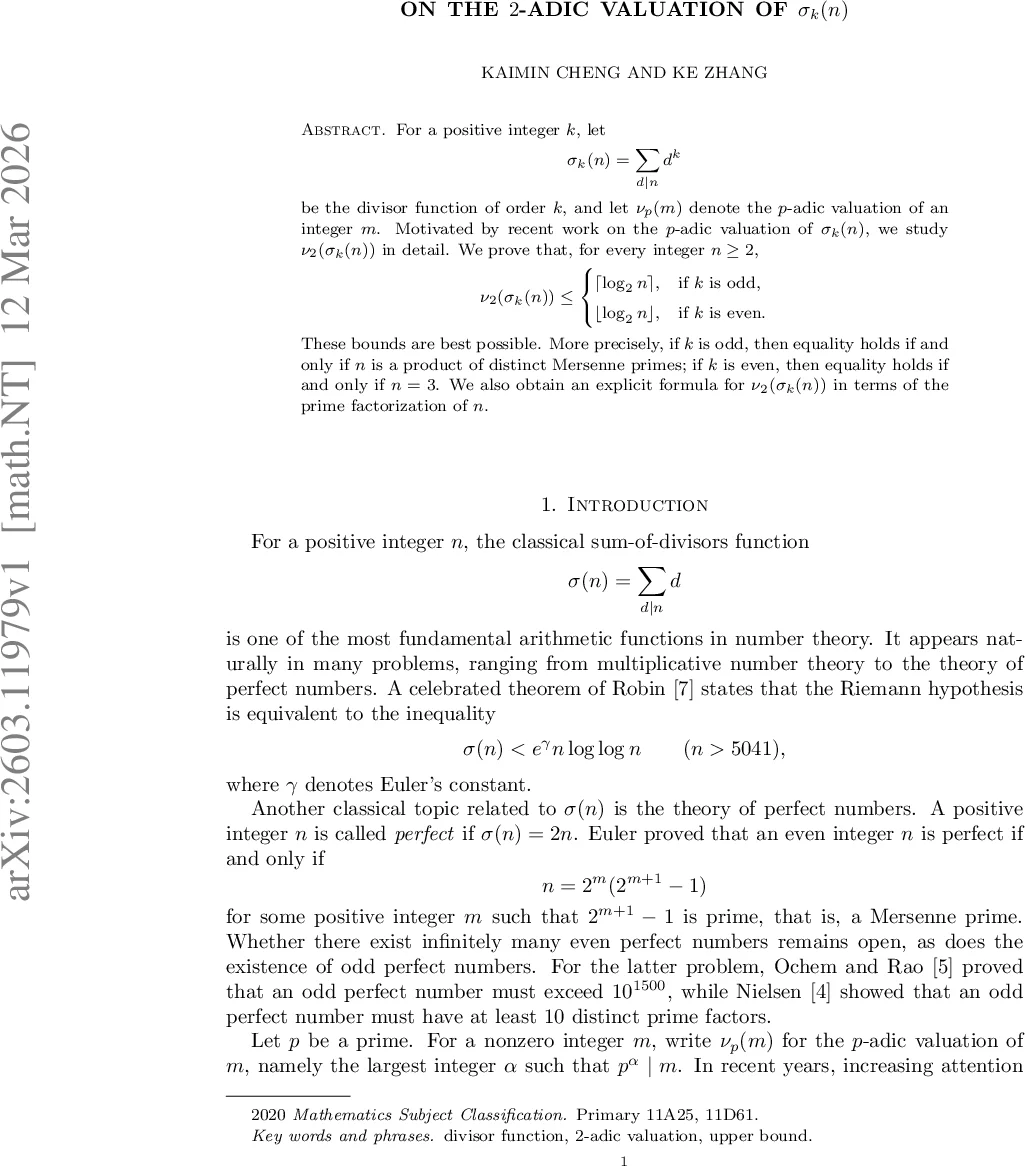
For a positive integer $k$, let [ σ_k(n)=\sum_{d\mid n} d^k ] be the divisor function of order $k$, and let $ν_p(m)$ denote the $p$-adic valuation of an integer $m$. Motivated by recent work on the $p$-adic valuation of $σ_k(n)$, we study $ν_2(σ_k(n))$ in detail. We prove that, for every integer $n\ge 2$, [ ν_2(σ_k(n)) \le \begin{cases} \lceil \log_2 n \rceil, & \text{if $k$ is odd},\[1mm] \lfloor \log_2 n \rfloor, & \text{if $k$ is even}. \end{cases} ] These bounds are best possible. More precisely, if $k$ is odd, then equality holds if and only if $n$ is a product of distinct Mersenne primes; if $k$ is even, then equality holds if and only if $n=3$. We also obtain an explicit formula for $ν_2(σ_k(n))$ in terms of the prime factorization of $n$.
💡 Research Summary
The paper investigates the 2‑adic valuation ν₂ of the generalized divisor sum σₖ(n)=∑{d|n}dᵏ for any positive integer k. Building on earlier work that gave the general bound ν_p(σₖ(n)) ≤ ⌈k·log_p n⌉, the authors sharpen this result dramatically in the case p=2. The main theorem provides an explicit formula for ν₂(σₖ(n)) in terms of the prime factorisation n=2ᵃ·∏{i=1}^r p_i^{α_i} (with distinct odd primes p_i). Specifically, \
Comments & Academic Discussion
Loading comments...
Leave a Comment