Normative Common Ground Replication (NormCoRe): Replication-by-Translation for Studying Norms in Multi-agent AI
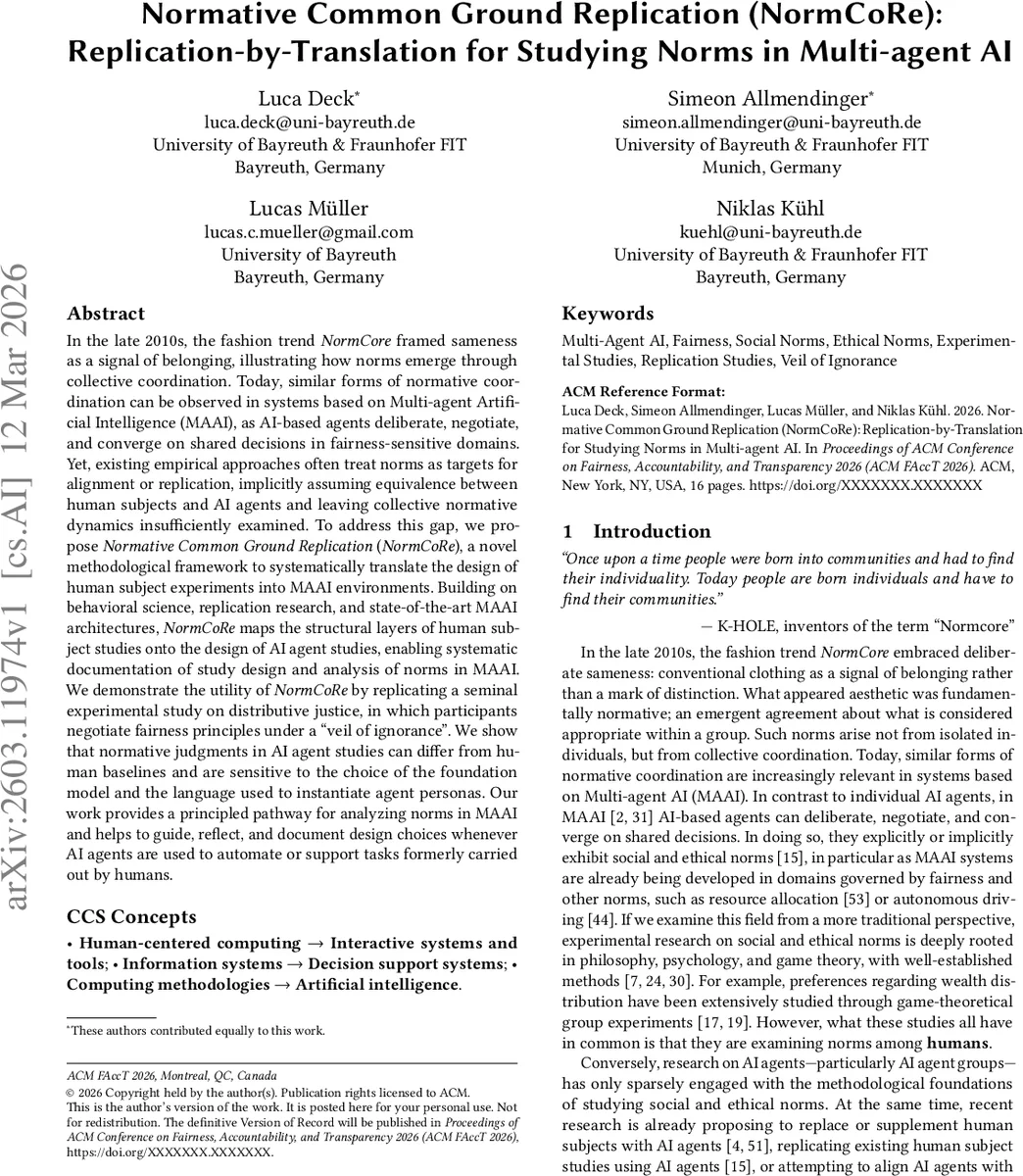
In the late 2010s, the fashion trend NormCore framed sameness as a signal of belonging, illustrating how norms emerge through collective coordination. Today, similar forms of normative coordination can be observed in systems based on Multi-agent Artificial Intelligence (MAAI), as AI-based agents deliberate, negotiate, and converge on shared decisions in fairness-sensitive domains. Yet, existing empirical approaches often treat norms as targets for alignment or replication, implicitly assuming equivalence between human subjects and AI agents and leaving collective normative dynamics insufficiently examined. To address this gap, we propose Normative Common Ground Replication (NormCoRe), a novel methodological framework to systematically translate the design of human subject experiments into MAAI environments. Building on behavioral science, replication research, and state-of-the-art MAAI architectures, NormCoRe maps the structural layers of human subject studies onto the design of AI agent studies, enabling systematic documentation of study design and analysis of norms in MAAI. We demonstrate the utility of NormCoRe by replicating a seminal experimental study on distributive justice, in which participants negotiate fairness principles under a “veil of ignorance”. We show that normative judgments in AI agent studies can differ from human baselines and are sensitive to the choice of the foundation model and the language used to instantiate agent personas. Our work provides a principled pathway for analyzing norms in MAAI and helps to guide, reflect, and document design choices whenever AI agents are used to automate or support tasks formerly carried out by humans.
💡 Research Summary
The paper introduces NormCoRe (Normative Common Ground Replication), a methodological framework for translating human‑subject experiments into multi‑agent artificial intelligence (MAAI) environments. The authors argue that existing AI research often treats human experiments as direct substitutes, overlooking fundamental ontological differences between humans and AI agents. To address this gap, NormCoRe formalizes replication as a translation problem, making explicit the design choices required when mapping human experimental constructs onto AI systems.
NormCoRe consists of five systematic steps: (1) identify the constructs and design components of the original human study (variables, demographics, procedures); (2) instantiate analogous layers in the AI setting (choice of foundation model, persona prompts, agent roles, interaction protocols); (3) provide a rationale for each translation decision, grounded in theory and prior empirical findings; (4) conduct sensitivity and robustness analyses to assess how translation choices affect outcomes; and (5) document all decisions and parameters in a standardized metadata schema to enable reproducibility.
To demonstrate the framework, the authors replicate the classic “veil of ignorance” distributive‑justice experiment by Frohlich and Oppenheimer (2009). In the original study, participants, unaware of their income class, negotiate a principle for dividing a hypothetical society’s resources. In the AI replication, three large language models (GPT‑4, Llama‑2‑13B, Claude‑2) are prompted in English and German to assume “low‑income”, “middle‑income”, and “high‑income” personas. A multi‑round deliberation protocol is implemented where agents exchange proposals, summarize prior rounds, and vote to reach consensus.
Results reveal two key findings. First, the choice of foundation model and the language of the persona prompt significantly shape the fairness judgments of the AI groups. For example, GPT‑4 agents using English prompts selected the “maximise total income while guaranteeing a floor for the worst‑off” principle in 78 % of runs, whereas the same model with German prompts did so in only 65 % of runs. Llama‑2 showed a more conservative allocation pattern, and Claude‑2 exhibited the highest variability across conditions. Second, while both human and AI groups converged on the same principle, the AI groups displayed a markedly higher concentration of choices, indicating that AI agents produce more deterministic, optimization‑driven outcomes compared with the broader distribution observed among humans, who bring cognitive and affective noise to the decision process.
The authors argue that NormCoRe moves beyond simple replication success metrics (e.g., statistical similarity) by exposing how translation decisions at multiple layers—model architecture, prompt phrasing, interaction order—condition normative outcomes. This transparency allows researchers to attribute observed divergences to specific design factors rather than to an assumed “human‑AI equivalence”.
Finally, the paper outlines future extensions of NormCoRe, such as cross‑cultural norm comparisons, incorporation of power asymmetries in negotiation protocols, and hybrid human‑AI group experiments. By providing a rigorous, documented pipeline for translating human experiments into AI settings, NormCoRe equips scholars and practitioners with the tools needed to study, evaluate, and responsibly design AI systems that participate in socially and ethically sensitive decision‑making.
Comments & Academic Discussion
Loading comments...
Leave a Comment