Systems of partial differential equations describing pseudo-spherical or spherical surfaces
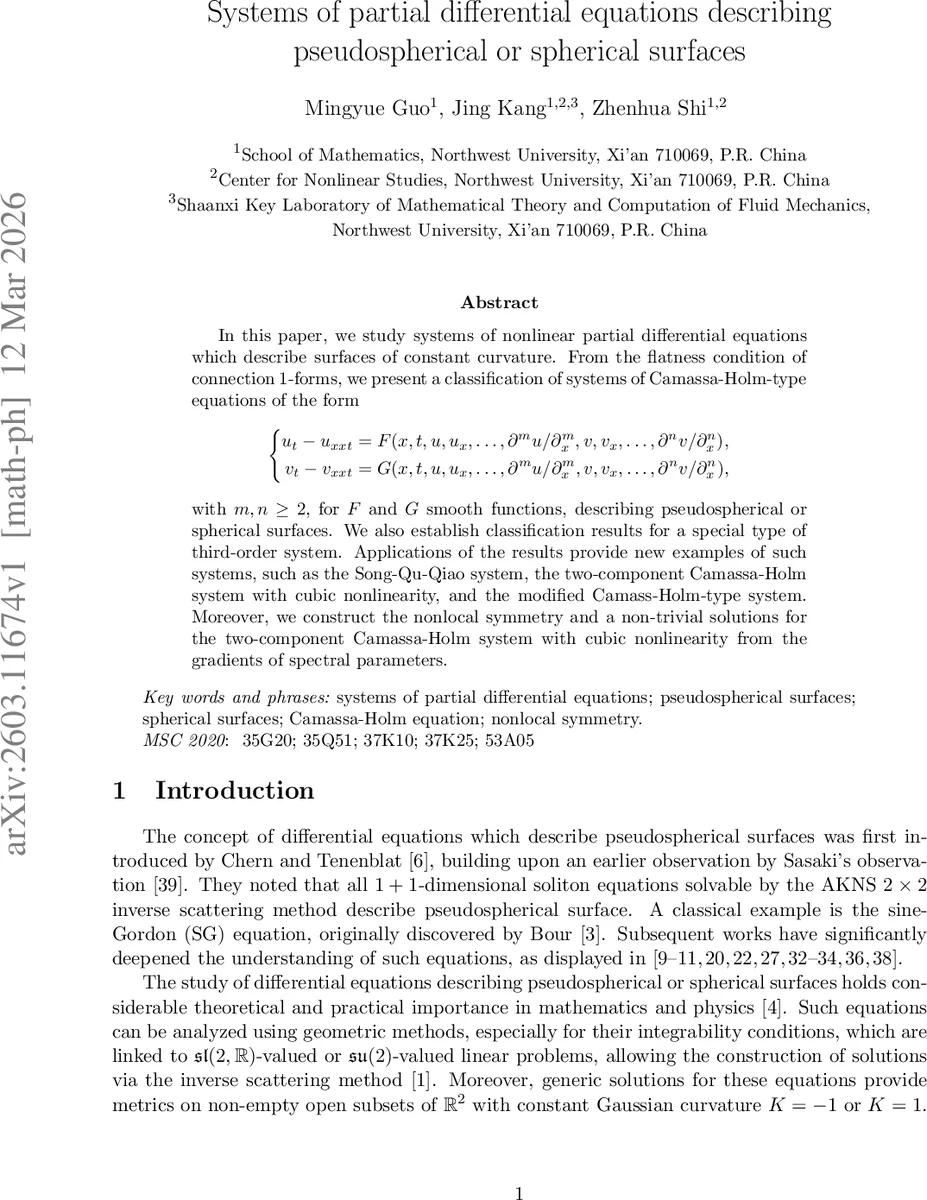
In this paper, we study systems of nonlinear partial differential equations which describe surfaces of constant curvature. From the flatness condition of connection 1-forms, we present a classification of systems of Camassa-Holm-type equations of the form \begin{equation*} \left{ \begin{aligned} u_{t} - u_{xxt} &= F(x, t, u, u_{x}, \dots, \partial ^{m} u/\partial x^{m}, v, v{x}, \dots, \partial ^{n} v/\partial x^{n}), \ v{t} - v_{xxt} &= G(x, t, u, u_{x}, \dots, \partial ^{m} u/\partial x^{m}, v, v{x}, \dots, \partial ^{n} v/\partial _x^{n}), \end{aligned} \right. \end{equation*} with $m,n\geq2$, for $F$ and $G$ smooth functions, describing pseudospherical or spherical surfaces. We also establish classification results for a special type of third-order system. Applications of the results provide new examples of such systems, such as the Song-Qu-Qiao system, the two-component Camassa-Holm system with cubic nonlinearity, and the modified Camass-Holm-type system. Moreover, we construct the nonlocal symmetry and a non-trivial solutions for the two-component Camassa-Holm system with cubic nonlinearity from the gradients of spectral parameters.
💡 Research Summary
This paper investigates nonlinear partial differential equation (PDE) systems that generate surfaces of constant Gaussian curvature, i.e., pseudospherical (K = −1) or spherical (K = +1) surfaces. The authors focus on two‑component Camassa‑Holm‑type evolution equations of the form
\
Comments & Academic Discussion
Loading comments...
Leave a Comment