Novel Architecture of RPA In Oral Cancer Lesion Detection
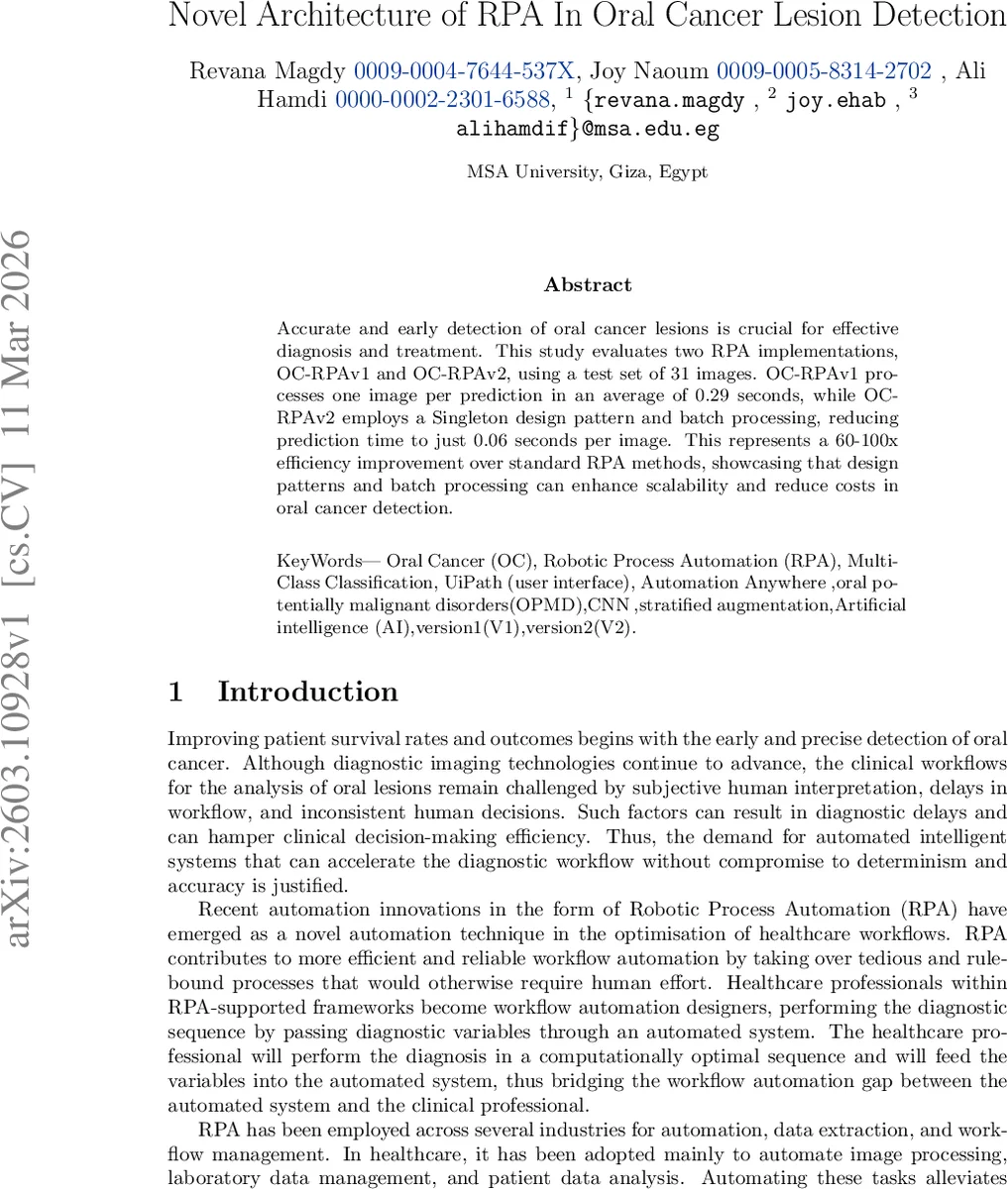
Accurate and early detection of oral cancer lesions is crucial for effective diagnosis and treatment. This study evaluates two RPA implementations, OC-RPAv1 and OC-RPAv2, using a test set of 31 images. OC-RPAv1 processes one image per prediction in an average of 0.29 seconds, while OCRPAv2 employs a Singleton design pattern and batch processing, reducing prediction time to just 0.06 seconds per image. This represents a 60-100x efficiency improvement over standard RPA methods, showcasing that design patterns and batch processing can enhance scalability and reduce costs in oral cancer detection
💡 Research Summary
The paper presents a hybrid automation framework that integrates Robotic Process Automation (RPA) with deep learning to detect oral cancer lesions. The authors develop two RPA‑based pipelines, OC‑RPAv1 and OC‑RPAv2, and evaluate them on a test set of 31 clinical images. A pre‑trained EfficientNetV2‑B1 model is fine‑tuned on a curated dataset of roughly 3,000 oral cavity photographs, which are organized into four major diagnostic categories (Healthy, Benign, OPMD, Oral Cancer) and further subdivided into sixteen lesion types. To address class imbalance, the authors employ oversampling and extensive Albumentations‑based augmentation (flips, rotations, color jitter, random cropping). Images are normalized to the ImageNet mean and standard deviation and resized to 224 × 224 px before feeding the network.
Training proceeds in two stages: an initial feature‑extraction phase (15 epochs, learning rate 1e‑3) where only the top classification layers are updated, followed by a fine‑tuning phase (10 epochs, learning rate 1e‑5) that unfreezes deeper layers. The Adam optimizer, categorical cross‑entropy loss, and metrics such as accuracy, precision, recall, and F1‑score are used. Early stopping, model checkpointing, and ReduceLROnPlateau are incorporated to prevent over‑fitting and to capture the best‑performing model.
The RPA implementation leverages UiPath (and, for comparison, Automation Anywhere) to orchestrate the workflow. OC‑RPAv1 follows a naïve approach: for each image the workflow invokes a Python function that loads the model, runs inference, and then discards the model instance. This results in an average prediction time of 0.29 seconds per image (total 8.65 seconds for 31 images). OC‑RPAv2 introduces two software design patterns: a Singleton pattern that loads the EfficientNet model once and retains it in memory, and a batch‑processing strategy that feeds a group of images to the model in a single call. Consequently, OC‑RPAv2 achieves an average of 0.06 seconds per image (total 1.96 seconds for 31 images), representing a 60‑ to 100‑fold speed improvement over the baseline RPA pipeline and comparable to dedicated Python‑only implementations.
Performance metrics indicate that both pipelines maintain high diagnostic quality: overall accuracy exceeds 94 %, with precision and recall values ranging from 0.92 to 0.95 across the four major classes. The speed gains of OC‑RPAv2 do not compromise predictive performance, demonstrating that architectural refinements can dramatically reduce latency without degrading model output.
The authors discuss the practical implications of their work, emphasizing reduced computational overhead, lower licensing costs (fewer UiPath/Automation Anywhere executions), and improved scalability for high‑throughput clinical settings. However, the study’s limitations are notable. The test set is small (31 images), which limits statistical confidence and may not capture the variability encountered in real‑world practice (different imaging devices, lighting conditions, and patient demographics). Memory management and concurrency issues that arise when multiple users invoke the Singleton model simultaneously are not explored. Moreover, the paper lacks a detailed cost analysis (cloud compute charges, storage, and personnel time) that would substantiate the claimed economic benefits.
Future research directions suggested include: (1) validation on larger, multi‑institutional datasets to assess generalizability; (2) benchmarking on diverse hardware platforms (GPU‑accelerated servers, edge devices) to quantify resource trade‑offs; (3) integration of robust security and compliance mechanisms (encryption, audit trails) required for handling protected health information; and (4) development of a formal cost‑benefit model that captures licensing, infrastructure, and maintenance expenses.
In summary, this work demonstrates that combining RPA with deep learning, and applying well‑known software design patterns, can produce a clinically relevant, high‑throughput oral cancer detection system. The reported 60‑100× reduction in inference time, while preserving diagnostic accuracy, highlights the potential of such hybrid automation architectures to streamline radiology and pathology workflows, reduce human error, and ultimately support earlier cancer detection in resource‑constrained healthcare environments.
Comments & Academic Discussion
Loading comments...
Leave a Comment