Inferring Clinically Relevant Molecular Subtypes of Pancreatic Cancer from Routine Histopathology Using Deep Learning
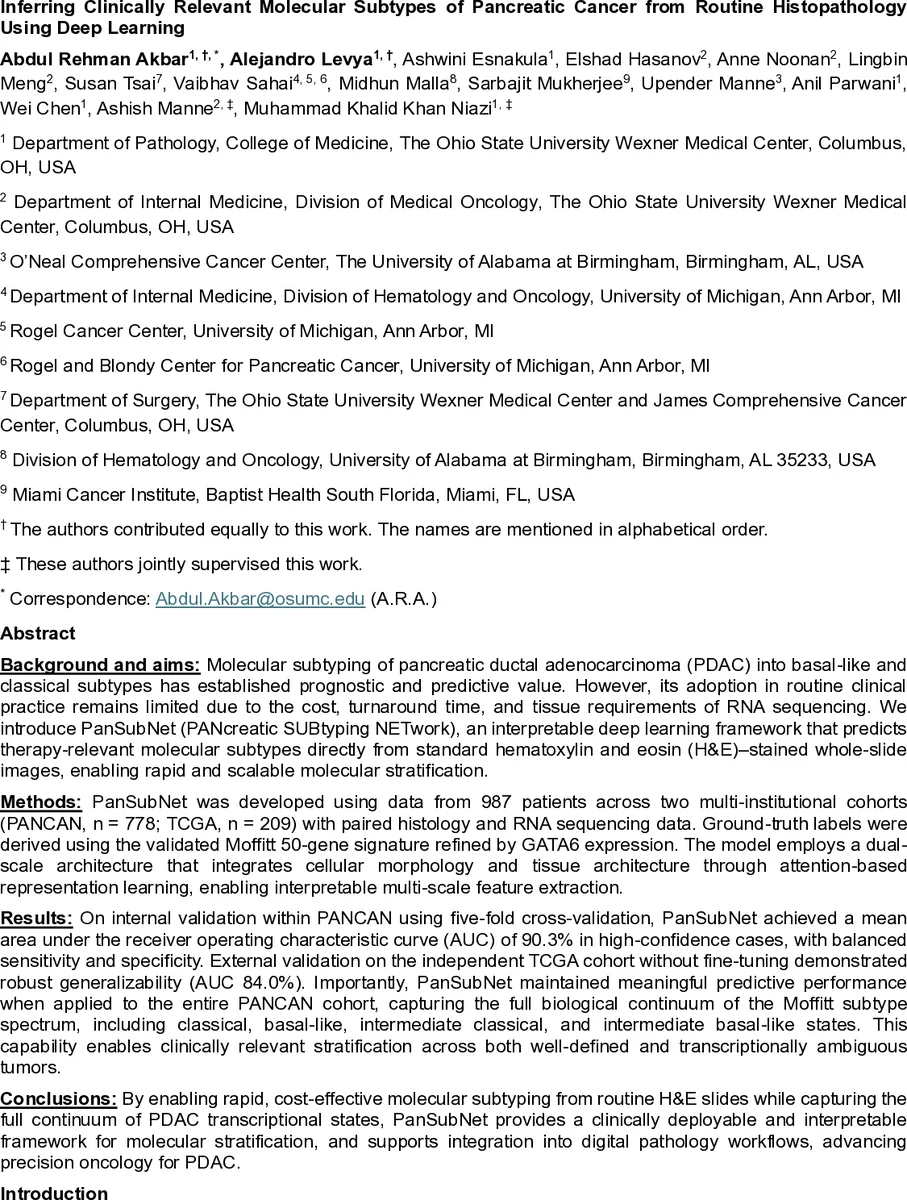
Molecular subtyping of PDAC into basal-like and classical has established prognostic and predictive value. However, its use in clinical practice is limited by cost, turnaround time, and tissue requirements, thereby restricting its application in the management of PDAC. We introduce PanSubNet, an interpretable deep learning framework that predicts therapy-relevant molecular subtypes directly from standard H&E-stained WSIs. PanSubNet was developed using data from 1,055 patients across two multi-institutional cohorts (PANCAN, n=846; TCGA, n=209) with paired histology and RNA-seq data. Ground-truth labels were derived using the validated Moffitt 50-gene signature refined by GATA6 expression. The model employs dual-scale architecture that fuses cellular-level morphology with tissue-level architecture, leveraging attention mechanisms for multi-scale representation learning and transparent feature attribution. On internal validation within PANCAN using five-fold cross-validation, PanSubNet achieved mean AUC of 88.5% with balanced sensitivity and specificity. External validation on the independent TCGA cohort without fine-tuning demonstrated robust generalizability (AUC 84.0%). PanSubNet preserved and, in metastatic disease, strengthened prognostic stratification compared to RNA-seq based labels. Prediction uncertainty linked to intermediate transcriptional states, not classification noise. Model predictions are aligned with established transcriptomic programs, differentiation markers, and DNA damage repair signatures. By enabling rapid, cost-effective molecular stratification from routine H&E-stained slides, PanSubNet offers a clinically deployable and interpretable tool for genetic subtyping. We are gathering data from two institutions to validate and assess real-world performance, supporting integration into digital pathology workflows and advancing precision oncology for PDAC.
💡 Research Summary
This study introduces PanSubNet, a deep‑learning framework that predicts the clinically relevant molecular subtypes of pancreatic ductal adenocarcinoma (PDAC) – basal‑like and classical – directly from routine hematoxylin‑and‑eosin (H&E) whole‑slide images (WSIs). Molecular subtyping based on the Moffitt 50‑gene signature has demonstrated prognostic and predictive value, but its adoption is limited by the cost, turnaround time, and tissue requirements of RNA sequencing. PanSubNet seeks to replace or complement transcriptomic testing by leveraging the ubiquity of digital pathology.
Cohorts and Ground‑Truth Labels
The authors assembled 1,055 patients from two multi‑institutional cohorts: the Pancreatic Cancer Action Network (PANCAN) cohort (n = 778) and The Cancer Genome Atlas (TCGA) cohort (n = 209). Each case had a paired H&E slide and RNA‑seq profile. Ground‑truth subtypes were derived using the validated Moffitt 50‑gene signature refined by GATA6 expression; only samples with absolute z‑score > 1 were considered high‑confidence (95 basal‑like and 76 classical in PANCAN; 15 basal‑like and 47 classical in TCGA). Intermediate cases were retained for exploratory analyses but excluded from supervised training.
Model Architecture
PanSubNet employs a dual‑scale design:
- Cell‑scale branch – CellVIT++ extracts cellular morphology, nuclear features, and local spatial context at the single‑cell level.
- Tissue‑scale branch – A UNet‑derived backbone (UNI2‑h) encodes global architectural patterns from 256 × 256 µm patches.
Both branches produce embeddings that are fused through a multi‑head attention mechanism, allowing the network to weight cellular versus architectural cues dynamically for each slide. The fused representation is fed into a binary classifier that outputs the probability of a basal‑like phenotype.
Performance Evaluation
- Internal validation (PANCAN, 5‑fold cross‑validation): mean AUC = 90.3 % (±5.33), accuracy = 87.0 % (±10.71), balanced accuracy = 87.2 % (±10.86). Sensitivity and specificity were closely matched (≈86.8 % and 87.6 %). Misclassifications were associated with lower decision margins, indicating that prediction confidence correlates with correctness.
- External validation (TCGA, no fine‑tuning): AUC = 84.0 %, accuracy = 76.0 %, balanced accuracy = 76.4 %, sensitivity = 75.5 %, specificity = 77.3 %. Performance remained robust despite differences in slide preparation, staining, and sequencing platforms.
When applied to the full PANCAN cohort (including low‑confidence and intermediate cases), the AUC dropped to 71.3 %, reflecting the continuous nature of the transcriptional spectrum. A secondary model fine‑tuned on PanSubNet embeddings could distinguish high‑confidence from low‑confidence cases with AUC ≈ 75 %, confirming that the learned features encode information about subtype certainty.
Comparison with Baseline
The authors benchmarked PanSubNet against an attention‑based multiple‑instance learning model (AttMIL) using the same UNI2‑h backbone. While AttMIL achieved a slightly higher internal AUC (96.8 %), it displayed a strong bias toward the classical class, resulting in reduced sensitivity for basal‑like tumors and a marked drop in external specificity (59 %). PanSubNet maintained balanced performance across cohorts, highlighting the advantage of integrating cellular‑level information.
Clinical Relevance and Survival Analysis
Kaplan‑Meier analyses were performed separately for metastatic patients and the entire cohort. Using RNA‑seq labels, the survival difference between basal‑like and classical tumors in the metastatic subset showed a trend (p = 0.08). In contrast, PanSubNet‑derived subtypes achieved statistically significant separation (p < 0.05). Notably, several tumors labeled classical by RNA‑seq but predicted basal‑like by PanSubNet experienced early deaths, suggesting that histologic cues may capture aggressive biology missed by bulk transcriptomics.
Biological Interpretability
Attention heatmaps revealed that basal‑like predictions were driven by regions of high nuclear density, desmoplastic stroma, and loss of glandular architecture, whereas classical predictions highlighted well‑formed glandular structures and differentiated epithelial cells. Correlation analyses linked model outputs with DNA‑damage‑repair gene expression, KRAS mutation burden, and pathway enrichment (EMT, inflammatory signaling), demonstrating concordance with known molecular mechanisms.
Future Directions
The authors are prospectively collecting data from two additional institutions to evaluate real‑world performance, integration into digital pathology pipelines, and cost‑effectiveness. They envision PanSubNet as a rapid, inexpensive decision‑support tool that can be deployed at the point of diagnosis, enabling biologically guided therapy selection (e.g., FOLFIRINOX for classical, alternative strategies for basal‑like) without the need for RNA sequencing.
Conclusion
PanSubNet provides a technically sound, interpretable, and clinically actionable method for inferring PDAC molecular subtypes from routine H&E slides. Its dual‑scale architecture, strong internal and external validation, and demonstrated prognostic relevance position it as a promising addition to precision oncology workflows for pancreatic cancer.
Comments & Academic Discussion
Loading comments...
Leave a Comment