Equipoise calibration of clinical trial design
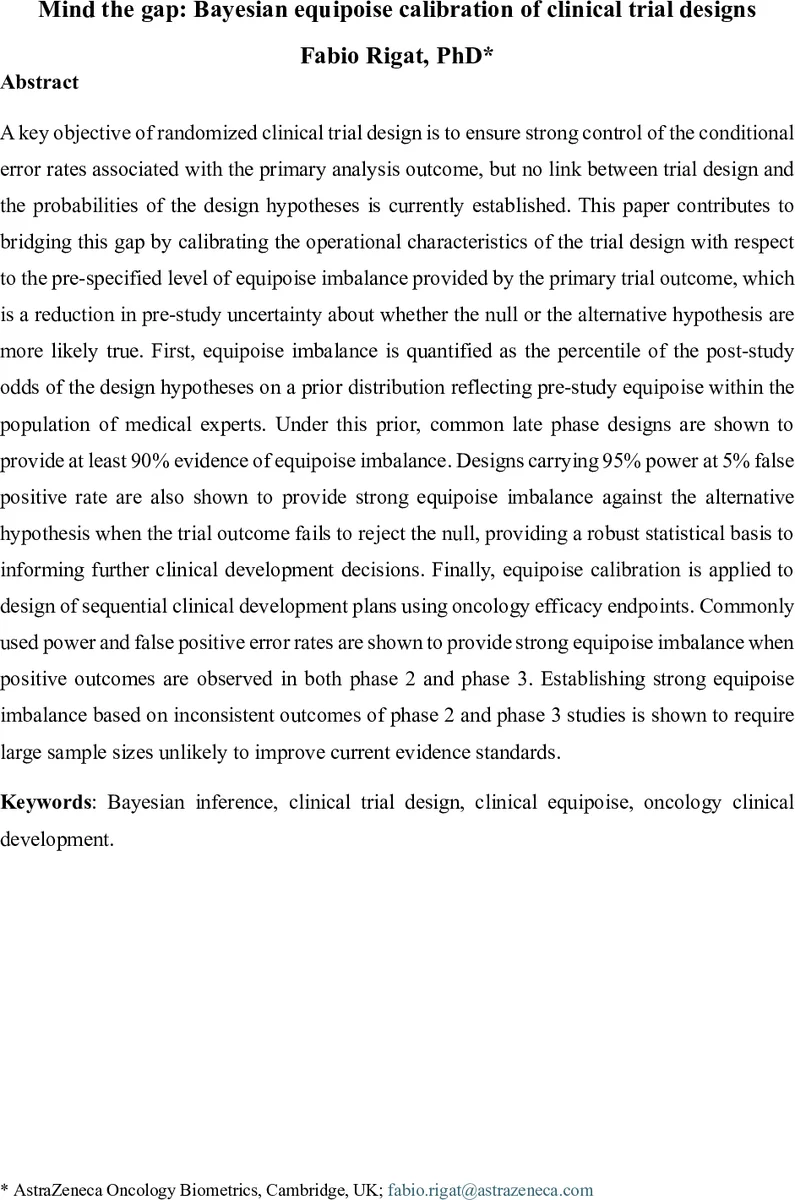
Clinical trial design ensures that primary analysis outcomes have strong statistical properties. However, mainstream methodology for randomised study design does not establish a formal link between statistical and clinical significance. This paper contributes to bridging this gap by calibrating the operational characteristics of primary trial outcomes to establishing clinical equipoise imbalance. Common late phase designs are shown to provide at least 90% evidence of equipoise imbalance. Designs carrying 95% power at 5% false positive rate are shown to demonstrate 95% evidence of equipoise imbalance, providing an operational definition of a robustly powered study. Equipoise calibration is applied to design of clinical development plans comprising phase 2 and phase 3 studies using standard oncology endpoints. Commonly used power and false positive error rates are shown to provide strong equipoise imbalance when positive outcomes are observed in both phase 2 and phase 3. Establishing strong equipoise imbalance based on inconsistent outcomes of phase 2 and phase 3 studies is shown to require large sample sizes unlikely to be associated with clinically meaningful effect sizes.
💡 Research Summary
The paper introduces the concept of “equipoise calibration” to bridge the long‑standing gap between the statistical properties of a clinical trial’s primary endpoint and the clinical relevance of its results. While traditional trial design focuses on controlling type‑I (false‑positive) and type‑II (false‑negative) error rates, it does not explicitly link these properties to the reduction of clinical uncertainty—known as clinical equipoise—among experts. The authors propose a Bayesian framework in which the pre‑study odds of the null hypothesis (H0) versus the alternative hypothesis (H1) are treated as a random variable reflecting the distribution of expert opinion. Three prior distributions for these odds are examined: a Beta‑Prime (1,1) distribution representing a uniform lack of prior knowledge, a Beta‑Prime (1,2) distribution with a modest tilt toward null, and a Beta‑Prime (0.5,0.5) distribution that concentrates mass at extreme odds.
Using Bayes’ theorem, the posterior odds after observing a trial outcome are expressed as the product of the prior odds and the likelihood ratio derived from the trial’s operating characteristics (power and α). For a typical design with 90 % power and a 5 % type‑I error, the likelihood ratio equals 0.9/0.05 = 18, so an expert who started with perfectly balanced odds (1:1) would end with posterior odds of 18:1 in favor of H1 after a positive result. By mapping this posterior odds value onto each prior distribution, the authors calculate the percentile of the expert population that would now consider the evidence to be “unequally balanced.” Under the Beta‑Prime (1,1) prior, 18:1 corresponds to the 94.7th percentile, meaning that almost the entire expert community would view the result as breaking equipoise.
The paper then derives the posterior odds thresholds required to achieve the 95th percentile under each prior. For the Beta‑Prime (1,1) prior, a posterior odds of 19:1 is needed; for Beta‑Prime (1,2) it drops to 3.5:1; and for Beta‑Prime (0.5,0.5) it skyrockets to 161:1, a level unattainable with realistic power levels. Consequently, the authors argue that the Beta‑Prime (1,1) model provides a conservative yet practical benchmark for equipoise calibration, while the (0.5,0.5) model is impractical for trial design.
To demonstrate real‑world applicability, the authors apply the framework to a standard oncology phase III group‑sequential design. Assuming a median control survival of 10 months, a hazard ratio of 0.7 (30 % risk reduction), and an O’Brien‑Fleming error‑spending plan with one interim analysis at 70 % information, the design yields a posterior odds of 19.7:1 for a positive outcome at 90 % power and 5 % α. This exceeds the 95th percentile threshold under the Beta‑Prime (1,1) prior, confirming that conventional confirmatory oncology trials already provide strong equipoise imbalance.
The authors extend the analysis to a sequential development program consisting of a randomized phase II trial followed by a phase III confirmatory trial, both using typical oncology efficacy endpoints. When both stages produce positive results, the combined program achieves very high overall equipoise imbalance (well above the 95th percentile). However, if the phase III trial fails to confirm the phase II signal, achieving strong equipoise imbalance would require dramatically larger sample sizes—far beyond what is feasible or clinically meaningful. This illustrates that the calibration framework can expose situations where additional data would only marginally reduce expert uncertainty, warning against inefficient over‑enrollment.
In summary, the paper makes four key contributions: (1) it formalizes clinical equipoise as a probabilistic prior over expert beliefs; (2) it links trial operating characteristics (power, α) to posterior odds via Bayes’ theorem; (3) it evaluates multiple prior models to define concrete percentile thresholds for “strong” equipoise imbalance; and (4) it applies the methodology to both a single confirmatory trial and a two‑stage development program, showing that typical oncology designs already meet stringent equipoise criteria while highlighting the impracticality of forcing strong imbalance when later stages are negative. This work provides a quantitative tool for investigators and regulators to assess not only statistical significance but also the degree to which a trial resolves clinical uncertainty, thereby advancing the design of truly practice‑changing studies.
Comments & Academic Discussion
Loading comments...
Leave a Comment