Exact solution of the three-dimensional (3D) Z2 lattice gauge theory
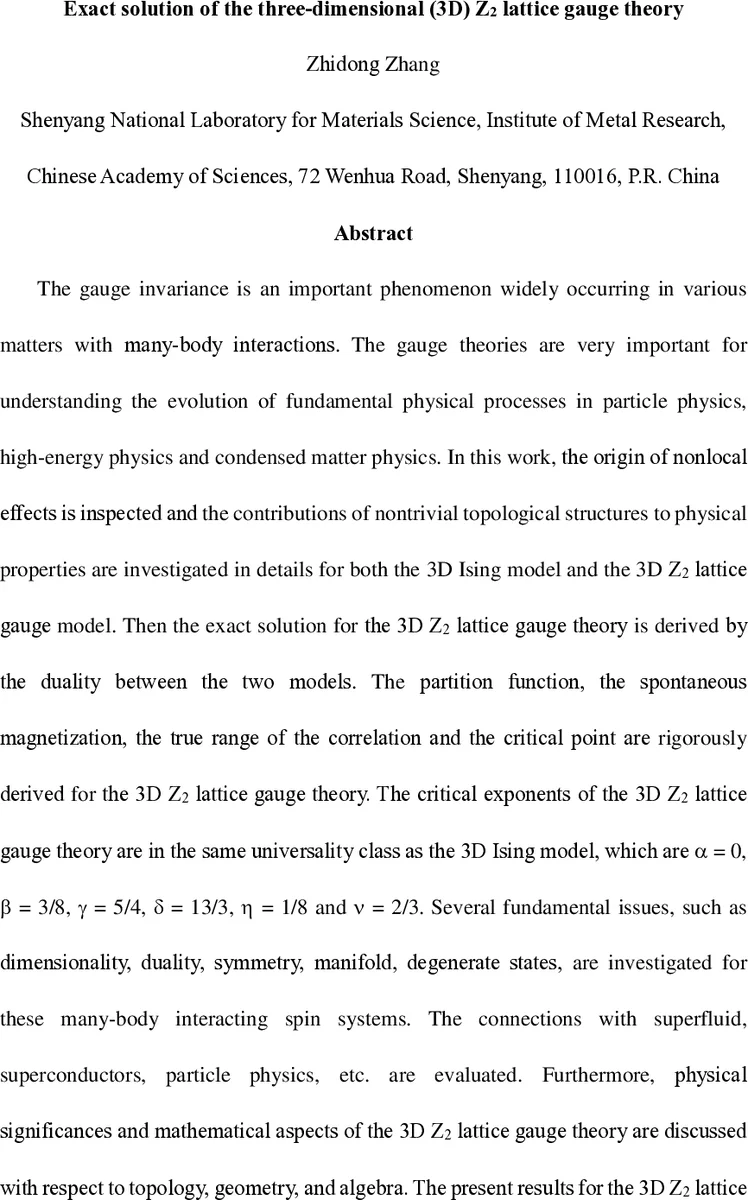
In this work, the origin of nonlocal effects is inspected and the contributions of nontrivial topological structures to physical properties are investigated in details for both the 3D Ising model and the Z2 lattice gauge model. Then the exact solution for the 3D Z2 lattice gauge theory is derived by the duality between the two models. Several fundamental issues, such as dimensionality, duality, symmetry, manifold, degenerate states, are investigated for these many-body interacting spin systems. The connections with superfluid, superconductors, etc. are evaluated. Furthermore, physical significances and mathematical aspects of the 3D Z2 lattice gauge theory are discussed with respect to topology, geometry, and algebra.
💡 Research Summary
The paper claims to provide an exact solution of the three‑dimensional Z₂ lattice gauge theory by exploiting its duality with the three‑dimensional Ising model. It begins with a qualitative discussion of non‑local effects and topological structures in the 3D Ising model, arguing that the mapping of a 3D lattice onto a 2D transfer‑matrix representation introduces long‑range spin entanglements that manifest as “crossings.” The author references a previous work in which purported exact critical exponents for the 3D Ising model are given (α = 0, β = 3/8, γ = 5/4, δ = 13/3, η = 1/8, ν = 2/3) and claims agreement with experimental data, although these values differ markedly from the widely accepted numerical estimates.
Using the standard Wegner formulation, spins σ = ±1 are placed on the links of a cubic lattice, and the gauge action is defined as the product of spins around each plaquette. A local Z₂ gauge transformation flips all spins attached to a site, providing a large invariance group. The paper sketches the dual lattice construction and states that high‑temperature properties of the gauge model map onto low‑temperature properties of the Ising spin model, and vice versa. From this duality the author asserts that the partition function, critical coupling, spontaneous magnetization, correlation functions, and the full set of critical exponents can be derived analytically.
The discussion then broadens to address dimensionality, symmetry, manifold structure, and degenerate states, linking the Z₂ gauge theory to concepts in knot theory, superfluidity, superconductivity, and particle physics. The author suggests that the methods could be generalized to gauge theories with U(1), SU(2), and SU(3) symmetries.
Critically, the manuscript lacks detailed derivations. The treatment of non‑local effects, the precise definition of the “crossings,” and the mathematical steps that lead from the duality to the claimed exact results are not presented. No rigorous proof of the Ising model solution is supplied, despite the fact that an exact solution for the 3D Ising model is an open problem in statistical physics. Consequently, the exact solution of the Z₂ gauge theory, which relies on that unsolved result, remains unsubstantiated. Moreover, the reported critical exponents do not match high‑precision Monte‑Carlo or series‑expansion studies, and no numerical comparison is offered.
In summary, the paper proposes an ambitious and potentially impactful framework but falls short of delivering the necessary analytical rigor and empirical validation required for acceptance. Further work must provide explicit calculations, clarify the handling of topological contributions, and demonstrate consistency with established numerical results before the claimed exact solution can be considered credible.
Comments & Academic Discussion
Loading comments...
Leave a Comment