Drilling hyperbolic groups
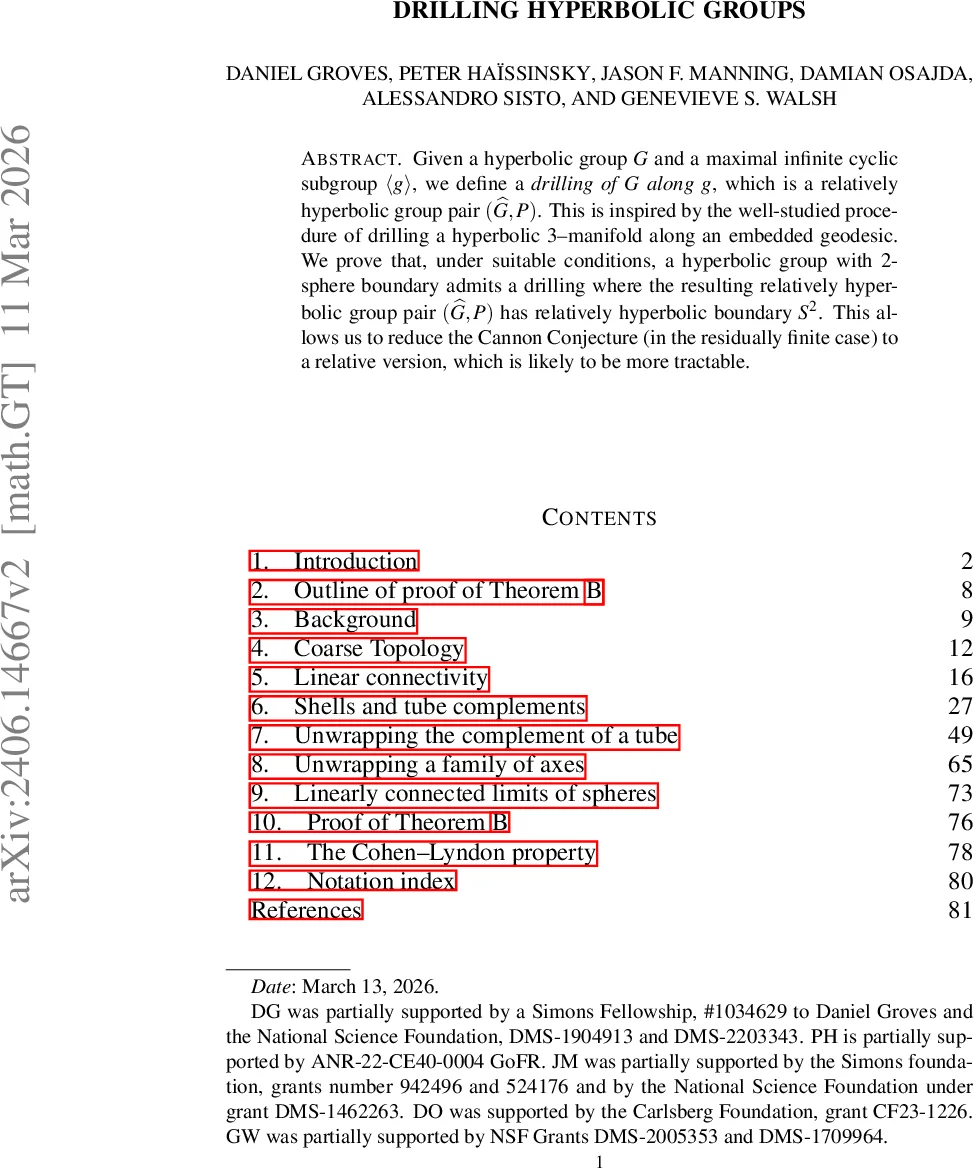
Given a hyperbolic group $G$ and a maximal infinite cyclic subgroup $\langle g \rangle$, we define a {\it drilling of $G$ along $g$}, which is a relatively hyperbolic group pair $(\widehat{G}, P)$. This is inspired by the well-studied procedure of drilling a hyperbolic $3$–manifold along an embedded geodesic. We prove that, under suitable conditions, a hyperbolic group with $2$-sphere boundary admits a drilling where the resulting relatively hyperbolic group pair $(\widehat{G}, P)$ has relatively hyperbolic boundary $S^2$. This allows us to reduce the Cannon Conjecture (in the residually finite case) to a relative version, which is likely to be more tractable.
💡 Research Summary
The paper introduces a group‑theoretic analogue of the classical “drilling” operation on hyperbolic 3‑manifolds and uses it to make progress on the Cannon Conjecture. Starting with a word‑hyperbolic group (G) and a maximal infinite cyclic subgroup (\langle g\rangle), the authors define a drilling of (G) along (g) as a relatively hyperbolic pair ((\widehat G,P)) together with a normal subgroup (N\triangleleft P) such that (P/N\cong\langle g\rangle) and (\widehat G/!!\langle!\langle N\rangle!\rangle\cong G). This mirrors the situation where one removes a tubular neighbourhood of an embedded geodesic in a closed hyperbolic 3‑manifold, obtaining a finite‑volume cusped manifold whose peripheral subgroup is (\mathbb Z^{2}) (or a Klein‑bottle group).
The central technical result, Theorem B, provides sufficient geometric conditions for such a drilling to exist. Let (X) be a hyperbolic graph with boundary homeomorphic to (S^{2}) and let (g) act as a hyperbolic isometry with a (g)‑invariant quasi‑geodesic axis (\gamma). If a subgroup (G\le \operatorname{Isom}(X)) acts freely and cocompactly on (X) and any other element of (G) moves (\gamma) at least a fixed distance (\Sigma) away, then there is a drilling ((\widehat G,P)) satisfying:
- ((\widehat G,P)) is relatively hyperbolic, with peripheral subgroup (P) either free abelian of rank 2 or the fundamental group of a Klein bottle;
- The Bowditch boundary of ((\widehat G,P)) is again a 2‑sphere;
- (P) is free abelian exactly when (g) preserves the orientation of (\partial X);
- (\widehat G) is torsion‑free iff (G) is.
The proof proceeds by a series of “medium‑scale” geometric constructions. First, a large tubular neighbourhood of the axis (\gamma) is examined; its frontier at distance (K) from (\gamma) is shown to be coarsely connected and to have a coarse fundamental group isomorphic to (\mathbb Z). This is achieved via a new coarse‑topology toolkit (coarse fundamental groups, coarse Cartan–Hadamard, coarse deformation retractions). Next, the authors “unwrap” this tubular neighbourhood by taking an infinite cyclic cover, producing a space that is topologically a product of a line with a disk, but with a puncture corresponding to the removed geodesic. By iteratively unwrapping a whole family of such tubes and attaching horoballs to the lifted boundaries, they construct a sequence of uniformly hyperbolic spaces whose Gromov–Hausdorff limits have boundaries homeomorphic to (S^{2}). The limit space (\widehat Y) is shown to be hyperbolic, with (\partial\widehat Y\cong S^{2}), and (\widehat G) acts on (\widehat Y) cusp‑uniformly with stabilizer (P). Consequently ((\widehat G,P)) is relatively hyperbolic with the desired spherical Bowditch boundary. The torsion‑free equivalence follows from a careful analysis of the action on the unwrapped spaces.
Armed with Theorem B, the authors prove Theorem A: assuming the Toral Relative Cannon Conjecture (that any relatively hyperbolic pair with spherical Bowditch boundary and peripheral (\mathbb Z^{2}) subgroups is Kleinian) and that (G) is residually finite with (\partial G\cong S^{2}), then (G) is virtually Kleinian. The argument selects a finite‑index torsion‑free subgroup (G_{0}) preserving orientation, chooses a maximal cyclic subgroup (\langle g\rangle), and applies separability of maximal abelian subgroups (available in residually finite groups) to arrange the axis of (g) to satisfy the separation hypothesis of Theorem B. The resulting drilled pair ((\widehat G,P)) satisfies the hypotheses of the toral relative conjecture, so (\widehat G) is Kleinian. By Dehn filling theory, (G) is obtained from (\widehat G) via a long filling, which yields a closed hyperbolic 3‑manifold group; residual finiteness then guarantees virtual Kleinianity of (G).
The paper also derives several corollaries. Corollary C states that any residually finite hyperbolic group with spherical boundary virtually admits a drilling as in Theorem B. Corollary D shows that if the original group is a PD(3) group (hence torsion‑free and of cohomological dimension 3), then the drilled pair ((\widehat G,P)) is a PD(3) pair, linking the construction to classical manifold topology.
A rich collection of examples illustrates the breadth of the drilling operation: from the classical case of a closed hyperbolic 3‑manifold and an embedded geodesic (Example 1.5), to trivial drillings via free products with (\mathbb Z^{2}) (Example 1.6), to non‑trivial drillings of free groups and surface groups (Examples 1.7), and finally to higher‑dimensional hyperbolic groups arising from relatively hyperbolic Dehn filling (Example 1.8). These examples demonstrate that the technique applies far beyond the original 3‑dimensional setting.
The technical heart of the work lies in the development of coarse topological tools (Section 4), the notion of “spherical connectivity” giving a local criterion for linear connectivity of boundaries (Section 5), and the detailed analysis of large tubular neighborhoods, shells, and their completions (Section 6). Sections 7‑10 develop the unwrapping process, the attachment of horoballs, and the convergence arguments needed to prove that the limit boundary is a 2‑sphere. Section 11 verifies that the quotient map from (\widehat G) to (G) is a long filling in the sense of relatively hyperbolic Dehn filling theory.
In summary, the authors provide a novel method to “drill” hyperbolic groups along maximal cyclic subgroups, producing relatively hyperbolic pairs with spherical Bowditch boundaries. This construction bridges the gap between the classical Cannon Conjecture and its toral relative analogue, showing that the latter suffices (under residual finiteness) to resolve the former. The paper also supplies a toolbox of coarse geometric techniques that are likely to find further applications in the study of hyperbolic groups, relatively hyperbolic boundaries, and group‑theoretic analogues of 3‑manifold topology.
Comments & Academic Discussion
Loading comments...
Leave a Comment