A Swampland-modified Hod bound for charged black holes with exotic matter
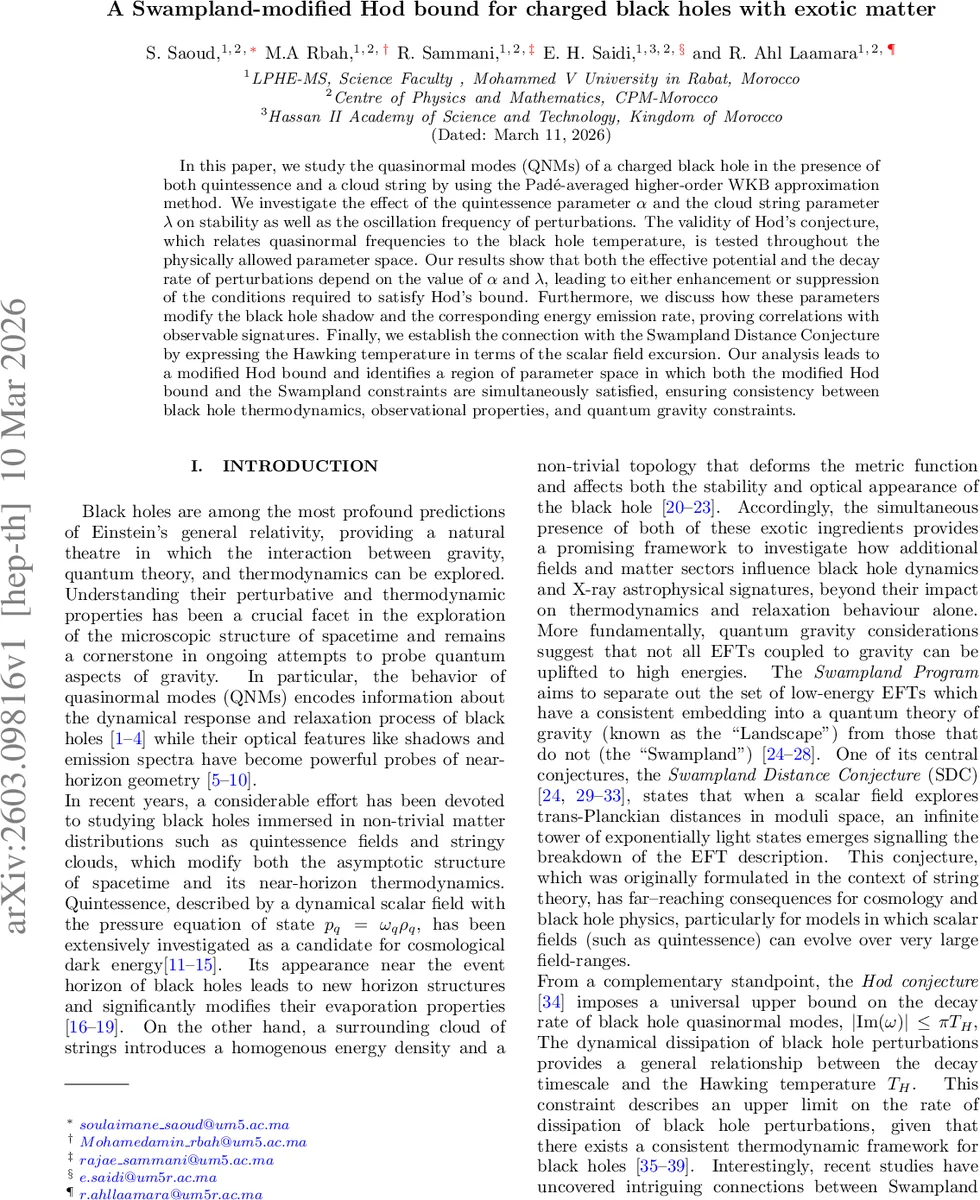
In this paper, we study the quasinormal modes (QNMs) of a charged black hole in the presence of both quintessence and a cloud of strings using the Pade-averaged higher-order WKB approximation method. We investigate the effect of the quintessence parameter $α$ and the cloud of strings parameter $λ$ on the stability as well as the oscillation frequency of perturbations. The validity of Hod’s conjecture, which relates quasinormal frequencies to the black hole temperature, is tested throughout the physically allowed parameter space. Our results show that both the effective potential and the decay rate of perturbations depend on the values of $α$ and $λ$, leading to either enhancement or suppression of the conditions required to satisfy Hod’s bound. Furthermore, we discuss how these parameters modify the black hole shadow and the corresponding energy emission rate, revealing correlations with observable signatures. Finally, we establish a connection with the Swampland Distance Conjecture by expressing the Hawking temperature in terms of the scalar field excursion. Our analysis leads to a modified Hod bound and identifies a region of parameter space in which both the modified Hod bound and the Swampland constraints are simultaneously satisfied, ensuring consistency between black hole thermodynamics, observational properties, and quantum gravity constraints.
💡 Research Summary
In this work the authors investigate the quasinormal mode (QNM) spectrum of a charged Reissner‑Nordström (RN) black hole that is simultaneously surrounded by two exotic matter components: a quintessence field and a cloud of strings. The spacetime metric is modified by the presence of these fields as
(f(r)=1-\frac{2M}{r}+\frac{Q^{2}}{r^{2}}-\lambda-\alpha,r^{3\omega_{q}+1}),
where (M) and (Q) are the black‑hole mass and charge, (\lambda) measures the string‑cloud density, (\alpha) quantifies the intensity of the quintessence, and (\omega_{q}) (restricted to (-1\le\omega_{q}\le-1/3)) is the quintessence equation‑of‑state parameter. The authors focus on the case (\omega_{q}=-1/3) for analytic simplicity, but the formalism applies to the full range.
Scalar perturbations obey the Klein‑Gordon equation, which after separation of variables and the introduction of the tortoise coordinate (r_{}) reduces to a Schrödinger‑type wave equation
(\frac{d^{2}\psi}{dr_{}^{2}}+\bigl(\omega^{2}-V_{\rm eff}(r)\bigr)\psi=0),
with the effective potential
(V_{\rm eff}(r)=f(r)\Bigl
Comments & Academic Discussion
Loading comments...
Leave a Comment