Prismatoid Band-Unfolding Revisited
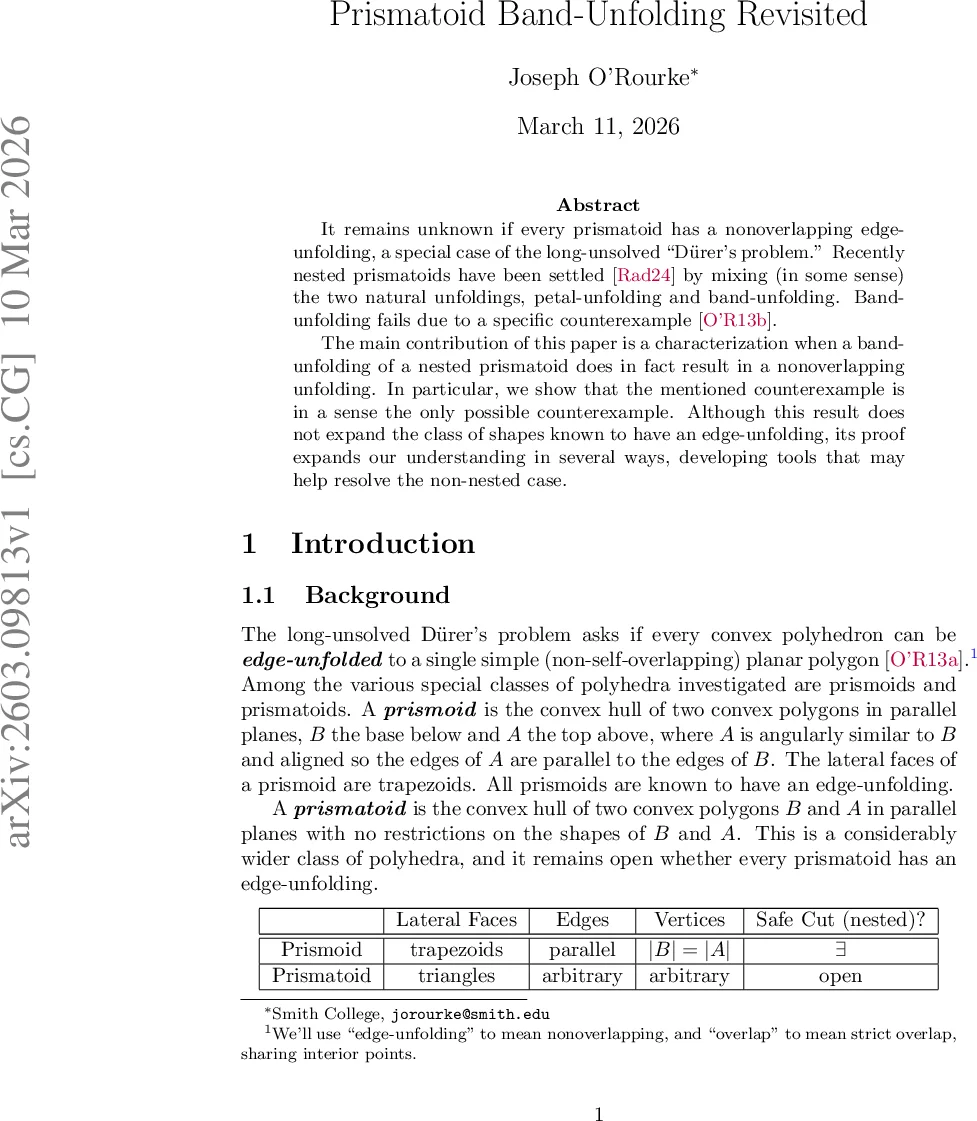
It remains unknown if every prismatoid has a nonoverlapping edge-unfolding, a special case of the long-unsolved “Dürer’s problem.” Recently nested prismatoids have been settled [Rad24] by mixing (in some sense) the two natural unfoldings, petal-unfolding and band-unfolding. Band-unfolding fails due to a specific counterexample [O’R13b]. The main contribution of this paper is a characterization when a band-unfolding of a nested prismatoid does in fact result in a nonoverlapping unfolding. In particular, we show that the mentioned counterexample is in a sense the only possible counterexample. Although this result does not expand the class of shapes known to have an edge-unfolding, its proof expands our understanding in several ways, developing tools that may help resolve the non-nested case.
💡 Research Summary
The paper revisits the long‑standing question of whether every prismatoid admits a non‑overlapping edge‑unfolding, a special case of Dürer’s problem. While all prismoids are known to unfold, the more general class of prismatoids—convex hulls of two arbitrary convex polygons lying in parallel planes—remains unresolved. Two natural unfolding strategies exist: petal‑unfolding, which fans the lateral faces around the base, and band‑unfolding, which lays the lateral faces out as a strip with the base and top attached on opposite sides. Prior work showed that every nested prismatoid (the top projects strictly inside the base) can be unfolded by a clever mixture of the two strategies, but a specific counterexample demonstrated that a pure band‑unfolding can fail for nested prismatoids.
The main contribution of this paper is a precise characterization of when a pure band‑unfolding of a nested prismatoid succeeds. The authors prove Theorem 1, which states that a nested prismatoid will have a non‑overlapping band‑unfolding provided two conditions hold: (1) the top polygon A possesses the Radial Monotonicity (RM) property, and (2) the lateral band L admits a “safe cut” compatible with that RM property. A safe cut is an edge of the band whose removal allows the band to be opened without self‑intersection; not every edge is safe, and the existence of such a cut for nested prismatoid bands remains an open question, though it is known for nested prismoid bands.
To establish the theorem, the authors develop several geometric tools. First, a series of “opening lemmas” (Lemmas 1‑4) analyze how lifting the top polygon from the plane (increasing its z‑coordinate) affects the dihedral angles along the band. By mapping the incident vectors onto the unit sphere and applying the spherical triangle inequality, they show that any planar convex angle θ at a vertex becomes a larger three‑dimensional angle ϕ > θ when the vertex is lifted, with ϕ approaching π as the height grows. Lemma 3 demonstrates that this opening is symmetric whether the vertex is considered from the convex side or the reflex side of the band. Lemma 4 proves that the opening angle is monotonic in the height z, using explicit analytic expressions and calculus.
The second major tool is the concept of Radial Monotonicity. A polygonal chain is RM with respect to a vertex v if every circle centered at v meets the chain in at most one point; a chain is RM (without qualification) if it is RM with respect to each of its vertices. Lemma 5 shows that any acute interior angle destroys RM, while Lemma 6 proves that for convex chains, RM with respect to a single vertex implies RM for the whole chain. The crucial Lemma 7 establishes that opening an RM chain never creates self‑intersection: the opened chain shares only the initial vertex with the original, a result that can be derived from Cauchy’s Arm Lemma or via an inductive “sweeping” argument. This guarantees that, once the band’s two boundary chains (the base side L_B and the top side L_A) are both RM, lifting the top polygon will open both boundaries without causing overlap.
The authors then combine these results. Theorem 2 (the “opening summary”) states that if two planar convex chains ρ₀ and ρ_z triangulate the same region, lifting one chain to height z opens it while preserving convexity, and the amount of opening grows monotonically with z. Applying this to the band’s boundaries, the authors show that a nested prismatoid satisfying the RM condition on its top polygon and possessing a safe cut will unfold without overlap.
Finally, the paper analyzes the specific counterexample previously identified (a hexagonal top polygon). By examining its angular structure, the authors demonstrate that it violates the RM property and thus cannot be placed safely on the band. They argue that, up to affine transformations, this hexagon is essentially the only shape that fails the RM condition, making the counterexample “the only possible” failure case for nested prismatoids.
Although the result does not enlarge the known class of prismatoids that can be unfolded—since nested prismatoids were already settled—it deepens the theoretical understanding of band‑unfoldings. The introduced tools (spherical‑geometry opening lemmas, monotonicity analysis, and radial monotonicity arguments) provide a framework that may be adapted to the non‑nested case, where the existence of safe cuts remains open. Moreover, the continuous‑height viewpoint and the explicit analytic treatment of angle opening could be useful for other unfolding problems involving non‑convex or higher‑genus polyhedra. In summary, the paper offers a rigorous, condition‑based guarantee for band‑unfoldings of nested prismatoids, clarifies why the known counterexample is unique, and lays groundwork for future progress on Dürer’s problem.
Comments & Academic Discussion
Loading comments...
Leave a Comment