Asymptotic behavior of the solution with positive temperature in nonlinear 3D thermoelasticity
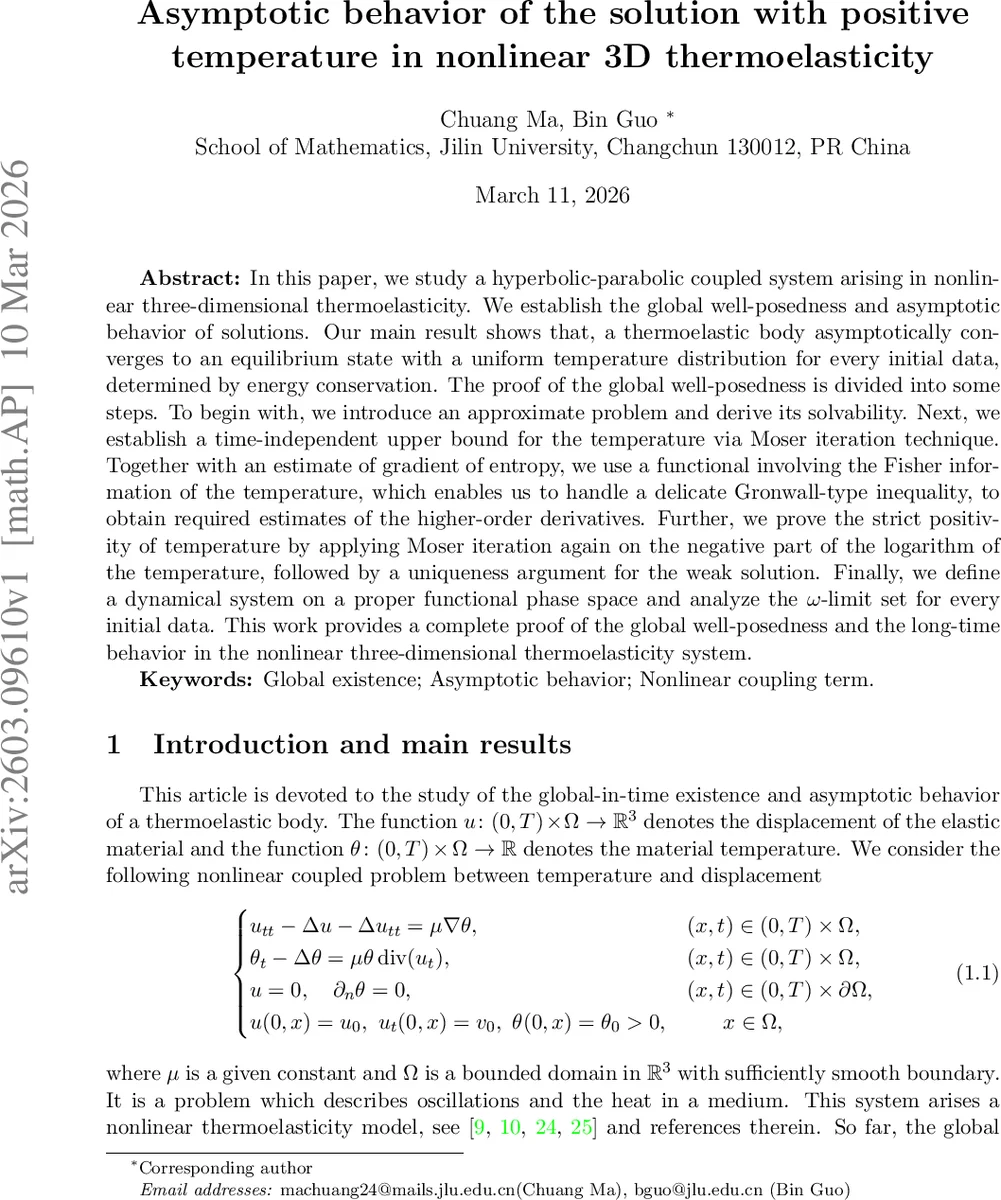
In this paper, we study a hyperbolic-parabolic coupled system arising in nonlinear three-dimensional thermoelasticity. We establish the global well-posedness and asymptotic behavior of solutions. Our main result shows that, a thermoelastic body asymptotically converges to an equilibrium state with a uniform temperature distribution for every initial data, determined by energy conservation. The proof of the global well-posedness is divided into some steps. To begin with, we introduce an approximate problem and derive its solvability. Next, we establish a time-independent upper bound for the temperature via Moser iteration technique. Together with an estimate of gradient of entropy, we use a functional involving the Fisher information of the temperature, which enables us to handle a delicate Gronwall-type inequality, to obtain required estimates of the higher-order derivatives. Further, we prove the strict positivity of temperature by applying Moser iteration again on the negative part of the logarithm of the temperature, followed by a uniqueness argument for the weak solution. Finally, we define a dynamical system on a proper functional phase space and analyze the $ω$-limit set for every initial data. This work provides a complete proof of the global well-posedness and the long-time behavior in the nonlinear three-dimensional thermoelasticity system.
💡 Research Summary
The paper addresses the global well‑posedness and long‑time behavior of a nonlinear three‑dimensional thermoelastic system coupling the displacement field u and the temperature θ. The governing equations consist of a hyperbolic momentum balance with a source term µ∇θ and a parabolic heat equation containing the nonlinear coupling term µθ div u_t. Under the simplifying physical assumptions of unit heat capacity, unit thermal conductivity, unit density, and homogeneous Dirichlet boundary condition for u together with homogeneous Neumann condition for θ, the authors reduce the model to the compact form (1.1).
The existence proof proceeds via a half‑Galerkin approximation. An auxiliary finite‑dimensional problem is constructed and solved using Schauder’s fixed‑point theorem. To pass to the limit, the authors rewrite the approximate system as an entropy equation, which is only valid when θ>0. Positivity of the temperature is established by two applications of the Moser iteration technique: the first yields a uniform L^∞ upper bound for θ, while the second, applied to –log θ, provides a uniform positive lower bound.
Higher‑order regularity is obtained by introducing a functional involving the Fisher information I(θ)=∫|∇log θ|² dx. Together with an entropy dissipation estimate, this functional controls a delicate Gronwall‑type inequality, giving uniform bounds for ∇u, u_tt, ∇θ and related Sobolev norms. These bounds enable the use of the Aubin‑Lions compactness lemma, leading to the convergence of the approximate solutions to a global weak solution in the sense of Definition 2.3. Uniqueness follows from an energy estimate for the difference of two solutions, exploiting the previously proved strict positivity of θ.
For the asymptotic analysis, the solution space H₀¹(Ω)×H₀¹(Ω)×L²(Ω) is equipped with a dynamical system structure. The authors study the ω‑limit set using the quantitative version of the second law of thermodynamics (entropy decay) and the conserved total energy. They prove that the ω‑limit set reduces to a single equilibrium point characterized by a uniform temperature
\
Comments & Academic Discussion
Loading comments...
Leave a Comment