Harvest Ambient Heat via Constraint-Shaped Phase-Change Cycles: Micro $ΔT$, Subcooled Liquid, and Liquid-Only Compression
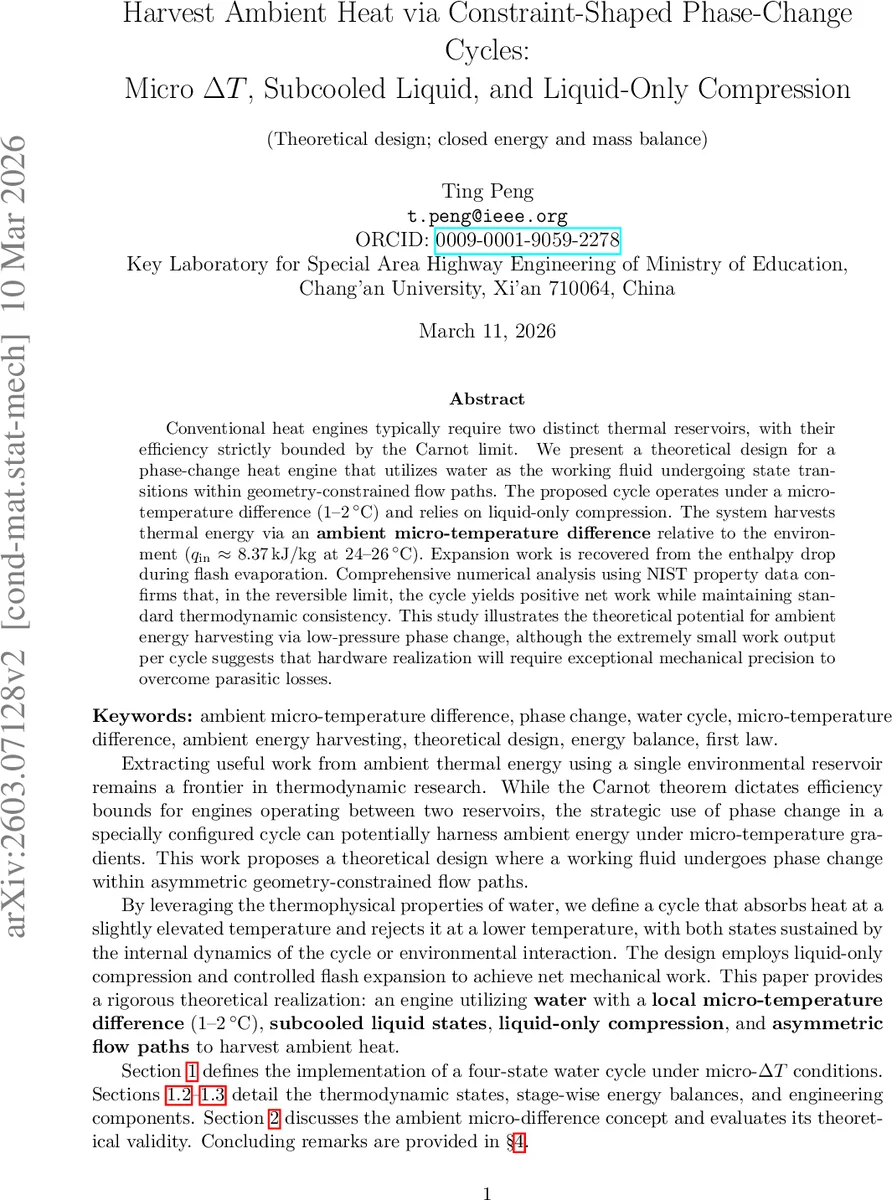
Conventional heat engines typically require two distinct thermal reservoirs, with their efficiency strictly bounded by the Carnot limit. We present a theoretical design for a phase-change heat engine that utilizes water as the working fluid undergoing state transitions within geometry-constrained flow paths. The proposed cycle operates under a micro-temperature difference (1–2,$^\circ$C) and relies on liquid-only compression. The system harvests thermal energy via an \textbf{ambient micro-temperature difference} relative to the environment ($q_{\mathrm{in}} \approx 8.37,\mathrm{kJ}/\mathrm{kg}$ at 24–26,$^\circ$C). Expansion work is recovered from the enthalpy drop during flash evaporation. Comprehensive numerical analysis using NIST property data confirms that, in the reversible limit, the cycle yields positive net work while maintaining standard thermodynamic consistency. This study illustrates the theoretical potential for ambient energy harvesting via low-pressure phase change, although the extremely small work output per cycle suggests that hardware realization will require exceptional mechanical precision to overcome parasitic losses.
💡 Research Summary
The paper proposes a theoretical phase‑change heat engine that harvests ambient thermal energy using only a micro‑temperature difference of 1–2 °C between two internal zones (approximately 24 °C and 26 °C). Water is the working fluid, and the cycle consists of four states: saturated liquid at low pressure (24 °C), sub‑cooled liquid after liquid‑only compression, saturated liquid at high pressure (26 °C), and a two‑phase mixture after flash expansion. The four processes are: (1) liquid‑only compression by a pump, (2) isobaric heat absorption from the environment, (3) flash expansion through a two‑phase expander that converts the enthalpy drop into shaft work, and (4) condensation returning the fluid to the initial state.
Using NIST water property data, the authors calculate the pump work as w_pump = v_f Δp ≈ 0.0004 kJ kg⁻¹, the heat absorbed from the environment as q_in = h₃ − h₂ ≈ 8.37 kJ kg⁻¹, and the ideal reversible expansion work as w_out ≈ 0.0500 kJ kg⁻¹. The net specific work is therefore w_net = w_out − w_pump ≈ 0.0496 kJ kg⁻¹, giving an efficiency η = w_net/q_in ≈ 0.59 %, which is below the Carnot limit for the same temperature span (≈0.67 %).
A key thermodynamic check is whether the cycle can sustain the 1–2 °C temperature difference on its own. An ideal Carnot heat pump that would move the same 8.37 kJ kg⁻¹ of heat from the colder side (≈297 K) to the hotter side (≈299 K) requires a minimum work of w_HP,ideal ≈ 0.056 kJ kg⁻¹, exceeding the net work produced. Consequently, the micro‑temperature gradient must be maintained by external means (natural diurnal variations, the flash cooling and condensation themselves) rather than by the cycle’s own output.
From an engineering perspective, the authors argue that all components are commercially available: magnetic‑driven or canned‑motor pumps for liquid compression, vacuum‑sealed pressure vessels for phase separation, and two‑phase turbines or positive‑displacement expanders to capture expansion work. However, the enthalpy drop available in water at these low pressures is tiny, so realistic expander efficiencies (30–60 %) would reduce the net work to 0.015–0.03 kJ kg⁻¹. At a mass flow of 1 kg s⁻¹ this translates to 15–30 W of mechanical power, while pump, bearing, seal, and leakage losses are likely to be comparable or larger. Therefore, achieving a self‑sustaining device would require parasitic losses well below 0.05 kW, a demanding target with current technology.
The paper discusses scaling strategies: increasing mass flow, parallelizing multiple identical cycles, or enlarging heat‑exchange surfaces. Yet each approach multiplies the same small net work per kilogram, so the absolute power remains limited unless the fundamental enthalpy difference can be amplified, which would require higher temperature spans or alternative working fluids.
In conclusion, the study demonstrates that, in a reversible limit, a water‑based phase‑change cycle can produce positive work from ambient heat under a micro‑temperature difference, and that the thermodynamic analysis is internally consistent. Nonetheless, the extremely low specific work and the stringent requirement on mechanical efficiency render practical implementation feasible only for ultra‑low‑power applications such as sensor power harvesting, and even then only if component losses can be suppressed to an unprecedented degree.
Comments & Academic Discussion
Loading comments...
Leave a Comment