On Cone Restriction Estimates in Higher Dimensions
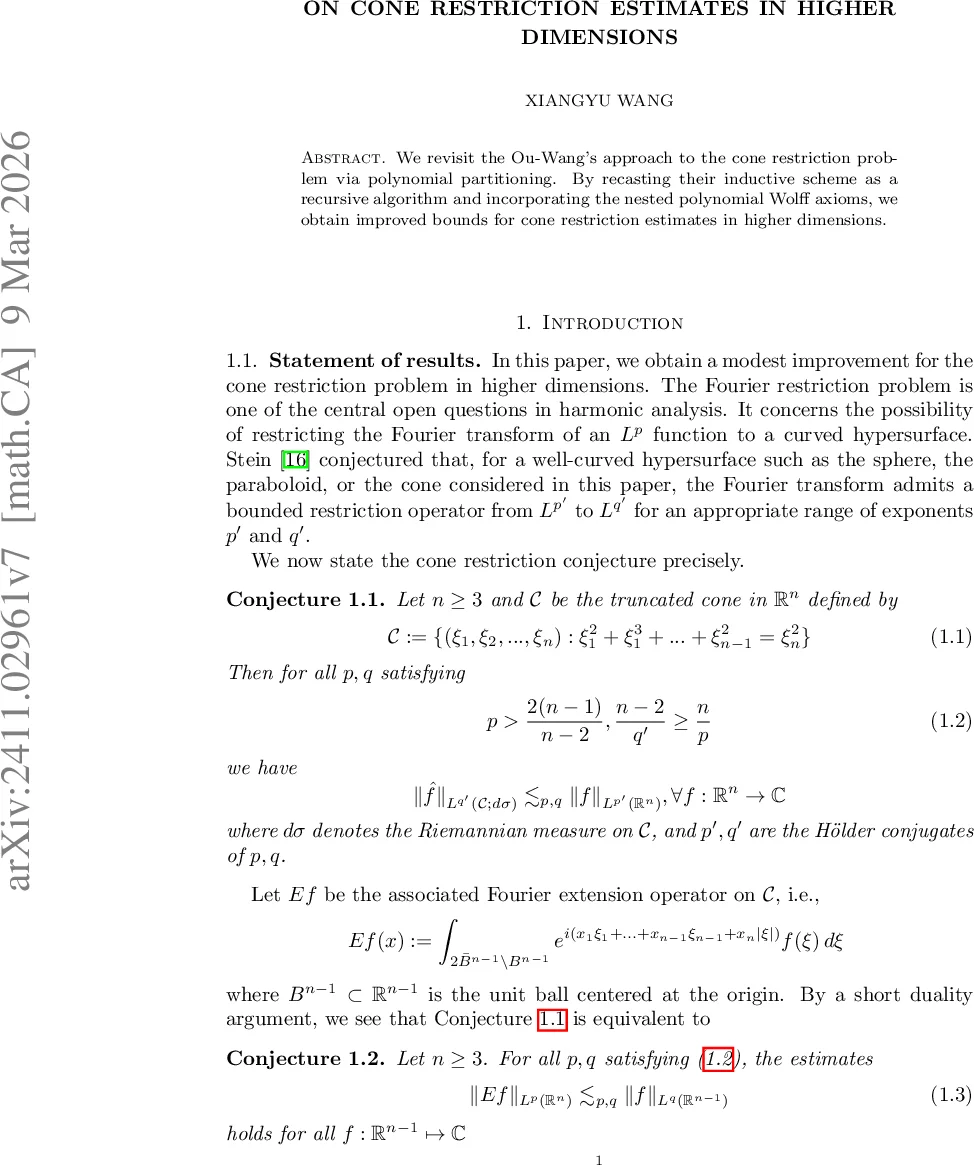
We revisit the Ou-Wang’s approach to the cone restriction problem via polynomial partitioning. By recasting their inductive scheme as a recursive algorithm and incorporating the nested polynomial Wolff axioms, we obtain improved bounds for cone restriction estimates in higher dimensions.
💡 Research Summary
The paper revisits the cone restriction problem—a central question in Fourier analysis concerning the boundedness of the Fourier extension operator from L^q(ℝ^{n‑1}) to L^p(ℝ^n) when the frequency support lies on the truncated cone C ⊂ ℝ^n. The classical conjecture, due to Stein, predicts that the estimate ‖Ef‖{L^p(ℝ^n)} ≤ C‖f‖{L^q(ℝ^{n‑1})} should hold for the range p > 2(n‑1)/(n‑2) and q′ ≤ (n‑2)p/n, where q′ is the Hölder conjugate of q. This conjecture is known only in low dimensions (n = 3,4,5) through the works of Barceló, Wolff, and Ou–Wang.
Ou and Wang (2015) introduced a polynomial partitioning approach to the cone problem, obtaining a k‑broad estimate that yields, after interpolation and ε‑removal, the best previously known L^p → L^p bound (Corollary 1.4) with p > 4 for n = 3 and p > (2/3)n + 1 for odd n > 3, etc. Their method relies on a single‑scale polynomial partition, a “leaf‑backtrack” to the root, and a Wolff‑type incidence bound for tubes tangent to algebraic varieties.
The present work refines this scheme in two major ways. First, the authors recast the inductive argument of Ou–Wang as an explicit recursive algorithm. This makes the dependence on the partition depth and on the parameters (p,q,k) transparent, allowing a systematic insertion of stronger geometric information at each recursion level. Second, they incorporate the “nested polynomial Wolff axioms” developed in recent works on the paraboloid (Hickman–Rogers, Hickman–Zahl). These axioms give a hierarchy of incidence bounds for tubes that are tangent to a sequence of nested algebraic varieties, each of lower dimension. By exploiting this hierarchy, the authors obtain tighter control over the number of tube directions that can cluster near a given variety.
A key technical innovation is the adaptation of the leaf‑backtrack mechanism to the cone geometry. Because the cone has far fewer angular sectors than the paraboloid, a naïve backtrack to the root would lead to an uncontrolled proliferation of tube directions. Instead, the authors backtrack only to an (n‑1)-dimensional ancestor, preserving enough angular resolution while still reducing the problem to a lower‑dimensional setting where the nested Wolff axioms apply.
The main result (Theorem 1.5) introduces explicit functions p(n,k) and q(n,k) defined via intricate rational expressions involving n and the auxiliary integer k (2 ≤ k ≤ n‑2). The admissibility conditions are sharpened: for k = 2 one requires p > p_{n,2}(q), while for k ≥ 3 the condition becomes p > p_{n,k}(q) together with a lower bound on q. These conditions are strictly weaker than those in Ou–Wang’s Theorem 2, thereby expanding the admissible (p,q) region.
From Theorem 1.5 the authors deduce Corollary 1.6, which states that for all dimensions n ≥ 3 the L^p → L^p restriction estimate holds whenever
p > 2 + λ_n – 1 + O(n^{‑2}), with λ ≈ 2.596.
This improves upon the previous bound p > 2 + 8/(3n) + O(n^{‑2}) obtained from Ou–Wang’s work. The improvement, though modest in absolute terms, is asymptotically significant because it pushes the exponent closer to the conjectured optimal value p = 2.
The paper’s structure is as follows. Section 2 reviews the necessary preliminaries: wave‑packet decomposition, L^2 orthogonality, scale comparison lemmas, the notion of medium tubes, and the definitions of tangential versus transverse tubes relative to algebraic varieties. Lemma 2.10 (a continuous analogue of Bézout’s theorem) is highlighted as a tool for controlling the interaction between tubes and varieties.
Section 3 presents the modified polynomial structural decomposition. By iterating polynomial partitioning and applying the nested Wolff axioms at each stage, the authors construct a recursive algorithm that yields a k‑broad estimate with improved constants. The analysis carefully tracks the loss incurred at each recursion and shows that the loss can be absorbed into the ε‑removal step.
Section 4 contains the “numerology” of the new bounds. The authors compute asymptotic expansions of p(n,k) and q(n,k), demonstrating that the dominant term in the exponent λ_n approaches the constant λ ≈ 2.596 as n → ∞. They also compare the new exponent with those from earlier works, illustrating the quantitative gain.
The paper concludes with remarks on possible extensions: applying the nested polynomial Wolff framework to other hypersurfaces (e.g., hyperboloids), refining the axioms for non‑transverse complete intersections, and exploring connections with decoupling theory and the Kakeya problem.
In summary, by reformulating the Ou–Wang induction as a recursive algorithm and by leveraging the nested polynomial Wolff axioms, the authors achieve a modest but meaningful improvement in the cone restriction exponent for all high dimensions. The work bridges techniques from polynomial partitioning, incidence geometry, and harmonic analysis, and it opens a pathway for further refinements toward the full Stein cone restriction conjecture.
Comments & Academic Discussion
Loading comments...
Leave a Comment