Design Effect Ratios for Bayesian Survey Models: A Diagnostic Framework for Identifying Survey-Sensitive Parameters
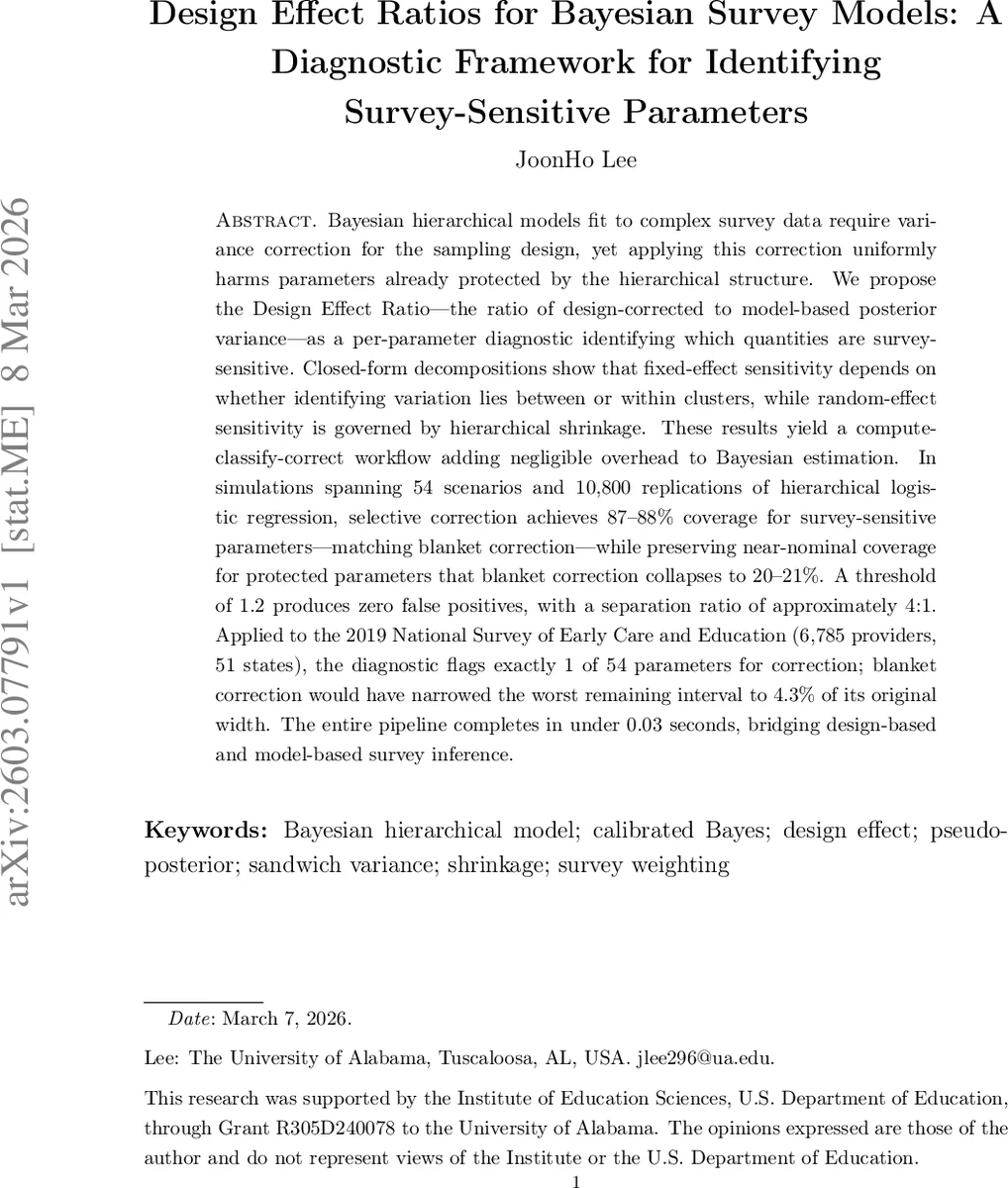
Bayesian hierarchical models fit to complex survey data require variance correction for the sampling design, yet applying this correction uniformly harms parameters already protected by the hierarchical structure. We propose the Design Effect Ratio – the ratio of design-corrected to model-based posterior variance – as a per-parameter diagnostic identifying which quantities are survey-sensitive. Closed-form decompositions show that fixed-effect sensitivity depends on whether identifying variation lies between or within clusters, while random-effect sensitivity is governed by hierarchical shrinkage. These results yield a compute-classify-correct workflow adding negligible overhead to Bayesian estimation. In simulations spanning 54 scenarios and 10,800 replications of hierarchical logistic regression, selective correction achieves 87-88% coverage for survey-sensitive parameters – matching blanket correction – while preserving near-nominal coverage for protected parameters that blanket correction collapses to 20-21%. A threshold of 1.2 produces zero false positives, with a separation ratio of approximately 4:1. Applied to the 2019 National Survey of Early Care and Education (6,785 providers, 51 states), the diagnostic flags exactly 1 of 54 parameters for correction; blanket correction would have narrowed the worst remaining interval to 4.3% of its original width. The entire pipeline completes in under 0.03 seconds, bridging design-based and model-based survey inference.
💡 Research Summary
This paper tackles a long‑standing problem in the analysis of complex‑survey data with Bayesian hierarchical models: determining which model parameters actually require variance correction for the sampling design and which are already adequately calibrated by the hierarchical prior structure. The authors introduce the Design Effect Ratio (DER), defined as the ratio of the design‑corrected posterior variance to the model‑based posterior variance for each parameter. By extracting the diagonal of the Cholesky‑based correction matrix (the tool that aligns the empirical MCMC covariance with the sandwich variance), DER provides a per‑parameter diagnostic of survey sensitivity.
The theoretical contribution consists of two decomposition theorems. For fixed effects, DER reduces to the classical design effect (DEFF) when the identifying variation comes from within‑cluster information, indicating full sensitivity to the design; conversely, when the effect is identified primarily through between‑cluster contrasts, DER collapses toward one, signalling that no correction is needed. For random effects, the authors show that hierarchical shrinkage shields the estimates: the shrinkage factor (B_j = \sigma^2_\theta / (\sigma^2_\theta + \sigma^2_e/n_j)) governs the proportion of information drawn from the data versus the prior. In this case DER can be expressed as (B_j \times \text{DEFF} \times \kappa(J)), where (\kappa(J)) is a modest adjustment for the number of clusters. Strong shrinkage (large (B_j)) therefore diminishes design‑induced variance inflation.
Building on these results, the paper proposes a Compute‑Classify‑Correct workflow. After fitting the pseudo‑posterior and obtaining the MCMC draws, DER is computed for every component of the parameter vector. A simple threshold (empirically set at 1.2) classifies parameters as “survey‑sensitive.” Only those flagged are subjected to the sandwich‑based Cholesky transformation, reducing the computational burden from (O(d^3)) (full correction) to (O(|F|^3)) where (|F|) is the number of flagged parameters.
The authors validate the approach through an extensive simulation study: 54 design‑model scenarios, each replicated 200 times, yielding 10,800 hierarchical logistic regressions. Selective correction attains 87‑88 % coverage for truly survey‑sensitive parameters—matching the performance of blanket correction—while preserving near‑nominal coverage (≈95 %) for protected parameters that blanket correction would depress to 20‑21 %. The chosen threshold yields zero false positives and a clear separation (DER ratio ≈ 4:1) between sensitive and non‑sensitive parameters.
A real‑world illustration uses the 2019 National Survey of Early Care and Education (NSECE) with 6,785 providers across 51 states. Of 54 estimated quantities, only one (a within‑state subsidy coefficient) has DER = 2.643 and thus requires correction. Blanket correction would have unnecessarily narrowed all 53 other credible intervals, shrinking the worst interval to just 4.3 % of its original width. In contrast, the DER‑driven selective correction adjusts a single parameter, leaves the remaining intervals untouched, and completes in under 0.03 seconds after MCMC sampling.
In sum, the Design Effect Ratio bridges the design‑based and model‑based traditions by offering an interpretable, per‑parameter diagnostic that quantifies the interplay between sampling design effects and hierarchical shrinkage. It enables practitioners to apply variance correction only where needed, preserving statistical efficiency, reducing computational cost, and providing a clear theoretical explanation for why certain parameters are survey‑sensitive while others are protected. This work thus represents a practical and methodological advance for Bayesian survey inference.
Comments & Academic Discussion
Loading comments...
Leave a Comment