Unifying Sidewinding and Rolling: A Wave-Based Framework for Self-Righting in Elongated Limbless and Multi-Legged Robots
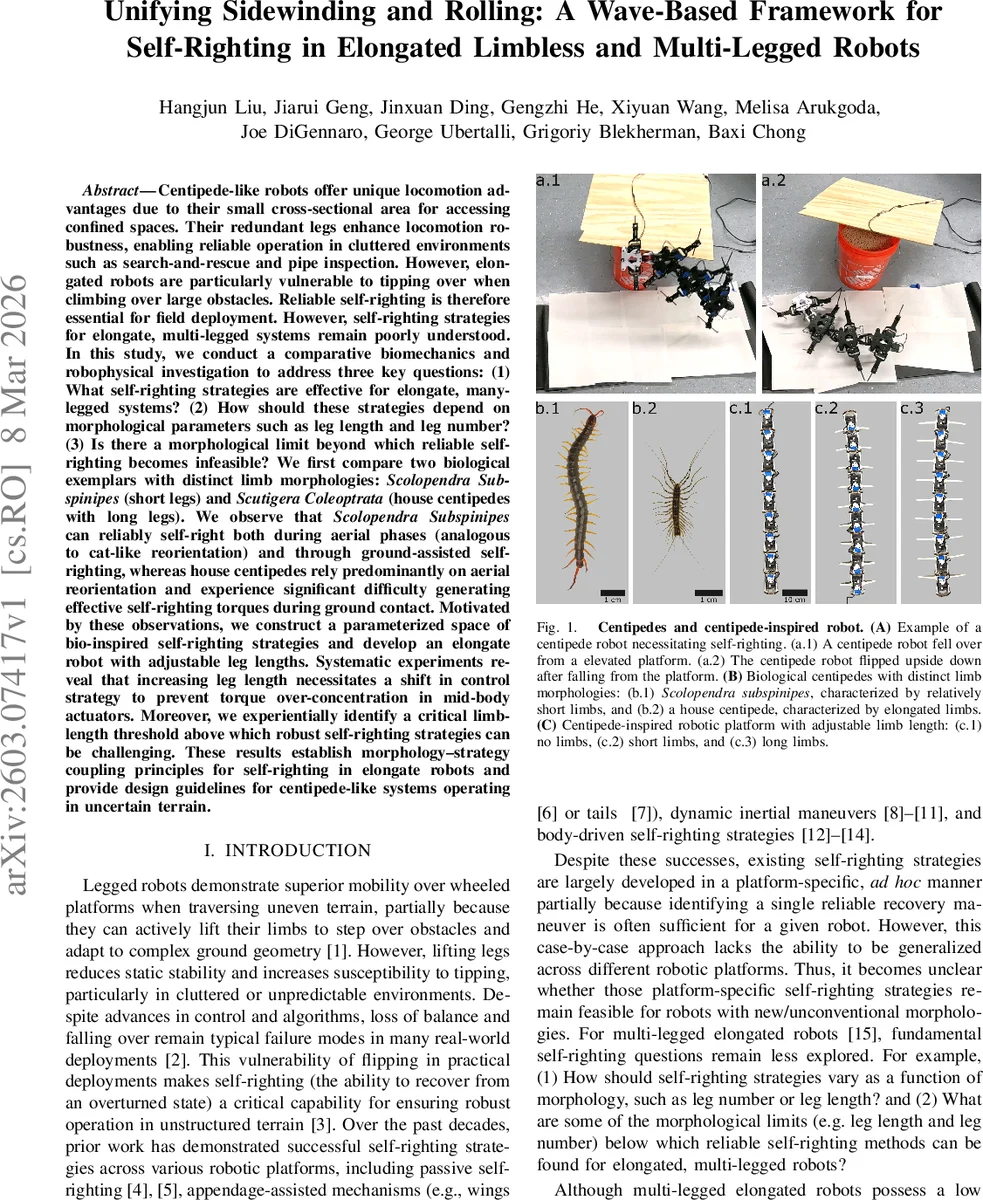
Centipede-like robots offer unique locomotion advantages due to their small cross-sectional area for accessing confined spaces, and their redundant legs enhance robustness in cluttered environments such as search-and-rescue and pipe inspection. However, elongated robots are particularly vulnerable to tipping over when climbing large obstacles, making reliable self-righting essential for field deployment. Self-righting strategies for elongate, multi-legged systems remain poorly understood. In this study, we conduct a comparative biomechanics and robophysical investigation to address three key questions: (1) What self-righting strategies are effective for elongate, many-legged systems? (2) How should these strategies depend on morphological parameters such as leg length and leg number? (3) Is there a morphological limit beyond which reliable self-righting becomes infeasible? We compare two biological exemplars: Scolopendra subspinipes (short legs) and Scutigera coleoptrata (house centipedes with long legs). Scolopendra subspinipes reliably self-rights both during aerial phases and through ground-assisted self-righting, whereas house centipedes rely predominantly on aerial reorientation and struggle to generate effective self-righting torques during ground contact. Motivated by these observations, we construct a parameterized space of bio-inspired self-righting strategies and develop an elongate robot with adjustable leg lengths. Systematic experiments reveal that increasing leg length necessitates a shift in control strategy to prevent torque over-concentration in mid-body actuators, and we identify a critical limb-length threshold above which robust self-righting becomes challenging. These results establish morphology-strategy coupling principles for self-righting in elongate robots and provide design guidelines for centipede-like systems operating in uncertain terrain.
💡 Research Summary
This paper addresses the critical problem of self‑righting for elongated, many‑legged robots—systems that excel in confined‑space navigation but are prone to overturning when climbing large obstacles. The authors pursue three questions: (1) which self‑righting strategies work for such robots, (2) how these strategies should depend on morphological parameters like leg length and leg number, and (3) whether a morphological limit exists beyond which reliable self‑righting becomes infeasible.
Biological observations
Two centipede species with contrasting limb morphologies were studied: Scolopendra subspinipes (short legs, ~0.13 body‑length) and Scutigera coleoptrata (long legs, ~0.7 body‑length). Individuals were dropped from 10 cm to 50 cm onto a controlled arena while high‑speed cameras captured front and side views. Four distinct self‑righting modes were identified: (i) aerial righting (completed before first ground contact), (ii) post‑bounce righting (reorientation during the rebound after the first impact), (iii) ground‑wave righting (a longitudinal traveling wave of body curvature that propagates from one end to the other), and (iv) ground‑one‑shot righting (a rapid whole‑body flip without a clear wave). The short‑leg species frequently employed ground‑wave and one‑shot strategies, whereas the long‑leg species relied almost exclusively on aerial righting; ground‑based modes were rare and ineffective. Ground‑wave righting, though slower, distributes torque along the body and reduces peak power demands, making it a promising primitive for robotic implementation.
Wave‑based control framework
Inspired by these observations, the authors propose a unified kinematic model that superposes a horizontal (yaw) traveling wave and a vertical (pitch) traveling wave along the robot’s segmented body. Joint angles are expressed as
α_y(i,t) = A_y sin(ωt + 2πi n_y/N + Δd)
α_p(i,t) = A_p sin(ωt + 2πi n_p/N)
where A_y and A_p are yaw and pitch amplitudes, ω is the temporal frequency, n_y and n_p are the numbers of waves along the body, N is the number of joints, and Δd is the phase offset between yaw and pitch. Setting A_y = A_p, n_y = n_p = 0 and Δd = –π/2 reduces the equations to pure rolling (axial rotation). Varying the parameters yields classic side‑winding, rolling, and intermediate hybrid gaits. This formulation provides a continuous parameter space that can be tuned to accommodate different limb morphologies.
Robophysical platform
A physical testbed was built using nine 2‑axis Dynamixel 2XL430 servomotors (18 controllable joints) linked by 3‑D‑printed segments, forming a snake‑like backbone. Three interchangeable leg modules (short, medium, long) were attached at the bottom, with lengths scaled from the measured ratios of S. subspinipes: short ≈ 1:13.8 body length, medium ≈ 1:11.8, long ≈ 1.2 : 1 (leg‑to‑leg spacing). Markers on the robot enabled motion capture from top and side cameras.
Experimental protocol and observed behaviors
The robot was placed upside‑down on a flat rigid surface and commanded with sinusoidal wave patterns spanning a grid of amplitudes (A), wave numbers (n), and phase offsets (Δd). Three outcome categories emerged: (1) side‑winding (lateral translation without significant axial rotation), (2) in‑place self‑righting (dominant axial roll while remaining stationary), and (3) side‑winding spin (simultaneous lateral translation and axial rotation). The latter, termed “side‑winding spin,” is a novel hybrid gait not previously reported; it enables the robot to encircle cylindrical obstacles while advancing, suggesting applications in payload transport and pipe inspection.
Key findings
-
Morphology‑strategy coupling – With short legs, the classic ground‑wave self‑righting (mid‑body torque distribution) achieved high success rates (> 80 %). As leg length increased, the same wave parameters caused torque to concentrate on the central actuators, leading to motor saturation and failure.
-
Control adaptation – Shifting the phase offset Δd to advance the wave front (i.e., initiating curvature earlier along the body) redistributed torque toward the front segments, restoring success rates for medium‑leg configurations. Increasing the number of waves (higher n_y, n_p) also helped spread load but required higher actuation bandwidth.
-
Morphological limit – Beyond a leg‑to‑body‑length ratio of roughly 0.9, no combination of wave parameters yielded a self‑righting probability above 50 %. This defines a practical design ceiling: robots with excessively long limbs must rely on alternative mechanisms (e.g., deployable wings, external pushers, or aerial reorientation) rather than pure body‑wave strategies.
-
Side‑winding spin utility – The hybrid gait achieved lateral displacements up to 0.8 body lengths per cycle, more than double previously reported side‑winding speeds for comparable snake robots. It also demonstrated that limbs, while potentially hindering pure rolling, can stabilize the body during complex combined motions.
Design guidelines
- For leg ratios ≤ 0.13 BL (short‑leg regime), employ mid‑body wave self‑righting and one‑shot flips; no special phase tuning is required.
- For intermediate ratios (~0.2 BL), use a forward‑biased wave (Δd ≈ –π/4) and increase wave count to avoid torque hotspots.
- For ratios ≥ 0.9 BL, pure wave‑based self‑righting is unreliable; incorporate auxiliary actuators or redesign the morphology to shorten limbs.
- Increasing leg count improves static stability on flat ground but complicates wave propagation; controller tuning must account for added degrees of freedom.
Conclusions and future work
The study demonstrates that self‑righting in elongated, many‑legged robots is governed by a clear morphology‑strategy relationship. The presented wave‑based framework unifies side‑winding and rolling, allowing systematic exploration of the control space across different limb configurations. By experimentally identifying a leg‑length threshold, the authors provide a concrete design rule for engineers. Future investigations will extend the analysis to uneven or compliant terrains, evaluate energy efficiency, and integrate the side‑winding spin into real‑world tasks such as pipe crawling and payload delivery.
Comments & Academic Discussion
Loading comments...
Leave a Comment